
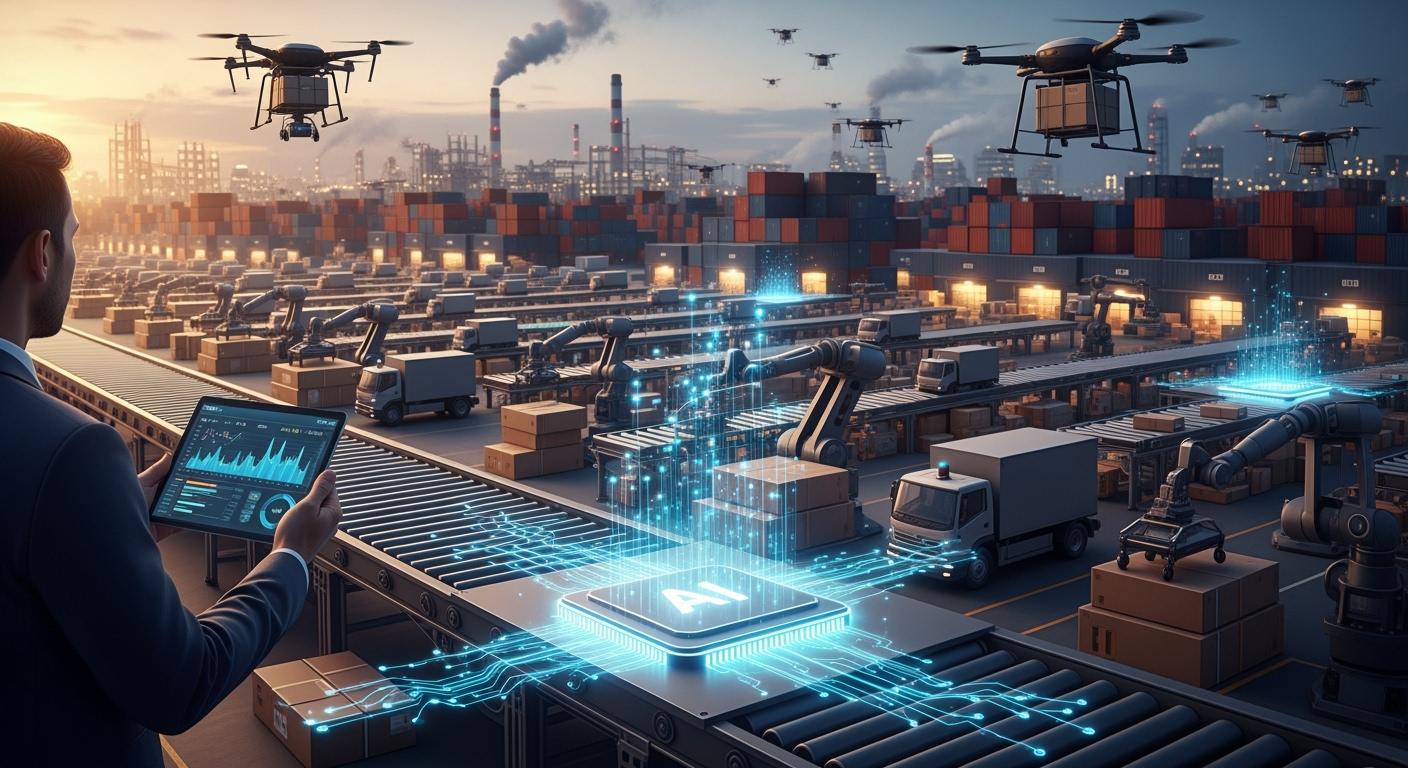
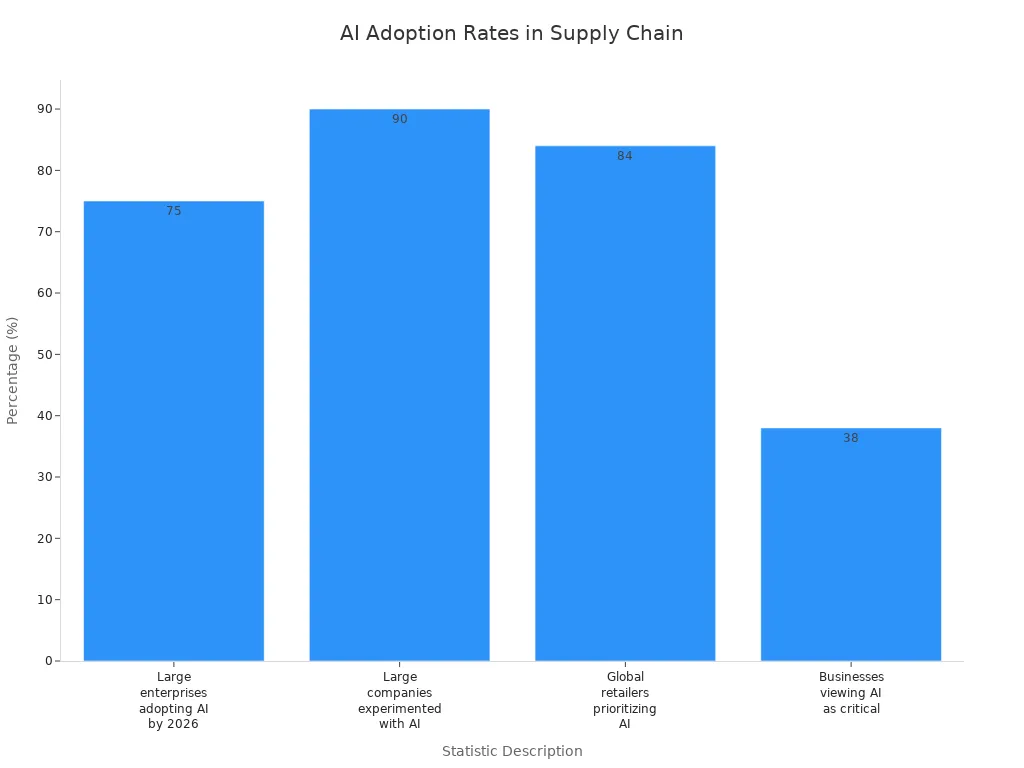
You see rapid advances in artificial intelligence transforming supply chain management right now. AI in supply chain delivers real-time data, generative AI, and intelligent networks that drive faster, smarter decisions. Most large enterprises have already adopted or experimented with automation, as shown below:
| Statistic Description | Percentage |
|---|---|
| Large enterprises adopting AI in supply chain by 2026 | 75% |
| Large companies that have experimented with AI | 90% |
| Global retailers prioritizing AI implementation | 84% |
| Businesses viewing AI adoption as critical | 38% |
- Automation boosts efficiency, cuts costs, and helps you respond quickly to disruptions.
- AI tools streamline operations and help you make better decisions.
- Real-time monitoring and automated responses reduce risk across industries, from retail to manufacturing.
Real-Time AI Supply Chain Integration
You see real-time AI supply chain integration changing how you manage operations. This trend connects every part of your supply chain, from suppliers to customers, using live data. You gain instant updates and insights, which help you act quickly and avoid problems. Real-time visibility and automation now set the standard for supply chain management.
AI Supply Chain Visibility
You need to see what happens in your supply chain at every moment. Real-time visibility lets you track goods, monitor inventory, and spot issues before they grow. AI in supply chain gives you this power. Companies use advanced tools to collect and analyze data from many sources. You can see where shipments are, how much stock you have, and if delays might happen.
Here are some leading technologies that enable real-time visibility in supply chain operations:
| Technology | Operational Use | Business Impact |
|---|---|---|
| Machine Learning | Demand forecasting | Lower stockouts; reduced markdowns |
| AI Platforms | Supplier collaboration | Fewer late deliveries; higher on-time in-full |
| AMRs & Co-bots | Warehouse automation | Higher lines per hour; shorter cycle times |
| Computer Vision | Quality control | Fewer returns; improved first-pass yield |
| Predictive Analytics | Dynamic routing | Lower fuel cost; higher on-time delivery |
| Intelligent Automation | Invoice matching | Reduced processing time; fewer errors |
You can see how these tools help you respond faster and make better choices. For example, Sony uses AI to track production and distribution in real time. MaxiCoffee uses AI to forecast inventory needs and keep deliveries on schedule. A European retailer uses machine learning to track shipments and improve supplier monitoring. These examples show how real-time visibility leads to fewer delays and better service.
Tip: Real-time visibility helps you spot risks early and fix them before they disrupt your supply chain.
Real-Time Decision-Making
You want to make decisions quickly and with confidence. Real-time AI in supply chain gives you the information you need, right when you need it. You can adjust routes, change orders, or update inventory levels in minutes, not days. This speed helps you stay ahead of problems and keep your customers happy.
When you use AI in supply chain management, you get faster feedback loops. You can improve your processes every week or even every day. AI processes large amounts of data and adapts to changes much faster than manual methods. This leads to improved decision-making and higher efficiency.
- You get instant insights into market trends and operational impacts.
- You reduce cycle times and make smarter choices.
- You stay competitive by acting on real-time data.
Artificial intelligence now plays a key role in supply chain operations. It helps you cut costs, reduce errors, and deliver better results. Real-time visibility and decision-making give you a strong advantage in today’s fast-moving market.
Predictive Analytics and Forecasting
Demand Forecasting with AI
You can use artificial intelligence to predict what your customers will want next. AI demand forecasting helps you see patterns in sales and spot changes before they happen. You get more accurate predictions than with old methods. AI models improve forecast accuracy by 20% or more. Current systems reach accuracy rates between 60% and 75%. Traditional forecasting often misses the mark and falls short of the 85% to 90% accuracy needed for best results.
When you use AI in supply chain, you synchronize supply and demand better. You avoid making too much or too little. This leads to less waste and happier customers. Companies like DHL and FedEx use predictive analytics to plan ahead. DHL saw a 25% increase in on-time deliveries by predicting delays from weather and traffic. FedEx reduced excess inventory costs by over 30% during busy seasons with machine learning models.
Tip: Predictive analytics lets you spot risks early and adjust your plans before problems grow.
Inventory Optimization
You can optimize your inventory with predictive analytics. You keep the right amount of stock and avoid running out. AI forecasting cuts stockouts by up to 65%. Walmart reduced stockouts by 30% using AI demand forecasting. This means you protect your revenue and prevent lost sales.
Here is a quick look at how AI improves inventory in supply chain management:
| Statistic Description | Impact |
|---|---|
| AI forecasting cuts stockouts by up to 65% | Immediate revenue boost |
| 35% decrease in out-of-stock situations | Prevents lost sales |
| Walmart reduced stockouts by 30% | Shows success in large retail |
You gain deeper insights into trends and risks. Advanced analytics transforms supply chain operations. You make smarter decisions by using data from many sources. Predictive analytics gives you proactive risk management. You can anticipate disruptions and adjust your plans in real time.
Note: Optimizing inventory with AI helps you stay competitive and keeps your customers satisfied.
Generative AI in Supply Chain
LLMs and Automation
You can use generative AI and large language models (LLMs) to automate many tasks in your supply chain. These tools help you process data, answer questions, and create reports in seconds. You save time and reduce errors by letting artificial intelligence handle routine work. LLMs can also help you find patterns in your data that you might miss.
Here are some common ways you can use generative AI in supply chain management:
| Use Case | Description |
|---|---|
| Demand Forecasting | Enhances decision-making by providing predictive insights to better anticipate customer demand. |
| Inventory Optimization | Reduces holding costs and controls surplus inventory through advanced analysis of stock levels. |
| Supplier Relationship Management | Improves collaboration and trust by analyzing supplier performance and interactions. |
| Reverse Logistics | Minimizes costs and waste by optimizing product returns and refurbishment processes. |
| Financial Optimization | Addresses challenges like credit risk evaluation and fraud detection through advanced algorithms. |
You can see how these ai applications in supply chain help you make better decisions and improve your daily operations. LLMs give you quick answers and help you stay ahead in a fast-changing market.
Tip: Automating routine tasks with LLMs lets your team focus on solving bigger problems.
Agentic AI for Scenario Modeling
Agentic AI gives you a new way to plan and react in your supply chain. These systems use real-time data to model different scenarios and suggest the best actions. You can test what happens if a supplier is late or if demand changes quickly. Agentic AI helps you choose the best path forward.
- Agentic AI brings real-time orchestration to your supply chain. You get faster decisions and better results.
- Predictive analytics use past sales and market signals to forecast demand. You can plan ahead with more confidence.
- Automation of routine tasks boosts your efficiency and helps you follow rules.
Agentic AI also watches for workflow breakdowns. It suggests changes to keep your supply chain running smoothly. You can spot compliance risks early and fix them before they cause problems. Real-time monitoring of vendor activities helps you avoid surprises.
Note: Using agentic AI in supply chain gives you more control and helps you build a stronger, more reliable network.
Autonomous Operations
Robotics in Warehousing
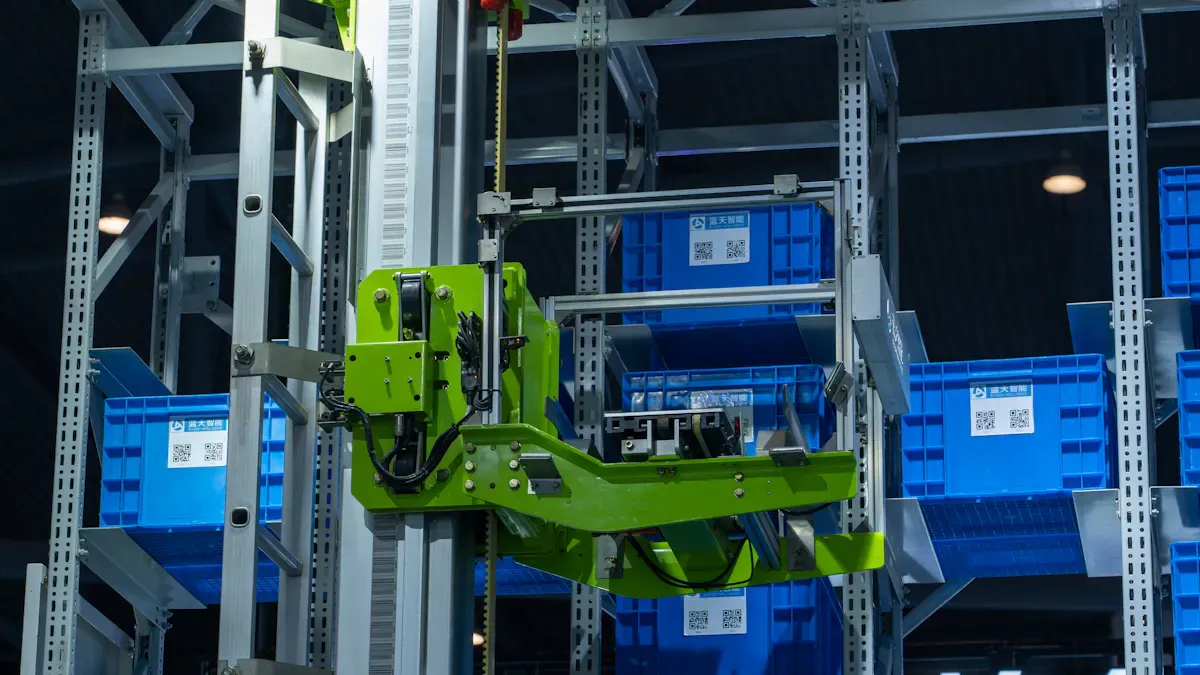
You see robotics changing the way you manage your supply chain. Robots now handle many tasks in warehouses. They pick, pack, and move goods faster than people. This automation of repetitive tasks brings increased efficiency to your operations. You can process more orders with fewer mistakes. Companies use autonomous mobile robots (AMRs) to speed up picking and packing. These robots help you lower labor costs and reduce errors.
- Automation of repetitive tasks boosts productivity.
- Improved inventory management leads to fewer mistakes.
- AMRs help you fill orders quickly and accurately.
You can manage larger order volumes with fewer resources. This means you save money and improve your bottom line. Studies show that robotics can cut supply chain costs by 10-20%. Over half of businesses reported a 10-20% decrease in supply chain costs in 2021. McKinsey’s benchmarks show a 20–50% improvement in forecast accuracy and a 15–30% reduction in inventory costs. You gain a clear advantage by using robotics in your supply chain management.
Tip: Robotics help you keep up with demand and deliver better service to your customers.
Self-Optimizing Logistics
You can use AI to make your logistics smarter and more flexible. Self-optimizing logistics systems use real-time data to plan routes, track inventory, and predict demand. AI algorithms analyze market trends and seasonal patterns. This helps you plan better and avoid both overstocking and understocking.
- Real-time inventory tracking and predictive modeling optimize stock levels.
- AI-powered route optimization can reduce fuel costs by up to 25% and increase on-time deliveries by 30%.
- Companies like DHL have improved delivery speed by 15% and cut fuel costs by 10% with AI-based route planners.
Church Brothers Farms used AI for demand sensing. They improved order fulfillment and reduced product waste. AI-driven last mile optimization can cut delivery costs by as much as 40% and boost customer satisfaction by 30%. You also get accurate, real-time updates on deliveries, which builds trust with your customers.
You see self-optimizing logistics as a key part of ai in supply chain. These systems help you respond quickly to changes and keep your supply chain running smoothly. You gain increased efficiency and better results across your entire supply chain.
Risk Management and Resilience
Disruption Sensing with AI
You face many risks in your supply chain every day. AI disruption sensing helps you spot problems before they grow. These smart systems watch for changes and disruptions across your entire network. You do not need to check every detail yourself. AI tools scan news, supplier data, and market signals. They find warning signs and alert you early.
- AI disruption sensing monitors and analyzes disruptions in real time.
- The system detects signals from news and checks how your network might be affected.
- You can respond quickly to events like natural disasters or political conflicts.
- AI tools help you plan for different futures during a crisis.
- These tools predict future events and give you insights that go beyond what people can see.
- Continuous scanning gives you more time to prepare for problems.
During the 2022 Russia–Ukraine conflict, companies used AI to track risks and adjust their supply chain plans. You can use these tools to protect your business and keep goods moving.
Tip: Early detection of disruptions helps you avoid delays and reduce losses.
Building Resilient Networks
You want your supply chain to stay strong, even when things change fast. AI gives you the power to build a network that can handle shocks. You use AI-powered demand forecasting and inventory optimization to keep the right amount of stock. This reduces waste and prevents stockouts. Predictive supplier risk management shows you where your suppliers might have problems. You can fix issues before they stop your operations. Smart logistics uses AI for route planning and tracking, making your deliveries faster and more reliable.
Here is how AI improves resilience in supply chain networks:
| Statistic Description | Value |
|---|---|
| Adoption of AI in supply chain operations by enterprises | 75% by 2026 |
| Improvement in forecasting accuracy with AI | 85% |
| Reduction in manual tasks in procurement | 65% |
| Reduction in forecasting errors with AI applications | Up to 50% |
| Reduction in lost sales due to AI applications | Up to 65% |
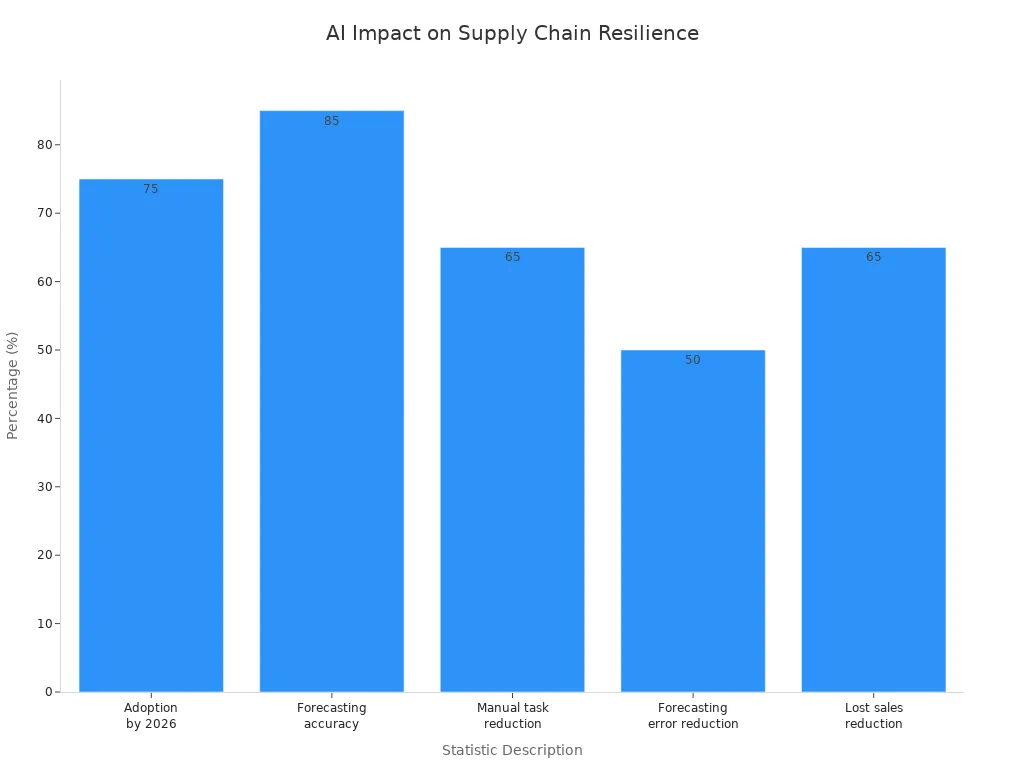
You see that AI in supply chain helps you cut errors and save money. You can focus on growth instead of worrying about risks. Supply chain management becomes easier and more reliable with these tools.
Note: Building a resilient supply chain protects your business and keeps your customers happy.
Sustainability and Efficiency
Route Optimization
You can use AI to make your supply chain more efficient and sustainable. AI-driven route optimization helps you plan the best paths for deliveries. You get real-time data that shows traffic, weather, and delivery windows. This information lets you choose routes that save fuel and time. AI algorithms analyze your logistics and help you lower transportation costs. You see fewer delays and more on-time deliveries.
| Source | Findings |
|---|---|
| AI for Supply Chain Resilience & Optimization | AI algorithms optimize routes, reducing costs and emissions by analyzing real-time data. |
| Harnessing AI for Agile and Ethical Supply Chains | AI can lead to a 20% reduction in transportation costs and a significant decrease in carbon footprint. |
| AI Supply Chain System Management | AI can reduce fuel costs by up to 25% and increase on-time deliveries by 30%. |
| Supply Chain Optimization Through AI | AI optimizes delivery routes, improving efficiency and reducing costs. |
You benefit from smarter logistics. AI in supply chain helps you cut fuel costs and reduce emissions. Last-mile delivery improves, and you see higher customer satisfaction. You can track shipments and adjust routes quickly. This makes your supply chain management more agile and reliable.
Tip: Route optimization with AI helps you lower your environmental footprint and boost efficiency.
Reducing Waste
You can use AI to reduce waste in your supply chain. AI-powered automation sorts waste faster and more accurately. This improves recycling and lowers landfill use. Precise demand forecasting helps you avoid overproduction. You keep inventory levels balanced and prevent excess stock. Optimized logistics lead to less fuel consumption and fewer greenhouse gas emissions.
- AI helps warehouses manage energy and waste. You see lower costs and better sustainability.
- Real-time monitoring lets you track energy use and adjust operations for efficiency.
- Predictive analytics help you manage inventory and minimize waste.
- AI solutions drive sustainable business practices in supply chain operations.
You see that AI gives you tools to build a greener supply chain. You make smarter choices and protect the environment. Your supply chain becomes more transparent and efficient. You can meet sustainability goals and deliver better results for your business.
Note: Reducing waste with AI supports both your business and the planet.
Challenges and Considerations
Data Quality and Integration
You face many challenges when you bring AI into your supply chain. Data quality stands out as one of the most important factors. If your data is inconsistent or outdated, AI tools cannot work well. You need high-quality, clean, and well-integrated data for AI models to give you accurate results. Poor data can lead to misinformation and missed opportunities. You must focus on data governance and due diligence before you start using AI.
“The fundamental data structure is critical to set yourself up for success,” said Winquist. “Don’t assume that AI can just come in and fix all of the problematic data that you may be used to. Instead, you need to focus on data cleanliness and the due diligence process up front.”
You also need to consider system complexities. Legacy systems can make it hard to scale AI solutions. You may need to shift to cloud-based platforms to improve accessibility. Regulatory changes can affect your supply chain, so you must stay proactive with compliance. Data privacy and security concerns require careful attention to protect sensitive information.
- High-quality data supports effective AI in supply chain management.
- Legacy systems and manual processes can slow down integration.
- Regulations and ethical standards guide responsible AI use.
Workforce Adaptation
You must help your team adapt to new AI technologies in your supply chain. Human-centered AI combines data-driven insights with your team’s expertise. Upskilling employees to interpret and refine AI outputs is essential. You should embed AI recommendations into daily workflows to boost productivity.
| Barrier Type | Description |
|---|---|
| Training Costs | You need to invest time and money to train your team. |
| Resistance to Change | Employees may push back against new technologies. |
| System Complexities | Specialized hardware and software can make adoption harder. |
| Operational Costs | Maintenance and replacement costs can be high. |
You can automate manual processes to keep your workforce lean and productive. Engaging talent in strategic initiatives helps with employee retention. Companies should adapt their organizational structures as technology advances. Governments can support this transformation with subsidies and guidance.
- AI fluency across your workforce helps you get the most from your supply chain.
- Transparency, fairness, and accountability are key for ethical AI adoption.
- Collaboration between teams ensures smooth integration and better results.
You see AI automation changing supply chain operations right now. You gain faster decisions, improved accuracy, and reduced costs. To get the most value, you should:
- Improve margins with data-driven insights.
- Use scenario planning to manage cash better.
- Optimize inventory for growth.
- Detect risks early with simulations.
- Automate tasks to boost workforce productivity.
| Best Practice | Description |
|---|---|
| Strategic Integration of AI | Align AI with your business goals for better results. |
| Cultivating an AI-Literate Workforce | Train your team to use AI tools with confidence. |
| Fostering a Culture of Innovation | Encourage new ideas and learn from experiments. |
Stay proactive. Invest in AI to keep your supply chain strong and ready for the future.
FAQ
What is the biggest benefit of using AI in your supply chain?
You gain faster decision-making and better accuracy. AI helps you spot problems early and respond quickly. This leads to lower costs and higher customer satisfaction.
How does AI help you reduce supply chain risks?
You use AI to monitor disruptions in real time. AI tools alert you to issues like delays or shortages.
- You can act before problems grow.
- You keep your supply chain running smoothly.
Can small businesses use AI for supply chain management?
| Business Size | AI Adoption Possible? |
|---|---|
| Small | Yes |
| Medium | Yes |
| Large | Yes |
You can start with simple AI tools. Many cloud-based solutions fit small budgets.
What skills do you need to work with AI in supply chains?
You need basic data skills and a willingness to learn. Training helps you understand AI tools.
Tip: Stay curious and ask questions. This helps you get the most from new technology.
See Also
The Influence of AI Sensors on Fashion Supply Chains
Accelerating Market Entry: AI's Role in Shortening Lead Times
AI-Driven Production Scheduling Based on Demand in 2025