
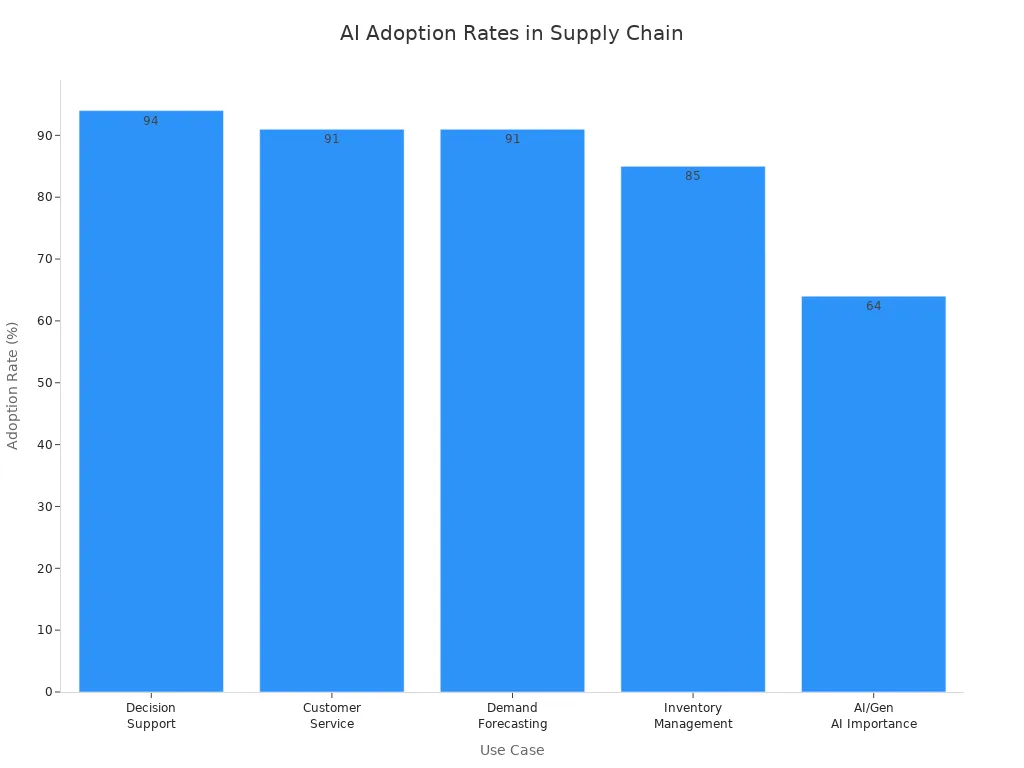
AI and generative AI have changed supply chain automation. You now see faster operations, greater accuracy, and lower costs across every stage. AI automation unlocks business success by improving how you manage procurement, warehouse, and logistics tasks. Companies like SPAR Austria have boosted demand forecasting accuracy above 90%, cutting waste and costs by 15%. The adoption rate for ai in supply chain automation continues to rise, with 94% of organizations using it for decision support.
You gain a competitive edge and prepare for future growth when you embrace automation powered by ai.
| Metric | Improvement |
|---|---|
| Reduction in logistics costs | 15% |
| Optimization in inventory levels | 35% |
| Boost in service levels | 65% |
AI in Supply Chain Automation
AI in supply chain automation gives you the power to make smarter decisions, streamline processes, and boost performance. You can use generative AI and AI agents to transform how you manage data, inventory, and logistics. These technologies help you respond faster to supply chain delays and changing market demands. Companies that adopt AI-driven automation see measurable improvements in efficiency, cost savings, and customer satisfaction.
Generative AI for Decision-Making
Generative AI changes the way you approach decision-making in supply chain automation. You can use it to analyze large volumes of data and generate actionable insights in seconds. For example, a procurement manager can receive a detailed risk assessment for suppliers almost instantly. Generative AI also creates alternative scenarios for demand fluctuations, helping you plan for unexpected events like weather disruptions or sudden spikes in demand.
Here is a table showing common applications of generative AI in supply chain decision-making and their outcomes:
| Application Area | Use Case Description | Measurable Outcome |
|---|---|---|
| Forecasting | Automatic generation of forecast narratives, explaining demand changes | Saves hours of manual analysis |
| Scenario Analysis | Generates alternative scenarios for demand fluctuations | Estimates impacts on inventory and costs |
| Contract Management | Analyzes contracts to find savings opportunities | Generates millions in savings for companies |
| Logistics and Transport | Proposes alternative routes during disruptions | Improves OTIF and reduces CO2 emissions |
| Customer Service | Automates order responses with context | Enhances customer satisfaction and clarity |
| Risk Management | Monitors supplier risks and suggests mitigation | Increases proactive risk management |
| Internal Knowledge and Training | Creates virtual assistants for policy and training | Accelerates onboarding and reduces learning curves |
You can see real-world results. A global automotive manufacturer used generative AI to predict monsoon disruptions. The system identified supplier vulnerabilities and enabled proactive order redistribution. This approach led to a 4.5x faster recovery from supply chain planning disruptions. Companies using AI in supply chain automation also report a 70% reduction in incident frequency and significant revenue growth.
AI Agents in Inventory Management
AI agents help you optimize inventory management by automating key tasks and improving accuracy. These agents connect with external APIs to forecast demand and maintain optimal stock levels. They analyze historical data, social media trends, economic reports, and weather forecasts to predict what you need and when you need it. You can set autonomous ordering thresholds, which reduces human error and speeds up replenishment.
AI agents also relocate inventory within warehouses to maximize picking efficiency and storage space. Over time, these systems learn and improve their decision-making. For example, Unilever improved forecast accuracy from 67% to 92% by integrating 26 external data sources. This change reduced excess inventory by €300 million. The AI agents automatically adjusted production schedules and inventory allocation based on real-time forecasts.
Here are some key results from companies using AI agents in inventory management:
| Company / Sector | AI Application Area | Key Results / Metrics |
|---|---|---|
| Amazon | AI-powered inventory systems | Improved stock optimization and customer satisfaction |
| Walmart | Machine learning for demand forecasting | Significant reduction in stockouts and overstocking |
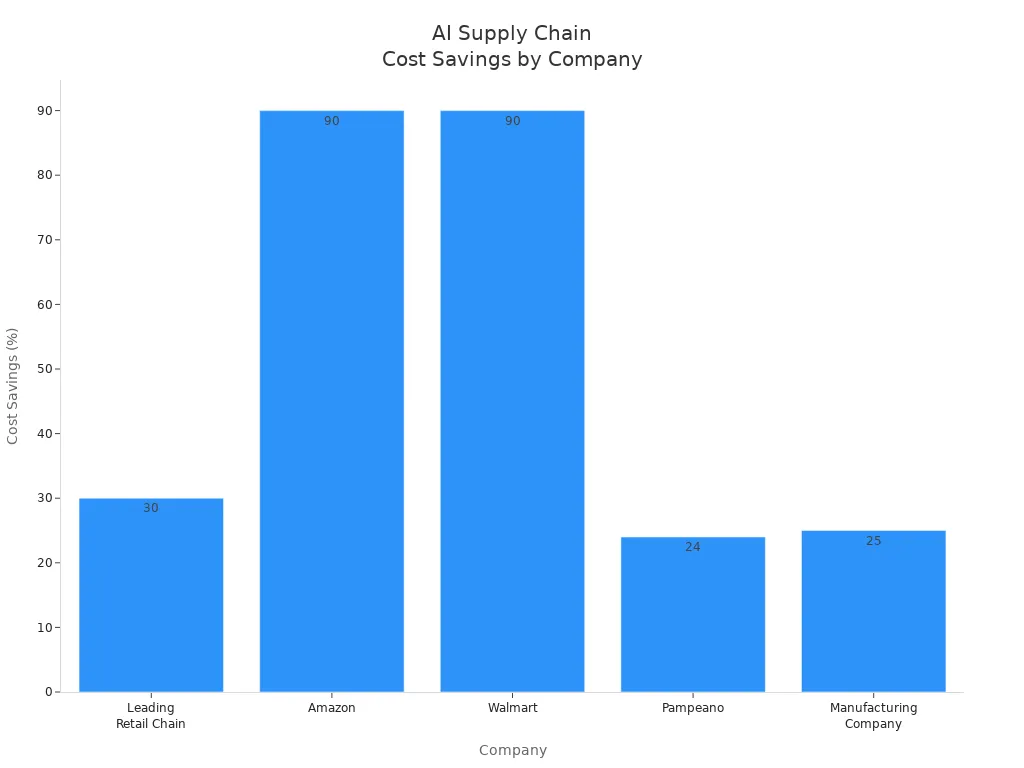
| Elite Maids NY | Automated stock replenishment | 90% decrease in out-of-stock cases, improved client satisfaction |
| Pampeano (leather goods) | AI inventory management system | 24% increase in revenue |
| Leading retail chain | AI-driven analytics | 30% reduction in stockouts, ensured availability of popular items |
| Manufacturing company | AI demand forecasting | 25% reduction in inventory holding costs, freed capital for reinvestment |
You benefit from real-time tracking of inventory across locations. AI agents automate inventory management, reducing errors and improving efficiency. Predictive analytics allow you to forecast demand accurately, minimizing stockouts and overstock situations.
Cost Savings and User Experience
AI automation delivers clear cost savings and a better user experience for supply chain managers and stakeholders. Companies that use AI in supply chain automation report a 30% reduction in stockouts and a 25% reduction in inventory holding costs. Amazon and Walmart both achieved a 90% decrease in out-of-stock cases, leading to higher client satisfaction.
You also see improvements in operational efficiency. AI enhances decision-making in procurement by automating repetitive evaluation tasks and improving access to relevant data. In warehouse operations, AI makes real-time decisions that adapt to changing conditions, improving accuracy and throughput. Logistics operations benefit from dynamic route optimization, which adjusts delivery plans based on real-time data.
When you use AI-driven automation, you gain faster sourcing cycle times, higher order accuracy, improved delivery reliability, and reduced transportation costs. These benefits help you stay ahead in a competitive market and support sustainable growth.
AI Automation in Procurement
AI automation transforms procurement by streamlining processes and reducing cycle times. You can use advanced tools like natural language processing, robotic process automation, and predictive analytics to handle large volumes of data. These technologies automate repetitive tasks, improve contract management, and help you make better decisions. The result is higher efficiency and more strategic focus for your team.
| AI Technology | Impact on Procurement Processes |
|---|---|
| Natural Language Processing | Automates extraction of critical information for rapid contract analysis and compliance checks. |
| Robotic Process Automation | Handles purchase order creation and invoice matching, reducing manual workload. |
| Predictive Analytics | Analyzes supplier data to identify reliable partners and forecast risks. |
| Contract Management | Automates lifecycle management for faster and more accurate contract processing. |
| Overall Impact | Reduces cycle times by up to 30% and manual workload by up to 80%. |
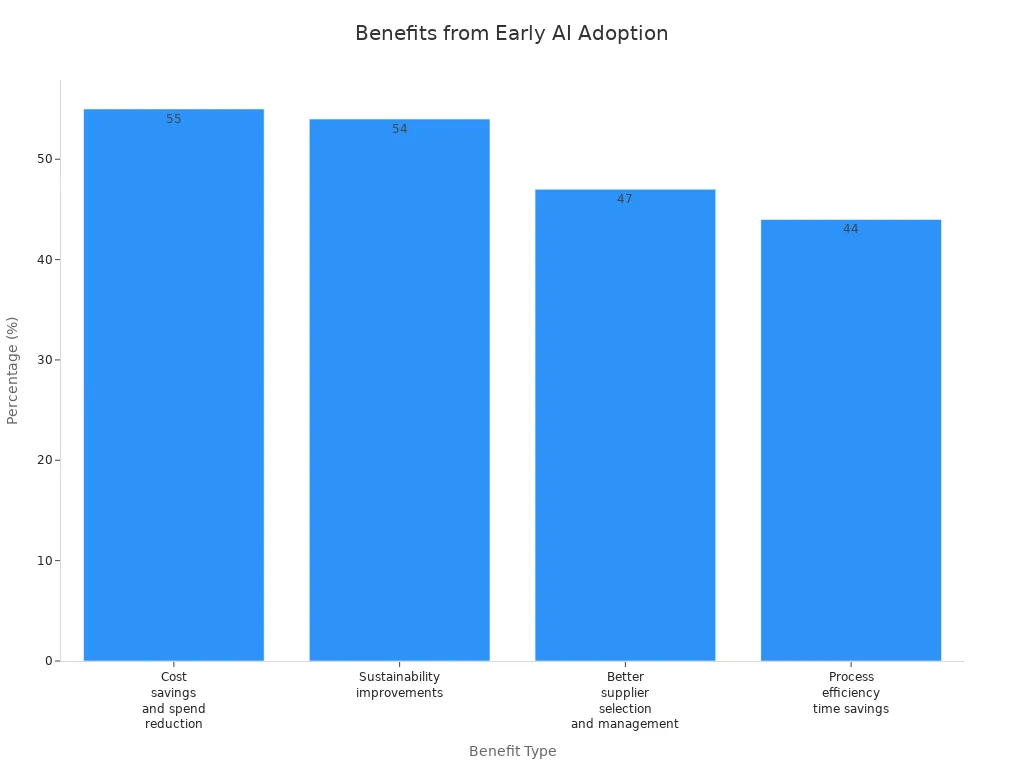
You see real benefits from early adoption. Many organizations report cost savings, better supplier selection, and improved sustainability. In fact, 92% of users express satisfaction with their current AI solutions in procurement.
Supplier Selection Optimization
AI in supply chain automation helps you analyze spending patterns, market trends, and supplier performance. You can select suppliers who offer the best value and predict price changes. This approach ensures timely procurement and reduces supply chain delays. You measure effectiveness using on-time delivery rates, defect rates, and financial stability.
- 77% of organizations use AI for supplier discovery and selection.
- 47% report better supplier management.
Demand Forecasting
You can use AI to improve demand forecasting accuracy. Machine learning and continuous data analysis help you anticipate market changes. Companies report a 10-20% reduction in inventory levels and a 5-10% increase in service levels. Whirlpool, for example, achieved a 15% reduction in inventory and a 10% boost in supply chain efficiency. AI supports dynamic reordering and waste reduction, especially in industries like food service and pharmaceuticals.
Contract Management
AI automates key stages of contract lifecycle management. You can extract important terms, track compliance, and receive alerts for renewals or breaches. Automation increases accuracy and speeds up contract processing. This improvement reduces bottlenecks and enhances overall procurement effectiveness. AI tools also extract metadata from contracts, making management easier and more reliable.
You gain a competitive edge by adopting AI in procurement. Faster processes, lower costs, and better inventory management set you apart in the market.
Warehouse Automation with AI
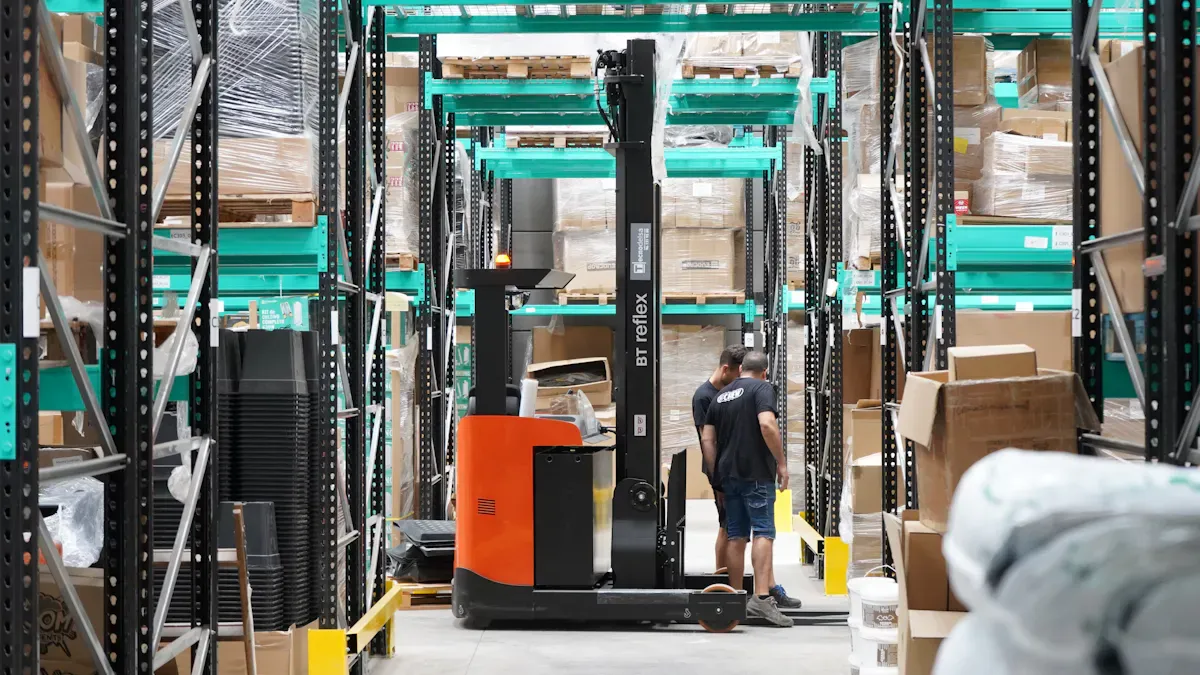
AI in supply chain automation changes how you manage warehouses. You can use ai to control robots, improve inventory visibility, and boost efficiency. These technologies help you achieve sustainable growth and reduce operational costs.
Robotics for Picking and Packing
You can deploy ai-powered robots to automate picking, sorting, and packing tasks. These robots use deep learning to identify items and determine the best way to grasp and move them. The Covariant Brain, for example, enables robots to handle a wide range of products with speed and accuracy. Robots deliver items directly to packing stations, reducing manual retrieval and increasing order fulfillment speed.
- AI-powered robots automate picking, sorting, and packing, increasing accuracy.
- They reduce labor costs and enhance order fulfillment speed.
- AI determines optimal grasp points for different items and refines movement pathways.
- Path optimization can cut walking time by up to 30%.
- Smart batching groups orders to maximize pick density and speed up processing.
- Robotic systems improve safety by handling heavy lifting, letting your team focus on complex tasks.
"The data show that intelligent warehouses outperform not only in volume and accuracy, but in adaptability. As peak season approaches, companies that have invested in AI aren’t just faster – they’re more resilient." – Javier Carrillo, CEO, Mecalux
Real-Time Inventory Tracking
You gain accurate inventory visibility with ai in supply chain automation. Real-time tracking gives you a clear view of stock across all locations. Computer vision systems automate product identification and counting, reducing errors. Predictive analytics help you anticipate stock needs, so you prevent shortages before they happen. Real-time monitoring ensures you always know what is available, supporting better decision-making.
Predictive Maintenance
AI automation enables predictive maintenance for warehouse equipment. You can use predictive models to spot issues before they cause downtime. This approach reduces repair costs and extends equipment life. The table below shows the benefits:
| Benefit | Percentage Reduction/Cost Saving |
|---|---|
| Downtime Reduction | 20–30% |
| Repair Cost Reduction | 15–20% |
| Overall Maintenance Expense Decrease | 5–10% |
| Savings from Avoiding Extra Expenses | Over 10% per predicted breakdown |
| Annual Savings Example | $400,000 annually in downtime costs |
| Payback Period | 12–24 months |
A manufacturer saved $400,000 each year by using predictive maintenance on material handling equipment. Another company saw an 80% drop in unplanned downtime and saved $300,000 per asset.
Predictive maintenance gives you the closest estimate possible of when a breakdown might occur, helping you avoid costly disruptions.
Warehouse automation with ai supports sustainable growth. You improve efficiency, reduce costs, and gain better control over your operations. These advances help you stay competitive in a fast-changing market.
AI in Logistics Optimization
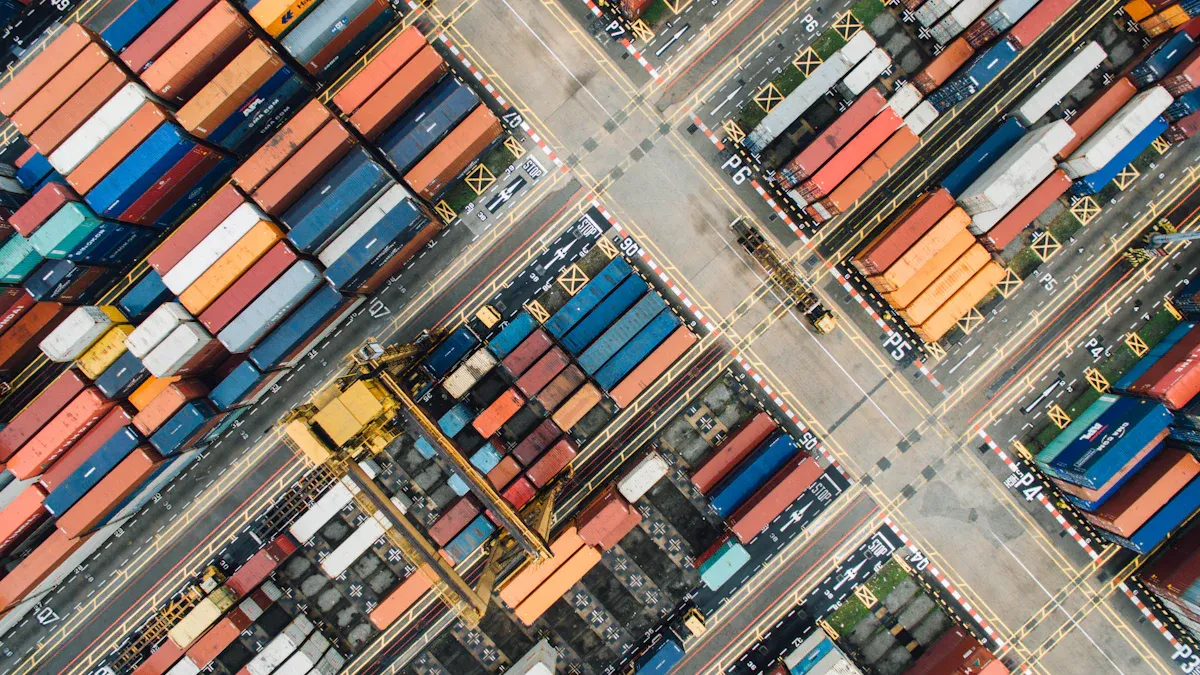
AI in supply chain automation gives you powerful tools to optimize logistics. You can use ai to improve shipping, delivery, and risk management. These technologies help you respond quickly to changes and keep your operations running smoothly.
Route Planning and Scheduling
You can use ai to create the best routes for your shipments. Generative ai builds real-time scenarios that consider traffic, weather, and fuel prices. This approach helps you minimize costs and avoid delays. Machine learning algorithms adjust delivery routes as conditions change. You get more reliable delivery planning and better resource use.
- AI analyzes many variables to find the most efficient transportation routes.
- It simulates "what-if" scenarios to help you adapt to unexpected events.
- Real-time data lets you update schedules and keep deliveries on track.
Companies that use ai for route planning see faster deliveries and lower transportation costs. You can boost efficiency and keep customers happy.
Shipment Tracking
You gain full visibility into your shipments with ai automation. Real-time tracking gives you continuous updates on shipment status. This feature helps you spot problems early and take action before they grow. AI-driven route optimization reduces delays and fuel use.
- AI tracks on-time delivery rates and defect rates, so you can improve supplier reliability.
- Predictive analytics optimize inventory levels, reducing the risk of overstocking or stockouts.
- Compliance monitoring ensures your shipments meet all regulations.
Many companies report fewer quality issues and better on-time delivery rates after using ai-powered tracking. You can make smarter decisions and keep your supply chain running smoothly.
Risk Mitigation
AI helps you manage risks in logistics by monitoring operations and predicting problems. You can address operational risks like delays or equipment failures before they disrupt your supply chain. AI also helps you handle market risks, compliance risks, and natural risks such as weather or geopolitical events.
- Predictive analytics forecast demand, so you can adjust inventory and avoid shortages.
- Automated monitoring checks for compliance, reducing the chance of penalties.
- IoT sensors provide real-time data, letting you respond quickly to new risks.
Dynamic risk assessment lets you adapt to changes and protect your business. With ai in logistics, you gain confidence and control over your supply chain.
Tip: Use ai automation to improve delivery reliability and reduce risk. You will see better results and stay ahead of the competition.
Implementation Considerations
Data Integration Challenges
You face several challenges when integrating ai into supply chain automation. Many organizations must restructure and migrate their data to frameworks that work with generative ai. You may need to invest significant resources to prepare your systems. Data ownership and privacy concerns often arise, especially when using third-party models that lack transparency about storage and usage. Fragmented systems and data silos can limit ai’s ability to deliver complete insights. Inaccurate or irrelevant data can make it hard for ai models to give you reliable recommendations. Legacy and on-premises systems may not connect easily with new ai solutions, creating interoperability issues. Resistance to change can also slow adoption, so you need to keep a human in the loop for oversight.
- Prepare systems for ai by restructuring and migrating data.
- Address privacy and ownership concerns with clear policies.
- Break down data silos to improve insight quality.
- Ensure data accuracy to support reliable ai outcomes.
- Upgrade legacy systems for better integration.
Change Management
Change management plays a key role in the success of ai in supply chain automation. You must train your teams on new technologies and workflows. This training helps reduce resistance and builds confidence in using ai tools. Effective change management ensures that ai integrates smoothly into your existing processes. You should involve your team early and provide ongoing support.
Tip: Engage your workforce from the start. Clear communication and hands-on training help everyone adapt to automation and ai.
Best Practices
You can follow best practices to achieve successful ai implementation. Start by assessing your data readiness with a comprehensive audit. Make sure your data is clean, complete, and centralized. Select ai platforms that support industry standards, scalability, and security. Begin with pilot projects that show value quickly, such as building a digital twin for a key process. Monitor ai performance and set up guardrails for safety and improvement. Evaluate your digital maturity and focus on high-impact use cases. Choose tools and vendors that fit your industry needs.
- Assess data readiness and integration.
- Select the right ai platforms and protocols.
- Pilot use cases and build digital twins.
- Monitor, scale, and optimize with guardrails.
By following these steps, you can lower costs, reduce risk, and unlock the full value of ai in supply chain automation.
Strategic Value and Future Outlook
Competitive Advantages
You gain long-term strategic value when you invest in supply chain automation powered by ai. These technologies support advanced functions like network design, risk forecasting, and sustainability modeling. You can adapt to market changes with more confidence and clarity. Ai enhances operational efficiency by improving forecast accuracy and reducing disruptions. You make faster decisions and respond quickly to new challenges. Your customers benefit from on-time deliveries and accurate orders, which boosts satisfaction and loyalty.
Here is a table showing how ai delivers value across your supply chain:
| Metric | Description |
|---|---|
| Financial Impact | Lower logistics costs, reduced inventory, better service levels |
| Operational Efficiency | Higher forecast accuracy, less shrinkage, faster order cycles |
| Speed and Responsiveness | Quicker decisions, faster time-to-market, shorter fulfillment cycles |
| Quality and Accuracy | Fewer product defects, fewer stockouts, better demand forecasting |
| Customer Experience | More on-time deliveries, accurate orders, higher customer satisfaction scores |
Evolving AI Capabilities
Ai continues to reshape how you manage procurement, warehouse operations, and logistics. You see improvements in decision-making and risk management as ai automates repetitive tasks. Only a small number of supply chains can execute decisions in real time today, but this number will grow quickly. Investment in real-time decision execution is expected to increase fivefold by 2028. Ai agents now analyze social media sentiment and weather patterns to improve demand forecasting. They also help you build environmentally conscious strategies and strengthen your resilience against disruptions. Ai gives you end-to-end visibility and predicts risks before they happen, making it the backbone of modern supply chains.
- Ai improves decision-making across all supply chain functions.
- It automates processes, leading to faster sourcing and better risk management.
- Ai agents support sustainability and resilience.
Preparing for Future Automation
You can prepare for future advances in ai by focusing on your data. Start with standardized, structured data from your ERP systems. Store and harmonize your data for efficient processing. Use data modeling and visualization tools to turn information into actionable insights.
To get ready for the next wave of automation, follow these steps:
- Audit your current processes to find inefficiencies and bottlenecks.
- Evaluate your data readiness to ensure it is clean, accurate, and organized.
- Set measurable objectives that align ai implementation with your business goals.
Tip: When you build a strong data foundation and set clear goals, you position your organization to lead in the era of ai-driven supply chain automation.
You see direct benefits when you use ai and generative ai in supply chain automation. These tools improve accuracy, speed, and cost savings. To start, join a data readiness workshop and build a prototype to test value. Companies like Infor and Kinaxis offer ai solutions for contract management and disruption forecasting.
| Company | AI Solution Description |
|---|---|
| Infor | Workforce and contract management, system insights |
| Kinaxis | Disruption management, forecasting, interactive execution |
You can identify vulnerabilities and respond to demand spikes by using ai. Stay competitive by adopting automation and prepare for future advances in technology.
FAQ
What is AI supply chain automation?
AI supply chain automation uses artificial intelligence to manage tasks like forecasting, inventory, and logistics. You gain faster operations, fewer errors, and lower costs. AI helps you make smarter decisions and improves your supply chain performance.
How does generative AI improve supply chain decision-making?
Generative AI analyzes large datasets and creates useful insights. You can plan for demand changes, spot risks, and optimize routes. This technology helps you respond quickly and stay ahead of disruptions.
Can AI reduce supply chain costs?
Yes. AI automation lowers logistics costs, reduces inventory waste, and improves order accuracy. You save money by using predictive analytics and automated processes. Many companies report cost savings of 15% or more.
Is AI difficult to implement in supply chains?
You may face challenges like data integration and training your team. Start with clean data and pilot projects. Choose platforms that fit your needs. Good planning and support make AI adoption easier.
What are the main benefits of AI in supply chain automation?
You see faster cycle times, better inventory management, and improved customer satisfaction. AI boosts efficiency and helps you adapt to market changes. You gain a competitive advantage and prepare for future growth.
See Also
Driving Business Growth Through Supply Chain Management Outsourcing
Gaining Competitive Edge Through Supply Chain Outsourcing Strategies
Achieving Rapid, Sustainable Success with Lean Logistics Approaches
Enhancing Operational Efficiency with Pick to Cart Solutions
Utilizing AI to Improve Production Forecasting Accuracy in 2024