
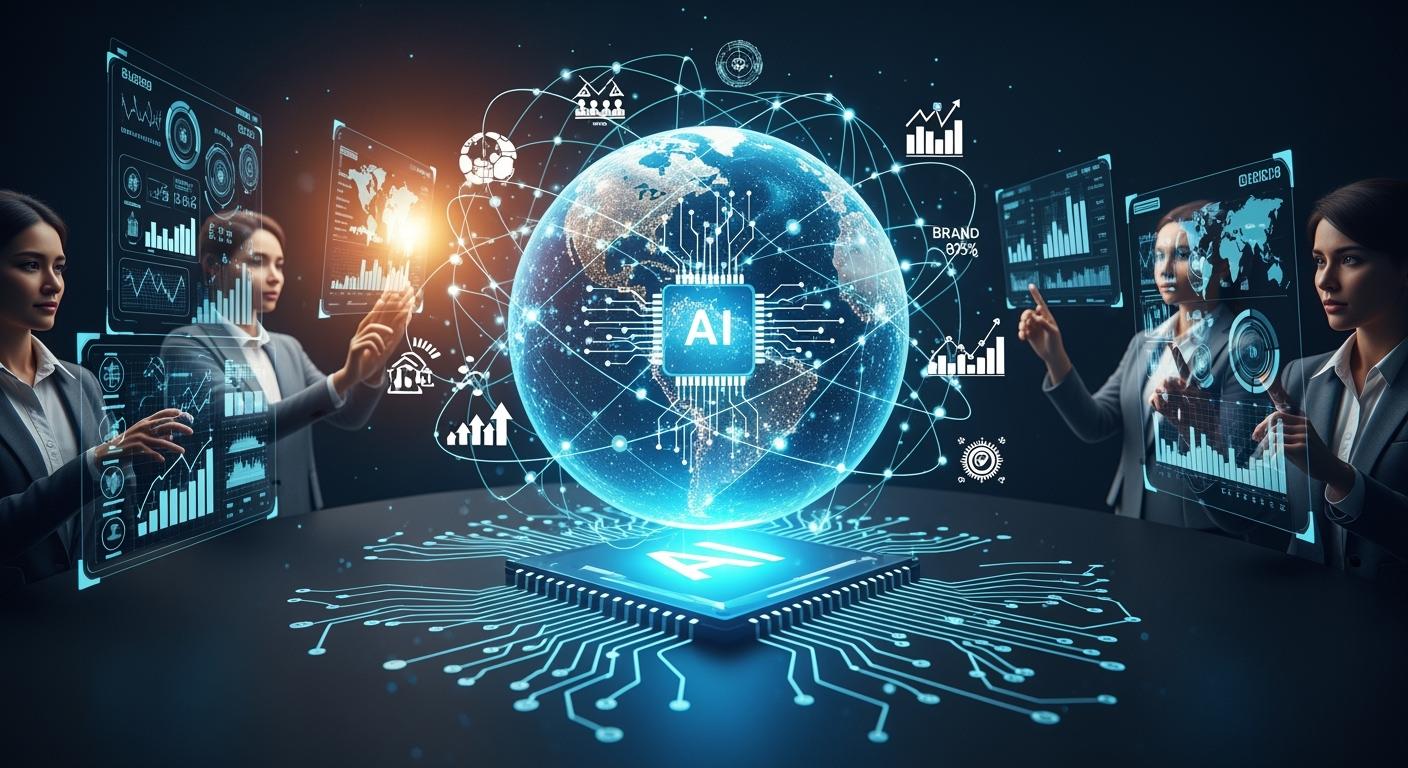
You drive your brand’s growth when you embrace AI for Scaling. This approach lets you enter new markets quickly and operate more efficiently. With AI, you can streamline workflows, automate repetitive tasks, and save on operational costs.
- Efficiency increases as you optimize processes.
- Productivity rises when automation handles routine work.
- Cost reduction becomes possible through smart technology.
AI transforms your operations, marketing, and customer experience into a unified strategy for global success.
The Role of AI for Scaling
AI for Scaling gives you the power to expand your brand globally without heavy investment. You can integrate strategy, brand development, and AI-led execution to unlock new levels of efficiency. This approach helps you automate operations, enhance customer experience, and build a data-driven strategy that supports rapid growth.
Automating Operations
You can automate many operational processes with AI. This technology streamlines customer service workflows, making your team more responsive and consistent. Adaptive ticket routing, personalized response drafting, and proactive issue identification allow you to handle customer requests faster and with fewer errors. Startups use AI to launch branding quickly, saving money and focusing on product development. Agencies manage multiple clients efficiently, keeping brand quality high while scaling services. Enterprises achieve brand consistency across global teams and markets, ensuring compliance and allowing for localized customization.
Agencies using AI can handle 30% more projects with the same workforce. This efficiency translates into billable growth and improved project timelines.
AI has become the operational standard for high-performing marketing teams. For example, Welcome Pickups saw a 66% increase in ride bookings on localized pages created with AI tools, which contributed about 2% to their overall revenue.
| Application | Measurable Outcomes |
|---|---|
| Predictive Analytics | Cost avoidance, revenue uplift, risk reduction, cost per transaction, fraud loss reduction. |
| Predictive Maintenance | Reduced unplanned downtime, lower labor costs, improved safety, extended asset life. |
| IT Operations Automation | Labor cost reductions, faster incident resolution, infrastructure cost optimization. |
| Intelligent Document Processing | Cost reductions per invoice, shorter processing times, lower error rates, saved full-time equivalent hours. |
| Supply Chain Optimization | Reduced inventory carrying costs, fewer stockouts, improved service levels, and fill rates. |
Enhancing Customer Experience
You can use AI to transform your customer experience. AI-powered customer service shifts your approach from reactive to proactive engagement. Support teams focus on building deeper relationships while maintaining consistent quality. Most executives now use AI for customer communication. Early adopters report improved consumer service and streamlined workflows. Revenue increases and better ratings show the impact.
| Case Study | Description | Results |
|---|---|---|
| Gen AI Agent for Onboarding | A conversational agent assists website visitors through onboarding. | 22% increase in conversion rate, 17% reduction in client acquisition cost, 20% improvement in engagement. |
| Electronics Retailer | A chatbot enhances product discovery and streamlines purchases. | Improved customer assistance and sales through accurate product recommendations. |
- 84% of executives use AI for customer communication.
- 69% report improved consumer service.
- 54% see streamlined workflows.
- Revenue increases by 34%.
- Ratings improve by 40%.
Customer satisfaction and perceived efficiency are critical metrics. You should focus on improving system efficiency and customer satisfaction to maximize the benefits of AI in customer service. These metrics help you build loyalty and grow your brand in international markets.
Data-Driven Strategy
AI for Scaling lets you build a data-driven strategy that supports global growth. Deep learning identifies complex patterns, helping you predict supply chain delays and customer churn. Machine learning automates data analysis, allowing you to track micro trends and optimize campaign performance. AI-enhanced CRMs improve lead prioritization and customer engagement, which is crucial for timely marketing efforts.
- AI automates manual tasks like content creation and sales forecasting, increasing operational efficiency.
- AI-powered chatbots and voice assistants enhance customer support, providing quicker responses and freeing up human resources.
You can see successful integration of AI-led execution in brand development across many industries. Brands like Pedigree, Nike, Heinz, Virgin Voyages, British Council, and Coca-Cola use AI technologies to achieve impressive results.
| Brand | AI Technologies Used | Channels | Results |
|---|---|---|---|
| Pedigree | AI machine learning model | Out-of-home, digital media | 6x more shelter visits, 50% of dogs adopted in 2 weeks, won 4 Cannes Lions |
| Nike | Computer vision, generative AI | YouTube, social media | 4.2 million views in 48 hours, 1082% increase in organic views, multiple Cannes Lions awards |
| Heinz | Generative AI (DALL·E 2), computer vision | Social media, PR, digital display | 1 billion impressions, 2500% ROI, 38% higher engagement rate |
| Virgin Voyages | Generative video, voice synthesis, AR | Social media, experiential microsite | 2 billion impressions, 25,000 personalized videos generated |
| British Council | Template-based design automation | Programmatic ads, social media | 70% reduction in content creation costs, 50% faster turnaround time |
| Coca-Cola | Generative AI, large language models | Branded microsite, digital OOH, social media | High-volume user-generated content, sustained PR coverage |
You can use AI for Scaling to unify your strategy, automate execution, and drive measurable outcomes. This approach helps you grow your brand faster and more efficiently in global markets.
AI Applications for Global Growth

AI for Scaling gives you the tools to expand your brand across borders. You can automate workflows, boost productivity, and unlock new creative possibilities. Many leading brands use AI to innovate, personalize, and optimize every step of their global journey.
Localization and Personalization
You need to connect with customers in every market. AI helps you localize content and personalize experiences at scale. You can translate campaigns, adapt visuals, and tailor messages for each region. This approach increases engagement and drives growth.
- Welcome Pickups saw a 66% increase in ride bookings after launching localized pages powered by AI. This change added about 2% to their total revenue.
- L’Oréal used AI for virtual try-ons and personalized recommendations. The result was over 1 billion virtual try-ons and three times higher conversion rates.
- Nike used predictive AI to recommend products. Customers engaged more and bought again, with repeat rates rising by 30%.
Tip: Use AI to analyze customer data and create hyper-personalized ads. You can deliver the right message to the right person at the right time.
Luxury and growth-stage brands also use generative AI to stand out. Zara and Louis Vuitton create AI-generated images for marketing. These tools help you keep brand consistency and launch campaigns faster. Fashion brands like Unmade use generative design to offer custom products, blending creativity with efficiency.
Predictive Market Analytics
You can use AI to predict trends and make smarter decisions. Predictive analytics lets you spot what customers want before your competitors do. You can analyze first-party data, track campaign results, and refine your strategy.
- A global e-commerce giant used predictive analytics to study customer behavior. They saw a 30% jump in engagement and more repeat purchases.
- A leading retailer used AI for real-time product recommendations. Their average order value rose by 20%, and customer retention improved.
- Personalized campaigns based on first-party data lead to better targeting and higher conversion rates.
| Outcome | Description |
|---|---|
| Improved Forecasting Accuracy | Companies report better forecasting with AI-driven analytics. |
| Better Resource Allocation | You can allocate resources more effectively. |
| Reduced Operational Costs | Automation lowers expenses. |
| Enhanced Decision-Making | AI gives you timely, data-driven insights. |
| Operational Efficiency | You boost productivity by automating tasks. |
| Competitive Advantage | AI helps you stay ahead of trends and rivals. |
| Adaptability and Resilience | Predictive tools help you prepare for future challenges. |
Note: Predictive analytics helps you launch products faster and respond to market changes with confidence.
Supply Chain Optimization
Managing a global supply chain is complex. AI makes it easier. You can forecast demand, reduce errors, and cut costs. AI-driven forecasting reduces mistakes by 20% to 50% compared to old methods. Early adopters have seen logistics costs drop by 15%, inventory improve by 35%, and service levels rise by 65%.
- AI helps you avoid stockouts and overstocking.
- You can optimize shipping routes and delivery times.
- Automation speeds up order processing and reduces manual work.
A 2022 McKinsey survey found that companies save the most money from AI in supply chain management. This impact shows why many brands make AI a core part of their operations.
How AI-Native Enterprises Boost Productivity
AI-native enterprises lead the way in automating workflows. You can see the benefits in every part of the business.
| Evidence Type | Statistic/Outcome |
|---|---|
| Productivity Gains | 4.8 times greater labor efficiency growth |
| Cost Reduction and Revenue | ROI from 30% to 200% |
| Process Execution Speed | 67% faster hiring and onboarding |
| Accuracy Improvement | Nearly 49% of human mistakes eliminated |
| Marketing and Sales Performance | 80% more leads, 75% higher conversions, 451% more qualified prospects |
Generative AI also drives efficiency and creativity. MIT researchers use AI to design new fabric patterns. Fashion brands like Unmade and luxury leaders like Louis Vuitton use generative tools to create unique products and campaigns. Tools such as DALL-E 2 and Midjourney let you turn text prompts into photorealistic images, speeding up design and marketing.
Callout: McKinsey predicts generative AI could add up to $275 billion to the profits of the apparel and luxury sectors in the next five years.
AI for Scaling empowers you to automate, personalize, and optimize every aspect of your global brand. You can reach new markets, delight customers, and grow faster than ever before.
Real-World Success Stories

Retail Brand Expansion
You can see how global retailers use AI to drive growth and efficiency. L’Oréal uses ModiFace and SkinConsult AI to offer virtual try-ons and skin diagnostics. This approach led to over 1 billion virtual try-ons and tripled conversion rates. H&M’s chatbot helps customers find clothing and gives styling tips, resulting in a 25% increase in conversion rates. Domino’s “Dom” voice assistant speeds up ordering, reducing order completion time by 15% and boosting customer satisfaction. Starbucks uses “Deep Brew” AI to suggest orders and power its loyalty program. This strategy increased active membership by 15% year-over-year, with loyalty members now making up 41% of U.S. sales.
| Brand | AI Solution | Results | Leader Takeaway |
|---|---|---|---|
| L’Oréal | ModiFace, SkinConsult AI | 3x higher conversions, 1B+ try-ons | AI removes friction and lifts conversions. |
| Domino’s | “Dom” voice assistant | Faster orders, higher satisfaction | Conversational AI boosts efficiency and experience. |
| Starbucks | “Deep Brew” for loyalty and suggestions | 15% more members, 41% of sales from loyalty | AI-driven convenience fuels repeat business. |
Consumer Tech Growth
You can find major gains in the consumer tech sector as well. Over 1.7 billion people use AI tools worldwide, with 500–600 million engaging daily. Despite this, market spending remains low, showing a big opportunity for monetization. More than a third of organizations report financial gains between €5 million and €15 million from AI. On average, companies see €6.24 million in benefits, either through higher profits or lower costs. When you implement AI well, you can unlock new revenue streams and improve your bottom line.
Lessons and Best Practices
You can apply several best practices from these success stories:
| Best Practice | Description |
|---|---|
| Cost reduction | Automate tasks to save money and reduce errors. |
| Enhanced decision-making | Use AI insights to make smarter choices. |
| Personalization at scale | Tailor experiences to each customer for higher revenue. |
| Productivity and innovation | Free up teams for creative work by automating routine jobs. |
| Scalability and flexibility | Scale operations quickly without major infrastructure changes. |
“Human-AI collaboration for competitive advantage is where the real opportunity sits. When everyone has access to the same AI tools, the differentiator becomes knowing which questions to ask and how to layer human expertise on top of AI output.”
Start with high-impact use cases, train AI on your brand data, and focus on seamless customer experiences. When you combine human creativity with AI, you set your brand up for global success.
Implementing AI for Scaling
Assessing Readiness
You need a clear plan before you start your AI journey. Begin by setting the foundation. Identify the key areas in your organization and define what readiness means for each. Use a simple scoring method to measure your current state across these pillars. Bring together teams from different departments to review your readiness. This cross-team review helps you spot gaps and strengths. Turn your findings into a practical roadmap with clear steps. Make sure you revisit your assessment often. Technology and team skills change quickly, so regular updates keep your plan relevant.
Step-by-step approach to assess readiness:
- Set the foundation by identifying key focus areas.
- Choose a scoring method to evaluate readiness.
- Run a cross-team review to find gaps.
- Turn your assessment into an actionable roadmap.
- Revisit and update your plan regularly.
Tip: Involve leaders from every department to get a full picture of your AI readiness.
Choosing Tools and Partners
Selecting the right tools and partners shapes your success with AI for Scaling. Start by looking for quick wins that deliver high impact. Understand the specific problems you want to solve. Data governance should guide your choices to ensure ethical and effective use. High-quality, diverse data helps your AI tools perform better. Companies like Blendhub have shown that the right tools can boost efficiency across teams. When you choose partners, look for those with proven experience in your industry.
Key criteria for selection:
- Identify high-impact, quick-win opportunities.
- Understand the problem deeply before choosing a tool.
- Ensure strong data governance practices.
- Use high-quality, unbiased data.
- Select partners with a track record of success.
Overcoming Challenges
You may face several challenges as you scale with AI. Moving from pilot projects to full adoption can be tough. Clear governance and accountability help you stay on track. You might need to redesign some processes to make them scalable. A structured approach works best. Start by diagnosing your needs. Embed governance at every stage. Redesign processes for scalability. Build AI literacy across your teams. Scale adoption step by step.
| Challenge | Solution |
|---|---|
| Transitioning from pilot to scale | Use a five-stage framework for transformation |
| Lack of governance | Embed clear accountability structures |
| Outdated processes | Redesign for scalability |
| Low organizational literacy | Invest in training and education |
Note: Success with AI for Scaling comes from combining structure, strong governance, and ongoing learning.
You accelerate global brand growth when you shift from headcount-first to capability-first expansion. AI for Scaling lets you reduce costs and boost flexibility, focusing on execution quality. Unified AI integration enhances customer experience and omnichannel support.
Omnicom’s ArtBotAI shows how large language models streamline digital assets, making personalized experiences easier to deliver.
Evaluate your leadership vision, data health, and technology strength. Build a mature talent strategy and invest in responsible AI.
| Action | Benefit |
|---|---|
| Align AI with business goals | Strategic scaling |
| Secure C-suite sponsorship | Higher success rates |
| Develop talent | Effective scaling |
Take the lead—make AI for Scaling your growth engine.
FAQ
What is AI for Scaling?
AI for Scaling uses artificial intelligence to help you grow your brand faster. You automate tasks, analyze data, and improve customer experiences. This approach lets you expand globally with less investment and more efficiency.
How can AI improve my global marketing strategy?
You use AI to personalize campaigns, predict trends, and localize content. AI tools help you reach new markets quickly. You can test ideas, measure results, and adjust your strategy in real time.
Is AI for Scaling only for large enterprises?
No. You can use AI for Scaling at any business size. Startups, agencies, and growth-stage brands all benefit. AI tools now offer flexible solutions that fit your needs and budget.
What challenges should I expect when adopting AI for Scaling?
You may face issues like data quality, process redesign, or team training. Start with clear goals and strong governance. Invest in education and choose partners with proven expertise.
See Also
Exploring How Top Brands Utilize WarpDriven Distribution Solutions
Boosting Expansion Through Outsourced Supply Chain Management
Utilizing Data Analytics for Smart Product Selection Strategies
Leveraging AI for Accurate Demand Predictions in Retail
The Role of Micro Fulfillment Centers in E-Commerce Expansion