

You face a turning point with ai-driven business transformation in 2026. Nearly 90% of organizations plan to increase ai spending. Many leaders now see ai as a key driver for revenue growth and business outcomes. If you ignore ai transformation, you risk losing market relevance and missing innovation. Your competitors move fast with digital transformation. Poor customer experience, outdated reports, and limited scalability can hurt your transformation. Ai shapes customer experience, employee engagement, operational efficiency, workforce planning, and trust.
- 86% of C-suite leaders boost ai investments.
- 32% use ai tools daily, showing rapid adoption.
Organizations that lag in ai-driven business transformation risk falling behind and losing market share.
AI-Driven Business Transformation & Customer Experience
Personalization With AI
You see ai changing customer experience through personalization. Ai learns what you like and adapts to your needs. Companies use ai to create hyper-personalization, which means you get offers and messages that fit your preferences. Ai-driven personalization helps you discover products faster and makes shopping easier. E-commerce platforms use ai to track your history and suggest items you may want. Customer service teams use ai to send tailored responses, improving customer engagement.
- 72% of consumers report improved customer experience from ai.
- 69% trust companies that use ai equally or more.
- 92% of businesses use ai-driven personalization.
- 82% of consumers say personalized experiences influence their brand choice.
- Ai creates customized product recommendations based on your history.
- Personalized email campaigns address your preferences.
- Tailored loyalty offers encourage you to return.
Ai capabilities help companies predict what you want next. Predictive analytics lets businesses engage you before you ask for help. Social media platforms use ai to enhance customer engagement and create deeper connections. Hyper-personalization makes you feel valued and increases satisfaction.
| Metric | Improvement |
|---|---|
| Conversion Rates | Up to 40% |
| ROI | 42% |
| Customer Satisfaction (CSAT) | +25–30% |
| Retention Rates | +15–30% |
| Customer Loyalty | +20%+ |
| Revenue Uplift | +10–25% |
Ai-driven personalization boosts customer experience and loyalty. You notice brands responding faster and offering relevant choices. Companies measure the impact through conversion rates, retention, and revenue uplift.
Automation For Seamless Service
Ai powers automation to make customer experience smooth and efficient. Intelligent automation handles repetitive tasks, so you get quick answers and faster service. Ai chatbots manage flight changes, upgrades, and cancellations for airlines. You see shorter queues at airports because ai-driven solutions assist passengers. Retailers use ai to automate support and detect fraud, improving payment completion rates.
| Company | AI Implementation Description | Results/Outcomes |
|---|---|---|
| Delta Airlines | AI chatbot manages flight changes, upgrades, and cancellations. | 60% improvement in self-service resolutions, increased customer loyalty scores. |
| Heathrow Airport | AI-driven solutions for passenger assistance and security. | Shorter queue times, improved traveler satisfaction. |
| Klarna | AI automates customer support and detects fraud. | Reduced fraud losses, increased payment completion rates. |
| Pizza My Heart | AI voice assistant streamlines phone orders and optimizes delivery schedules. | 25% increase in order accuracy, improved customer retention. |
| Sam’s Club | AI Scan & Go app enhances checkout experiences. | 50% reduction in checkout times, increased customer loyalty. |
| Comcast | AI virtual assistant troubleshoots issues and alerts customers to outages. | 30% reduction in wait times, decreased inbound support calls. |
| Netflix | AI personalizes experiences and enhances automated support interactions. | Faster issue resolution, higher customer satisfaction rates. |
| Decathlon | AI chat assistant optimizes product searches and automates support requests. | 65% of customer queries automated, 15% increase in online conversions. |
| American Eagle | AI chatbot offers style recommendations and assists with order tracking. | 20% reduction in live chat volumes, improved customer satisfaction scores. |
| Unity Technologies | AI-driven help desk resolves inquiries and improves response accuracy. | 40% reduction in ticket resolution times, increased self-service adoption rates. |
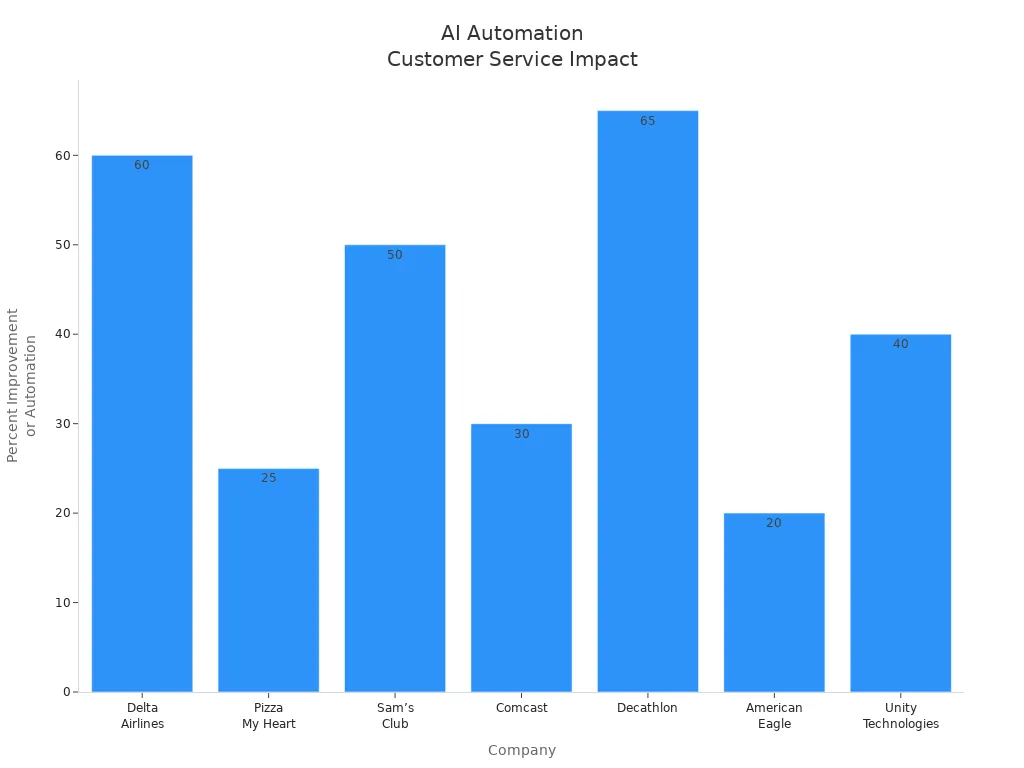
Ai-driven systems handle workflows like data entry and scheduling. Tasks that took hours now finish in minutes. Ai algorithms predict equipment failures, so companies plan maintenance before problems happen. Ai combined with IoT devices allows real-time adjustments in logistics and staffing. Virtual assistants provide faster response times, letting human agents focus on complex issues. Ai improves customer experience by automating common requests and reducing wait times.
- Ai resolves an average of 41% of customer interactions without live agent support.
- For successful companies, this figure rises to 51.5%.
Intelligent automation increases operational efficiency and makes customer experience seamless. You benefit from faster service and fewer errors.
Employee Empowerment Through AI Tools
Ai empowers employees to deliver better customer experience. Ai tools automate repetitive tasks, so employees focus on high-value work. Personalization of employee journeys through ai gives workers more autonomy and flexibility. Data-driven insights from ai improve decision-making and help employees solve problems before they grow.
| Company | AI Tool | Description |
|---|---|---|
| Starbucks | Deep Brew | Personalizes recommendations in real-time via the app, enhancing user experience and driving loyalty. |
| Bank of America | Erica | A chatbot providing personalized financial advice and quick resolutions, improving user satisfaction. |
| Amazon | AI Algorithms | Analyzes customer behavior for tailored recommendations and uses chatbots for improved service. |
| Sephora | Virtual Artist | Allows virtual try-ons of products, enhancing customer confidence and satisfaction. |
Ai capabilities help employees respond faster and personalize customer engagement. Predictive analytics lets staff anticipate needs and offer proactive solutions. Ai-driven transformation improves employee experience by streamlining workflows and boosting engagement.
- Ai tools automate repetitive tasks, increasing efficiency and productivity.
- Employees focus on higher-value activities.
- Personalization fosters greater autonomy and flexibility.
- Data-driven insights enable proactive problem-solving.
Ai enhances customer experience and employee productivity. You see employees using ai to personalize service and resolve issues quickly. Hyper-personalization and intelligent automation make both customer and employee journeys smoother.
Ai-driven business transformation shapes customer experience, employee engagement, and operational efficiency. You notice brands using ai capabilities to deliver hyper-personalization, seamless automation, and empowered employees. Companies that invest in ai, predictive analytics, and intelligent automation lead in customer engagement and satisfaction.
Innovation & AI Transformation
Rapid Product Development
You see innovation moving faster than ever. AI helps you build new products quickly. You can test ideas and create prototypes in days instead of weeks. Early adopters of AI report faster time to market and better product-market fit. AI tools speed up every stage of development, from concept to launch. You use AI to validate ideas and generate product concepts. Teams use OpenAI models for rapid prototyping and feedback analysis. AI-assisted coding tools help you develop features faster. Generative video capabilities make product demos and marketing easier.
- AI integration accelerates development cycles and boosts efficiency.
- Solutions can be prototyped and validated in days.
- The innovation cycle shortens, with ideation, simulation, and iteration happening in hours.
- 76% of executives say AI has shortened the time to market for new products.
You gain market responsiveness and can launch products before competitors. AI transformation gives you an edge in innovation.
Data-Driven Insights
You rely on AI to make smart decisions. AI analyzes data and gives you insights that drive innovation. Leading companies use AI analytics to improve operations. Amazon uses AI to study customer interactions and boost sales. Kaiser Permanente applies predictive analytics to manage chronic diseases. PayPal uses AI for real-time fraud detection. GE monitors equipment with AI to prevent downtime. Uber uses AI to match rides and set prices.
- Retail: AI adjusts prices based on real-time data.
- Healthcare: AI predicts patient inflow and suggests staffing.
- Finance: AI blocks fraud by monitoring transactions.
- Logistics: AI creates efficient delivery routes.
- Manufacturing: AI schedules maintenance before breakdowns.
- E-Commerce: AI recommends products to increase sales.
- Agriculture: AI sets irrigation schedules for crops.
- Media: AI personalizes content recommendations.
- Energy: AI optimizes grid distribution.
- Marketing: AI reallocates ad budgets based on performance.
You see predictive analytics in healthcare identifying high-risk patients. Automated insights in finance track performance. Sentiment analysis helps retail brands adjust marketing. Image and video analysis in manufacturing finds defects. Anomaly detection in finance blocks suspicious transactions.
You use AI-driven insights to inform strategy and improve innovation. Data-driven decisions help you stay ahead.
| Role | Responsibility |
|---|---|
| Chief Executive Officer | Ensures AI investments align with strategy and generate returns |
| Chief Technology Officer | Guides the direction for AI adoption and utilization |
| Chief Risk/Compliance Officer | Addresses enterprise-level AI system risks |
| Chief Legal Officer | Prepares for evolving policy and regulatory landscape |
| Chief Data Officer | Safeguards data integrity and privacy |
| Chief AI Officer | Integrates responsibilities and maintains focus on AI transformation |
Strong governance ensures your AI transformation succeeds. CEOs expect innovation to deliver results. You need leaders who guide AI adoption and protect data. You build trust and drive innovation with clear roles and responsibilities.
AI-Driven ERP & Operational Efficiency

Real-Time Analytics
You experience a new level of operational efficiency with ai-driven erp systems. These platforms give you immediate access to performance metrics. You monitor your business as events unfold. Real-time analytics let you spot issues and act quickly. You use customizable dashboards to view data in formats that make sense to you. These reporting tools help you understand operations at a granular level. You drill down into specific metrics and see trends as they happen.
- Ai-driven erp systems transform your business from reactive to proactive.
- Predictive analytics and real-time monitoring help you identify risks before they become problems.
- Continuous monitoring detects inefficiencies early, reducing costs and boosting productivity.
You see ai-driven erp solutions adapt to changing conditions. Ai analyzes supply and demand patterns. It suggests adjustments in production schedules and inventory policies. You minimize waste and keep costs low. In retail, you optimize inventory levels and ensure products are available. In healthcare, you streamline administrative tasks and improve patient outcomes.
| Statistic | Value |
|---|---|
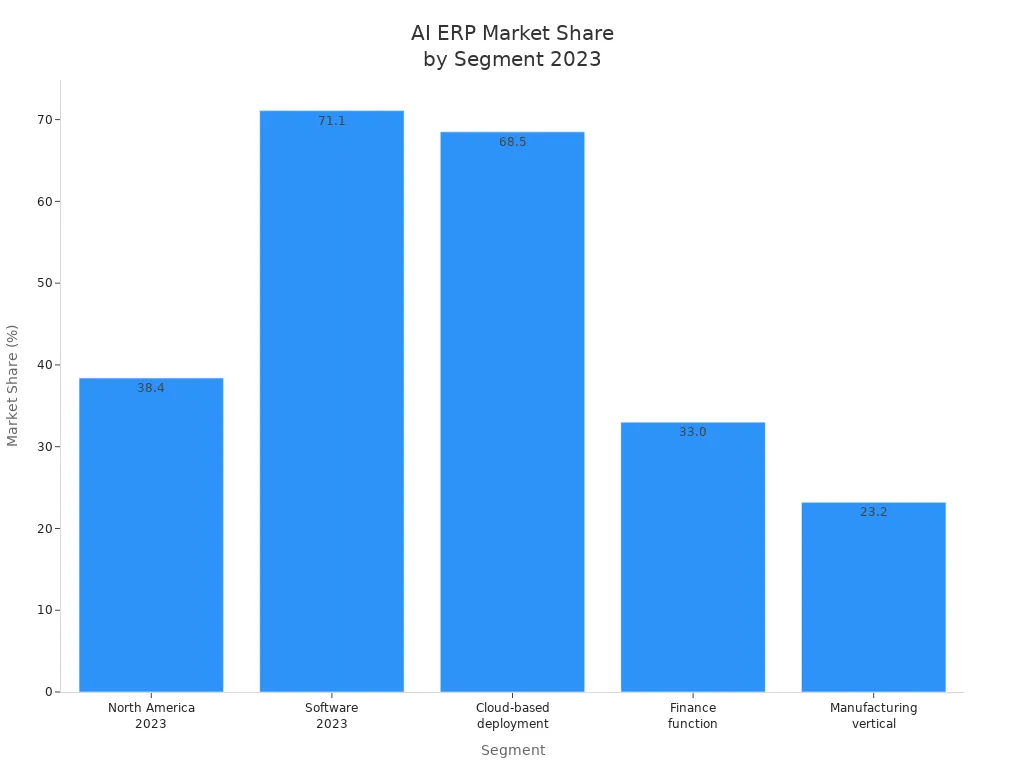
| Global AI in ERP market value in 2023 | USD 4.5 billion |
| Projected market value by 2033 | USD 46.5 billion |
| Compound annual growth rate (CAGR) | 26.3% |
| North America's market share in 2023 | 38.4% |
| Software segment market share in 2023 | 71.1% |
| Cloud-based deployment market share | 68.5% |
| Finance function market share | 33.0% |
| Manufacturing industry vertical share | 23.2% |
Cost Reduction & Process Streamlining
You see ai-driven erp systems deliver cost savings and streamline processes. Ai helps you automate tasks and reduce manual labor. You save time and money by using predictive maintenance. Manufacturers cut unplanned downtime by up to 50% and maintenance costs by up to 25%. Logistics companies report a 10% cost reduction after implementing ai. Ai-driven erp platforms optimize inventory and sales processes in retail. You avoid stockouts and overstock situations, improving cash flow.
Ai-driven erp systems enable flexible process implementation. You adapt quickly to market changes and customer needs.
In healthcare, you integrate patient records, scheduling, and billing. You improve resource utilization and ensure supplies are available. Ai-driven erp solutions help you analyze workflows and propose changes to improve cycle times.
| Organization | AI Application | Cost Reduction Details |
|---|---|---|
| JPMorgan | COIN platform | Saved 360,000 hours of lawyer time annually, reducing labor expenses significantly. |
| Various companies | Logistics and transportation | 46% reported a 10% cost reduction after implementing AI. |
| Manufacturers | Predictive maintenance | Reduced unplanned downtime by up to 50% and maintenance costs by up to 25%. |
| Microsoft | Data center optimization | Increased server utilization from 50-60% to 80-90%, maximizing hardware value. |
| Omega Healthcare | Document Understanding | Saved 15,000 employee hours per month, reducing documentation time by 40%. |
| US Healthcare System | Administrative automation | Potential annual savings of $150 billion by automating tasks like documentation. |
You benefit from ai-driven erp transformation. You make faster decisions, reduce costs, and improve operational efficiency. Analytics guide your actions and help you stay competitive.
Workforce & Digital Transformation
Upskilling With AI
You see companies investing in upskilling as digital transformation changes job requirements. AI helps you learn new skills faster. Organizations use personalized, skills-based learning plans that adapt to your needs. AI analyzes your strengths and gaps, then recommends training content in real time. You benefit from scalable, adaptive training that fits your schedule. Labor shortages in fields like AI and data science drive more investment in upskilling. Remote and hybrid work also require new digital collaboration skills.
| Key Factors Driving Growth | Description |
|---|---|
| Personalized, skills-based learning | Organizations are moving towards tailored development plans as job requirements evolve. |
| Digital transformation | Industries are adopting new digital tools, increasing the need for continuous workforce development. |
| Scalable, adaptive training | AI can analyze skills gaps and personalize learning content in real time. |
| Labor shortages | Investment in upskilling is driven by demand in areas like AI and data science. |
| Remote and hybrid work | New digital collaboration skills are required for effective remote work. |
Employers that focus on skill development help you stay relevant. This proactive approach improves your employability and supports workforce transformation. You gain confidence as you learn to use AI tools and digital platforms.
Workforce Expansion & Planning
AI adoption influences workforce planning and expansion strategies. You see organizations filling talent gaps based on skills, not just previous roles. AI assesses the skills needed and guides decisions on recruitment and upskilling. It predicts turnover and retention rates using real-time data. You benefit from accurate forecasting of workforce demand and supply. AI infers skills and enables dynamic scheduling.
- Organizations fill talent gaps based on skills rather than previous roles.
- AI helps assess requisite skills in the workforce and informs decisions on recruitment and upskilling.
- AI enhances the ability to predict turnover and retention rates.
- It uses real-time data for accurate forecasting of demand and supply.
- AI can infer skills and activate dynamic scheduling.
- AI agents analyze scenarios and provide recommendations for workforce planning.
- They help redesign jobs by reallocating tasks to AI, improving efficiency.
Building a future-ready workforce means you focus on skills that remain relevant. You capitalize on tasks enhanced by AI and automate routine work. Jobs are reimagined to align with AI capabilities.
| Action Category | Description |
|---|---|
| Future-Proof | Emphasize skills that will remain relevant despite AI advancements. |
| Capitalize | Focus on tasks that can be enhanced by AI to improve productivity. |
| Automate | Identify tasks that can be automated to free up human resources for more complex work. |
| Reimagine | Reshape jobs to incorporate new skills and tasks that align with AI capabilities. |
You notice that 66% of business leaders plan to recruit new talent for AI skills. Only half would redeploy employees affected by AI, which risks creating a two-speed workforce. Supporting skill growth helps you stay employable and boosts talent retention. Strong governance builds trust and ensures your transformation succeeds.
You play a key role in digital transformation. Upskilling and workforce planning with AI prepare you for future challenges and opportunities.
Trust, Governance & Competitive Edge
Responsible AI Practices
You build trust in your organization by using responsible AI practices. Strong governance gives you clear rules and helps you avoid mistakes. You involve cross-functional teams to bring different ideas into AI governance. You make sure your AI models explain their decisions, which increases transparency. You define roles and responsibilities so everyone knows their part. You automate compliance to keep oversight strong and respond quickly to risks. You conduct continuous risk assessments to adapt to new AI technologies.
- Strong governance and ethical AI practices ensure fairness, transparency, and accountability in AI-driven decisions.
- These practices help you reduce risks like bias, discrimination, and privacy violations.
- You foster a culture of trust and collaboration among employees.
- Ethical principles such as autonomy, justice, and beneficence guide your AI development and deployment.
- You use ethical impact assessments and include stakeholders to capture diverse viewpoints.
- You codify ethical principles into operational policies, aligning AI practices with societal values.
- Transparency lets you validate the fairness and accuracy of AI applications.
- You benchmark performance and show accountability, which builds trust.
"Consumer trust depends upon the trustworthiness of companies, and having an ethical culture and producing ethical products are, perhaps, the most important way to be a trustworthy company." – Brian Green, Director of Technology Ethics, Markkula Center for Applied Ethics at Santa Clara University
Staying Ahead In The Market
You maintain a competitive edge by adopting proactive AI strategies. You monitor and use the latest AI breakthroughs to gain faster time-to-value and offer broader personalization. You stay ahead of evolving regulations like the EU AI Act and ISO 42001, which helps you manage compliance. Consumers expect AI-driven personalization with fairness, transparency, and respect for privacy. You encourage an agile mindset and continuous learning within your organization to support responsible AI deployment.
| Statistic | Insight |
|---|---|
| 86% of people worry about data privacy | Indicates a significant concern among consumers that can affect brand trust. |
| 79% avoid brands they don’t trust with their data | Highlights the direct impact of trust on consumer behavior and brand loyalty. |
| 73% say openness about AI usage influences buying decisions | Shows the importance of transparency in building consumer trust. |
You see companies like Unilever gain consumer trust by publishing their Responsible AI Framework. Apple builds loyalty by prioritizing data privacy with its on-device AI approach. You shift from data reporting to data command and build an AI-enabled workforce through investment in AI literacy. You prioritize proactive decision making by embedding predictive analytics into workflows. You establish an AI office or center of excellence, select promising use cases, and leverage partners to reduce deployment time. You frequently evaluate outcomes and design for responsible AI and governance from the start.
Digital transformation and AI transformation require you to focus on ethical practices and strong governance. You build trust, stay competitive, and lead your market by making responsible choices.
You see that ai-driven business transformation shapes your future. You gain growth, innovation, and resilience by embedding ai into your core operations. Recent studies show 94% of leaders view ai as a strategic imperative for long-term success.
| Key Insight | Description |
|---|---|
| AI as a Strategic Imperative | 94% of senior digital leaders believe effective AI adoption is critical for long-term competitiveness. |
| Investment Focus | 63% prioritize AI workflow integration over standalone initiatives. |
"AI's adoption cycle is nearly ten times faster than earlier industrial revolutions. You must embed ai deeply to unlock its full potential."
You secure your organization’s future by investing in ai, upskilling, and strong governance. Digital transformation and ai transformation require decisive leadership and responsible action. Start your journey now to lead in the age of ai.
FAQ
What is AI-driven business transformation?
You use technology to change how your company works. AI helps you make smarter decisions and improve customer service. You see faster results and better efficiency.
How does AI improve customer experience?
You get personalized recommendations and quick answers. AI learns your preferences and helps companies respond to your needs. You notice smoother service and higher satisfaction.
Why should you invest in AI now?
You stay ahead of competitors by adopting AI early. You gain new skills and prepare for future challenges. You secure your company’s growth and resilience.
Is AI safe and trustworthy?
You build trust by using strong governance and ethical practices. You check AI systems for fairness and transparency. You protect data and follow rules to keep customers safe.
See Also
The Essential Role of SaaS WMS in Modern Warehousing
Best Practices for Accurate Production Forecasting Using AI in 2024
The Impact of Outsourcing on Supply Chain Agility