
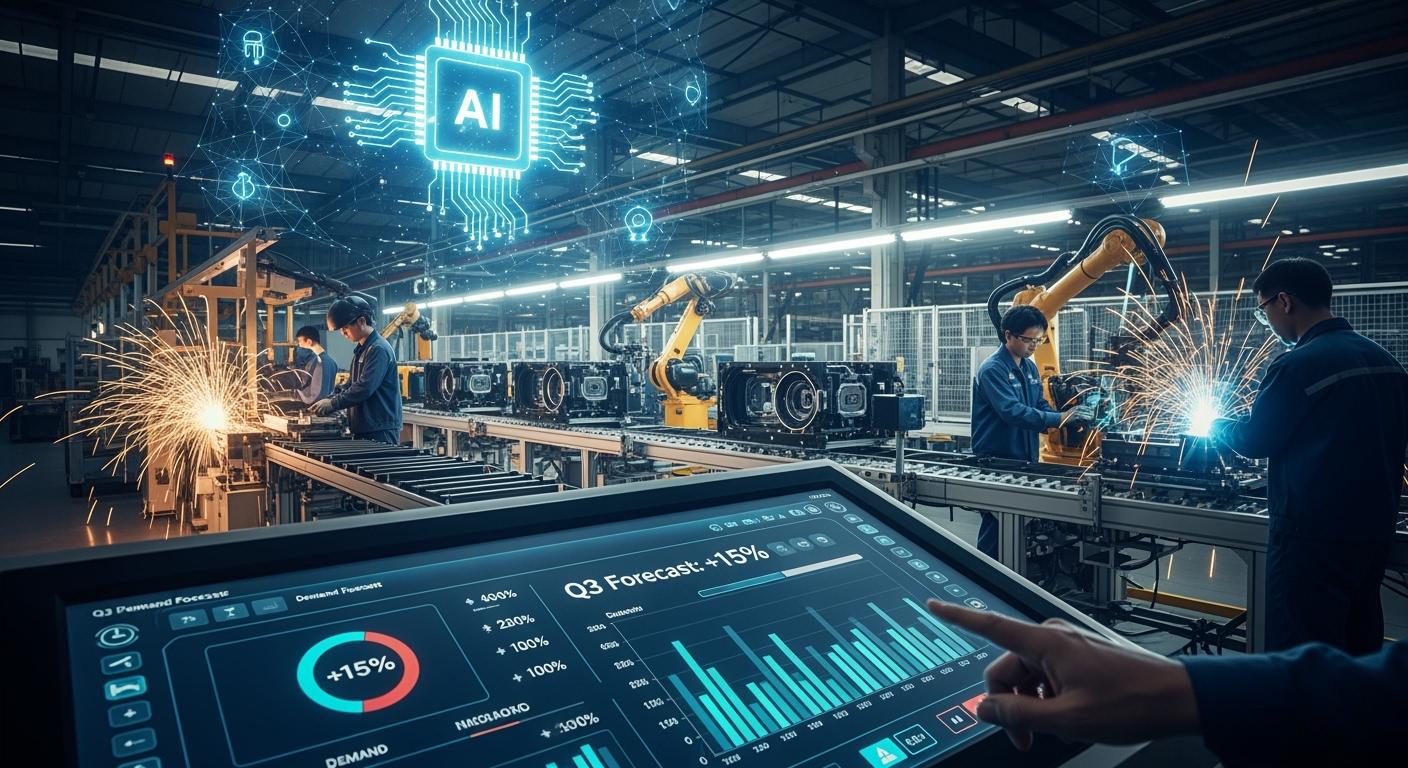
AI demand forecasting is changing how you manage manufacturing. Many companies see positive ROI in the first year and enjoy higher profit margins. AI quickly analyzes large datasets, so you gain more accurate predictions and faster responses to market changes. The table below shows how AI-powered systems deliver real results:
| Benefit | Impact |
|---|---|
| Improved Forecast Accuracy | AI finds complex patterns, helping you predict demand better. |
| Cost Savings | You save money by reducing overproduction and inventory costs. |
| Inventory Optimization | AI matches production to real demand, cutting waste and supporting sustainability. |
| Supply Chain Agility | Real-time insights let you adapt quickly to shifts and disruptions. |
AI Demand Forecasting in Manufacturing

What Is AI Demand Forecasting?
You use ai demand forecasting to predict what your customers will want and when. This process relies on machine learning algorithms that study large amounts of data. These systems look at past sales, market trends, and even outside factors like weather or social media. Unlike older methods, ai demand forecasting keeps learning and adjusting. This means your predictions get better over time.
When you use ai demand forecasting, you gain several advantages:
- You can spot changes in demand early, which helps you plan for raw materials.
- You work better with suppliers because you share forecasts and plan together.
- Your machines run more efficiently, and you reduce downtime.
- You match production to real market needs, so you waste less and save money.
- The system finds patterns in data that people might miss, which improves forecast accuracy.
Factories that use ai demand forecasting process huge streams of data. They customize their systems to fit their production needs. This helps you align your operations with what the market really wants.
AI vs. Traditional Demand Forecasting
You might wonder how ai-powered demand forecasting compares to older methods. The main differences stand out in how each approach handles data, adapts to change, and delivers results.
| Feature | AI-based Forecasting | Traditional Forecasting |
|---|---|---|
| Precision | High precision using advanced analytics | Lower precision, often reliant on historical averages |
| Data Integration | Integrates complex data from multiple sources | Limited to simpler datasets |
| Adaptability | Adapts to changing conditions and trends | Less adaptable to sudden market changes |
| Insight Generation | Identifies patterns and correlations missed by humans | Relies on basic statistical methods |
| Response to Volatility | Anticipates demand amid volatility | Struggles with unexpected disruptions |
You see a big difference in forecast accuracy. Traditional demand forecasting often has error rates between 25% and 40%. When you switch to ai demand forecasting, you can cut those errors down to 10% to 16%. Some manufacturers report forecast accuracies as high as 85% to 95%. This means you make better decisions, reduce waste, and keep your customers happy.
Key Benefits for Manufacturers

Higher Forecast Accuracy
You want to make sure your forecasts are as accurate as possible. AI demand forecasting gives you this power. With advanced algorithms and predictive analytics, you can analyze huge amounts of data from many sources. This includes sales history, market trends, and even real-time data like weather or social media. AI learns from every new piece of information, so your forecast accuracy keeps improving.
Many manufacturers have seen big improvements. For example, Kraft Heinz boosted its monthly forecast accuracy by 8% and improved weekly item-location forecasts by 10%. Church Brothers Farms increased short-term forecast accuracy by up to 40%. These gains led to smarter planning and less wasted inventory.
| Company | Improvement in Forecast Accuracy | Operational Efficiency Impact |
|---|---|---|
| Walmart | High precision in demand forecasts | Enhanced inventory management and supply chain operations |
| Zara | Optimized inventory levels | Reduced stockouts and improved supply chain efficiency |
| Danone Group | Improved forecasts | Better planning across departments and achieved target service levels |
| Kraft Heinz | 8% boost in monthly accuracy | 25% reduction in excess inventory and improved service levels |
| Church Brothers Farms | Up to 40% increase in short-term accuracy | Minimized excess stock and improved order fulfillment rates |
AI-powered forecasting helps you handle volatility and seasonality. When demand changes quickly, you can react fast. You do not have to guess or rely on outdated reports. Instead, you get accurate forecasts that help you make better decisions every day.
Inventory and Cost Optimization
You want to keep your inventory levels just right. Too much inventory means wasted money and space. Too little means you cannot meet customer demand. AI demand forecasting helps you find the perfect balance. By using real-time data and advanced analytics, you can match your stock to what customers actually want.
AI-powered data analytics allows businesses to improve forecast accuracy, which can lead to significant reductions in inventory waste and enhanced profitability. Research indicates that AI forecasting can reduce forecast errors by up to 50% compared to traditional methods.
Many organizations report 20-30% reductions in inventory carrying costs after using AI-powered forecasting. Fill rates improve by 5-10 percentage points, and you save money by holding less safety stock. You also reduce the risk of products becoming obsolete.
| Metric | Improvement Range |
|---|---|
| Reduction in forecast error (MAPE, WAPE) | 20–50% |
| Reduction in manual planning time | 30–60% |
| Fewer stockouts | 65% |
| Lower average inventory levels | 20–30% |
| Working capital savings | $500K+ within six months |
| ROI | 10× to 30× within a year |
When you use AI demand forecasting, you can run simulations for different demand and supply scenarios. This helps you reduce average inventory levels while still meeting your service goals. You lower your carrying costs and protect your revenue, even when the market changes quickly.
Supply Chain Agility
You need your supply chain to be flexible and fast. AI demand forecasting gives you real-time insights, so you can spot problems before they grow. You can predict disruptions, adjust your plans, and keep your operations running smoothly.
- A global fiberglass manufacturer improved forecast accuracy by 30% and reduced excess inventory by 25% within 90 days after using AI-driven forecasting.
- AI-powered monitoring lets you analyze real-time data, predict disruptions, and respond quickly. This leads to a 20% reduction in disruptions.
- High-performing supply chains that use AI see a 25% reduction in overstock and faster response times.
In New Zealand, agriculture companies use AI tools to analyze weather and soil data. This helps farmers forecast food production, manage supply, and reduce waste. Danone Group uses machine learning to predict demand for fresh products, making their supply chain more responsive.
You can see how AI demand forecasting helps you handle sudden changes, like spikes in demand or supply chain disruptions. You stay ahead of problems and keep your customers happy.
Customer Satisfaction
You want your customers to get what they need, when they need it. AI demand forecasting helps you deliver on this promise. With accurate forecasts, you keep products in stock and avoid delays. This reliability builds trust and keeps customers coming back.
- AI demand forecasting ensures the right products are available at the right time, fulfilling customer expectations effectively.
- This reliability fosters customer loyalty and encourages repeat business.
- Personalized marketing through AI tools allows for customized recommendations based on purchasing behavior, enhancing the overall customer experience.
AI-driven demand forecasting moves you from reacting to problems to planning ahead. You can optimize production, inventory, and resource allocation. This leads to lower costs and higher customer satisfaction.
Accurate forecasts mean you meet customer expectations. When products are available as needed, satisfaction and loyalty go up. This is especially important in fast-moving sectors like e-commerce and retail, where demand can change quickly. AI technologies in manufacturing ensure on-time product availability, which boosts satisfaction and can increase your sales.
Steps to Implement AI-Powered Demand Forecasting
Data Preparation
You start by gathering and cleaning your data. Collect historical sales, market trends, and external factors that affect demand. Bring together information from sales, marketing, operations, supply chain, and finance. Place this data in a staging area for review. Clean and organize it to remove errors and fill gaps. Use multiple forecasting methods to improve accuracy. Segment demand by product or region for more precise results. Add real-time data, such as weather or economic trends, to give your forecasts more context. Machine learning algorithms help you find patterns and predict inventory needs. Regular updates keep your forecasts relevant and agile. This step builds the foundation for ai demand forecasting and optimized inventory management.
Tool and Partner Selection
Choose ai-powered forecasting tools that fit your business needs. Look for solutions that offer advanced analytics, predictive models, and real-time insights. Make sure the tools can integrate with your current systems and support production planning. When you select a technology partner, check their expertise in predictive analytics and generative ai. The right partner will customize the system for your supply chain and help you scale as your business grows. Use the table below to guide your selection:
| Criteria | Description |
|---|---|
| Expertise in predictive analytics | Generates accurate demand forecasts |
| Generative AI capabilities | Supports advanced forecasting techniques |
| Customization | Aligns with your business needs |
| Integration | Works with your existing workflows |
| Production planning knowledge | Optimizes supply chain efficiency |
A reliable vendor will provide technical support and guide you through every stage of integration.
Change Management
You need a strong change management plan to make ai-driven demand forecasting work. Build cross-functional teams from IT, logistics, marketing, and operations. Set clear goals and communicate the benefits of ai to everyone involved. Train your team to use new tools and understand real-time data. Work closely with suppliers through collaborative forecasting. This helps you synchronize production and reduce lead times. Use just-in-time inventory management to lower costs and waste. These steps increase supply chain resilience and help you adapt to market changes. With the right approach, you turn actionable insights into better planning and higher forecast accuracy.
Overcoming Challenges in AI Demand Forecasting
Data Quality and Integration
You face several hurdles when you start using ai for demand forecasting. The most common challenge is making sure your data is accurate and complete. If you use poor quality data, your forecast will not be reliable. Inaccurate or missing historical sales data can cause ai models to make mistakes. Sometimes, you rely on external sources like social media or real-time data, but these can be inconsistent.
To improve your results, you should gather data from credible sources. Include historical sales, customer demographics, and real-time data from your supply chain. Clean and organize your data before you feed it into ai systems. Invest in data cleaning tools and make sure your data is well-integrated across all systems. This step helps you avoid ai hallucinations and keeps your forecast accurate.
Here is a table showing common pitfalls and how you can avoid them:
| Pitfall | Description | How to Avoid It |
|---|---|---|
| Poor Data Quality | Incomplete or biased data leads to bad forecasts | Use robust data governance and cleaning tools |
| Integration Issues | Legacy systems may not support ai | Build flexible architecture for smooth integration |
| Missing Real-Time Data | Gaps in real-time data cause errors | Ensure consistent data collection and monitoring |
You can use ai to process complex datasets faster than traditional methods. This gives you more accurate demand predictions and helps your supply chain stay agile.
Managing Change
You need to manage change carefully when you bring ai into your forecasting process. Employees may resist new systems if they do not understand the benefits. You can start with a small pilot project to show how ai improves forecast accuracy. This builds confidence and helps your team see the value.
Follow these steps to make the transition easier:
- Choose a reliable vendor who offers technical support.
- Audit your data sources and keep your historical data structured.
- Align your technical infrastructure with ai requirements.
- Launch a pilot project to test ai in a limited area.
- Build a cross-functional team from supply chain, operations, and IT.
- Train your team and encourage feedback.
- Involve analysts to monitor forecast accuracy.
- Run ai models alongside your current methods before full adoption.
You can avoid resistance by communicating clearly and involving your team in every step. When you use ai for real-time forecasting, you help your supply chain respond faster to market changes. This leads to better planning and higher customer satisfaction.
You can transform your manufacturing operations with ai demand forecasting. The table below highlights the main benefits:
| Benefit | Description |
|---|---|
| Inventory Management | Reduces costs and prevents stockouts by predicting demand accurately. |
| Production Efficiency | Helps you plan production with better precision. |
| Customer Satisfaction | Improves product availability and shortens lead times. |
| Supply Chain Optimization | Enables smarter material ordering and resource use. |
To get started:
- Review your current forecasting process.
- Check if your data supports ai adoption.
- Set clear goals for your ai journey.
Ai gives you real-time insights, higher accuracy, and a competitive edge. Now is the time to consider ai-powered solutions for your business.
FAQ
What data do you need for AI demand forecasting?
You need historical sales, inventory records, market trends, and external factors like weather or promotions. Clean and organized data helps AI models make better predictions.
How quickly can you see results from AI demand forecasting?
Many manufacturers notice improvements within a few months. You may see better forecast accuracy and lower inventory costs in the first year.
Can AI demand forecasting handle sudden market changes?
Yes! AI models adapt to new data fast. You can respond to demand spikes, supply chain disruptions, or seasonal shifts with more confidence.
Is AI demand forecasting expensive to implement?
You can start with cloud-based tools or pilot projects. Many solutions scale with your needs. The long-term savings from reduced waste and better planning often outweigh the initial investment.
See Also
Utilizing AI and Data for Demand Forecasting in 2025
Best Practices for Accurate Production Forecasting Using AI in 2024
Enhancing Your Shopping Experience with AI Demand Forecasting