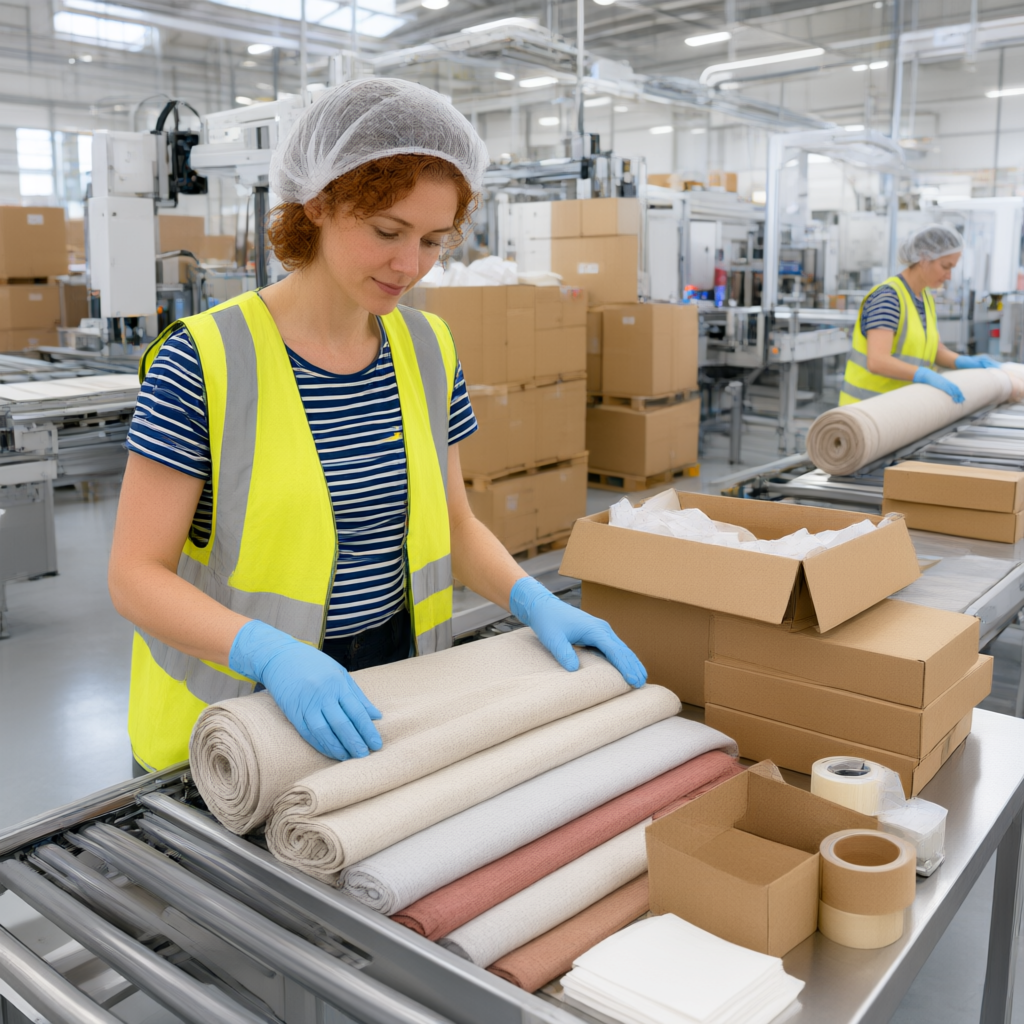
On demand clothing manufacturing means garments are produced in small batches, or even one at a time, after real demand appears instead of months ahead on a guess. Quick-response small orders are how a factory makes that possible: short runs, fast reorders and tight feedback between the store and the sewing line. This guide is from WarpDriven AI, which builds AI agents and factory software for apparel makers and sellers around a data-first approach we call Quant-Commerce. It explains how the model works in practice for US brands heading into 2026.
In short:
- You make less up front and more of what actually sells.
- Data from your store and the wider market tells you what to cut next.
- The factory relationship, meaning lead time, communication and quality checks, decides whether the model works.
- Some tools are mature today. Others are still being built.
Key Takeaways
- On-demand clothing production means a garment or a small batch is made after demand is shown, not months ahead on a forecast; quick response means the factory can turn a reorder around fast.
- Small runs cut the risk of dead stock and let a brand test one style, one colour or one fit before it commits real money.
- Demand signals such as sell-through, search interest, reviews, returns and trend moments decide what to cut next.
- Factory success depends on clear lead times, a written communication plan that covers language, time zones and tools, and quality checks at set points.
- AI demand prediction and visual inspection are in use today. Fully connected, self-adjusting factories are still being built out.
What do on-demand and quick-response actually mean?
These two phrases get mixed up a lot, so here they are in plain terms.
On-demand
On-demand production starts with a signal of demand. The signal might be a paid order, a pre-order, a waitlist or strong early sales data. Only then does fabric get cut. At the extreme, this is single-unit production, such as a printed T-shirt made after checkout. More often, for cut-and-sew apparel, it means a small batch made close to the moment of sale.
Quick-response
Quick response is about speed and repeat orders. A brand places a small first order and watches how it sells. If it moves, the brand reorders fast. The factory keeps patterns, approved samples and material sources ready, so the second run takes far less setup than the first.
How they differ from the traditional model
In the traditional model, a brand designs a season far ahead, places one large order to get a low unit price, then hopes the forecast was right. If it was wrong, the extra stock gets marked down, sold off or thrown away. On-demand and quick-response flip that order of events. You learn first, then you scale.
| Factor | Traditional bulk | Quick-response small orders | True on-demand |
|---|---|---|---|
| When production starts | Long before the selling season | Small test first, reorders follow sales | After an order or clear demand signal |
| Order size | Large | Small to medium, repeated | Single units or very small batches |
| Unit cost | Lowest | Moderate | Highest per piece |
| Inventory risk | High | Lower | Lowest |
| Best for | Proven basics with steady demand | Trend pieces, new styles, testing colours | Personalised, printed or made-to-order items |
| What it depends on | Accurate long-range forecasts | Fast factory turnaround and good data | Automated order flow and flexible production |
Most US brands do not pick just one column. They run steady sellers in bulk, test new ideas in small runs, and offer made-to-order where it fits.
Why do small runs matter so much?
Small runs matter because fashion demand is hard to predict. A colour can be everywhere in one month and gone the next. When you commit to a large order, you bet the whole margin on one guess. When you commit to a small run, you pay a little more per piece to buy information.
Less waste, less dead stock
Overproduction is one of the biggest hidden costs in apparel. Every unsold coat ties up cash, warehouse space and staff time. Small runs keep that exposure low. Better prediction plus smaller batches means fewer garments made for nobody.
Small factories can compete
Small runs also open the door to smaller factories. Large factories tend to favour big orders because setup costs are spread over more units. Smaller, flexible workshops can win on speed and willingness to run short. Cutting idle machine time matters directly for quick response, because idle time between short jobs is where small-run profit usually leaks away.
Testing before scaling
A small run works like a real-world survey. Picture a brand that wants to try a new outerwear shape. Instead of ordering every size in four colours, it makes one colour in a core size range, lists it, and watches. Customer questions, sizing feedback and sell-through all arrive within weeks. The next order is shaped by facts, not hope.
Cash flow that breathes
For a growing US label, cash is often the tightest limit. Small runs free cash that would otherwise sit in boxes. That money can go into marketing, a second test style, or a reorder of the winner.
Which data signals decide what to make next?
Quick response only works if you know what to respond to. That means watching a short list of signals and acting on them on a schedule.
Your own store signals
- Sell-through by style, colour and size. Which variants sell out first? Which sit still?
- Add-to-cart and wishlist activity. Interest that has not turned into sales yet can point to a price or stock issue.
- Returns and return reasons. A pattern of "runs small" is a grading problem to fix before the reorder, not after.
- Reviews and customer questions. Repeated questions about fabric weight or lining tell you what the product page or the product itself is missing.
Market and trend signals
Outside your store, trend moments can shift demand quickly. Celebrity street style is a classic trigger. For a quick-response brand, a moment like this is a prompt to ask useful questions. Do we already have a brown colourway in our coat pattern? Can our mill supply that wool shade in a small quantity? Can we style it with athleisure in our product photos? A brand with a ready pattern and a flexible factory can test a colour like that while the trend is still rising. A brand locked into a large seasonal order cannot.
Search and marketplace signals
Rising searches on marketplaces and search engines, plus what competitors are adding to their ranges, help confirm whether a trend is broad or just a single headline. Look for several signals that point the same way before you commit fabric.
Turning signals into decisions
The hard part is not collecting data. It is joining it up. Sales data lives in one system, factory capacity in another and trend notes in someone's inbox. This is where WarpDriven AI focuses. Its Six AI Agents work as one team on the same company knowledge and data, including Nexus for market intelligence, Genesis for creative and design, Beacon for marketing and content, and Compass for recommendations. For store owners, WarpDriven for Shopify & WooCommerce and WarpDriven for Amazon offer data-driven selection suggestions and AI-generated product pages. In practice, that is Quant-Commerce: the signal that a style is selling feeds into the decision to reorder it, and people make that decision.
How do you work with a factory on lead time, communication and quality checks?
This is where on demand clothing manufacturing succeeds or fails. A great data model is useless if the factory cannot deliver a clean, on-time small run.
Lead time: know every step
Lead time is not one number. Break it into parts and agree on each one:
- Sampling: making and approving the first sample, plus any fit revisions.
- Materials: whether fabric and trims are in stock or must be ordered. Stock fabric is the biggest speed advantage for quick response.
- Cutting and sewing: actual production time, which depends on the factory's current queue.
- Finishing and packing: pressing, labelling, folding and cartons.
- Shipping: transit to your US warehouse or fulfilment partner.
For reorders, ask the factory which steps can be skipped. Approved patterns, stored samples and reserved fabric can cut a reorder down to production and shipping only.
Communication: write the plan down
Small orders move fast, so a missed message costs more. Have a clear plan for how you will communicate with the factory, including language preferences, time zones and preferred communication tools. For a US brand working with an overseas factory, that might look like this:
- Agree on one working language and one shared document for specs.
- Set a daily overlap window that suits both time zones.
- Pick one main channel for decisions, so approvals do not get lost across email, chat and calls.
- Name one contact person on each side.
- Use photos and measured videos for anything about fit or colour, not just words.
Quality checks: build them into the run
With small batches, there is little room to fix problems after shipping. Check at three points:
- Before production: fabric, colour shade and trims against the approved sample.
- During production: early pieces off the line, measured against the size spec.
- Before shipping: a final check of finished, packed goods.
Factories are adding technology to this step. WarpDriven AI offers WarpDriven Factory AI, which combines AI visual inspection of garments and fabric, size measurement, equipment health monitoring, RFID warehousing and quality data in one hardware-and-software system that runs locally on the production line. For small runs, catching a defect on the line rather than in a customer's hands is often the difference between profit and loss.
Keep orders and production on one record
Quick response creates many small orders, and many small orders create paperwork. When customer orders, inventory, purchasing and work orders sit in separate spreadsheets, mistakes multiply. WarpDriven Forge is a custom sales ERP and production ERP for manufacturers and traders, built on Odoo 19 around how the business works. It covers customers, orders, inventory, purchasing, finance, scheduling and work orders on one dataset. On the selling side, the WarpDriven Distribution Management System joins the supply chain and sales channels such as a standalone store, Shopify, WooCommerce, Amazon, eBay and 1688 into one network.
What is live today and what is still in development?
There is a lot of hype around smart factories. Here is a grounded view of where things stand.
Live and practical today
- Small-batch and reorder production: flexible factories across the industry already run short orders and repeat them on demand. This describes the industry, not a WarpDriven AI service.
- Print-on-demand for simple items: printed tees, hoodies and accessories made after checkout are well established.
- AI-assisted demand planning: AI is already used to help predict demand and reduce waste.
- AI visual inspection: camera-based checks of fabric and garments run on production lines now.
- Connected sales channels: one inventory feeding several storefronts is a working reality.
Growing fast
Browzwear's write-up of the AI-Driven Digital Transformation Summit in Vietnam, published in April 2025, describes AI reshaping garment manufacturing, with factories in a major sourcing hub exploring how to apply it on the floor. Digital design, 3D sampling and AI-guided planning are spreading from early adopters to mainstream suppliers.
Still in development
- Fully automated sewing for complex garments: tailored coats, like double-breasted styles, still rely on skilled operators.
- End-to-end self-adjusting factories: systems where store data automatically reschedules the whole line, with no human sign-off, are still mostly pilots.
- Single-unit production for every category: one-off making works for prints and simple cuts, but it is not yet efficient for most structured outerwear.
- Small-batch minimum order quantities with WarpDriven AI's factory partners: this is being built (in development) and is not available today.
The practical takeaway: build your process on what is live now, and stay ready to adopt the next layer as it matures.
Where to start
If you run a factory with real production capacity and want to sell to US customers, the lowest-risk path is narrow and focused. WarpDriven AI's AI Business Partner service pairs AI agents with expert advisors to research the market first, then invest in brand, website, channels and orders, starting with one product. Once you sell, buyers need to find you. WarpDriven AI's SEO & GEO service provides managed content that helps customers find and remember your brand in search engines and in AI assistants' answers, with regular AI answer checks.
FAQ
What is the difference between on-demand and quick-response manufacturing?
On-demand means you make the product after a customer or a clear demand signal appears, sometimes one piece at a time. Quick response means a factory can produce and reorder small batches fast. Many brands use both: they test small, then reorder quickly what sells.
Is on-demand clothing production more expensive per piece?
Usually the unit cost is higher than in a large bulk run, because setup work is spread over fewer pieces. Many brands accept this because they avoid markdowns and unsold stock. Compare total cost, including leftover inventory, not just the unit price.
How do I find a factory that accepts small orders?
Look for factories that clearly state they take small or test runs, and ask how they handle reorders, sampling and quality checks. Agree early on a communication plan that covers language, time zones and tools. Start with one product before you widen the range.
Can AI really help small garment factories?
Yes, in specific ways. Industry sources describe AI helping factories predict demand, reduce waste, cut idle time and catch quality problems sooner. It works best on clear tasks like inspection and planning, with people still making final decisions.
What should I check before approving a small production run?
Confirm the approved sample, the fabric and trims, the size measurements, the packing method and the ship date in writing. Ask for checks during production and before shipping, not only at the end. Keep a record of any defects so the next run improves.
Next step
Want to see how AI Business Partner would work for you? Choose a way forward below.