

You want to make smart decisions when selecting an AI platform for your enterprise. This choice shapes how you scale automation, secure data, and manage governance. With the right AI, your organization builds a foundation for growth. Consider these points:
- A strong AI platform lets your enterprise scale and integrate automation.
- Context-aware AI boosts employee productivity and long-term value.
- Robust infrastructure helps your enterprise stay agile and competitive.
Use this guide as a practical checklist and maximize your AI investment.
Assessing Enterprise Readiness
Define Business Goals
You set the foundation for successful enterprise ai adoption when you define clear business goals. Start by identifying the main challenges your enterprise faces. Many organizations use ai to improve customer satisfaction, reduce process inefficiencies, or boost productivity. Focus on the problems that ai can solve better than your current methods. This approach ensures that your ai platform delivers measurable value.
- Improve customer satisfaction through faster response times.
- Reduce manual errors with automation.
- Boost productivity by freeing employees from repetitive tasks.
Tip: Clear objectives help you avoid investing in technology that does not address your enterprise’s real needs.
Evaluate Data & Talent
You need to assess your data quality and the skills of your team before you select an ai platform. Many enterprises struggle with data silos or inconsistent data formats. Poor data quality can limit the impact of ai and automation. You also need skilled professionals who understand both ai and your business processes. In fact, 46% of enterprises report a shortage of ai-skilled talent as a barrier to adoption.
- Review your data sources for accuracy and completeness.
- Identify gaps in your team’s ai and automation skills.
- Plan for training or hiring to fill those gaps.
A strong foundation in data and talent supports enterprise ai readiness and long-term success.
Align Stakeholders
Collaboration drives enterprise ai projects forward. You must bring together IT, business leaders, and compliance teams to ensure alignment. Establish a data privacy policy to clarify how your enterprise handles and accesses data. Implement role-based access controls for ai tools and outputs. Regular audits of ai outputs help you maintain accuracy and reduce bias.
- Develop a process for identifying and correcting errors in ai outputs.
- Create an incident response plan for harmful or incorrect results.
- Perform an honest readiness assessment before selecting an ai platform.
- Use evidence-based criteria for vendor evaluation.
- Plan for total costs and disciplined scaling from pilot to production.
Collaboration at every stage ensures your enterprise ai platform supports both innovation and governance.
Build vs. Buy: AI Platform Choices

In-House Development Pros & Cons
You may consider building your own ai platform to gain more control over your enterprise automation journey. This approach lets you tailor solutions to fit your legacy systems and unique business needs. However, it also brings challenges. Review the table below to weigh the main advantages and disadvantages:
| Advantages | Disadvantages |
|---|---|
| Integrates with legacy systems, allowing for a cohesive AI strategy. | Security and compliance issues arise if sensitive data is mishandled. |
| Centralizes data and best practices, providing a foundation for operations. | Unexpected costs can accumulate without proper planning. |
| Reduces dependence on external AI providers, maintaining control over tools. | Lack of organized data can hinder effective AI implementation. |
| Enables automation of machine learning processes without deep expertise. | Trust issues may arise if AI solutions are perceived as unexplainable. |
| Supports continuous AI-driven operations rather than one-off solutions. | Legacy systems may limit the effectiveness of new AI initiatives. |
Note: Building in-house gives you flexibility, but you must plan for hidden costs and ensure your data is ready for ai and automation.
Off-the-Shelf AI Platform Benefits
Many enterprises choose off-the-shelf ai platforms to speed up deployment and reduce upfront costs. These solutions often come with built-in automation features, security controls, and support. Compare the time and cost profiles below:
| Criteria | Build | Buy |
|---|---|---|
| Time to value | 12-24 months | 3-6 months |
| Cost profile | High upfront, lower ongoing | Lower upfront, recurring fees |
You can launch automation projects faster and scale ai across your enterprise with less risk. Off-the-shelf platforms also help you stay current with industry standards and compliance.
Hybrid Approaches
Hybrid strategies combine the strengths of both custom and off-the-shelf solutions. You might train large ai models in the cloud, then deploy them on-premises for real-time automation and privacy. This approach supports fast analytics, personalized decision support, and enhanced trust in ai outputs. Many enterprises use hybrid models to accelerate automation cycles and reduce manual effort.
Tip: Start by assessing your data readiness and identifying use cases that benefit from both forecasting and creative ai. Hybrid approaches help your enterprise adapt as technology and business needs evolve.
AI Platform Evaluation Criteria
Selecting the right ai platform for your enterprise requires a structured evaluation framework. You need to focus on technical and business requirements that drive value, security, and innovation. Industry guides recommend using a checklist approach to compare enterprise ai solutions. The table below summarizes leading frameworks you can use:
| Framework/Criteria | Description |
|---|---|
| Core Principles of AI | Major technical requirements for an Enterprise AI platform critical to success. |
| Enterprise AI Requirements Checklist | A list of 98 specific criteria that a complete Enterprise AI platform must deliver. |
| Vendor Business Evaluation Criteria | 5 key non-technical criteria that buyers need to evaluate when selecting an AI platform. |
You should use these frameworks to ensure your enterprise ai solutions meet your business goals and compliance needs.
Security & Compliance
Security forms the backbone of any enterprise ai deployment. You must demand enterprise-grade security from your ai platform. Look for platforms that hold certifications such as SOC 2, ISO 27001, HIPAA, and GDPR. These certifications show that the platform protects sensitive data and meets global standards.
Key features for enterprise ai solutions include:
- Data control options, such as VPC deployment, to keep your information safe.
- Monitoring and auditing tools for governance and accountability.
- Built-in data governance and transparency controls.
In regulated industries, you need ai solutions that document model purpose, training data, and behavior. The platform should provide traceability and auditability for every ai decision. You must align controls with regional and industry regulations, such as the EU AI Act, GDPR, and CCPA. Ongoing monitoring and risk assessments help you maintain compliance and trust.
Scalability & Performance
Your enterprise must ensure that ai solutions can scale with business growth. The architecture should handle large data volumes and complex automated workflows. You need platforms that adapt to changing workloads and support secure agent orchestration.
The table below highlights important aspects of scalable enterprise ai solutions:
| Aspect | Description |
|---|---|
| Architectural Integrity | Handles large data volumes within complex enterprise structures. |
| Security | Maintains strict controls to protect sensitive enterprise data. |
| Compliance | Meets regulatory requirements for enterprise ai solutions. |
| Adaptability | Evolves with your organization’s needs and supports new ai-powered workflows. |
You should also compare performance using industry benchmarks. MLPerf evaluates ai models for training and inference speed. LLM Benchmark tests large ai agents on real-world business tasks. These benchmarks help you select ai platforms that deliver reliable analytics and automation at scale.
| Benchmark Name | Description |
|---|---|
| MLPerf | Evaluates AI models based on their performance in training and inference tasks. |
| LLM Benchmark | Validates large AI models against real-world business tasks, providing a scientific approach to performance evaluation. |
Integration Capabilities
Integration is essential for enterprise ai solutions. You want an ai platform that connects easily to your existing applications, databases, and unstructured data sources. This reduces the need for custom development and speeds up automation projects.
| Key Consideration | Description |
|---|---|
| Seamless Connection | Connects to enterprise applications, databases, and unstructured data sources with minimal effort. |
| Security and Compliance | Includes compliance certifications and data control options for governance and accountability. |
| Handling Workflows | Manages high-volume, complex ai-powered workflows with strong uptime and performance guarantees. |
You should prioritize platforms that support reliable analytics and automated workflows. These features help you unlock value from your data and scale ai agents across your enterprise.
Governance & Transparency
Governance and transparency are critical for responsible enterprise ai adoption. You need features that provide visibility into model training, validation, deployment, and monitoring. Trusted ai platforms offer tools for ethics, compliance, risk management, and trust building.
| Feature | Description |
|---|---|
| Ethics | Detects and reduces ai bias, promoting fairness and accountability. |
| Compliance | Ensures ai use follows laws and ai-specific regulations. |
| Risk Management | Assesses and manages model risk to lower legal and financial exposure. |
| Trust Building | Supports responsible ai use, increasing trust in enterprise ai solutions. |
You should evaluate governance, transparency, and security controls throughout the ai lifecycle. Enterprise ai governance creates policies and accountability for ethical ai use. This approach builds trust and helps you scale ai agents with confidence.
Cost & Pricing Models
Cost plays a major role in your ai platform decision. You need to understand both upfront and ongoing expenses. Enterprise ai solutions offer several pricing models:
- Session-based pricing
- Usage-based pricing
- Per-seat-based pricing
- Tiered volume pricing for large deployments
- Pay-as-you-go plans for smaller teams
You should compare these models to your expected analytics and automation needs. Look for features that maximize ROI and minimize hidden costs. The right pricing model supports sustainable growth for your enterprise ai solutions.
Comparing Enterprise AI Automation Platforms
Vendor Shortlisting
You need a structured approach when you compare enterprise ai automation platforms. Start by creating a shortlist of vendors that match your enterprise needs. Use clear criteria to guide your selection process. The table below shows important factors you should consider:
| Criteria | Description |
|---|---|
| Security Posture | Review the vendor’s security measures and compliance standards. |
| Integration Capability | Check how well the platform connects with your current systems. |
| Total Cost Transparency | Understand all costs, not just the initial price. |
| Data Governance | Ensure strong data management and privacy practices. |
| Scalability Evidence | Look for proof the platform grows with your enterprise. |
| Practical Testing | Test the platform with your business requirements. |
| Vendor Stability | Consider the vendor’s reputation and long-term presence. |
A careful review helps you avoid surprises and ensures the ai automation platform fits your enterprise.
Demos & Proof of Concept
You should always request demos and proof of concept from enterprise ai automation platforms. Use the same inputs and demo scope for each vendor. This makes your comparison fair and accurate. The table below lists what to focus on during demos:
| Criteria | Description |
|---|---|
| Consistent Inputs | Use identical data and tasks for each platform. |
| Consistent Demo Scope | Keep the demo tasks and outputs the same. |
| Evaluation Checklist | Score setup time, workflow speed, and reporting clarity. |
| Workflow and Repeatability | Ask about importing, exporting, and human review support. |
| Validation of LLM-based Scoring | Check how the platform validates AI scoring against real results. |
A structured demo process helps you see which ai automation platform delivers the best value for your enterprise.
References & Case Studies
You should ask each vendor for references and case studies. These show how enterprise ai automation platforms perform in real-world situations. Look for examples from enterprises like yours. Ask about results, challenges, and support. This step gives you confidence in your ai automation platform choice.
Tip: Speak directly with other enterprise users to learn about their automation journey and outcomes.
Avoiding Common Pitfalls
Many enterprises face challenges when comparing ai automation platforms. Poor data quality can lead to outdated or wrong information. Up to 80% of enterprise data is unstructured, which makes ai access difficult. Integrating ai into legacy systems often brings complexity. Most enterprises will face ai skills shortages in the next few years. Unrealistic expectations about ai capabilities can cause disappointment. Projects often fail without a strong data foundation.
- Review your data quality before you start.
- Plan for integration with legacy systems.
- Set realistic goals for your ai automation platform.
- Invest in training to build enterprise ai skills.
A careful approach helps your enterprise avoid common mistakes and succeed with ai automation.
AI Automation Platform Cost Analysis
Upfront vs. Ongoing Costs
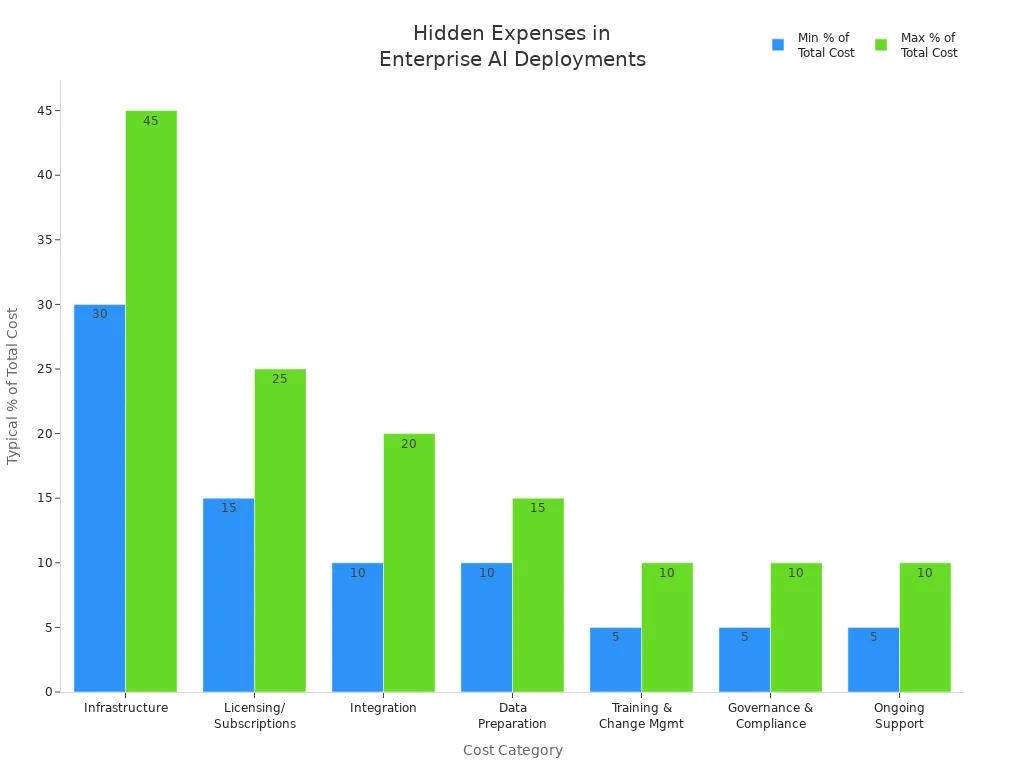
You must understand the difference between upfront and ongoing costs when planning your enterprise ai deployment. Upfront costs often exceed initial vendor quotes by 200-400%. Infrastructure alone can account for 30-45% of your total spend. Many enterprises underestimate these expenses during the early stages of automation. Ongoing costs continue after the initial deployment. You need to budget for infrastructure, licensing, integration, data preparation, training, governance, and support.
- Infrastructure: 30-45% of total spend, including cloud deployment, storage, and networking.
- Licensing/Subscriptions: 15-25% for platform fees and API access.
- Integration: 10-20% for connecting ai to your existing systems.
- Data Preparation: 10-15% for cleaning and structuring data.
- Training & Change Management: 5-10% for upskilling your team.
- Governance & Compliance: 5-10% for audits and policies.
- Ongoing Support: 5-10% for maintenance and updates.
Average monthly ai budgets are projected to reach $85,521 by 2025. The number of organizations investing over $100,000 monthly will rise from 20% to 45%.
Hidden Expenses
You may encounter hidden expenses during your enterprise ai deployment. These costs often appear after you launch automation projects. The table below outlines typical hidden expenses and what you should budget for:
| Cost Category | Typical % of Total | What to Budget |
|---|---|---|
| Infrastructure | 30-45% | Cloud compute, storage, networking |
| Licensing/Subscriptions | 15-25% | Platform fees, API costs, seat licenses |
| Integration | 10-20% | Connecting ai to existing systems |
| Data Preparation | 10-15% | Cleaning, structuring, migrating data |
| Training & Change Management | 5-10% | Team upskilling, workflow redesign |
| Governance & Compliance | 5-10% | Policies, audits, monitoring |
| Ongoing Support | 5-10% | Maintenance, updates, vendor management |
ROI Assessment
You should calculate ROI for your ai platform by measuring both tangible savings and intangible value. Tangible savings include reduced labor costs and faster processing times. Intangible value covers improved customer satisfaction and greater agility. These benefits drive long-term growth for your enterprise. Use a structured approach to track cost reductions and business improvements after each automation deployment. This helps you maximize the value of your enterprise ai investment.
Tip: Review ROI regularly to ensure your ai platform continues to deliver measurable results as your enterprise scales automation.
Implementation & Scaling

Deployment Planning
You need a clear plan to deploy an enterprise ai platform and scale automation. Start with these steps to guide your rollout:
- Define clear objectives for your enterprise. Set business goals and decide how ai will help you reach them.
- Assess your data and infrastructure. Check if your current systems support ai and automation.
- Identify high-impact use cases. Focus on automation projects that bring the most value to your enterprise.
- Establish governance and risk controls. Set rules for ai use and manage risks.
- Run pilot projects. Test your ideas with small automation pilots before scaling.
- Scale across the organization. Expand successful ai solutions to more teams and processes.
- Monitor, measure, and improve. Track results and refine your automation strategy.
Tip: A step-by-step deployment plan helps your enterprise avoid costly mistakes and ensures ai delivers real business value.
Training & Support
You must invest in training and support to drive successful enterprise ai adoption. Employees need to understand both the power and limits of ai and automation. Start with baseline training on ai capabilities. Teach your team how to think critically about ai outputs. Reinforce privacy and compliance practices to protect your enterprise.
| Training Service | Description |
|---|---|
| Platform AI Adoption Programs | In-depth training and consulting tailored to unique ai functions in large enterprise systems. |
You should use a structured, persona-based approach. Train the general workforce on ai literacy and how to spot tasks for automation. Give power users advanced training on agent design and business process mapping. This approach builds confidence and helps your enterprise scale automation faster.
Monitoring & Improvement
You must monitor your ai platform to keep automation reliable and effective. Use specialized tools to track model performance, manage risks, and ensure compliance. Tools like Weights & Biases help you manage machine learning experiments and model lifecycles. Fiddler AI and Harmonic Security give you visibility and control over ai usage. Holistic AI and IBM watsonx.governance support auditing and policy management for enterprise ai. ModelOp Center and Monitaur offer real-time monitoring and governance frameworks.
- Track ai model performance and outcomes.
- Audit automation workflows for accuracy and fairness.
- Update models and processes as your enterprise grows.
Note: Continuous monitoring and improvement keep your enterprise ai platform aligned with business goals and regulatory standards.
Future Trends in Enterprise AI Platforms
AI Agent Platforms
You will see ai agent platforms become central to enterprise automation. These platforms now handle complex tasks across many applications. They help you automate workflows, support employees, and improve customer service. You can choose from different types of ai agent platforms, such as ecosystem-centric, purpose-built, developer-focused, and horizontal platforms. Each type fits different enterprise needs.
- Ai agent platforms boost productivity by helping employees and customers in real time.
- They let you experiment safely and make changes quickly.
- You can automate repetitive tasks and use ai-driven advice to save money.
- Executives gain better visibility into ai projects and can standardize automation across teams.
- Trustworthiness and security remain top priorities for future enterprise ai solutions.
| Benefit | How AI Agent Platforms Help Enterprises |
|---|---|
| Enhance Productivity | Support employees and customers without adding more staff. |
| Facilitate Safe Experimentation | Allow you to test and improve automation while keeping control. |
| Optimize Resources | Automate routine work and use ai to find cost savings. |
| Gain Enterprise-wide Visibility | Give leaders insights and help manage ai across the organization. |
Flexibility for Growth
You need platforms that grow with your enterprise. Ai agent platforms now offer more flexibility, letting you scale automation as your business changes. You can add new features, connect to more data sources, and support new use cases. This flexibility helps you stay ahead in a fast-changing market. You can start small and expand your enterprise ai projects as you see results.
Tip: Choose ai agent platforms that support both current and future automation needs. This approach keeps your enterprise ready for new challenges.
Regulatory Changes
You must prepare for new rules that affect enterprise ai. Governments around the world now create laws to manage ai and automation. These regulations focus on safety, fairness, and privacy. The European Union’s AI Act sets strict rules for high-risk applications and can lead to large fines. In the United States, you face a mix of federal and state laws. Other countries, like Canada, China, and Singapore, also introduce their own ai regulations. This creates a complex environment for enterprise ai compliance.
| Regulatory Change | Description |
|---|---|
| European Union's AI Act | Sets the first full ai regulation, with fines up to €35 million for high-risk use. |
| U.S. AI Regulations | Features many new federal and state laws, making compliance more challenging. |
| Other International Regulations | Includes new rules from Canada, China, and Singapore, adding to the complexity for global enterprises. |
You should work with legal and compliance teams to keep your enterprise ai and automation projects safe and legal.
You can select the right ai platform for your enterprise by following a structured process. Review your goals, data, and team readiness. Use a checklist to compare ai solutions and avoid costly mistakes. A criteria-driven approach helps you maximize ROI and reduce risk. Next, form a cross-functional team and schedule demos with top ai vendors.
Tip: Careful planning ensures your enterprise gets long-term value from ai investments.
FAQ
What is the most important factor when choosing an enterprise AI platform?
You should focus on alignment with your business goals. The right platform must support your key objectives, integrate with your systems, and scale as your needs grow.
How can you estimate the total cost of an AI platform?
You need to consider both upfront and ongoing costs. Review this table for a quick overview:
| Cost Type | Example Expenses |
|---|---|
| Upfront | Licensing, setup, training |
| Ongoing | Support, updates, scaling |
Can you integrate an AI platform with legacy systems?
Yes, most enterprise AI platforms offer integration tools and APIs. You should check compatibility with your current systems before making a decision.
How do you ensure compliance with AI regulations?
You must select platforms with strong governance features. Look for certifications like SOC 2 or GDPR. Regular audits and clear documentation help you stay compliant.
Tip: Work with your legal team to review all regulatory requirements before deployment.
See Also
Utilizing AI to Improve Production Forecasting in 2024
AI-Driven Safety Stock Solutions for Fashion Retail in 2025
Key Features of WarpDriven ERP for Smart Supply Chain Management
Top 10 E-commerce Platforms Supporting Seamless Accounting Integration