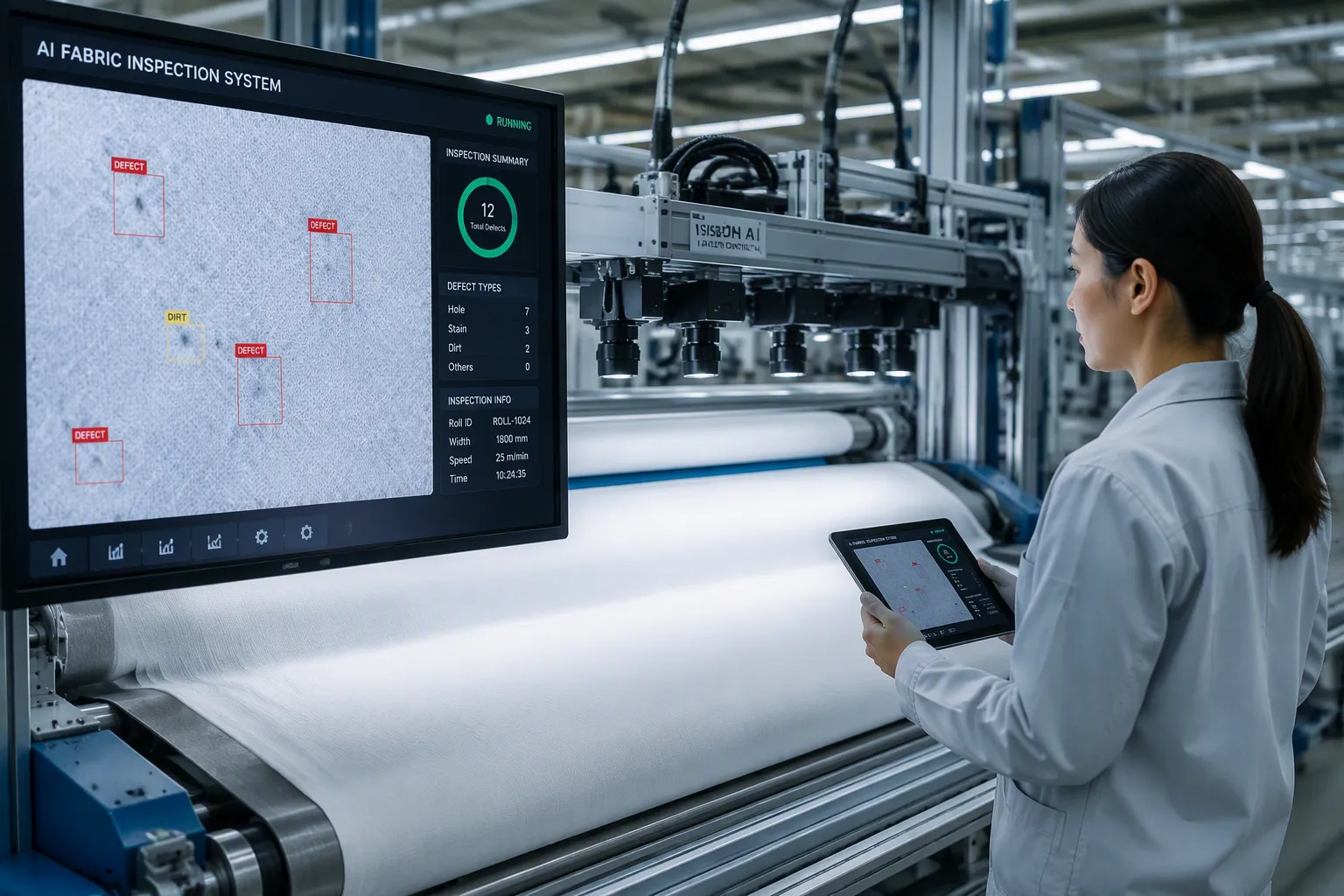
Manual fabric inspection fails you. It is slow, inconsistent, and costly. Your inspectors miss defects. A single defect can ruin a batch. Fatigue causes them to miss about 15% of fabric problems. These defects cost you money. Their accuracy drops from 80–90% at shift start to 50–70% after just 20–30 minutes.
Artificial intelligence changes everything. AI fabric defect detection uses computer vision and machine learning. Cameras capture images of your fabric. AI models spot imperfections in real time. This textile defect detection achieves over 99.99% accuracy. That beats human inspection by a wide margin.
This technology works now. You can deploy it in your textile industry today. This post explains how defect detection works and why AI transforms your production. You will discover the secret to perfect textiles.
What Is AI Fabric Defect Detection?
AI fabric defect detection uses artificial intelligence to spot imperfections in textiles. You combine computer vision technology with machine learning models. Cameras, sensors, and lighting capture fabric details. You train the system on a dataset of good and defective fabric images. Labeling processes teach the machine learning models to recognize flaws. This ai-powered fabric inspection system integrates with your manufacturing tools for real-time quality control.
The essential components of this system include:
- Imaging hardware with cameras and proper lighting
- A dataset containing both good and defective product images
- Annotation and labeling processes to train the models
- Deep learning models for classification and detection tasks
- Integration with factory tools for real-time alerts
The detection process follows five clear steps. First, AI-enabled cameras capture fabric textures and patterns. Second, deep learning models extract features like weave density and color tone. Third, the system compares these features against verified samples. Fourth, anomaly detection flags inconsistencies. Fifth, the system produces a trust score confirming fabric quality. These ai-based techniques eliminate subjective human judgment. Shallow neural network layers capture edges and yarn directions. Deeper layers encode semantic defect patterns. This ai fabric defect detection system catches even tiny defects. The hierarchical learning enables detection of subtle texture disturbances.
AI and Computer Vision for Defect Detection
Why Textile Defect Detection Matters
Manual inspection has significant limitations. You can see the difference in this comparison:
| Feature | Manual Inspection | AI-Integrated System |
|---|---|---|
| Accuracy Rate | ~85% | >95% |
| Inspection Speed | 10–15 m/min | 20–40+ m/min |
| Consistency Over Time | Decreases | Highly consistent |
| Real-Time Feedback | No | Yes |
| Labor Dependency | High | Low |
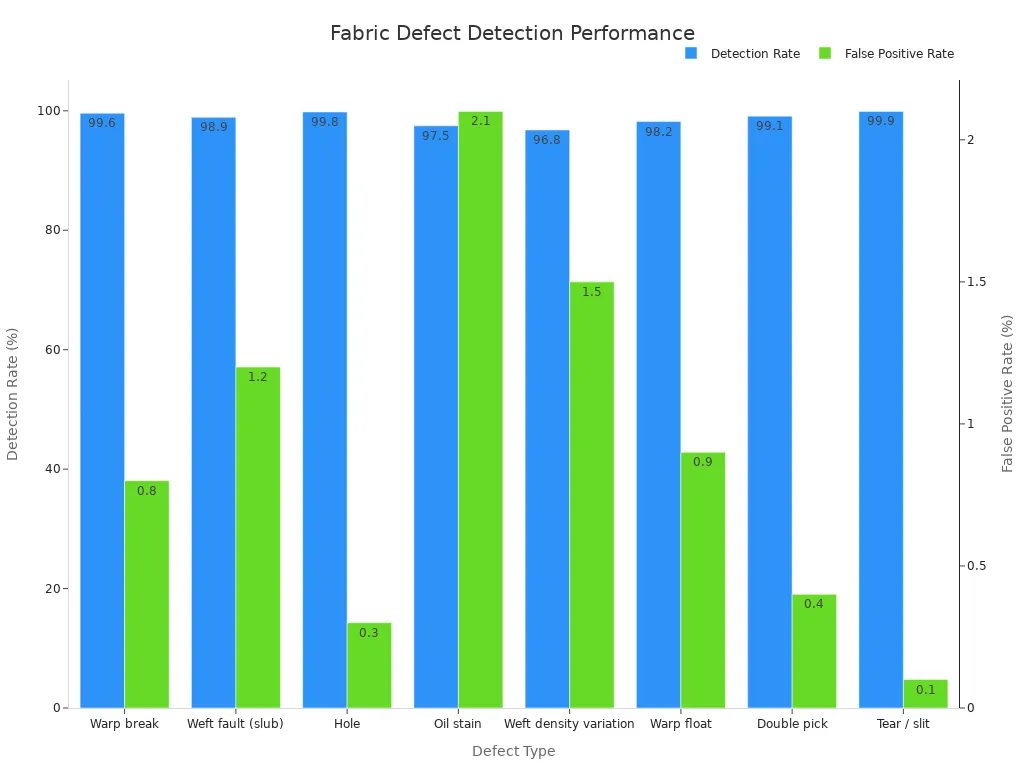
AI fabric inspection systems detect surface defects that human inspectors miss. These systems find structural defects like holes and tears. They also spot contamination defects such as oil stains. The textile industry deals with many defect types. Common defects include:
| Defect Type | Category | Min. Detectable Size | Detection Rate |
|---|---|---|---|
| Warp break | Warp | 0.3 mm × 1.0 mm | 99.6% |
| Hole | Structural | 0.3 mm diameter | 99.8% |
| Oil stain | Contamination | 1.0 mm × 1.0 mm | 97.5% |
| Tear / slit | Structural | 2.0 mm length | 99.9% |
The chart below shows detection rates for these defect types.
A real-time industrial study in Ethiopian textile factories showed that inspection accuracy depends on operator mental condition and lighting. An ai virtual inspection system eliminates these variables. You get reliable textile defect detection regardless of time or fatigue. The textile industry benefits from this ai fabric inspection system. Artificial intelligence transforms how you manage quality. You achieve perfect textiles with every batch.
How Textile Defect Detection Works
The fabric inspection process follows a clear pipeline. You need to understand each stage to appreciate how this technology delivers perfect results. The system combines hardware, software, and artificial intelligence in a seamless workflow.
Image Capture for Defect Mapping
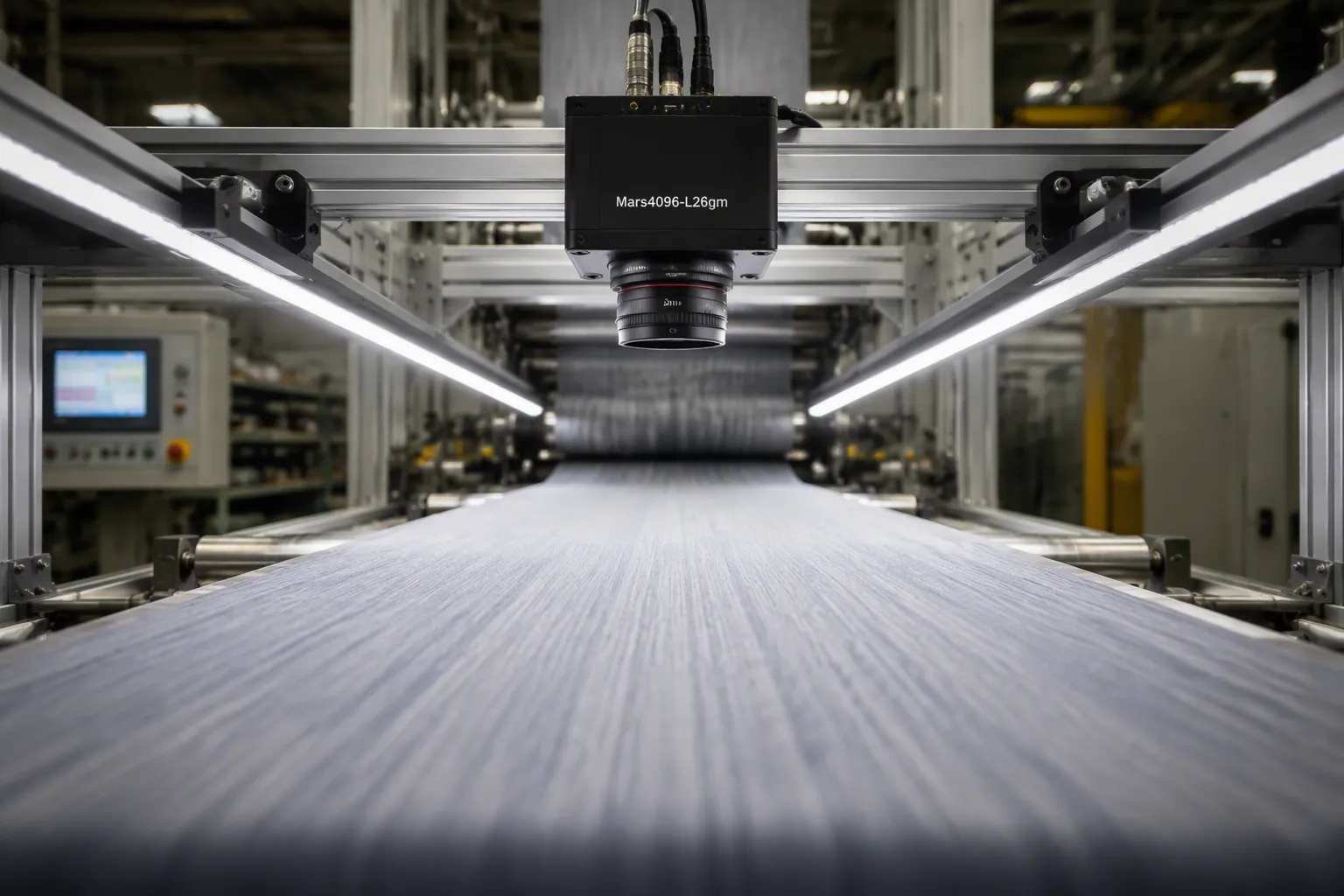
Your journey begins with image capture. High-speed cameras continuously photograph the moving fabric as it rolls through production. You need the right equipment for this task. A 4K line scan camera, such as the Mars4096-L26gm model, captures images line by line. This approach provides exceptional precision for continuous materials. A 28mm line scan lens pairs with the camera to focus on fabric details. Custom 2-meter linear light sources illuminate the surface evenly. You position the camera at specific working distances: 1.5 meters for color fabric and 1 meter for monochrome material.
Line scan cameras excel at inspecting fast-moving production lines. They capture each line of the fabric sequentially, building a complete image as the material passes. This method ensures you miss nothing. Industrial lighting plays a critical role here. Consistent illumination highlights defects that might otherwise blend into the background. Without proper lighting, even the best camera produces unreliable images.
The system captures images at remarkable speeds. Common ai fabric inspection machines operate at 40–50 m/min for basic inspection tasks. Most industrial production scenarios require 60–70 m/min. High-efficiency continuous production factories push beyond 80 m/min. SUNTECH's Automatic Camera Inspection Machine achieves a stable detection speed of 80 m/min in real industrial applications. This speed balances accuracy with efficiency. For most high-efficiency environments, a stable operating speed of 60–80 m/min proves sufficient.
AI Classification and Localization
Once the cameras capture images, the real intelligence begins. The system sends each image to ai algorithms for analysis. Machine learning models compare fabric patterns against expected quality standards. This comparison happens in real time, enabling instant quality control.
The classification stage categorizes each defect. Object detection models like YOLOv8 or YOLOv9 serve as the current default for production systems. These models process frames in a single pass, minimizing latency for moving fabric. They output a bounding box plus a class label for each defect. You get precise information about what the defect is and where it sits on the fabric.
Advanced loss functions improve bounding-box precision. CIoU and DFL functions penalize distance, aspect ratio, and shape mismatch. This ensures accurate defect boundaries even when fabric moves or shows subtle inconsistencies. Adaptive anchor box strategies adjust dimensions dynamically to match varying defect scales. Attention mechanisms emphasize critical image regions, helping the system differentiate between defects and background textures.
The localization stage maps each defect to exact coordinates. The system records the fabric position in meters along the roll's length. It also tracks the cross-direction position across the fabric width. You receive the defect area in square centimeters for severity assessment. The system generates a roll map that combines length and width data. This spatial mapping enables downstream cut optimization.
The 4-Point System coordinates defect mapping with fabric dimensions. The formula works as follows: Points per 100 square yards equals Total Defect Points times 3600, divided by Fabric width in inches times Length inspected in yards. This calculation links defect severity directly to both width and length of the fabric roll. You get defect density normalized per unit area.
Hardware acceleration through GPUs or edge AI enables high-speed inference directly on production lines. This real-time defect detection capability means you identify problems the moment they occur. You can stop production immediately, fix the issue, and prevent defective fabric from reaching your customers. The entire textile defect detection process operates without human intervention, eliminating fatigue and inconsistency from your quality control.
This smart defect detection system transforms your inspection workflow. You move from reactive quality checks to proactive defect prevention. The ai-based techniques deliver consistent results every time, regardless of shift timing or operator condition. Computer vision technology combined with machine learning gives you complete visibility into your fabric quality.
Benefits of AI Fabric Inspection
The advantages of AI fabric inspection reach far beyond catching flaws. You gain measurable improvements in quality, waste reduction, cost control, and production speed. These benefits transform your entire manufacturing operation.
AI-Driven Quality and Waste Reduction
You achieve consistent quality with artificial intelligence at the core of your inspection process. Manual inspectors lose focus after 20–30 minutes. Their accuracy drops from 80–90% to 50–70%. AI never tires. It applies the same mathematical standards to every meter of fabric, every shift, every day. This consistency eliminates the subjective judgment that causes quality variations between inspectors and shifts.
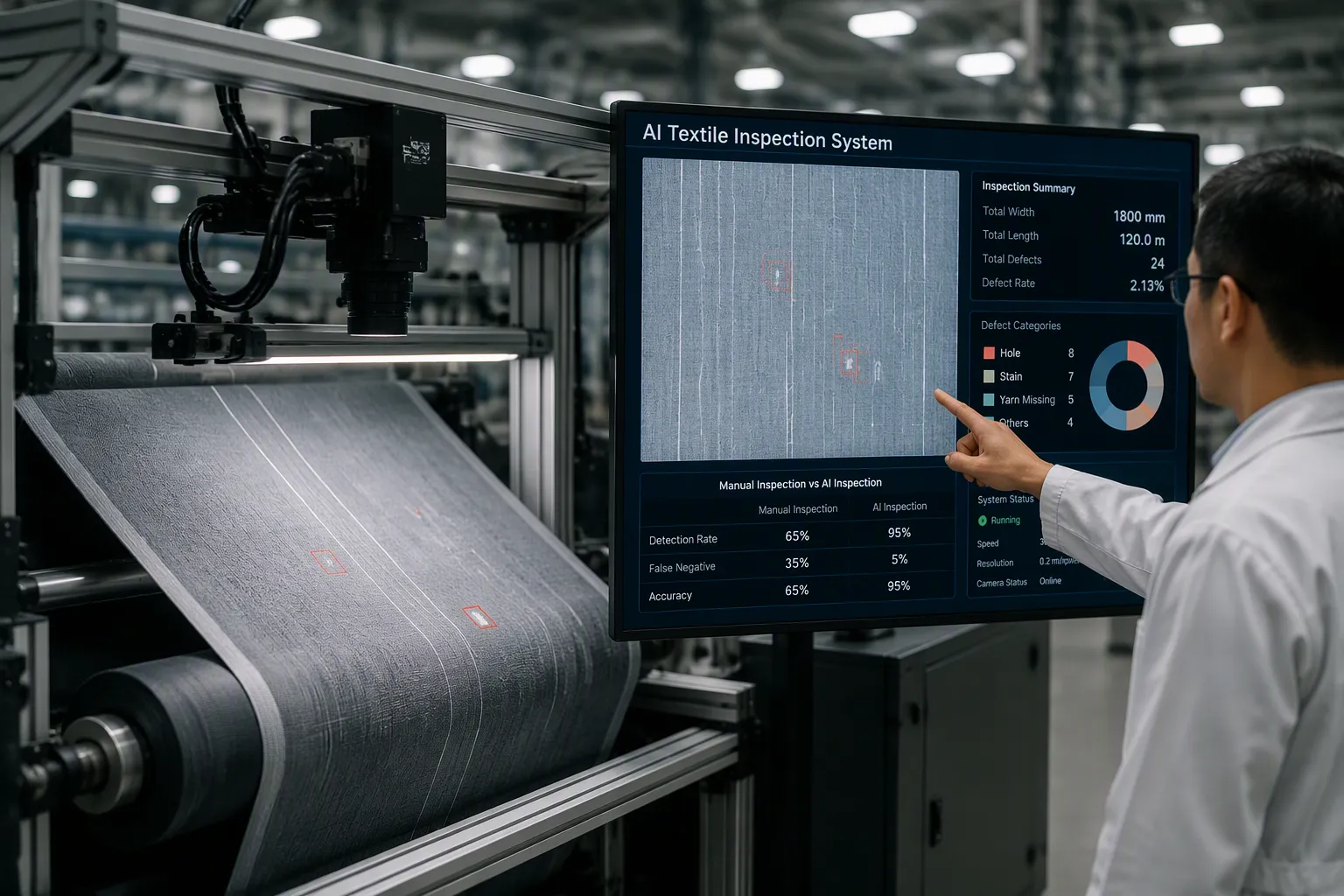
The waste reduction numbers tell a compelling story. Manual inspection catches only about 65% of defects. AI-powered fabric inspection detects 95% or more. Consider a production line producing 15,000 meters of fabric monthly. Manual inspection allows roughly 5,250 meters of defective fabric to escape. AI inspection reduces escaped defects to just 750 meters—an 85.7% reduction. Each critical defect incident wastes about 7.5 meters of fabric with manual methods. AI reduces that waste to mere centimeters.
| Metric | Manual Inspection | AI Inspection |
|---|---|---|
| Defect detection rate | 65% | 95% |
| Defective meters caught per month | 9,750 m | 14,250 m |
| Escaped defects per month | 5,250 m | 750 m |
| Waste per critical defect incident | 7.5 m | centimeters |
The textile industry also benefits from digital traceability. Each fabric roll receives a digital record containing defect maps and quality reports. You can trace every flaw to its source. This documentation enables root-cause investigation and continuous improvement. You move from reactive quality control to proactive defect prevention.
Cost Reduction and Faster Production with AI
The financial benefits of AI fabric inspection appear quickly. A mid-size apparel factory producing 3 million garments annually can reduce rework costs from $150,000 to $45,000 per year. That represents $105,000 in annual savings. These savings come from catching defects early, before they propagate through the production process.
The payback period for AI fabric inspection depends on order volume and labor cost structures. For medium-to-large plants with continuous production, the payback period is usually significantly more favorable than the alternative of ever-increasing labor expenditures.
The typical ROI period for AI fabric inspection systems ranges from 12 to 24 months. Companies with larger production scales and stable order volumes may break even in under 12 months. The returns come from multiple sources: reduced labor requirements, lower rework rates, enhanced quality consistency, and boosted production efficiency.
Faster inspections deliver another layer of savings. AI fabric inspection removes the inspection bottleneck that slows your production line. Manual inspection limits line speed to about 30 m/min because vision degrades at higher speeds. AI systems maintain full detection accuracy at 60–80 m/min. This allows your production lines to run at 95–100% of mechanical maximum speed instead of 85%. You gain a 3× improvement in inspection throughput while maintaining 95%+ detection accuracy.
The speed gain appears twice. First, the inspection itself runs faster. Second, the entire production line accelerates once the bottleneck lifts. Mills can safely increase line speed because AI accuracy does not degrade at higher speeds, unlike manual inspection. This dual speed advantage compounds your efficiency gains.
The benefits of artificial intelligence in textile defect detection extend to every aspect of your operation. You reduce waste, cut costs, accelerate production, and deliver consistent quality to your customers. These advantages make AI fabric inspection an essential investment for modern textile manufacturers seeking competitive advantage.
AI fabric defect detection transforms your quality control. You understand the complete pipeline: image capture, classification, and defect mapping. This ai-powered fabric inspection delivers measurable benefits.
Pilot projects confirm the value. A peer-reviewed study documented 97.13% accuracy with system uptime above 99.7% during a three-month industrial trial. Typical payback periods run just 7–8 months. You catch 3–4× more defects per 100 meters than human inspectors.
A peer-reviewed study (Springer Nature) documented an AI-driven anomaly detection system achieving 97.13% accuracy using an ensemble of deep learning models, with system uptime above 99.7% across a three-month industrial trial.
The textile industry gains efficiency through advanced textile defect detection. Artificial intelligence eliminates the inspection bottleneck. You reduce waste and cut costs.
Start your pilot project today. Invest in ai fabric inspection. The secret to perfect textiles awaits you.
FAQ
What accuracy does AI fabric inspection deliver?
AI fabric inspection achieves over 99.99% accuracy. This beats human inspectors who catch only about 65% of defects. The system detects even subtle flaws.
How does AI defect detection work for different textiles?
You train the AI on your specific fabric. The system learns patterns for each textile. This flexibility helps the textile industry achieve consistent quality.
What defect types can the system find?
The system finds structural defects like holes and tears. It also spots contamination issues such as oil stains. The detection covers many flaw types.
Does AI fabric inspection improve speed?
Yes. AI inspection runs at 60-80 m/min compared to manual inspection at 10-15 m/min. You remove the bottleneck. This boosts your production efficiency.
How does AI detection compare to human inspection?
AI detection achieves 95%+ defect detection rates. Human accuracy drops to 50-70% after 30 minutes. You get consistent results with AI every shift.
See Also
Forecasting Textile Machinery Failures With Artificial Intelligence
Intelligent Fashion Technology Reduces Product Return Rates
Innovative Artificial Intelligence Promotes Sustainable Fashion Industry
Strategic Approaches For Apparel Brands To Evolve From Manufacturing
Leveraging Sales Analytics For Precise Fashion Trend Predictions