
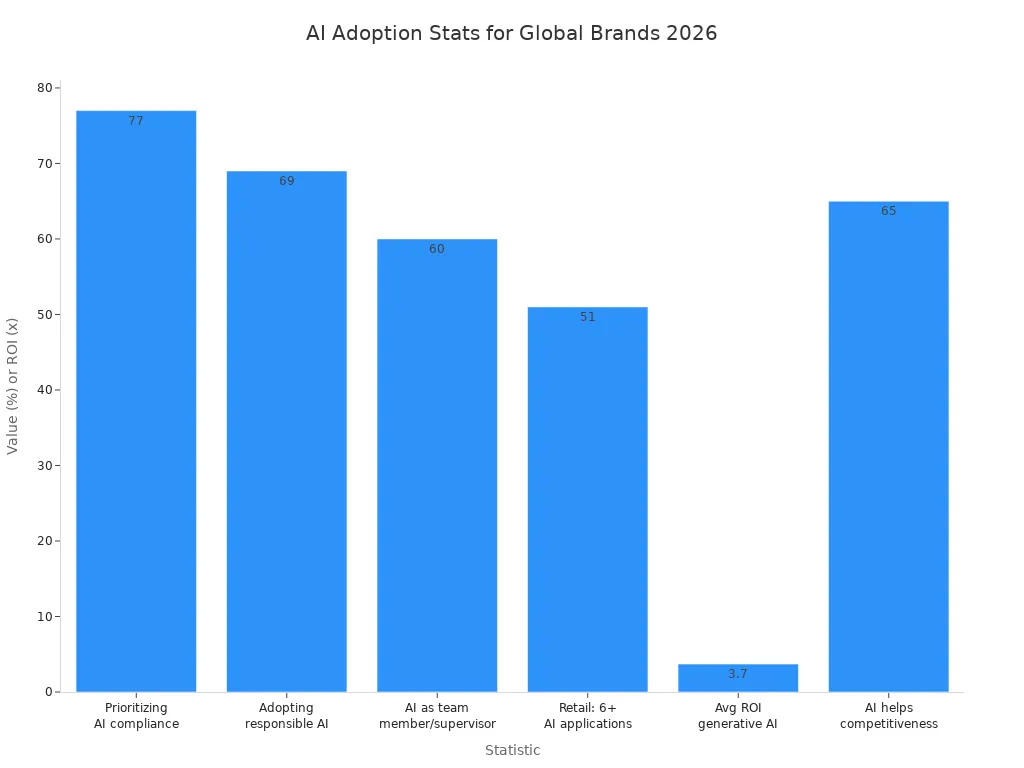
AI for scaling now drives the global brands' expansion in 2026. You see brands using ai marketing revolution strategies to reach new markets faster. Companies report an average ROI of 3.7x from generative ai, and 60% plan to make ai a team member or supervisor soon. Brands benefit from improved growth, reduced costs, and better marketing results. Almost 65% of organizations say ai helps them stay ahead.
Traditional Challenges for Global Brands
Localization and Cultural Barriers
You face many hurdles when you take your brand global. One of the biggest is understanding and respecting local cultures. If you do not adapt your products and marketing to fit local preferences, you risk losing customers. For example, a study found that 76% of online shoppers prefer to buy products with information in their own language. In fact, 40% will not buy if the information is not in their language, even if they speak another one. Over half of business leaders say their companies have lost business because they did not localize well. Nearly two-thirds have seen negative impacts from poor localization. When you invest in strong marketing localization, you can see conversion rates two to three times higher than with basic translation.
Tip: Always research local customs and language before launching in a new market.
Operational Complexity and Costs
Managing a global brand means you must handle many moving parts. You deal with different suppliers, currencies, and regulations. This complexity increases your costs and makes it harder to keep track of everything. Here is a table that shows some common challenges:
| Challenge | Description |
|---|---|
| Logistics and Operational Complexity | Managing supply chain issues and infrastructure gaps in new markets. |
| Currency and Pricing Variations | Dealing with different currencies and pricing strategies for each market. |
| Regulatory Complexities | Navigating legal frameworks and compliance standards across countries. |
| Supplier Management | Monitoring suppliers and handling higher management costs. |
You may also face risks and uncertainties that can hurt your business performance.
Slow Market Insights
You need fast and accurate insights to succeed in new markets. If you do not understand local trends or cultural nuances, your marketing messages may miss the mark. Many brands have failed because they underestimated these differences. Slow access to insights can lead to wasted resources and even damage your reputation. Cultural misunderstandings and regulatory issues can also cause failed expansions.
Note: Quick and accurate insights help you avoid costly mistakes and build trust with new customers.
AI for Scaling: Breaking Barriers

Automated Localization
You can now expand your brand into new markets faster than ever. AI for scaling makes localization almost instant. You do not have to wait weeks for translations or worry about missing trends. AI-driven automation can localize your content across 18 languages at once. It keeps your brand glossary consistent and adapts idioms to fit each culture. Built-in review tools help you avoid cultural mistakes, so your message always feels right for each audience.
- AI for scaling lets you:
- Launch products in multiple countries at the same time.
- Keep your brand voice strong while sounding local.
- Save money by reducing manual translation work.
Note: Diego Cresceri says that you must still combine AI with local experts. AI helps you move fast, but human insight keeps your brand authentic. Treat language as a tool for growth, not just a task to finish.
Here is how AI breaks localization barriers for global brands:
| Evidence Description | Impact on Global Brands |
|---|---|
| AI speeds up localization and automates tasks | Enables faster market entry and consistent messaging |
| AI automates localization, making content ready almost instantly | Prevents loss of trends and customers due to slow updates |
| AI creates personalized experiences and adapts campaigns | Enhances customer engagement across different regions |
Real-Time Data Analysis
You need real-time insights to win in new markets. AI for scaling gives you up-to-the-minute data about what customers want and how markets change. You can see trends as they happen and adjust your strategy right away. This helps you stay ahead of your competitors and avoid costly mistakes.
- Real-time insights let you:
- Make better decisions quickly.
- Spot problems before they grow.
- Give customers what they want, when they want it.
Here is a table showing the benefits of real-time data analysis for global brands:
| Benefit | Description |
|---|---|
| Competitive Advantage | Staying ahead of trends and market changes with real-time insights can provide a significant edge over competitors. |
| Enhanced Decision Making | Access to up-to-date information allows businesses to make better and faster decisions. |
| Increased Efficiency | Real-time data helps teams identify and address issues promptly, reducing downtime and improving operational efficiency. |
| Improved Customer Experience | By automating your understanding of customer behavior in real-time, businesses can deliver more personalized and timely responses. |
You can use ai-powered insights to understand customer behavior in every region. This means you can personalize offers and messages for each market. You do not have to guess what works. You see the results right away.
Streamlined Operations
AI for scaling changes how you run your business. You do not need large teams to handle every task. AI-driven automation takes care of repetitive work, so your team can focus on solving complex problems. This makes scaling easier and cheaper.
- AI streamlines operations by:
- Automating workflows and speeding up customer service.
- Helping you manage more projects with the same number of people.
- Predicting inventory needs and reducing waste.
Here is a table showing how AI improves operations and reduces costs:
| Evidence Description | Impact on Time-to-Market |
|---|---|
| AI can automate many operational processes, streamlining workflows and improving responsiveness. | Reduces time taken to handle customer requests. |
| Agencies using AI can manage 30% more projects with the same workforce. | Enhances project timelines and efficiency. |
| Welcome Pickups experienced a 66% increase in bookings from localized pages created with AI. | Contributes to faster market adaptation and revenue growth. |
You can see how companies like Siemens use AI to cut downtime by 50% and boost production by 20%. This shows that AI for scaling does not just save money. It helps you grow faster and serve more customers.
Tip: As you move toward AI-native operations, you redesign your workflows. You focus on business processes, not just departments. You may need fewer people for routine tasks, but you will need new skills to manage and supervise AI systems.
AI-based strategies also bring big investment savings. You can scale up or down easily, process more data, and manage risks better than with traditional methods. This gives you a strong edge in the global market.
AI Strategies for Global Brands
Hyper-Personalized Engagement
You can use ai for scaling to create hyper-personalized engagement that drives growth for global brands. AI analyzes customer data and finds patterns in behavior. You build dynamic profiles that change as customers interact with your brand. This approach helps you deliver personalized experiences that match customer needs.
- Personalized communications increase loyalty and repeat business.
- Brands that align offers with customer interests build emotional connections.
- Conversational ai predicts customer intent and responds with relevant messages.
You see higher customer engagement when you deliver consistent, relevant content. This builds trust and encourages repeat visits. You can use ai-powered content to tailor messages for each customer. This strategy increases customer lifetime value and supports growth.
Tip: Use ai to track customer engagement and adjust your marketing solutions for better results.
Here is a table showing how hyper-personalized engagement impacts global brands:
| Strategy | Benefit |
|---|---|
| Personalized communications | Lasting loyalty and repeat business |
| Dynamic customer profiles | Enhanced engagement |
| Relevant content delivery | Increased trust and lifetime value |
| Predictive conversational AI | Improved consumer engagement |
Dynamic Content Creation
You can transform your content creation workflows with ai-powered content. AI helps you automate digital content generation and accelerate content creation. You produce visuals, text, and personalized advertising for different markets. This process supports digital marketing and global expansion.
The Branded, an ai content creation agency, shows how brands use ai to enhance personalization and streamline content production. You reach global audiences with content that fits local preferences. Generative ai drives innovation in marketing strategies. You see ai become a foundation for content creation and marketing. This shift supports growth and scaling.
Emerging technologies like generative ai help you create marketing solutions that adapt to changing trends. You use ai-powered content to deliver personalized experiences and engage customers in every region. Digital content automation lets you produce more content with less effort.
Note: AI helps you manage content creation workflows and ensures your marketing stays relevant in every market.
Here is a list of benefits from dynamic content creation:
- Faster content generation for global brands.
- Personalized advertising that matches local interests.
- Enhanced engagement through visuals and tailored messages.
- Streamlined workflows that support growth and scaling.
Intelligent Market Entry
You can use ai to make smarter decisions when entering new markets. AI gives you real-time insights into customer preferences and market trends. You analyze data to find the best opportunities for growth. This approach reduces risks and helps you adapt quickly.
- AI delivers measurable productivity and efficiency gains.
- You must ensure ai fits your culture and operations.
- Human oversight is critical for validating ai outputs.
You can follow these steps to scale ai safely and embed it into daily operations:
- Establish an ai office or center of excellence to improve collaboration.
- Prioritize ai use cases that deliver the most value.
- Leverage partnerships to speed up deployment and access specialized skills.
- Evaluate expected outcomes regularly for timely adjustments.
- Design for responsible ai and governance from the start.
Strong coordination and partnerships accelerate ai adoption. You need frequent evaluation of outcomes to scale effectively. Responsible ai practices should guide your strategy.
Tip: Use ai-powered insights to identify market entry points and adjust your approach for each region.
Here is a table showing intelligent market entry strategies:
| Step | Impact |
|---|---|
| Establish AI office | Enhanced collaboration |
| Prioritize use cases | Focused growth |
| Leverage partnerships | Faster deployment |
| Evaluate outcomes | Timely adjustments |
| Responsible AI governance | Safe scaling and trust |
You can use ai for scaling to support intelligent market entry, streamline operations, and drive growth for global brands. AI-powered content, real-time insights, and strong partnerships help you succeed in new markets.
Success Stories in AI for Scaling

Retail Brand Localization
You can see how global brands achieve rapid success with ai for scaling. One international fashion retailer improved its localization process by using ai technologies. This change led to 50% faster turnaround times, which helped the brand reach new markets quickly. You gain improved translation quality, so you spend less time editing. The brand managed high content volumes in-house, without needing outside help. Translator engagement increased because ai output matched the brand’s tone and context.
- Faster time to market
- Better translation quality
- More control over content
- Higher translator satisfaction
You can use ai to make your marketing more effective and support growth in new regions.
Tech Brand Market Insights
You benefit from real-time insights when you use ai in tech brands. Companies like Netflix and Uber use AutoML to recommend content and match rides. Dynamic eCommerce pricing adjusts based on demand patterns. Financial fraud detection systems evolve to spot new schemes. You see how ai analytics drive success for global brands.
| Outcome | Statistic |
|---|---|
| Customer Acquisition | 23 times more likely to acquire customers |
| Profitability | 19 times more likely to profit |
| Revenue Growth | 80% of businesses report direct revenue growth |
| Investment in AI Analytics | 75% of businesses have invested in AI analytics |
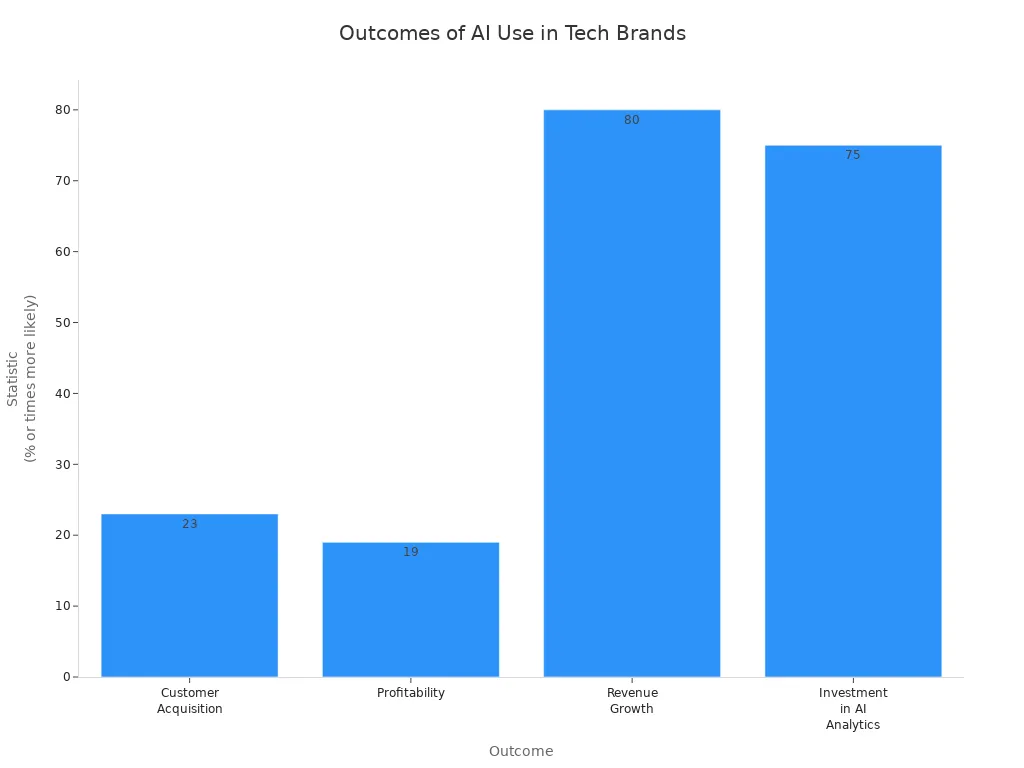
You use ai-powered insights to make better decisions and drive growth. Tech brands show that scaling with ai leads to higher success rates.
CPG Brand Efficiency
You improve operational efficiency by integrating ai into your business. AI algorithms analyze historical sales data and market trends to create precise demand forecasts. Automated systems track goods in real time, identify delays, and optimize routes for faster deliveries. One global CPG company unified retail execution data across markets using ai-driven demand forecasting tools. These tools modeled local demand accurately, which reduced stockouts and surplus. You optimize production timelines and ensure smoother operations.
Tip: Use ai to analyze data and gain insights that support marketing and business success.
You see how global brands use ai for scaling to achieve growth, improve efficiency, and gain valuable insights. Success stories show that ai transforms marketing, operations, and decision-making for brands worldwide.
| Brand | AI Initiative | Key Impact |
|---|---|---|
| Spotify | AI-powered personalized audio campaigns | 60 million shares of Spotify Wrapped annually, boosting social reach. 35% of listening time from personalized playlists. 2.7x lift in ad recall and 20% higher click-through rates for personalized ads. |
| L’Oréal | ModiFace and SkinConsult AI | 1 billion uses of ModiFace globally. 3x higher conversion rates for virtual try-ons. 20 million personalized skincare diagnostics generated. |
| Netflix | AI recommendation engine | 80% of content watched driven by personalized recommendations. Lower churn rates maintained below industry averages. |
| Cadbury | AI deepfake technology for ads | Campaign reached 140 million people. 32% increase in brand engagement and 21% rise in online sentiment scores. Empowered over 2,500 small businesses with personalized ads during Diwali. |
Best Practices for AI Integration
Building AI-Ready Teams
You need to build teams that can support your ai strategy integration. Start by making ai governance a priority. Assign clear ownership and involve leadership in every step. Encourage cross-functional collaboration so your team blends data skills with storytelling. Regular human review and bias testing help you keep your ai projects safe and effective. Bring in expert support when you scale up. Train your staff to understand both the benefits and risks of ai. Invest in ongoing education so your team stays ready as technology evolves. Lead with transparency by tracking ai usage and keeping audit-ready records.
| Strategy | Description |
|---|---|
| AI Governance | Assign ownership and involve leadership. |
| Best Practices | Use human review and bias testing. |
| Expert Support | Bring in experts for scaling projects. |
| Transparency | Track usage and keep records. |
| Training | Teach teams about benefits and risks. |
| Cross-Functional Collaboration | Blend skills from different departments. |
| Ongoing Education | Keep staff updated as technology changes. |
Tip: Build a team that can adapt quickly and work together across functions.
Choosing the Right Tools
You must select tools that fit your business needs. Choose user-friendly tools with intuitive design. Make sure the tools integrate with your current systems to avoid disruptions. Look for scalability so your tools grow with your brand. Evaluate the total cost of ownership, not just the upfront price. Check the vendor’s reputation and customer support. Security and compliance are essential for protecting your data.
| Criteria | Description |
|---|---|
| Ease of Use | User-friendly design and proper training. |
| Integration | Fits with existing systems. |
| Scalability | Grows with your needs. |
| Total Cost of Ownership | Value over price. |
| Vendor Reputation | Reliable vendor. |
| Customer Support | Good troubleshooting and assistance. |
| Security and Compliance | Meets industry standards. |
Note: The right tools help you scale your marketing and operations without losing control.
Measuring Impact
You need to measure the impact of ai on your expansion efforts. Use the AI Intensity Index to track how your industry and region deploy ai. Map quarterly data and telemetry for real-time updates. This index helps you spot trends and make policy decisions. Many organizations report improved productivity and efficiency. You can enhance insights and decision-making. Cost savings and better client relationships are common results. Service delivery improves, and you see more innovation in products and marketing.
- 66% of organizations report higher productivity and efficiency.
- 53% gain better insights and decision-making.
- 40% reduce costs, and 38% improve client relationships.
- 20% see product enhancements and innovation.
Tip: Track your results and adjust your ai strategy integration for continued growth.
You see ai for scaling change how brands grow worldwide in 2026. Companies use ai to speed up innovation, improve customer experiences, and make smarter decisions.
| Key Insight | Description |
|---|---|
| AI Access Growth | More workers use ai tools, rising from under 40% to about 60%. |
| Streamlining Operations | Brands automate tasks and boost returns on investment. |
| Distinct Market Position | AI helps brands stand out and win new markets. |
To start, focus on value, reskill your teams, and build secure digital systems. The future will bring even faster change as ai spreads across all business areas.
FAQ
What is AI for scaling in global brands?
You use AI for scaling to help your brand grow in new markets. AI automates tasks, analyzes data, and personalizes content. This makes your expansion faster and more efficient.
How does AI improve localization?
AI translates and adapts your content for different cultures. You get faster, more accurate results. You also keep your brand voice consistent. AI tools help you avoid cultural mistakes.
What skills do you need to manage AI-driven expansion?
You need skills in data analysis, project management, and AI tools. You also need people who understand local markets. Training your team helps you get the best results.
How do you measure the success of AI integration?
You track key metrics like ROI, customer engagement, and time-to-market. Use a table to compare before and after AI adoption:
| Metric | Before AI | After AI |
|---|---|---|
| ROI | 1.5x | 3.7x |
| Time-to-Market | 8 weeks | 2 weeks |
| Customer Engagement | Medium | High |
See Also
Innovative Brands Expanding Through WarpDriven Distribution Solutions
Predicting Future Demand Using AI and Data Analytics
Revamping Apparel: Strategies for Manufacturing to Branding Success