
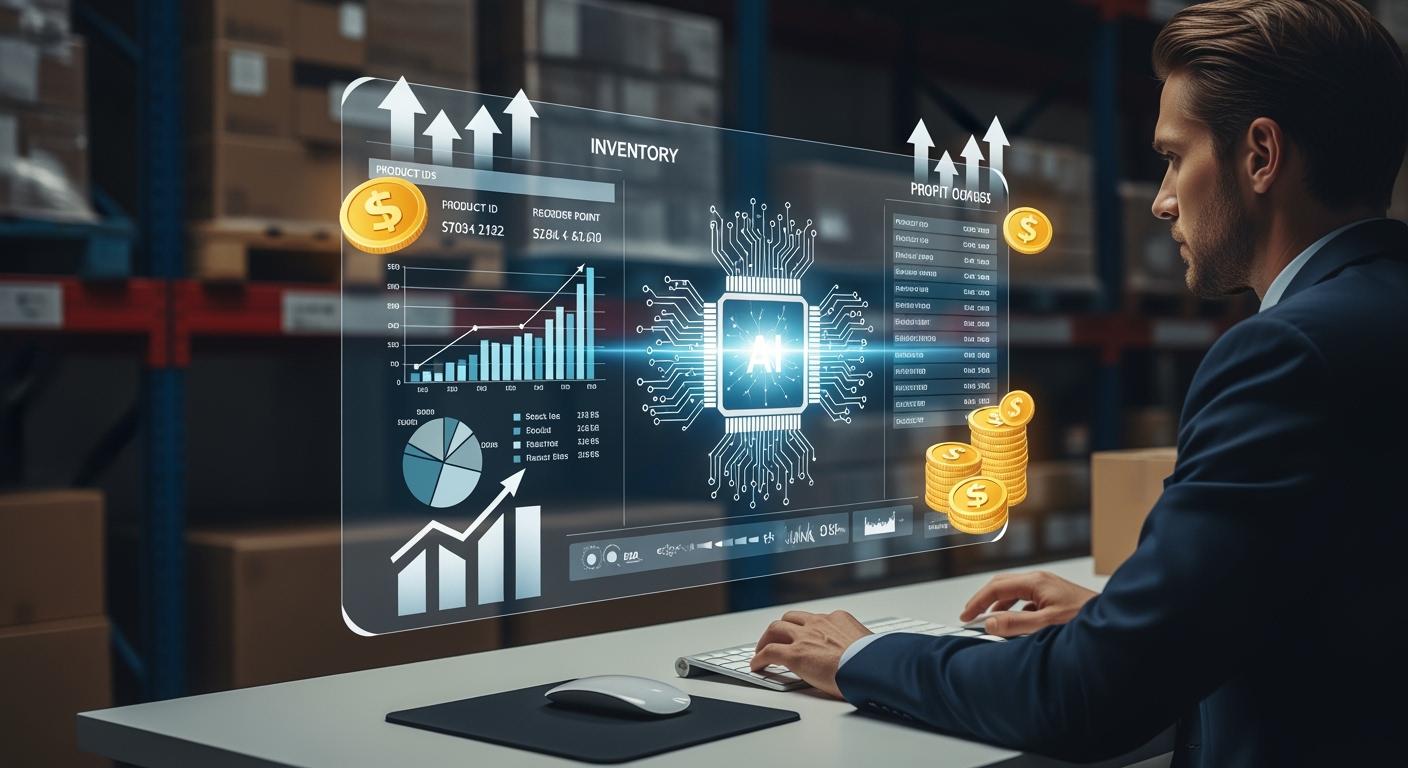
You can boost your profits in 2026 with inventory optimization powered by ai-driven inventory solutions. These systems help you avoid stockouts, lower your storage costs, and predict demand with accuracy. You see more sales and less wasted inventory. Many businesses now use smart AI tools to keep shelves full and customers happy. Future-proof your business by making these solutions part of your strategy.
AI Inventory Optimization and Profit Impact
Reducing Stockouts
You want your customers to find what they need every time they visit your store or website. Stockouts frustrate shoppers and send them to your competitors. With inventory optimization powered by AI, you can keep shelves stocked and avoid missed sales. AI systems analyze sales data, trends, and even outside factors like weather or holidays. They predict when you will run low and trigger timely reorders.
Here is how AI-driven inventory optimization compares to traditional methods:
| Metric | AI-Driven Improvement | Traditional Method Performance |
|---|---|---|
| Forecasting Accuracy Improvement | Up to 30% | Less responsive to changes |
| Stockout Reduction | 15-50% | Higher stockout rates |
| Mean Absolute Error (MAE) | Up to 25% reduction | Static rules lead to errors |
| Mean Absolute Percentage Error (MAPE) | Up to 30% reduction | Less accurate forecasting |
Major companies have already seen results:
- Walmart reduced stockouts by 15% during the pandemic using AI.
- Cisco improved demand planning and cut stockouts with AI-driven forecasting.
When you reduce stockouts by 30-50%, you capture sales that would have gone to someone else. One business recovered $300,000 in lost sales and saw a 293% return on investment after using AI inventory optimization. You can expect a direct boost in revenue and happier customers.
Lowering Holding Costs
You do not want to tie up cash in products that sit in your warehouse. Excess inventory leads to higher storage costs, wasted space, and even spoilage. AI inventory optimization helps you match supply with demand, so you only keep what you need. These systems adjust in real time, reducing both overstock and shortages.
Walmart’s AI initiatives cut inventory costs by up to 30%. Amazon saw a 10–15% decrease in carrying costs and a 5–7% increase in sales after using smarter inventory management. AI-powered logistics connect your warehouse, transportation, and yard operations. This unified approach lowers carrying costs and improves your cash flow.
Tip: Inventory carrying costs can reach 20–30% of your inventory value each year. Lowering your average inventory levels saves money and reduces risk.
When you use inventory optimization, you lower storage and holding costs. You also minimize stockouts, which means fewer lost sales and more satisfied customers. Keeping the right products available maximizes your revenue and profit margins.
Improving Demand Forecasts
You need to know what your customers will buy next week, next month, or even next season. Accurate demand forecasts help you plan better and avoid costly mistakes. AI inventory optimization uses advanced algorithms to analyze sales, promotions, weather, and supplier lead times. These self-learning models improve over time, making your forecasts more precise.
- AI algorithms boost forecasting accuracy to 80–95%.
- They reduce stockouts and improve inventory planning.
- AI considers many variables, so your forecasts reflect real-world conditions.
- Self-learning models keep getting smarter, which means better results for you.
With improved demand forecasting, you can optimize inventory levels, reduce waste, and make smarter decisions about production and purchasing. You respond faster to market changes and keep your customers happy. This leads to lower costs and higher profits.
Boosting Sales
You want to grow your business and increase sales every year. Inventory optimization with AI helps you do that by making sure products are always available when customers want them. When you reduce stockouts and improve product availability, you capture more sales and build customer loyalty.
- Amazon reported a 5% increase in revenue after improving inventory management with AI.
- The stockout rate dropped by 25%, which led to higher customer satisfaction and more sales.
- Inventory turnover improved by 20%, cutting carrying costs and boosting efficiency.
- Boyner, a retailer, saw a 4.8% increase in sales after using AI-driven inventory optimization. Automated replenishment made in-store availability better, which helped sales grow.
Retailers using AI inventory optimization have seen revenue increases of 30% or more. A leading shoe retailer gained $21.4 million in extra sales within six months of deploying AI. On-shelf availability improved by 8.8%, and lost sales dropped by nearly 12%. These results show that the right strategies can transform your bottom line.
Key Strategies for Inventory Optimization
Data Integration and Pattern Detection
You need strong data integration to make inventory optimization work. This means connecting your sales, logistics, and supplier data into one system. When you do this, you get real-time updates and clear visibility across your supply chain. You can spot inventory issues quickly and adjust before problems grow. Centralizing your information also helps you work better with vendors and supports advanced inventory strategies like vendor managed inventory.
AI tools help you detect patterns in your data. They look at past sales, seasonality, promotions, and even outside factors like weather. These tools use predictive analytics for demand forecasting, so you can see trends and react fast. AI also finds unusual changes in inventory or sales, which helps you catch errors or theft early.
Predictive Demand Forecasting
You want to know what your customers will buy next. Predictive demand forecasting uses AI models to study your data and predict future demand. Some models, like LSTM networks, do a great job with seasonality and sales spikes. Hybrid models that mix AI forecasting, optimization, and IoT feedback give you even better control.
| Model | Mape (%) | RMSE | Accuracy (%) |
|---|---|---|---|
| EOQ | 21.5 | 49.3 | 78.5 |
| GBM | 12.4 | 28.7 | 87.6 |
| LSTM | 10.2 | 24.1 | 89.8 |
When you use these models, you improve inventory forecasting and reduce both overstock and stockouts. Companies that use AI for forecasting have seen accuracy jump from 60% to 80%. This leads to lower costs and higher sales.
"Companies need to manage their inventory carefully. Otherwise, inefficiencies arise. You might have products sitting idle in your warehouse, which ties up working capital, or you may run out of stock, leading to missed sales opportunities." – Hector Peña
Optimization Engine and Replenishment
You need an optimization engine to keep your inventory at the right level. This engine uses machine learning to set stock levels based on past data. It can spot slow-moving items and suggest markdowns before you lose money. The engine also balances inventory across all your locations and connects with your accounting software to show the financial impact of your decisions.
Automated replenishment powered by AI makes your supply chain faster and more efficient. AI tracks sales and demand, then restocks high-demand products automatically. This reduces manual work and errors. You get faster replenishment cycles and smarter inventory management.
Real-Time Monitoring
Real-time monitoring gives you up-to-the-minute information about your inventory. You can see what is selling, what is not, and where you need to act. This helps you avoid overstocking or running out of products. Real-time monitoring also speeds up decision-making and streamlines your operations.
- You respond quickly to changes in demand or supply.
- You improve forecasting accuracy and reduce losses.
- You keep customers happy with accurate order information and steady product supply.
With these inventory strategies, you turn inventory optimization into a proactive process. You stay ahead of problems and keep your business running smoothly.
Real-World Results and Trends

Profit Gains from AI Inventory Optimization
You can see impressive profit gains when you use inventory optimization powered by AI. Many companies have reported strong results after making the switch. The table below shows how leading businesses have benefited:
| Company | Profit Gain/Cost Reduction | Source |
|---|---|---|
| Various | Up to 40% reduction in excess inventory | Superagi |
| Companies | Up to 20% reduction in inventory costs | McKinsey |
| Amazon | 35% reduction in stockouts | Superagi |
| Retailers | 20% average revenue increase | Envive |
| Walmart | 10-20% reduction in inventory levels | McKinsey |
| Walmart | 5-10% increase in sales | McKinsey |
You can reduce excess inventory by up to 40% and cut inventory costs by 20%. Retailers have seen a 20% average revenue increase. Amazon and Walmart have both improved sales and reduced stockouts with inventory optimization.
Business Success Stories
You can learn from top brands that have transformed their operations with inventory optimization. Here are some real-world examples:
- H&M used AI to analyze sales and returns. This helped the company forecast demand better and lower excess inventory costs.
- Tesco applied AI to manage over 100,000 product lines. The company achieved big cost savings and reduced waste.
- Rolls-Royce uses AI to predict maintenance needs. This approach optimizes spare parts inventory and improves service efficiency.
- Amazon’s predictive inventory system led to a 35% drop in stockouts. This means more products available for customers and higher sales.
These stories show that inventory optimization works for many industries, from retail to manufacturing.
Industry Trends for 2026
You will see new trends in inventory optimization by 2026. AI will make demand forecasting more accurate. Dynamic safety stock calculations will replace old static methods. This change will help you manage inventory better and reduce waste.
- Automated replenishment will cut manual planning time by 75%.
- Real-time inventory visibility will help you handle complex supply chains.
- AI inventory management will reach 8-15% Mean Absolute Percentage Error (MAPE), much better than traditional methods.
- Dynamic safety stock can reduce excess inventory by up to 28%.
You can expect inventory optimization to become smarter and faster. These trends will help you stay ahead in a changing market.
Implementing Inventory Optimization with AI
Assessing Current Inventory
You need to understand your current inventory before you start with inventory optimization. Begin with a careful review of your stock and processes. Follow these steps to get a clear picture:
- Audit your stock levels and turnover rates.
- Identify areas where you often have too much or too little inventory.
- Analyze long-term inventory trends.
- Investigate your workflows for hidden problems, such as delayed reorders.
- Compare your demand forecasts with actual sales to find gaps.
This process helps you spot issues and set goals for your new inventory management systems.
Selecting AI Tools
You want to choose the right tools for inventory optimization. Look for solutions that fit your business needs and work well with your current systems. Use this table to guide your selection:
| Criteria | Description |
|---|---|
| Deployment Speed | Choose tools that you can set up quickly. |
| Integration Flexibility | Pick solutions with open APIs for easy connection to your systems. |
| Total Cost of Ownership | Consider all costs, including setup and training. |
| Barcode Execution Capabilities | Make sure the tool supports barcode scanning for compliance. |
| Model Transparency | Vendors should explain how their AI makes decisions. |
| Retraining Cadence | Check how often the AI updates to stay accurate. |
| Audit Trails | Look for tools that track decision history for accountability. |
The right AI tool will support automated replenishment and make your inventory management systems smarter.
System Integration
You need your new AI system to work with your existing platforms. Make sure your inventory optimization solution connects smoothly with your ERP or warehouse software. Choose tools with strong APIs or pre-built connectors for easy data sharing. Start with a pilot program to test the integration and fix any issues. Some systems, like ThroughPut.AI, can connect to ERP, WMS, and MRP platforms without major changes. Real-time data sync gives you a clear view of your inventory and supply chain.
Continuous Improvement
You should keep improving your inventory management systems after you launch automated replenishment. Review your results often. Use data from your AI tools to adjust your processes. Automated replenishment recommendations help you respond to changes in demand. Regular updates and audits keep your inventory optimization on track. This approach helps you get the most value from your investment and keeps your business ready for the future.
Challenges and Solutions
Data Quality Issues
You need high-quality data for successful inventory optimization. Poor data can lead to wrong decisions and lost profits. Common problems include missing, inaccurate, or biased data. These issues make it hard for AI to give you reliable results. You also face challenges when your data does not represent all your products or locations. This can hurt your visibility and inventory performance.
| Issue Type | Description |
|---|---|
| Inaccurate, incomplete data | Data that is missing or wrong can cause AI to make poor recommendations. |
| Biased data | If your data does not show true trends, your results will be off. |
| Unbalanced data | Too much data from one area can skew your visibility and planning. |
You can solve these problems by cleaning your data and checking it often. Good data gives you better visibility and helps your AI system work well.
Change Management
You may find it hard to get everyone on board with new AI tools. People worry about changes to their jobs or daily tasks. You can make this easier by starting with small projects that show clear results. Train your team early and explain how AI helps them, not replaces them. Focus on building trust in the system and improving visibility for all users.
| Strategy | Description |
|---|---|
| Focused Use Cases | Start with projects that show quick wins, like better forecast accuracy. |
| Data Integration | Connect all your systems for full visibility and less rework. |
| Change Management Design | Train users and show how AI supports their work. |
Cost and ROI
You might worry about the cost of inventory optimization with AI. Costs include software, training, and data setup. Most businesses see a return on investment within a year. You gain direct savings, better efficiency, and more revenue. For every $1 million you invest, you can save $2–5 million each year by cutting inventory costs and stockouts.
| Cost Category | Typical Range | ROI Timeframe |
|---|---|---|
| Custom AI Development | $100K–$500K | 6–12 months |
| AI Integration & Training | $25K–$150K | 3–12 months |
| Data Infrastructure Setup | $30K–$200K | 12–18 months |
| Staff Training & Change Mgmt | $15K–$75K | 3–9 months |
| Ongoing Maintenance & Updates | $10K–$50K annually | Continuous |
| Third-Party AI Tools | $5K–$100K annually | 1–6 months |
You also gain competitive advantages and new growth opportunities.
Ongoing Optimization
You must keep improving your system to get the best results. Use real-time monitoring for full visibility into your stock. Adjust your inventory policies as demand changes. Automated replenishment and predictive forecasting help you avoid both shortages and excess. Move stock between locations to balance supply and improve visibility everywhere. Plan for supply chain risks and act early on slow-moving items. These steps help you keep high service levels, reduce locked-in capital, and improve cash flow.
Tip: Regular reviews and updates keep your visibility strong and your inventory optimization on track.
You can boost profits and stay ahead by using AI for inventory optimization. This technology helps you reduce costs, improve forecasts, and increase sales. Now is the best time to prepare for 2026. To get started or improve your process, follow these steps:
- Align your teams across procurement, operations, finance, and sales.
- Start small with one product category or location.
- Unify your data for better forecasting.
- Launch pilot projects for quick wins.
- Upskill employees to use AI insights.
FAQ
What is inventory management and why does it matter?
You use inventory management to track products, supplies, and materials. Good inventory management helps you avoid running out of stock. It also keeps your costs low. You improve performance and keep customers happy when you manage your inventory well.
How does AI improve inventory management performance?
AI helps you spot trends and patterns in your inventory management data. You use real-time data analytics to make better decisions. AI can predict demand, automate orders, and boost performance. This leads to fewer mistakes and higher supply chain efficiency.
What is real-time inventory visibility?
You get real-time inventory visibility when you see your stock levels instantly. This helps you react fast to changes. You use real-time data to improve performance. You also avoid stockouts and keep your inventory management system accurate.
How can inventory management boost supply chain efficiency?
You use inventory management to keep your supply chain running smoothly. You track products from suppliers to customers. This improves performance and reduces delays. You save money and time by using inventory management to boost supply chain efficiency.
How do I measure inventory management performance?
You measure inventory management performance by tracking key metrics. Look at stock turnover, order accuracy, and lost sales. You also check how well your system uses real-time data. Good performance means you meet customer needs and keep costs down.
See Also
Utilizing AI and Data for Demand Predictions in 2025
Maximizing Production Forecasting Accuracy with AI in 2024
Effective Inventory Management Techniques for 2025 Success
Smart AI Solutions for Anticipating Shopping Demand
Using Predictive Analytics for Retail Inventory Replenishment