

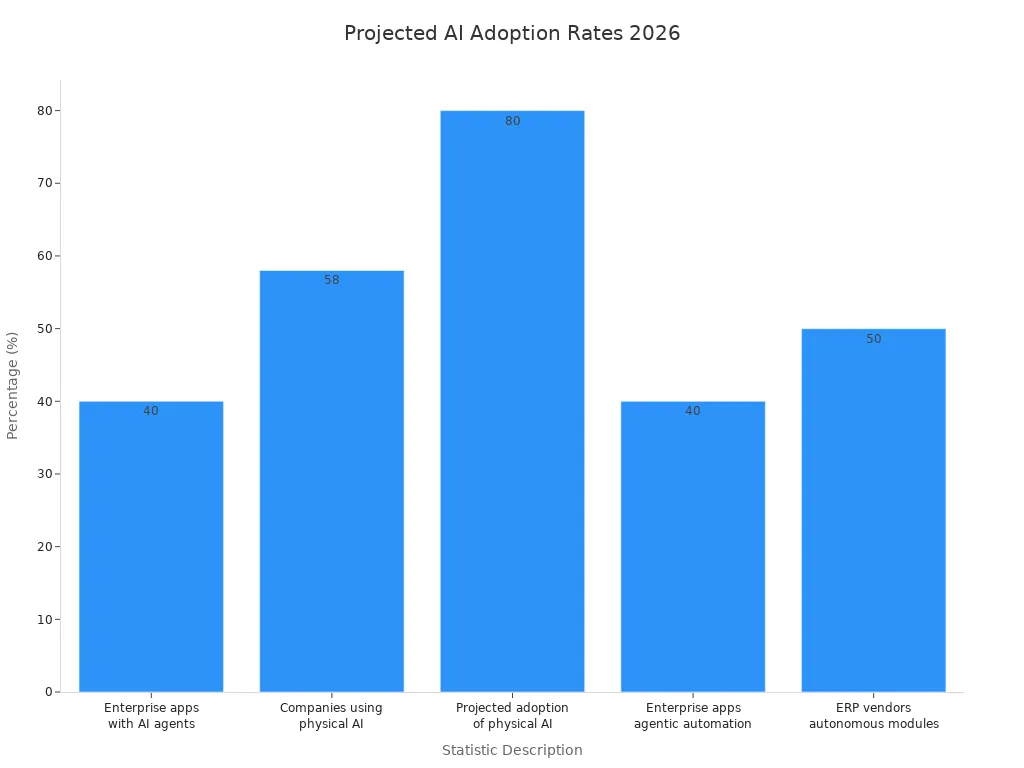
Imagine your organization trying to keep up as AI reshapes business transformation. Do you know how ready you are for this change? An AI digital transformation roadmap helps you navigate this shift by guiding you from digital transformation to intelligence-first strategies. You need clear steps to measure AI adoption and connect each project to real business value. By 2026, organizations will see rapid AI growth, as shown below:
| Statistic Description | Percentage |
|---|---|
| Enterprise apps with AI agents by 2026 | 40% |
| Companies using physical AI | 58% |
| Projected adoption of physical AI within two years | 80% |
| Enterprise applications enhanced by agentic automation by 2027 | 40% |
| ERP vendors launching autonomous governance modules by 2026 | 50% |
Understanding Digital Transformation Roadmap
From Digital-First to Intelligence-First
You have seen digital transformation change how businesses operate. In the past, you focused on moving processes online and automating tasks. Now, you must shift your mindset. AI is not just a tool—it is the engine that drives enterprise digital transformation forward. You need to move from digital-first thinking to intelligence-first strategies. This means you use AI to make decisions, predict trends, and personalize experiences. AI-powered digital transformation helps you unlock new value and stay ahead of competitors.
When you adopt intelligence-first strategies, you do more than add technology. You connect your business goals with AI solutions. You make sure every project supports your enterprise digital transformation. This approach helps you avoid isolated efforts that do not deliver real results. You create a culture where AI guides your actions and shapes your future.
What the Roadmap Covers
A digital transformation roadmap gives you a clear path for your AI journey. It aligns your strategy, people, and technology. You can see how each step connects to your business outcomes. This prevents wasted effort and helps you focus on what matters most.
Here are the main components you should include in your ai transformation roadmap:
| Component | Description |
|---|---|
| Strategic objectives linked to KPIs | Defines the goals of the AI initiative and how they relate to key performance indicators. |
| Readiness assessment findings | Evaluates the current state of data maturity and system architecture before starting AI initiatives. |
| Prioritized use case portfolio | Identifies and ranks use cases based on feasibility and impact. |
| Data governance framework | Establishes rules for data access, logging, and auditing to ensure compliance and security. |
| Pilot success metrics | Sets clear performance metrics for pilots to measure their effectiveness. |
| Scaling strategy | Plans for how successful pilots will be expanded across the organization. |
| Operational oversight structure | Ensures ongoing governance and monitoring of AI initiatives for long-term success. |
You also need to consider governance, ethical standards, and how AI fits into your existing systems. Your digital transformation roadmap should include human rights, trust, and security. It should not focus only on technology. You must plan for people, change management, and ongoing improvement. This way, your enterprise digital transformation will deliver lasting impact for your organization.
Building an AI Transformation Roadmap

Comprehensive Planning for AI
You need a strong plan before you start your ai transformation journey. A comprehensive plan helps you avoid wasted time and resources. It gives you a clear path to follow and helps you measure your progress. Many organizations begin with excitement but lose direction without a structured approach. You can prevent this by following a step-by-step process.
Here are the essential steps for building your ai transformation roadmap:
- Assess Readiness: Start by checking your data quality, system architecture, and team skills. Make sure your organization can support ai projects.
- Strategy and Business Alignment: Define the main business problem you want ai to solve. Set clear goals, such as increasing revenue, reducing costs, or lowering risks.
- Use Case Portfolio and Prioritization: List possible ai use cases. Rank them by how easy they are to do, their impact, and any risks.
- Data and Platform Foundation: Build a strong base with clean data and secure systems. Set up tools to monitor your ai solutions.
- Pilot Prove Value Fast: Run small pilot projects. Use clear metrics to see if your ai solutions work.
- Scale Across Teams and Workflows: If a pilot succeeds, expand it to more teams and processes. Focus on making ai part of daily work.
- Operate, Govern, and Optimize: Move from pilots to ongoing operations. Set up rules and checks to keep improving your ai systems.
Tip: Use frameworks like the AI Transformation Framework or Stratechi's AI Transformation Strategy. These help you focus on workforce upskilling, data foundations, and a clear diagnostic before you scale.
You can also use the 4-Phase AI Framework for Business Transformation. This guides you through adoption in a way that matches your goals. A practical roadmap balances your vision with what you can achieve now.
Aligning with Business Priorities
You must connect every ai initiative to a real business outcome. This means you start with a clear goal, not just a new technology. For example, you might want to grow revenue, cut costs, reduce risk, or improve customer experience. You should measure success with numbers that matter to your business.
Here are ways to align ai with your business priorities:
- Define the business outcome before you build any ai solution.
- Make sure each ai project links directly to a business goal.
- Involve both business leaders and technology teams from the start.
- Use frameworks like the BRIDGE Framework to keep everyone on track.
- Review your results often and compare them to your starting point.
Many enterprise ai transformation projects fail because they do not connect ai to business needs. Even with good tools and data, you need a clear link between ai and your goals. Without this, 95% of ai pilots do not make a real impact. You can avoid this by making alignment your top priority.
Common challenges include a lack of skilled talent, poor data quality, system integration issues, and uncertainty about return on investment. You can overcome these by focusing on measurable outcomes and shared accountability.
Note: Success in ai business transformation comes from solving real problems, not just using new technology. Start with the business need, then choose the right ai solution.
A well-built ai transformation roadmap helps your enterprise move from digital transformation to intelligence-first strategies. It connects your digital transformation roadmap to real business value. You can lead your organization through enterprise ai transformation and achieve lasting results.
Assessing Readiness for AI
Organizational Capabilities
You must check if your organization is ready for AI before you start your ai transformation roadmap. Readiness means more than just having technology. It means your teams, systems, and culture can support new ways of working. You need to look at several key areas:
- Teams should work together and adapt to change.
- Your technical infrastructure must support growth and connect with other systems.
- You need to know what data you have and if it is good enough for ai.
- Check if your staff has the right skills for both technology and business.
- Make sure your ai projects match your business strategy.
- Review your rules for data and risk management.
A strong foundation helps you avoid problems later. The table below shows the most important capabilities for successful ai in any enterprise:
| Capability | Description |
|---|---|
| Governance Framework | You need clear rules and oversight to manage risk and build trust. Board-level support is important. |
| Data Readiness | Good data quality and access rules help your ai models work well. |
| Scalable Architecture | Flexible systems let you grow and change without getting stuck. |
| Change Management | Leaders and cross-team support help everyone accept and use ai. |
Data Foundations
You cannot have effective ai without strong data foundations. Start by auditing your data. Find out where your data lives, what format it uses, and if there are any quality issues. Good data governance is key. Poor data leads to poor results in ai.
You need the right infrastructure. This means enough computing power, storage, and network speed. Security and privacy must protect sensitive information. Use data processing frameworks to handle large amounts of data and complex tasks. Centralize your data in a catalog or data lake. Assign clear roles for managing data. Curate metadata to keep your data consistent and easy to use.
When you build these foundations, you support data-driven decision-making and set your digital transformation up for success. Organizations that invest in these steps see better results from ai and can scale faster.
Identifying High-Impact AI Use Cases
Mapping Business Processes
You need to start by mapping your business processes to find the best places for ai. This step helps you see where work slows down, where people do the same tasks over and over, and where data gets lost. AI process mapping uses machine learning and natural language processing to create clear pictures of how your business works. These maps show you bottlenecks and suggest ways to improve in real time.
When you map your processes, you uncover steps that only exist in people’s heads. You make these steps visible and measurable. This helps you spot tasks that ai-driven automation can handle. Start with high-impact processes. Early wins build support for your ai transformation roadmap and show value quickly.
Cross-functional mapping brings teams together. It helps everyone see their role and builds trust. This makes it easier to add ai to your digital transformation.
Prioritization Criteria
You must choose the right use case to get the most value from ai. Not every idea will help your enterprise reach its goals. Use clear criteria to decide which use case to start with.
Here are the main criteria you should consider:
| Criteria | Description |
|---|---|
| Alignment with Business Objectives | Supports your business goals now and in the future. |
| Expected Value | Looks at how much money you can make, how much you can save, and how you can improve customer experience. |
| Data Availability | Checks if you have the right data and if it is good enough for ai. |
| Operationalization Difficulty | Measures how hard it is to add ai to your current systems. |
| Scalability | Sees if you can use the solution in other parts of your business. |
| Risk and Compliance | Finds any risks or rules you need to follow. |
| Differentiation | Shows how the use case makes you stand out from others. |
| Stakeholder Support | Checks if leaders and teams support the use case. |
You should also look at business function impact, human-ai collaboration, and cost-benefit analysis. Focus on use cases that solve real problems, improve efficiency, and support your strategic goals. This approach helps organizations build ai maturity and embed ai into daily operations.
Laying the Technology Foundation
Data Quality and Integration
You cannot build strong ai solutions without high-quality data. You need to make sure your data is accurate, consistent, and ready for ai use. Start by defining clear data requirements that match your ai goals. Use automated tools to collect and update data. This helps you keep your information fresh and reliable.
"Data quality is crucial in analytics initiatives." – Drew Clarke, EVP & GM of the Data Business Unit at Qlik
You should set up data governance policies. These rules help you decide who owns the data and who can use it. Validate your data at entry points to catch errors early. Regularly clean your data with automated tools. Use data profiling to find and fix problems before they affect your ai projects.
For effective ai integration, you need to connect data from different sources. Use unified identity graphs to match customer data across devices. Event-driven data flows help you process real-time signals. Real-time decisioning APIs let you act on data instantly. Always include consent and privacy controls to protect your users.
A strong data foundation supports your ai transformation roadmap. It helps your enterprise scale ai projects and deliver better results.
Choosing AI Tools
You must pick the right tools for your ai journey. Look for platforms that fit your business needs and work well with your current systems. Cloud-based compute resources give you the power to train and deploy ai models at scale. Data processing frameworks help you manage large datasets and complex tasks.
When you choose ai tools, consider these factors:
- Make sure the tool matches your domain and business goals.
- Check if the tool can connect with your existing systems for smooth ai integration.
- Review security and compliance features to protect your data.
- Think about long-term support and how the tool fits your company culture.
- Balance between large ai platforms and specialized vendors.
You should also set up clear data governance policies. These include quality standards, access controls, and update procedures. Good governance keeps your ai projects on track and supports sustainable growth.
A solid technology foundation lets organizations move from pilots to full-scale ai adoption. You can unlock new value and stay ahead in the digital age.
Piloting and Scaling AI Initiatives

Quick Win Pilots
You can start your ai transformation roadmap by launching quick win pilots. These pilots help you test ideas and show value fast. A well-designed ai pilot lets you validate investments, check team readiness, and find new opportunities or challenges. You should pick projects that solve a business problem everyone knows. Choose pilots with low ai complexity and focus on clear, measurable outcomes. Make sure the impact is visible to your team.
Here are steps you can follow:
- Select three pilot projects that match your strategic goals.
- Use workshops to identify and prioritize these projects.
- Define each use case, assign ownership, and set SMART goals for impact.
You should activate pilots within 30 days. Test them for 90 days. Decide if you want to keep or cancel the project. To measure success, compare performance to baseline metrics. Ask if the ai model works better than old methods. Look for business impact, such as improved customer experience or cost savings. Check if you can scale the ai system across departments.
| Metric Type | Examples |
|---|---|
| Outcome metrics | Cost savings, revenue lift, efficiency |
| Platform metrics | System uptime, latency, model accuracy, drift |
| Adoption metrics | Active users, task-completion rate, satisfaction (CSAT/NPS) |
Tip: Quick win pilots build trust and help you learn fast. They prepare your enterprise for bigger ai projects.
Scaling Across the Organization
Once you see success with pilots, you can scale ai across your organization. You need strong governance to clarify ownership and accountability. Map data flows and define responsibilities. This builds trust in ai and helps more teams adopt it.
Many organizations struggle to scale ai beyond pilots. You can avoid this by setting clear KPIs and metrics. Launch pilots to generate early wins. Scale only proven ai solutions to reduce risk and boost adoption. Monitor ai performance to keep everyone accountable.
| Evidence Type | Description |
|---|---|
| Governance Board | 55% of organizations have an AI governance board for responsible adoption. |
| Scaling Challenges | 74% of companies struggle to scale AI, showing the need for clear metrics. |
- Establish ethical ai governance with cross-team collaboration.
- Define KPIs and metrics for ai success.
- Scale solutions that work and monitor performance.
You can use your ai transformation roadmap to guide scaling. This helps your enterprise unlock new value and stay ahead in the digital age.
Governance and Continuous Optimization
AI Governance Structures
You need strong governance to guide your ai journey. Good governance helps you use ai responsibly and safely. You should set up clear rules and processes for every step. Many organizations use a mix of teams and boards to make decisions about ai. These groups include leaders from technology, business, and the community. They help you review powerful ai systems and set ethical standards.
Here is a table that shows the key parts of a strong ai governance structure:
| Key Component | Description |
|---|---|
| Approval Processes | Set up formal steps for approving ai projects with teams from different areas. |
| Validation and Evaluation | Check ai models often to make sure they are accurate and match your values. |
| Control Mechanisms | Create ways for people to oversee ai and update models quickly. |
| Risk Management | Find and manage risks during the whole ai lifecycle. |
| Transparency and Accountability | Keep clear records and make sure everyone knows how ai makes decisions. |
| Ongoing Audits and Monitoring | Watch ai systems all the time and check them for fairness and ethics. |
You can also use multi-stakeholder frameworks. These bring together government, technology experts, and local groups. AI Ethics Councils and Community Oversight Boards give more people a voice. Technical standards bodies help you follow the best rules. Interdisciplinary research teams study how ai affects society and help you improve your governance.
Monitoring and Improvement
You must keep checking your ai systems after you launch them. This helps you find problems early and keep your ai working well. Start with a plan for how often you will check your models and what you will look for. Assign a team with different skills to watch over your ai, especially for high-risk projects.
Here are steps you can follow to monitor and improve your ai:
- Create a plan for regular checks and updates.
- Pick a team to watch your ai based on how risky the project is.
- Review rules and laws often to stay up to date.
You should use real-time tools to spot bias, errors, or strange behavior in your ai. Run audits after you launch to see if your ai is fair, accurate, and follows the rules. Set up retraining cycles to keep your models fresh as data and user needs change. Always measure success by looking at real-world results, not just technical scores.
Tip: Continuous monitoring and improvement help your enterprise get the most value from your ai transformation roadmap. This keeps your ai safe, fair, and ready for the future.
Common Pitfalls and Best Practices
Mistakes to Avoid
You may face several challenges during your ai transformation roadmap. Many organizations struggle with data quality. Outdated or unstructured data can cause ai systems to give wrong answers. You should check your data before starting any project. People in your enterprise might worry about losing their jobs. This fear can slow down your digital transformation. You need to help your teams understand how ai can support their work.
You may also find it hard to fit ai into your current systems. Integration can be complex and cause delays. Some leaders expect fast results from ai, but real change takes time. If you rush, you may not see the value you want. Moving from small pilots to full-scale ai can create performance problems. You should plan for growth from the start.
Tip: Set clear goals and talk openly with your teams. This helps you avoid common mistakes and build trust in ai.
Proven Strategies
You can follow best practices to make your ai projects successful. The table below shows what works best for organizations:
| Best Practice | Description |
|---|---|
| Strategy and Governance | Set a clear plan and rules for ai that match your business goals. |
| Workforce Empowerment | Train your teams and help them accept ai. Celebrate early wins and build a strong community. |
| Technology Architecture | Keep your tools simple and focus on good data. |
| Continuous Measurement of Success | Use dashboards to track progress and improve your ai over time. |
| Centralized Control with Autonomy | Balance strong rules with freedom for teams to try new ideas. |
| Future-Proofing with Open Standards | Use open tools and standards so you can change and grow easily. |
| Lakehouse Architecture | Store and process all your data in one place for better teamwork and results. |
| Migration Strategy | Redesign your systems for ai instead of just moving old ones to the cloud. |
You should use these best practices to guide your digital transformation. They help you avoid mistakes and get the most from your ai investments. When you follow these steps, your enterprise can build trust, scale ai, and stay ahead in a changing world.
2026 Digital Transformation Checklist
Key Milestones
You need to track your progress as you move through your ai transformation roadmap. A clear checklist helps you see where you stand and what comes next. The table below shows the main milestones for a successful digital transformation in 2026. Each phase has important activities and goals that guide your enterprise forward.
| Phase | Timeframe | Key Activities and Objectives |
|---|---|---|
| 1 | Jan-Mar 2026 | Assessment of current state, defining target state, vendor selection, detailed program planning. |
| 2 | Apr-Sep 2026 | Implementing quick wins, strategic pilot programs, iterative refinement, enterprise rollout planning. |
| 3 | Oct-Dec 2026+ | Continuous improvement, embedding innovation, measuring impact against strategic objectives. |
Tip: Use this table to check your progress and keep your digital transformation roadmap on track.
Customizing Your Roadmap
Every organization has unique needs. You should shape your ai transformation roadmap to fit your goals and resources. Start by doing a full ai readiness assessment. Align your ai plans with your business strategy. Begin with pilot projects that have high impact but low complexity. Build strong data infrastructure and set up good governance for your data.
You should teach employees about ai at all levels. Set up an AI Center of Excellence to lead your projects. Work with trusted ai vendors and consultants when you need extra help. Use feedback from your teams to improve your ai strategy over time.
Here is a simple checklist to help you customize your roadmap:
- Assess your readiness for ai.
- Align your ai roadmap with your business strategy.
- Launch high-impact, low-complexity pilots.
- Invest in data infrastructure and governance.
- Educate your workforce about ai.
- Create an AI Center of Excellence.
- Build partnerships with vendors and consultants.
- Use feedback to refine your ai strategy.
Note: Customizing your roadmap helps your organization get the most value from ai and supports long-term success.
You need a structured roadmap to guide your ai journey and reach success in 2026. Organizations with clear strategies see more projects move from pilot to production and gain measurable results. Start by completing a quick self-assessment and use a checklist to track progress. Keep learning and improving your systems as needs change. The table below shows how ongoing innovation and lifecycle management help you stay ahead.
| Strategy Aspect | Description |
|---|---|
| Continuous Innovation | Find new use cases and evolve systems as needs change. |
| Lifecycle Management | Improve models and adapt to new technologies for long-term value. |
FAQ
What is an AI digital transformation roadmap?
An AI digital transformation roadmap is a step-by-step plan. You use it to guide your business as you adopt AI. This roadmap helps you set goals, measure progress, and make sure every project supports your business needs.
How do I know if my organization is ready for AI?
You can check your readiness by looking at your data quality, team skills, and current technology. A readiness assessment helps you find gaps. You should also see if your leaders support AI and if your business goals match your AI plans.
Which business areas benefit most from AI transformation?
You see the biggest impact in areas with lots of data or repetitive tasks. For example, customer service, supply chain, and finance often gain the most. AI can help you improve speed, accuracy, and decision-making in these departments.
How can I measure the success of my AI projects?
You should track clear metrics like cost savings, revenue growth, and customer satisfaction. Compare results before and after using AI. Use dashboards to see progress. Regular reviews help you spot problems and improve your AI systems.
See Also
Actionable Strategies for Ecommerce Success in 2025
Best Practices for Accurate Production Forecasting Using AI
Technological Innovations Revolutionizing Shipping Operations by 2025