

You must align your enterprise ai platform with your business goals and readiness to unlock real value. Many organizations focus only on features, but you should consider scalability, organizational fit, and long-term impact. Industry reports show that 95% of IT leaders face integration challenges, and only 25% of ai initiatives deliver expected ROI. Use this ai buying guide to avoid mistakes. Review common pitfalls in the table below before you select your platform.
| Pitfall | Description |
|---|---|
| Integration Challenges | 95% of IT leaders report integration hurdles impeding AI implementation. |
| Lack of User Engagement | Engaging employees early in the evaluation process is essential for driving adoption and satisfaction. |
| Inadequate Evaluation of Scalability | Organizations often fail to assess scalability, leading to issues as needs grow. |
Enterprise Readiness
Assessing Data Infrastructure
You must evaluate your enterprise data infrastructure before you adopt an enterprise ai platform. Strong data systems support ai solutions and help you scale across the enterprise. Review your current workflows and measure how many have been redesigned as ai-native. Track the percentage of employees using ai weekly. Monitor the outputs that include code first drafted by ai. Measure the percentage of operations fully automated by ai. Link ai adoption to revenue gained or costs saved. Use an ai infrastructure readiness score to assess your systems. The table below shows key metrics for enterprise readiness:
| Metric | Description |
|---|---|
| % of workflows redesigned as AI-native | Indicates the extent to which core work is being rebuilt with AI in mind. |
| % of employees using AI weekly | Reflects the actual behavioral adoption of AI across the organization. |
| % of outputs including code first drafted by AI | Demonstrates that AI is integral to the work process. |
| % of operations fully automated by AI | Measures the degree of automation achieved without human intervention. |
| % revenue gained or cost saved due to AI | Links AI adoption directly to financial performance. |
| AI infrastructure readiness score | Assesses the preparedness of systems and tools for scaling AI initiatives. |
Tip: Assess your existing data systems and infrastructure to ensure they can support new enterprise ai solutions.
Identifying Skills Gaps
You must identify skills gaps in your enterprise workforce to maximize ai adoption. Many enterprises educate their broader workforce to raise ai fluency. Others design upskilling and reskilling strategies. Some hire specialized talent or redesign career paths. The chart below compares methods used to identify ai skills gaps in large enterprises:
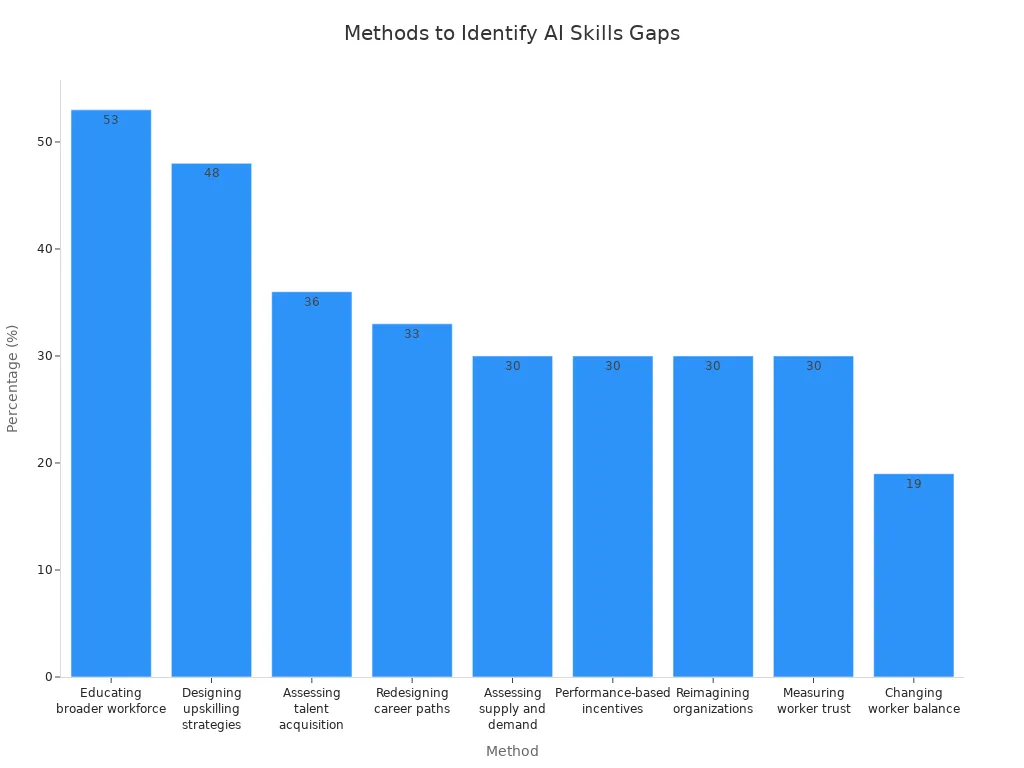
You can also measure worker trust and engagement, assess supply and demand for skills, and provide performance-based incentives for leveraging ai. Changing the balance between full-time, contract, and gig workers helps address new patterns from ai usage.
Managing Change
Change management is critical for enterprise ai platform adoption. You must align leadership and ensure all departments share goals and resources. Continuous communication helps mitigate resistance and fosters engagement. Comprehensive training prepares employees for new roles and evolving skill requirements. Involve employees in implementation decisions to address fears. Invest in skill development and provide ongoing support. Honest communication about role changes builds trust. The table below outlines effective change management strategies for enterprise ai:
| Strategy | Description |
|---|---|
| Leadership Alignment | Leaders must champion AI initiatives, ensuring all departments are synced on goals and resources. |
| Continuous Communication | Ongoing dialogue about changes and expectations helps mitigate resistance and fosters engagement. |
| Training | Comprehensive training prepares employees for new roles and evolving skill requirements. |
| Employee Involvement | Involving employees in implementation decisions helps address fears and resistance to change. |
| Skill Development | Investing in skill development ensures employees are equipped to handle new technologies effectively. |
| Honest Communication | Addressing fears directly through transparent communication about role changes is crucial. |
| Comprehensive Training | Organizations must prepare their workforce for new roles and evolving skill requirements. |
| Addressing Cultural Resistance | A robust strategy considers the impact of AI on employee responsibilities and cultural dynamics. |
| Ongoing Support | Continuous support is essential to help employees adapt to new workflows and technologies. |
Note: Run pilot projects to test assumptions and gather insights. Scale validated ai solutions across the enterprise to maximize benefits.
Defining Business Needs
Aligning AI Platform Capabilities
You need to match your enterprise ai platform with your business goals. Start by developing a clear ai strategy that supports your enterprise objectives. Build a strong data governance framework and invest in secure, scalable platforms. Foster cross-functional collaboration to bring together different skills and viewpoints. Implement explainable ai and governance frameworks to ensure transparency and trust.
- Start with a clear understanding of your business goals.
- Define governance requirements for your enterprise.
- Assess your data maturity to support ai solutions.
- Evaluate how ai will impact users across your enterprise.
Tip: A comprehensive ai strategy helps your enterprise stay focused and ensures your ai platform delivers real value.
Prioritizing Use Cases
You should focus on use cases that align with your enterprise strategy and deliver measurable results. Select projects that use shared data, can scale, and meet compliance standards. Consider the following criteria when you prioritize ai use cases:
- Value: Choose use cases that align with your enterprise objectives and offer high ROI.
- Ease of implementation: Assess how easy it is to launch and support each ai project.
- Stakeholder buy-in: Make sure leaders and employees support the chosen use cases.
Also, look at problem tractability, economic value, and ethical considerations. These factors help your enterprise ai projects succeed and grow.
Stakeholder Buy-In
You must secure support from key stakeholders to ensure your enterprise ai platform succeeds. Communicate clearly how ai addresses their needs. Use data-driven insights to show potential benefits. Manage expectations by sharing realistic views of ai capabilities. Involve stakeholders early for better alignment. Identify and mobilize internal champions to support your enterprise ai initiative.
Note: Actively seek feedback from stakeholders throughout the project. Respond to concerns and stay transparent about what your ai system can and cannot do. This approach builds trust and drives adoption across your enterprise.
Evaluating AI Platform Options

Selecting the right ai platform for your enterprise requires a structured evaluation framework. You should not rely on feature checklists alone. Instead, use industry best practices and expert guides to compare enterprise ai automation platforms. A structured approach helps you assess technical features, security, integration, and vendor reputation. This process ensures your enterprise ai solutions deliver value at scale and adapt to future needs.
Technical Features & Architecture
You need to examine the technical features and architecture of each ai automation platform. Look for platforms that support exploratory data analysis, multi-model support, and centralized data management. These features help your enterprise build, train, and deploy ai solutions efficiently. The right architecture should offer a unified data ecosystem, robust model development tools, and a business integration layer. You also want production-grade security and human oversight for safe and reliable operations.
| Feature | Description |
|---|---|
| Exploratory data analysis | Enables you to explore data and identify new ai use cases. |
| Data product generation | Lets non-technical users create data products for ai training. |
| Multi-model support | Offers a range of large language models for developers. |
| RAG workflow creation | Allows no-code creation of retrieval-augmented generation pipelines. |
| Centralized data management | Ensures accurate integration and governance of enterprise data. |
| Production-grade security | Provides compliance and builds customer trust. |
| Core Component | Description |
|---|---|
| Unified data ecosystem | Organizes data from all enterprise systems for ai use. |
| AI model development tools | Supports building, training, and deploying ai solutions. |
| Business integration layer | Embeds ai insights into daily enterprise workflows. |
| Security, governance framework | Manages privacy and regulatory compliance. |
| Human oversight | Involves cross-functional teams to monitor and refine ai models. |
When you evaluate enterprise ai automation platforms, consider scalability, agentic systems, and support for large-scale automation. Platforms with agentic systems enable advanced ai agent orchestration, letting you automate complex workflows across your enterprise. Pre-built solutions and flexible architectures help you adapt quickly as your needs evolve.
Tip: Choose an ai automation platform that supports both technical and non-technical users. This approach accelerates adoption and maximizes the impact of your ai solutions.
Security & Compliance
Security and compliance are critical for any enterprise ai platform. You must ensure the platform meets industry standards and regulatory requirements. Look for platforms that offer production-grade security and comprehensive compliance features. The table below highlights key standards you should check:
| Compliance Standard | Description |
|---|---|
| PCI-DSS for Financial Services | Requires strict security for ai systems handling payment data, including encryption and regular testing. |
| SOC 2 Type II Compliance | Essential for B2B SaaS; most enterprises require this before signing contracts. |
| GDPR and Data Privacy Requirements | Mandatory for ai systems processing EU personal data; non-negotiable in Europe. |
| The EU AI Act: High-Risk AI Requirements | Sets a legal framework for ai, enforceable from August 2024. |
| State-Level AI Regulations | Many states have laws to prevent algorithmic discrimination and ensure fairness. |
You should also verify that the ai automation platform provides strong data governance, audit trails, and continuous monitoring. These features protect your enterprise from data breaches and regulatory penalties.
Integration & Flexibility
Integration and flexibility determine how well an ai platform fits into your enterprise environment. You need a platform that connects seamlessly with your existing software and business systems. Deep enterprise integrations prevent information silos and support ai agent orchestration across departments. Look for pre-built connectors, open APIs, and support for multiple use cases.
- Integration capabilities: Ensure the platform connects with your core systems and supports both pre-built and custom integrations.
- Breadth of supported use cases: The platform should serve multiple departments and functions.
- Governance, safety, and observability: Robust monitoring and safety features are essential for enterprise ai automation platforms.
- Scalability and deployment: Assess how quickly you can deploy ai solutions and scale them as your enterprise grows.
A future-proof ai automation platform adapts to new models and technologies. It must maintain strict security controls while supporting flexible deployment options.
Note: Flexible ai agent orchestration lets you automate complex processes and respond to changing business needs.
Vendor Reputation
Vendor reputation plays a key role in your platform selection. You want a partner with a proven track record in delivering enterprise ai solutions. Review independent evaluations, customer testimonials, and industry awards. Compare core evaluation capabilities, safety handling, and production observability across leading vendor solutions.
| Platform | Core Evaluation Capabilities | Distinct Features | Safety Handling | Production Observability | Enterprise Readiness |
|---|---|---|---|---|---|
| Microsoft AI Foundry | Yes | Azure AI SDK | Yes | Yes | High |
| Microsoft Copilot Studio | Yes | Integrated Tools | Yes | Yes | High |
| LangSmith | Yes | Experiment Workflows | Yes | Yes | High |
| Arize AI | Yes | Observability Tools | Yes | Yes | High |
| Galileo | Yes | Custom Solutions | Yes | Yes | High |
| Maxim AI | Yes | Comprehensive Tools | Yes | Yes | High |
You should also consider the vendor’s support for ai agent orchestration, scalability, and large-scale automation. Strong vendor support ensures your enterprise ai automation platforms remain reliable and effective as your needs change.
Tip: Build a center of excellence within your enterprise to manage ai automation platform adoption and vendor relationships. This approach helps you measure ROI, maintain governance, and ensure long-term success.
AI Automation Platform Considerations
Scalability & Performance
You must evaluate scalability and performance when you select an ai automation platform for your enterprise. Leading enterprise ai automation platforms support rapid growth and adapt to changing workloads. You should measure integration depth and breadth, security and compliance, pricing transparency, and organizational memory. These benchmarks help you understand how well an ai platform fits your enterprise needs.
- Integration depth and breadth show how many native integrations the platform offers and how quickly you can connect new tools.
- Security and compliance include certifications, permission inheritance, and encryption standards.
- Pricing transparency reveals the true cost of ownership and feature inclusivity.
- Organizational memory tracks the platform’s ability to learn from interactions and maintain context.
You also need to check deployment options. Enterprise ai automation platforms should offer cloud, private VPC, or on-premises deployment with high-availability scaling. Fine-grained RBAC, SSO/SAML support, and immutable audit logs strengthen security.
Automation Capabilities
Automation capabilities set leading ai automation platforms apart. You want an ai platform that automates complex workflows, supports ai agent orchestration, and integrates with enterprise systems. The table below highlights core automation features:
| Core Capabilities of AI Automation Platforms | Description |
|---|---|
| Intelligent workflow automation | Automates complex workflows across the enterprise. |
| AI-driven decisioning and orchestration | Uses ai to make informed decisions and manage processes. |
| Event-based and real-time automation | Responds to events in real-time for immediate action. |
| Enterprise system integration | Connects with existing enterprise systems for seamless operation. |
| Monitoring, optimization, and lifecycle management | Ensures ongoing performance and improvement of automated processes. |
| Visual canvas for designing workflows | Provides a user-friendly interface for creating workflows without coding. |
| AI native features such as full AI agents | Incorporates advanced ai capabilities for enhanced automation. |
You should look for platforms that support ai agent orchestration and offer visual tools for workflow design. These features help your enterprise build and scale ai solutions quickly.
Real-World ROI
You must assess real-world ROI before you invest in an ai automation platform. Enterprises track financial, operational, client-facing, and deployment metrics to measure success. The table below shows key ROI metrics:
| Metric Type | Description |
|---|---|
| Financial metrics | Revenue growth, cost reduction, EBIT impact, and return on invested capital. |
| Operational metrics | Productivity gains, cycle time reductions, and error rate improvements. |
| Client-facing metrics | Changes in Net Promoter Score, conversion rates, and customer satisfaction. |
| Deployment metrics | Percentage of workflows deployed, time from pilot to value, and adoption rates. |
| ROI Realization Rates | 5% achieve substantial value, 35% are scaling, 60% report minimal gains. |
| Long-term ROI | Revenue growth from ai products, market share gains, and new business models after 3-5 years. |
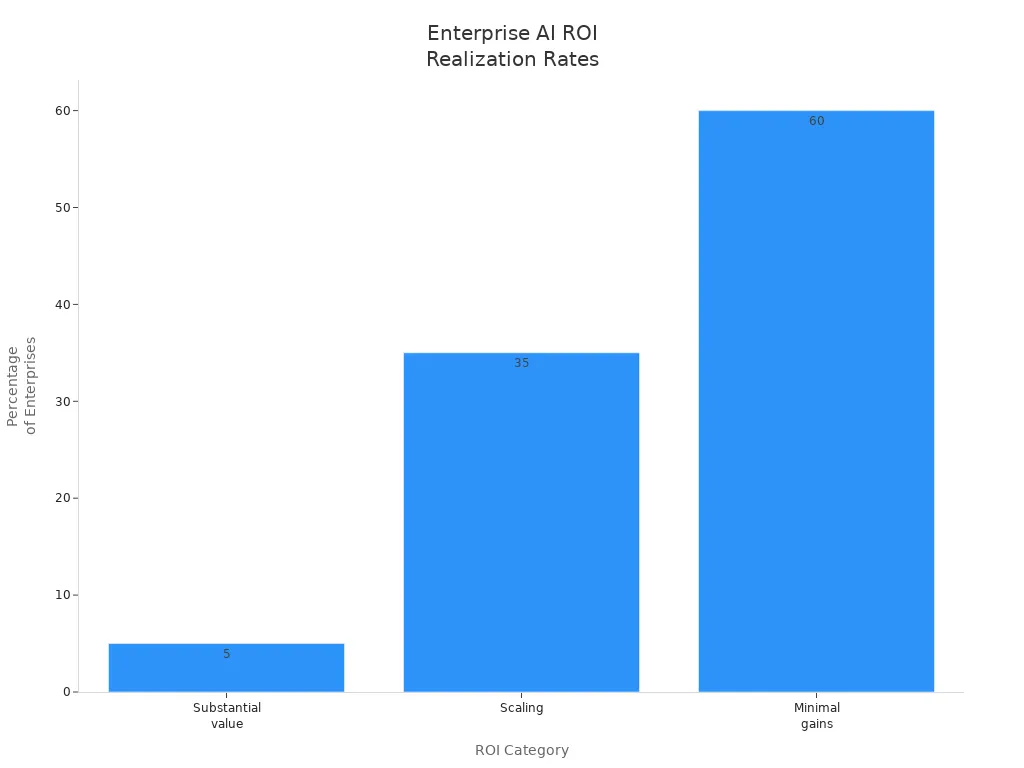
Only 5% of enterprises achieve substantial value from ai at scale. About 35% are scaling ai technology and starting to see results. Most enterprises, around 60%, report minimal gains despite investment. Shifting decision-making to agentic ai platforms reduces decision latency. Your enterprise can respond faster to market changes and improve operational agility. You should prioritize autonomous decision intelligence to enhance performance and reduce cognitive load on your teams.
Tip: Track ROI metrics regularly to ensure your ai automation platform delivers measurable value for your enterprise.
Cost & Total Ownership
Pricing Models
You will find several pricing models when you compare enterprise AI platforms. Each model affects your total cost of ownership and long-term planning. Review the table below to understand the most common pricing structures:
| Pricing Model | Description |
|---|---|
| Enterprise Pricing | Pricing tailored for large organizations |
| Subscription-Based | Regular payments for access to the platform |
| Usage-Based | Costs based on the amount of usage |
| Per-Seat-Based | Pricing based on the number of users |
| Tiered Volume Pricing | Discounts based on the volume of usage |
| Pay-As-You-Go | Flexible pricing without bulk commitments |
You may also encounter different deployment options. SaaS AI tools offer quick setup but limited customization, with a typical total cost of ownership two to three times the list price each year. Cloud AI services provide scalability and moderate customization, but costs can reach four to six times the initial estimate. Self-hosted AI gives you maximum control for sensitive enterprise data, yet the total cost can be six to ten times the infrastructure cost. Custom AI development delivers unique advantages but often costs ten to fifteen times the initial scope.
Hidden Costs
You should look beyond the sticker price when you evaluate enterprise AI solutions. Many organizations underestimate hidden costs, which can impact your budget. The table below highlights common cost components:
| Cost Component | Description |
|---|---|
| Software Licenses | Base platform fees for AI tools, typically subscription-based, ranging from $10K-$500K+ annually. |
| Compute Resources | Cloud GPU/TPU costs for training and inference, often the largest expense. |
| Data Infrastructure | Costs for storage, vector databases, data pipelines, and ETL tools. |
| Talent Costs | Salaries for ML engineers, data scientists, and AI specialists, plus recruiting expenses. |
| Integration & Customization | Development work connecting AI to existing systems and creating workflows. |
| Training & Change Management | Employee education and organizational adoption programs. |
| Governance & Compliance | Security audits, compliance reviews, and risk management frameworks. |
Note: Many enterprises see their initial AI deployment quote multiply several times due to these hidden costs. For example, a $300K estimate can become $1.8M in the first year.
Value Assessment
You need a structured approach to assess the value of your enterprise AI investment. Strong governance helps you set decision rights and manage accountability. Risk management addresses unique AI challenges and mitigation strategies. Performance monitoring tracks ROI and gathers feedback for continuous improvement. Regulatory compliance ensures you meet all legal requirements. Skill gap management supports training and knowledge retention.
- Develop specialized capabilities for AI value measurement, using analytics tools.
- Manage AI initiatives as a portfolio to balance risk and allocate resources.
- Establish feedback loops to connect value insights with ongoing AI solutions development.
A comprehensive value assessment aligns your AI solutions with enterprise goals and helps you maximize returns from vendor solutions.
Common Pitfalls
Integration Challenges
You may face several integration challenges when you bring an ai platform into your enterprise. Many enterprises struggle with legacy system compatibility. Outdated infrastructure often lacks the APIs and flexibility needed for modern ai workloads. Data silos across departments can block ai models from accessing the full range of enterprise data, which leads to poor predictions. You might also find that your teams lack the technical skills to build and maintain ai systems. Ongoing maintenance and optimization are necessary to keep ai models accurate. Weak data governance can expose your enterprise to privacy risks and regulatory penalties. Without a clear understanding of how ai fits your business goals, you may struggle to achieve success.
- Legacy system compatibility
- Scattered and fragmented data
- Lack of technical specialization
- Maintenance and continuous optimization
- Weak data security and governance
- Unclear use cases for ai
Tip: Build cross-functional teams and invest in data integration tools to overcome these challenges.
Underestimating Change
Many enterprises underestimate the amount of change needed for successful ai adoption. You may see structural misalignment when you try to fit ai into old workflows. Traditional hierarchies often clash with the cross-functional work that ai requires. Without clear governance, your ai projects may become siloed. Employees sometimes fear that ai will replace their jobs, which leads to resistance. Insufficient training is a major issue, with 38% of ai adoption problems linked to it. Employees may quietly avoid new systems, keeping old habits. Research shows that 75% of organizations reach a point where too much change causes resistance and defensive behavior.
- Structural misalignment with existing workflows
- Hierarchical barriers to cross-functional collaboration
- Lack of governance for ai decision-making
- Employee fear and resistance
- Insufficient training and quiet non-adoption
Note: Communicate openly and provide ongoing training to help your enterprise adapt to ai-driven changes.
Ignoring Scalability
Ignoring scalability can slow down ai adoption in your enterprise. If you do not plan for growth, your return on investment drops and support costs rise. Training overhead increases, and employees may resist new systems. Operational friction can stall ai projects because workflows cannot absorb new outputs. Fragmentation costs can waste up to 30% of your team's workweek as they search for data. Without shared context, your enterprise will not realize the full economic benefits of your ai platform.
- Slower adoption
- Lower ROI
- Higher support and training costs
- Increased internal resistance
- Operational friction and fragmentation
Tip: Choose an ai platform that scales with your enterprise and supports future growth.
Vendor Support
Strong vendor support is essential for enterprise ai success. You need a partner who understands your industry and can help you solve problems quickly. Poor vendor support can delay issue resolution and disrupt your operations. Look for vendors who offer clear communication, fast response times, and ongoing training. Reliable support helps your enterprise get the most value from your ai investment and ensures your platform stays up to date.
| Vendor Support Factor | Why It Matters for Enterprise AI |
|---|---|
| Fast response times | Keeps your ai systems running smoothly |
| Ongoing training | Helps your teams stay current |
| Clear communication | Reduces confusion and errors |
| Industry expertise | Ensures solutions fit your enterprise |
Tip: Evaluate vendor support as carefully as you assess technical features when selecting an ai platform.
Implementation & Scaling

Pilot Projects
You should start your enterprise ai journey with pilot projects. These projects help you test assumptions and refine your approach before scaling. Lighthouse projects act as proof-of-concept examples that show the value of ai in your enterprise. They also create frameworks you can use for future projects. A structured pilot process helps you move from idea to enterprise-wide adoption.
| Step | Description |
|---|---|
| 1 | Run pilot projects to test assumptions and methodologies. |
| 2 | Gather insights from these tests to fine-tune approaches. |
A typical pilot project in an enterprise follows four phases, each lasting about four weeks:
| Phase | Duration | Description |
|---|---|---|
| 1 | 4 weeks | Develop a business case and align stakeholders. |
| 2 | 4 weeks | Implement the pilot and train users. |
| 3 | 4 weeks | Measure success and collect feedback. |
| 4 | 4 weeks | Prepare for scaling with enterprise planning. |
Tip: Use pilot projects to build confidence in ai and set the stage for larger enterprise initiatives.
Building Expertise
You need to build expertise across your enterprise to get the most from ai. Start by defining clear business objectives that align with your operational challenges. Make sure your data is ready by creating a reliable data ecosystem. Pilot targeted projects to learn quickly and validate your methods. Cross-functional teams bring together different skills and viewpoints, which strengthens your ai efforts. Choose the right technology and partners to support your enterprise needs. Change management and employee engagement are key for successful ai adoption.
- Align ai initiatives with business goals.
- Engage leadership to foster ownership.
- Build cross-functional teams for diverse expertise.
- Prioritize change management and adoption.
Note: Building expertise helps your enterprise adapt to new ai technologies and ensures long-term success.
Scaling Across Enterprise
Scaling ai across your enterprise requires a step-by-step approach. Start small and scale gradually. Focus on data quality and integrate ai with your existing systems. Make sure your solutions can grow as your enterprise expands. Balance performance with cost, and always prioritize security and compliance. Measure the impact of ai and track your return on investment. Encourage continuous improvement and responsible scaling. A strong data foundation is key to ai success in any enterprise.
- Start small, scale gradually.
- Focus on data quality.
- Integrate with existing systems.
- Ensure scalability.
- Balance performance and cost.
- Prioritize security and compliance.
- Measure ROI and impact.
- Scale ai responsibly.
- Encourage continuous improvement.
- Build a strong data foundation.
Tip: Involve stakeholders from across your enterprise and monitor ai models closely to ensure ongoing value.
Selecting the right enterprise ai platform requires a clear plan. Start by matching the platform to your enterprise needs and compliance goals. Use pilots and demos to test vendor claims. Build a roadmap that begins with a pilot and scales across your enterprise. Check how fast you can deploy ai and how well it fits with your systems. Review support quality and total ownership costs. Always keep your enterprise focused on long-term ai value and adaptability.
FAQ
What is the most important factor when choosing an enterprise AI platform?
You should focus on how well the platform fits your business goals. Look for strong integration, security, and support. A good platform helps you scale and adapt as your needs change.
How do I ensure compliance and security with AI platforms?
You must check for industry certifications and clear data policies. Review the platform’s approach to ai governance essentials. Regular audits and strong access controls protect your data and help you meet regulations.
When should I involve an ai strategy consultant?
You should bring in an ai strategy consultant early in your planning. This expert helps you define goals, assess readiness, and avoid costly mistakes. Early guidance leads to better results and smoother adoption.
What are common hidden costs in enterprise AI adoption?
Hidden costs often include training, integration, and ongoing support. You may also pay for extra compute resources and compliance checks. Always review the full cost of ownership before you decide.
How can I measure the success of my AI platform?
Track key metrics like ROI, user adoption, and process improvements. Use simple dashboards to monitor progress. Regular reviews help you adjust your strategy and maximize value.
See Also
Utilizing AI To Improve Production Forecasting Accuracy In 2024
Using AI And Data For Demand Forecasting In 2025
Innovative AI Solutions In Fashion For A Sustainable Future
Why WarpDriven ERP Is Unique For Smart Supply Chain Management