
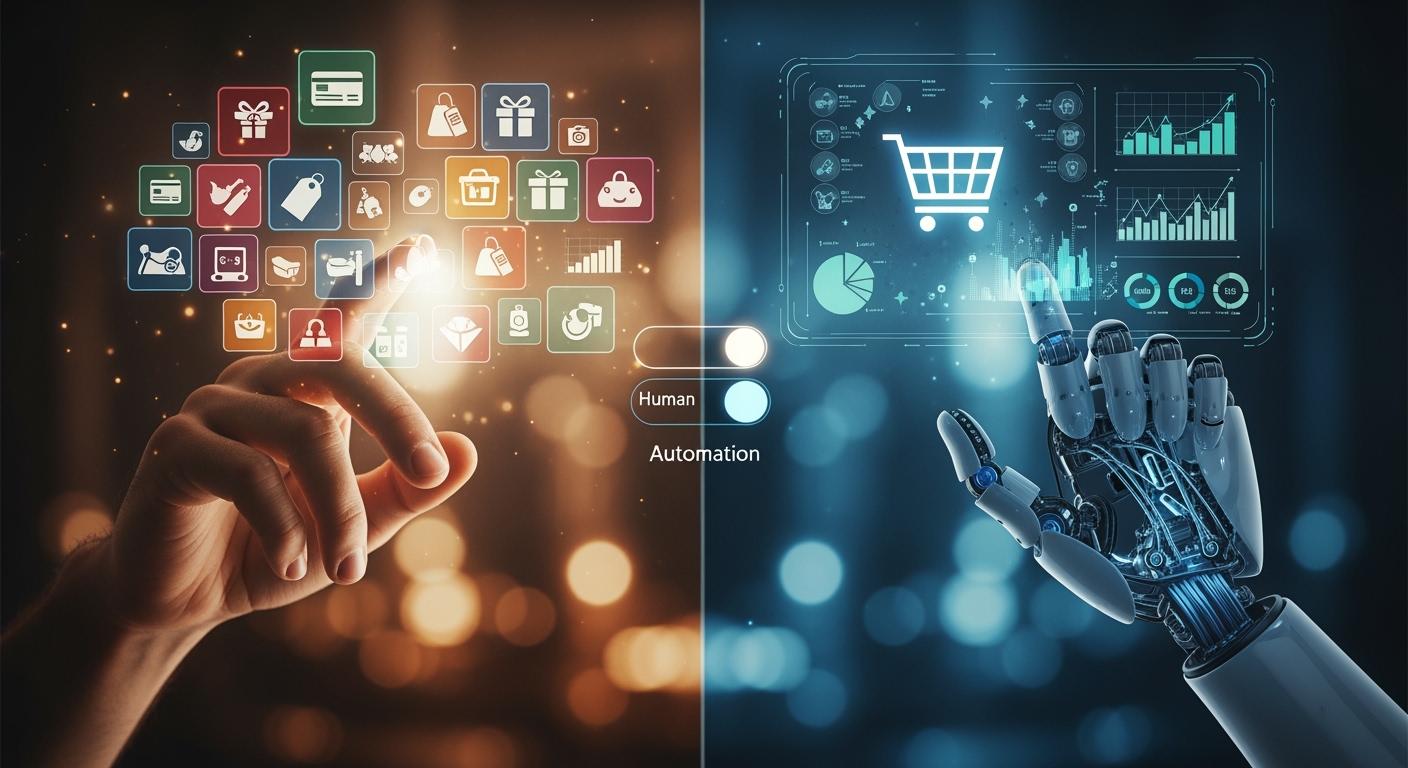
You face a choice between human-in-the-loop and fully autonomous commerce agents. The main difference is how much control you keep. Human-in-the-loop agents let you step in, which many leaders value for accountability and common sense. This has a direct impact on your business and customer experience. The table below shows what industry experts and surveys say about trust, oversight, and risk:
| Perspective | Evidence |
|---|---|
| Head of Compliance | "Ultimately, it is the human beings who must be accountable. You can’t outsource accountability." |
| Chief Financial Officer | "There needs to be a human component because while AI is great, sometimes nothing can beat good old common sense and intuition." |
| Survey Preference | 42% of respondents believe human oversight is mandatory, not optional. |
As you read, think about your business’s complexity, compliance needs, and customer experience goals.
What Is Human-in-the-Loop?
HITL Definition and Role
You may hear the term HITL when people talk about advanced ai systems. HITL stands for human-in-the-loop. This means you, as a human, stay involved in important steps of the process. HITL agents work with ai to complete tasks, but you make the final decisions. This approach keeps you in control and lets you use your judgment when it matters most. HITL agents support human-ai interaction by blending ai efficiency with human oversight.
The roles of HITL agents in business are wide-ranging. Here is a table that shows common roles and where you might see them:
| Role Description | Example Application |
|---|---|
| Oversight and Accountability | Financial institutions monitor transactions and conduct KYC checks, with human analysts making high-risk decisions. |
| Clinical Decision Support | Agents triage cases and summarize patient data, while clinicians review and approve clinical next steps. |
| Content Creation and Approval | Content agents draft materials, which are then refined and approved by humans to meet brand and legal standards. |
| CI/CD Pipeline Management | Agents manage deployment processes, while humans gatekeep critical changes and deployments. |
Key Features of Human-in-the-Loop Agents
HITL agents have several features that set them apart from other ai systems:
- HITL agents handle complex workflows that need human input, such as writing contracts or negotiating terms.
- You set the goals, and the ai agent carries out the tasks. This keeps you in charge.
- HITL agents focus on reducing your effort but never remove your choices.
- These agents use reasoning. They weigh options and make judgment calls, not just follow rules.
- You can set guardrails for HITL agents, making sure control stays with you.
- HITL agents execute tasks while you keep oversight. This is different from fully autonomous ai systems.
HITL agents help you get the benefits of ai efficiency while keeping important decisions in your hands.
When to Use HITL
You should use HITL when your business needs both ai power and human judgment. HITL works best in areas where mistakes can have big impacts. For example, in healthcare, ai agents can pre-screen medical images, but doctors confirm the diagnosis. In finance, ai flags suspicious transactions, but human underwriters review them for fairness and compliance. In legal services, ai can prioritize cases, but officers make the final ethical decisions.
HITL is a smart choice when you want to balance speed, accuracy, and trust. You get the speed of ai, but you do not lose control. HITL agents make sure you can step in whenever needed.
What Are Fully Autonomous Commerce Agents?
Autonomous Agent Capabilities
You can think of fully autonomous commerce agents as advanced ai systems that work on their own. These agents do not wait for your instructions at every step. They understand your goals and act to achieve them. You get a system that learns from interactions and adapts to new situations. Here are some main capabilities you will find in these agents:
| Capability | Description |
|---|---|
| Understanding user intent | The agent interprets what you want and uses your history to suggest products. |
| Analyzing options | It reviews choices and gives you the best recommendations. |
| Executing purchases | The agent can buy items for you without your help. |
| Proactive fraud prevention | It works to stop fraud before it happens during transactions. |
| Hyper-personalized shopping | The agent creates a shopping experience just for you, using your data. |
| Autonomous post-purchase support | It answers your questions and solves problems after you buy, all on its own. |
You see autonomy in every part of the process. The agent does not just help you; it acts for you.
Agentic AI Overview
Agentic ai means you get systems that can sense, decide, and act based on your needs. These agents use autonomy to handle tasks from start to finish. You do not need to check every step. The agent can manage exceptions and work with other agents. This level of autonomy makes your business more efficient. You trust the agent to adapt and solve problems as they come up. Autonomy in agentic ai is not just about following rules. It is about making smart choices in real time.
Note: Agentic ai brings autonomy to a new level. You get agents that can coordinate, learn, and improve over time.
Use Cases for Full Autonomy
You will find full autonomy in many parts of retail and e-commerce. Here are some common examples:
- Analytics-driven campaign optimization: The agent changes prices and promotions using live market data.
- Virtual shopping assistants: The agent helps customers find products and gives personal suggestions.
- Shelf optimization: The agent decides where to place products in stores for better sales.
- Dynamic customer service: The agent answers questions and solves problems without human help.
You gain speed, accuracy, and a better customer experience with autonomy. Autonomous agents let you focus on strategy while they handle the details. You see the power of autonomy in every part of your business.
Human-in-the-Loop vs Fully Autonomous: Key Differences

Control and Oversight
You need to understand how control and oversight shape the way ai agents work in commerce. Human-in-the-loop agents keep you involved in every important step. You make decisions when tasks become complex or require ethical judgment. Human oversight gives you confidence that the process stays fair and transparent. Autonomous agents operate without your constant input. They follow clear rules and handle predictable tasks on their own. You see less direct control, but you gain efficiency.
Tip: If your business deals with sensitive data or high-stakes decisions, human oversight can protect your reputation and build trust.
The table below shows how control and oversight compare between human-in-the-loop and autonomous agents:
| Aspect | Human-in-the-Loop Agents | Fully Autonomous Agents |
|---|---|---|
| Control and Oversight | Requires human oversight for complex decision-making and ethical considerations. | Operates independently in predictable environments with clear rules. |
| Handling Complexity | Excels in nuanced tasks requiring emotional intelligence and creativity. | Best for high-volume, repetitive tasks with low complexity. |
| Adaptability to Edge Cases | Capable of navigating unforeseen circumstances and edge cases. | Limited to scenarios within training data, struggles with novel situations. |
| Accountability and Trust | Provides a layer of ethical oversight and public trust in high-stakes decisions. | Lacks human accountability, which can be critical in sensitive areas. |
| Continuous Improvement | Human feedback is essential for refining ai models and improving accuracy. | Operates based on pre-defined algorithms without human input for learning. |
You see that human-in-the-loop agents excel when you need flexibility and accountability. Autonomous agents shine in environments where automation can drive efficiency and speed.
Risk and Error Management
Risk and error management play a big role in the impact of ai systems. Human-in-the-loop agents reduce errors because you check their work. Human oversight helps you catch mistakes before they affect customers or compliance. You adapt risk strategies as situations change. Autonomous agents rely on automation and algorithms. They manage risk using predefined rules. You may see higher error rates because there is no human oversight to catch unusual cases.
Note: Human oversight ensures compliance and legal accuracy, especially in regulated industries.
The table below highlights how error rates and risk management differ:
| Aspect | Human-in-the-Loop Agents | Fully Autonomous Agents |
|---|---|---|
| Error Rate Management | Improved through human oversight | Higher due to lack of oversight |
| Risk Management Strategies | Collaborative and adaptive | Rigid and predefined |
| Compliance and Legal Oversight | Ensured by human intervention | Often insufficient without human input |
You gain accuracy and quality with human-in-the-loop agents. Autonomous agents offer speed, but you must monitor for errors and compliance gaps.
Scalability and Speed
Scalability and speed show the biggest advantages of autonomous agents. You can automate tasks across large operations without adding more staff. Ai-driven automation lets you handle thousands of transactions, manage inventory, and respond to customers in real time. Human-in-the-loop agents limit scalability because you need people to review and approve tasks. You may see slower response times, but you maintain quality and accuracy.
Here are some examples of how autonomous agents deliver scalability and speed:
- E-commerce platforms use ai-driven automation to manage inventory and customer service, reaching levels of scalability beyond human teams.
- Financial trading relies on autonomous algorithms to execute trades at speeds humans cannot match.
- Manufacturing uses automation and robotics for precision and efficiency, outpacing traditional human-run operations.
- Logistics benefits from automated warehousing and delivery systems, providing unmatched speed and cost-effectiveness.
- R&D and innovation accelerate with autonomous systems that use computational power and continuous learning.
Callout: If your business needs to grow fast or handle high volumes, autonomous agents and automation can help you scale without sacrificing speed.
You must balance scalability and quality. Human-in-the-loop agents protect accuracy and oversight, but autonomous agents drive automation and operational impact.
Building Trust and Ensuring Compliance
HITL for Building Trust
You want your customers to feel confident when they interact with ai in your business. Building trust starts with clear communication and responsible design. A human-in-the-loop approach helps you combine ai speed with human judgment. This method gives you better results in complex situations and helps your customers feel safe.
Here are some effective ways to build trust with ai-powered agents:
- Use a human-in-the-loop approach to ensure accurate outcomes, especially when decisions are complex.
- Stay transparent with customers about how ai works and what it can and cannot do.
- Train ai on diverse and inclusive data to avoid bias and make sure everyone gets fair treatment.
- Protect customer data with strong security measures.
For example, an ecommerce company uses ai to spot fraud but lets human agents review flagged orders. This reduces mistakes and builds trust. A chatbot can introduce itself as ai and offer to connect customers with a human for tough questions. These steps show your commitment to building trust and improving operational efficiency.
Compliance and Regulatory Considerations
You must follow strict rules when you use ai in commerce. Compliance protects your business and your customers. You need to set clear permissions for ai agents and log every action for audits. Regulations like GDPR, HIPAA, SOX, and the EU AI Act require you to keep oversight and control.
Key compliance steps include:
- Define what decisions ai agents can make on their own.
- Allow human operators to override ai actions when needed.
- Make sure all decisions are explainable and easy to audit.
- Test ai systems often for bias and errors.
- Control and log access to sensitive data.
- Map out who is responsible for ai outcomes.
- Check third-party ai models before using them.
Note: Good compliance means you use technical tools like version control, role-based access, and secure logs. These tools help you track every decision and keep data safe. When you follow these steps, you improve operational efficiency and build trust with your customers.
Decision Factors for Choosing an Agent
Business Needs Assessment
You need to match the right agent to your business goals. Start by looking at your business size, the complexity of your tasks, and how much risk you can accept. Larger businesses often have more resources for automation, while smaller businesses may want more human oversight. If your business handles complex decision-making or high-stakes choices, you should consider human-in-the-loop systems. These systems let you understand the reasoning behind each decision. Explainable AI helps you see why an agent made a choice, which builds trust and allows you to step in when needed.
Here is a simple checklist to guide your decision:
- Does your business need human oversight for critical decisions?
- Are your tasks predictable or do they change often?
- How much error can your business tolerate?
- Do you need to explain decisions to customers or regulators?
- Is your business ready for the technology and infrastructure needed for automation?
Tip: Use this checklist to see if your business needs more control or more speed. The right choice will have a big impact on your business impact and customer experience.
Cost and Resource Implications
You must think about both direct and hidden costs when choosing between human-in-the-loop and fully autonomous agents. Human-in-the-loop AI gives you better oversight and is best for high-stakes decisions, but it works slower and needs more people. Fully autonomous AI works faster and costs less per task. For example, AI agents can handle tasks for as little as $0.09, while human workers cost much more per minute. Customer service with AI can cost between $0.015 and $0.12 per interaction, but human agents cost $0.25 to $0.42 per minute.
However, you should also plan for extra costs. These include building the right infrastructure, training staff, and making sure you follow all rules. Human-in-the-loop systems need more documentation and oversight, which slows things down but improves accuracy. Fully autonomous systems need strong technology and may require you to update your business systems. You can expect productivity to improve by up to 60% with the right automation, but only if your business is ready for it.
Remember: The best decision balances cost, speed, accuracy, and the needs of your business. Think about the long-term impact on your decision-making and how it shapes your business future.
Real-World Examples

HITL in Practice
You can see human-in-the-loop agents at work in many industries. For example, in customer support, ai helps answer simple questions, but you or your team step in for complex issues. This approach keeps your service fast and accurate. In finance, ai agents process invoices and payments, but humans review high-value transactions. This method saves time and reduces mistakes.
Here is a table that shows how different industries use ai with human oversight:
| Industry | Benefits | Challenges |
|---|---|---|
| Finance | Eliminated 1,750 hours of manual AP work annually, improved accuracy. | N/A |
| Logistics | Achieved 99% data accuracy, cut processing costs by 50%. | N/A |
| HR | Reduced time-to-hire by 75%, saved over 50,000 hours of interview time. | N/A |
| Customer Support | Deflected 43% of tickets, leading to a 9.44% increase in satisfaction. | Need for human escalation for complex queries. |
| Insurance | Near real-time claims processing, 70% documents handled by ai. | Integration of ai with human oversight. |
You get faster results and better accuracy with ai, but you still need people to handle special cases or tough questions.
Fully Autonomous in Practice
Fully autonomous commerce agents work without human help. You can find these agents in online shopping, where they recommend products, set prices, and even complete sales. These ai agents learn from customer data and make decisions in real time. You see faster service and more personal experiences for your customers.
Here is a table that highlights the benefits and challenges of using fully autonomous ai agents:
| Benefits | Challenges |
|---|---|
| Enhanced customer experience | Excessive agency leading to unintended actions |
| Increased sales growth | Security threats from potential exploitation |
| Improved personalization at scale | Regulatory concerns regarding transparency and ethics |
You gain speed and growth with ai, but you must watch for security risks and make sure your system stays fair and clear.
Hybrid and Evolving Approaches
Combining HITL and Autonomy
You do not have to choose only one approach for your business. Many companies now use hybrid models that blend human-in-the-loop with autonomous ai agents. These models give you the best of both worlds. You get the speed and efficiency of autonomous systems, but you also keep human judgment for important decisions.
Three main hybrid decision-making paradigms help you combine these approaches:
- Human oversight: You let ai handle routine tasks, but humans review and approve critical steps.
- Learning to abstain: The ai agent knows when to pause and ask for your help if it faces uncertainty.
- Learning together: You and the ai agent work as a team, learning from each other over time.
You see these paradigms in action when ai agents escalate complex cases to human experts. This structure supports transparency and helps you build trust with your customers. While research on these hybrid models is still growing, many businesses already see automation benefits and improved outcomes.
Future Trends
You will see even more changes as ai and autonomous agents evolve. In the future, autonomous agents will automate complex workflows, especially in areas like procurement. These agents will use machine learning to study past outcomes and find the best ways to buy products or services. They will also use market intelligence to adjust schedules and strategies based on real-time data.
You will still play a key role. Human-in-the-loop features will remain important, allowing you to oversee and guide decisions when needed. This mix of automation and human input will give your business unparalleled scalability and flexibility. As ai agents become smarter, you will gain more automation benefits, but you will also need to focus on keeping systems fair and transparent.
Tip: Stay open to new hybrid models. They help you balance efficiency, control, and trust as ai and autonomous technologies continue to grow.
You see clear differences between human-in-the-loop and fully autonomous agents. The table below shows their strengths and weaknesses:
| Aspect | Human-in-the-Loop (HITL) | Fully Autonomous Agents |
|---|---|---|
| Strengths | Ensures accuracy and builds trust | Handles tasks independently |
| Weaknesses | Needs human oversight | May lack sensitivity in processes |
You should align your choice with your business goals, risk tolerance, and compliance needs. To start, pilot a solution, invest in secure data systems, and establish clear oversight. Keep evaluating as technology evolves.
FAQ
What is the main benefit of human-in-the-loop agents?
You gain control and oversight. HITL agents let you check decisions and step in when needed. This builds trust and helps you avoid mistakes in important tasks.
Can fully autonomous agents replace human workers?
You can automate many tasks with fully autonomous agents. However, you still need humans for complex decisions, ethical issues, and creative work. AI works best as a tool, not a full replacement.
How do I decide which agent type fits my business?
Tip: Make a list of your business needs. If you value speed and scale, choose autonomous agents. If you need accuracy and trust, use HITL agents. Consider your risk tolerance and compliance requirements.
Are hybrid models common in commerce?
Hybrid models are growing fast. You see AI handling routine tasks while humans review critical steps. This approach gives you both efficiency and control.
See Also
Effective Ecommerce Strategies for 2025: A Practical Guide
The Evolution of Ecommerce Services in the Future
AI-Driven Safety Stock Solutions for Fashion Retail in 2025
Impress Customers Using Advanced Machine Learning for Orders