

In 2026, you see companies launch products 30% faster because they use ai trend forecasting. You get real-time market insights that help you spot new trends before your competitors. You rely on AI to create innovative ideas and improve quality. You use these tools every day to make smarter decisions and stay ahead.
AI Trend Forecasting in 2026
AI trend forecasting is now the foundation of product development. You no longer treat it as an experiment. You rely on AI every day to guide your decisions and shape your workflow. Agentic AI automates entire processes, which changes how you work and collaborate. You see teams restructure to include both humans and AI, making product development faster and smarter.
Real-Time Market Insights
You get real-time insights from AI trend forecasting. These insights help you spot demand signals instantly. You can adjust your product strategies right away when you see shifts in consumer behavior. AI improves inventory management, so you avoid forecasting errors and keep stock levels optimal.
- Real-time data analysis gives you instant access to demand signals.
- AI-powered demand forecasting lets you change strategies quickly.
- AI-based forecasting helps you manage inventory and reduce errors.
You notice that AI trend forecasting launches new products faster than traditional methods. It manages many SKUs and handles unpredictable demand. You plan across multiple locations and set safety stock levels with greater accuracy.
| Method | Speed | Accuracy |
|---|---|---|
| AI Trend Forecasting | Near-instantaneous | 85-95% |
| Traditional Methods | Slower, manual | 70-79% |
You see that real-time insights from AI trend forecasting are much faster and more accurate than older methods.
Accelerated Product Innovation
AI speeds up product innovation cycles. You see companies like BMW and Boeing use generative design AI and simulation tools. They cut component development times by up to 50%. PepsiCo uses AI analytics on social media and consumption data. They shorten their innovation cycle to just a few months. Researchers in pharmaceuticals use AI models like AlphaFold for protein folding. They achieve breakthroughs in weeks instead of years.
| Industry | Example | Impact on Innovation Cycle |
|---|---|---|
| Automotive | BMW and Boeing using generative design AI and simulation tools | Cut component development times by up to 50% |
| Consumer Goods | PepsiCo utilizing AI analytics on social media and consumption data | Shortened product innovation cycle to a few months |
| Pharmaceuticals | Researchers using AI models like AlphaFold for protein folding | Achieved breakthroughs in weeks instead of years |
| General | Companies using AI in product development (Kearney, McKinsey) | 20-50% reductions in time-to-market |
| Manufacturing | Generative AI and machine learning on factory floors | Cut development lead times in half |
| Cultural Shift | Adoption of iterative, experimentative mindsets in businesses | Accelerated innovation through rapid experimentation |
You see a cultural shift. Teams adopt iterative and experimentative mindsets. AI enables rapid experimentation, so you innovate faster.
Predictive Quality Assurance
AI transforms quality assurance from reactive to predictive. You use AI systems to predict which agents are at risk of quality failures. AI forecasts which code modules may have defects based on development patterns. You get live guidance during customer interactions, which improves quality in real time.
- AI predicts quality failures early.
- AI forecasts defects in code modules.
- Real-time quality assurance becomes standard.
You see higher customer satisfaction scores. You notice fewer escaped defects. You spend less on QA overhead. You iterate faster.
- Higher customer satisfaction scores.
- Fewer escaped defects.
- Lower QA overhead.
- Faster iteration cycles.
Predictive quality control uses machine learning and data analysis. You foresee and fix quality issues before they happen. This proactive approach reduces defects and improves product quality. You see a big shift from traditional reactive quality management.
You also notice that 68% of QA teams use AI-driven solutions for critical QA activities. AI transforms product QA and testing. You prioritize prevention over remediation. Digital modeling grows fast, with the global digital twin market expected to reach $110.1 billion by 2028.
Tip: You can use AI trend forecasting to spot quality risks early and improve customer satisfaction.
AI is not just a tool. You see it as a partner in every step of product development. You integrate AI into your workflow, which makes your team more efficient and innovative.
Key Product Development Trends Shaped by AI
Integrated Strategy and Delivery
You see a big shift in how you connect strategy with delivery in digital product development. AI helps you align your goals with your actions, but you also notice a gap. About 75% of product leaders struggle to follow through on strategic plans. Executives and managers often see this challenge differently. For example, 42% of executives say following strategy is a major barrier, while only 21% of managers agree. This divide can slow down your progress.
AI transformation helps you close this gap. You use AI to automate routine tasks and focus more on strategic planning. You get real-time analytics that show you where your process slows down. You can predict bottlenecks and fix them before they become problems. You also use AI to analyze market trends and customer feedback. This helps you create better product concepts and adapt your strategy quickly.
- AI-powered tools help you test ideas early and reduce risks.
- Automation frees up your time for creative work.
- Data-driven strategies give you clear insights for decision-making.
- Continuous market analysis lets you adjust your plans in real time.
- Enhanced collaboration improves communication among your teams.
You see that AI trend forecasting makes your workflow more efficient. You can measure the benefits by tracking cost savings, quality improvements, and faster market response. Companies like Salesforce review their ROI every quarter to see how AI impacts their product management costs.
Note: AI-driven predictive testing lets you spot failures before they happen. This reduces defects and speeds up your time-to-market.
Human-AI Collaboration in Design
You work with AI as a creative partner in digital product development. AI trends show that you can use machine learning tools to predict design flaws and avoid expensive mistakes. You replace physical prototypes with digital models, which saves money and time. You also use AI to test new ideas quickly, so you can focus on product innovation.
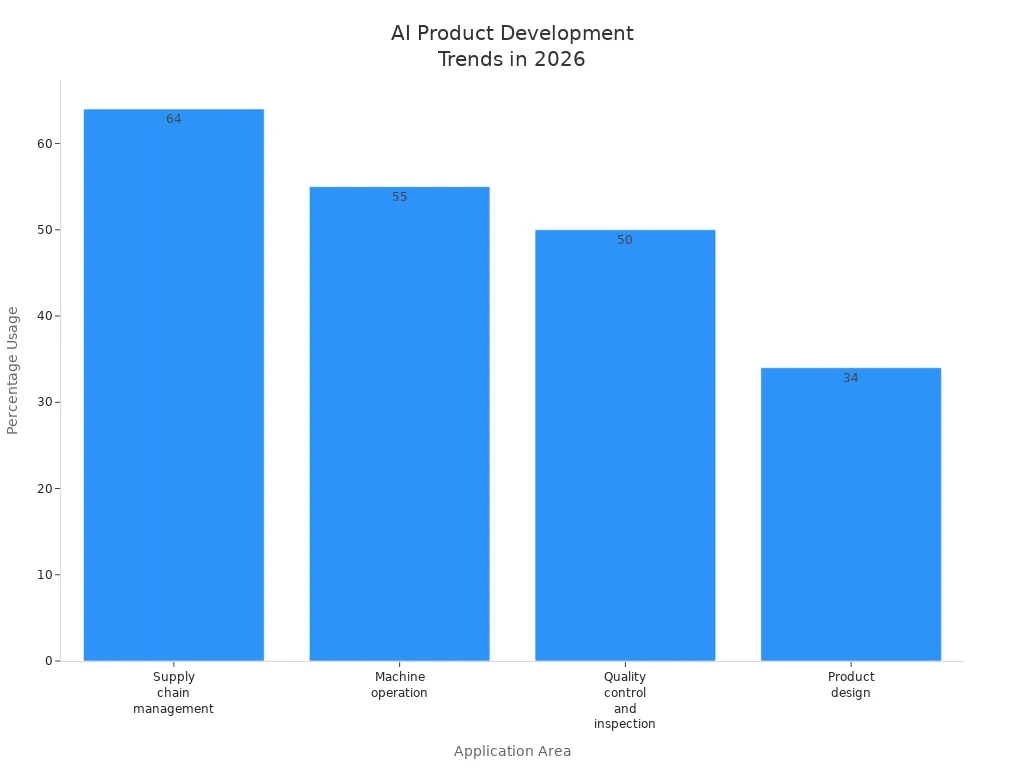
You see that 34% of companies use AI in product design. This number keeps growing as more teams see the value of human-AI collaboration. You bring your creativity, and AI brings speed and data analysis. Together, you create better products.
You notice that AI transformation is not just about automation. It is about working together to solve problems and drive product innovation. You use AI to analyze customer needs, test features, and improve designs. This teamwork leads to higher quality and more successful launches.
- 71% of people expect AI to change how you detect defects and improve manufacturing precision.
- You use digital twins to model products and predict how they will perform.
- You get faster feedback and can make changes before you build anything.
You see that digital product development now depends on both human creativity and AI trends. This balance helps you stay ahead in a fast-changing market.
Agentic AI in Decision-Making
You use agentic AI to make smarter decisions in every part of digital product development. Agentic AI acts on its own, using real-time data to automate complex workflows and monitor risks. You see it working in many areas:
| Application Area | Description |
|---|---|
| Workflow Automation | Automates complex workflows, making your process faster and less manual. |
| Cost Optimization | Analyzes market data to find cost-saving chances early in the product cycle. |
| Risk Management | Watches for supply chain risks and warns you before problems grow. |
| Collaboration | Helps your teams share information and make better sourcing choices. |
| Continuous Monitoring | Checks conditions all the time and makes smart decisions on its own. |
You see that 64% of companies use AI in supply chain management, 55% in machine operation, and 50% in quality control. These product development trends show that agentic AI is now a key part of your workflow.
You use AI to spot risks, optimize costs, and improve teamwork. You also see that AI transformation helps you respond faster to market changes. You can trust agentic AI to handle routine decisions, so you can focus on product innovation and strategy.
Tip: Use agentic AI to monitor your supply chain and catch problems before they affect your customers.
You notice that digital product development is changing fast. AI trends shape how you design, build, and deliver products. You stay competitive by using these tools to boost efficiency, quality, and creativity.
Benefits of AI Demand Forecasting
Inventory and Workflow Optimization
You use demand forecasting to keep your inventory at the right level. AI trend forecasting helps you predict what products your customers want and when they want them. This means you avoid having too much or too little stock. You see fewer wasted products and lower storage costs. Your team works more efficiently because you know what to order and when to ship.
| Benefit | Description |
|---|---|
| Improved Accuracy | AI enhances prediction accuracy by analyzing real-time data from multiple sources. |
| Inventory Optimization | Reduces forecasting errors and improves inventory turnover, ensuring the right products are available. |
| Enhanced Responsiveness | Allows for quick adjustments to product strategies based on market changes and consumer behavior. |
You notice that demand forecasting gives you real-time insights. You can react quickly to changes in customer demand. This helps you keep your shelves stocked with the right products.
Risk Management and Scenario Planning
Demand forecasting helps you prepare for the unexpected. You use AI to model different scenarios, like sudden changes in demand or supply chain disruptions. This lets you plan for risks before they happen. You can see how things like inflation or global events might affect your business.
- AI automates the creation and analysis of 'what-if' scenarios.
- You assess the impact of factors like interest rates and geopolitical events.
- You develop strong contingency plans and make proactive decisions.
| Improvement Type | Description |
|---|---|
| Scenario Modeling | AI allows for quick and accurate modeling of multiple scenarios, enhancing preparedness for disruptions. |
| Impact Assessment | You can assess the effects of various internal and external variables on your operations. |
| Proactive Decision-Making | AI enables the development of robust contingency plans, allowing for proactive rather than reactive decisions. |
Demand forecasting makes your supply chain stronger. You reduce waste and avoid running out of products. You keep your customers happy because you always have what they need.
Hyper-Personalization
Demand forecasting lets you create products and experiences just for your customers. You use AI to study real-time behavior, preferences, and purchase history. This helps you know what each shopper wants at every step.
- Hyper-personalization anticipates individual shopper needs.
- AI combines data to deliver tailored experiences.
- Companies see up to a $20 return for every $1 invested in advanced personalization.
- Brands using personalization grow revenue 6% to 10% faster than others.
- Some companies report a 4x increase in email click-through rates and millions in extra revenue.
You see that demand forecasting helps you build stronger customer relationships. You offer products that match what people want. This leads to higher sales and happier customers.
Tip: Track your demand forecasting results by measuring accuracy, cost savings, and revenue growth. Use both numbers and customer feedback to see the full value.
Best Practices for AI Integration
Implementation Roadmap
You need a clear roadmap to integrate ai into your product development process. Start by assessing your current workflows, data practices, and team skills. This step helps you understand where you stand and what you need for digital transformation. Next, select initial use cases that offer high value but low complexity. These cases let you test ai-enabled solutions without overwhelming your team. Launch a pilot project with defined scope and success metrics. Gather feedback and measure results to refine your approach. This process supports roi-focused ai initiatives and builds confidence in ai-driven solutions.
- Assess readiness: Review your product management, data quality, and team skills.
- Choose use cases: Pick ai applications that are easy to implement and deliver quick wins.
- Pilot and measure: Set clear goals, run tests, and collect feedback for improvement.
Tip: Use ai to automate routine tasks and focus on strategic goals. This approach boosts efficiency and supports roi-focused ai initiatives.
Building AI-Ready Teams
You build ai-ready teams by developing key skills. Technical fluency helps your team understand ai systems and their outputs. Data sense-making lets you make informed decisions based on ai insights. Encourage higher-order thinking, such as systems analysis and critical evaluation. These skills become more important as ai capabilities grow. Un-automatable human skills like empathy and adaptability help your team work well with ai-enabled tools. Foster collaboration and continuous learning to keep your team agile.
- Technical fluency and data sense-making
- Systems thinking and critical evaluation
- Empathy and adaptability for human-ai collaboration
You create a culture that values both ai and human strengths. This balance drives innovation and supports ai-driven solutions.
Selecting AI Tools
You select ai tools by focusing on practical criteria. Choose tools that save meaningful time on recurring tasks. Make sure the tools are reliable for real work and integrate with your product management stack. Look for ai tools with active development and a clear path to enterprise use. Defensible pricing matters for both individuals and teams. Evaluate how each tool fits into your workflow and supports roi-focused ai initiatives.
| Criteria | Why It Matters |
|---|---|
| Time-saving | Reduces manual work and boosts productivity |
| Reliability | Ensures consistent performance |
| Integration | Fits with your existing systems |
| Active development | Keeps tools updated and relevant |
| Defensible pricing | Supports cost-effective scaling |
You avoid common pitfalls by checking data quality, reviewing privacy risks, and ensuring compliance with regulations. Test ai tools under real production loads to prevent surprises. Monitor integration with third-party APIs and manage technical debt from ai-generated code.
Note: Choose ai tools that align with your business goals and support ai-enabled product development.
Overcoming AI Challenges in 2026
Data Quality and Integration
You depend on strong data quality to get reliable results from ai. Poor data leads to flawed predictions and reduces trust in your product development process. You use ai to speed up data integration and make workflows more resilient. Automated cleansing and validation help you maintain data integrity. You move beyond manual processes to support real-time ai use cases. You need centralized oversight to keep data flows secure and compliant. Resilient integrations adapt to changing business systems and prevent data quality issues. You see that a strong data foundation improves employee experience and supports ai-driven innovation.
| Key Aspect | Description |
|---|---|
| Strong Data Foundation | Essential for reliable ai outputs; poor data quality leads to flawed predictions and reduced trust. |
| AI in Data Integration | Enhances processes, making them faster and more resilient, reducing manual errors and maintenance. |
| Data Governance | Critical for ensuring data integrity; involves automated cleansing and validation to maintain quality. |
| Integration Maturity | Organizations must move beyond manual processes to support real-time ai use cases effectively. |
| Compliance and Risk Management | Centralized oversight is necessary to ensure data flows are secure and compliant with regulations. |
| Change Management | Resilient integrations are needed to adapt to evolving business systems and prevent data quality issues. |
Ethical and Privacy Issues
You face ethical and privacy challenges when you use ai in product development. Algorithmic bias can reinforce dominant aesthetics and underrepresent diverse cultures. Many people feel uncomfortable because they do not understand how ai generates recommendations. You notice that there are no widely accepted industry standards for ethical ai use. You must address these issues to protect employee experience and build trust with your customers.
- Algorithmic bias affects diversity and inclusion.
- Transparency and explainability matter for user trust.
- Lack of ethical frameworks creates uncertainty.
Tip: You can improve employee experience by making ai systems more transparent and inclusive.
Change Management
You need effective change management strategies to adopt ai in your product development teams. You use models like Kotter's 8-Step, ADKAR, and McKinsey 7-S to guide your team through change. Prosci Agile Change Management helps you integrate agile principles. Wipro's human-centric approach puts employee experience first. Engineering-first platform playbooks address specific workflows for technical teams. You focus on the needs and experiences of your employees to make ai adoption successful.
- Structured models guide change step by step.
- Human-centric approaches improve employee experience.
- Agile principles support flexible adaptation.
Note: You can boost employee experience by involving your team in every step of ai adoption.
You see AI trend forecasting reshape product development in 2026.
- You experience faster innovation cycles and wider access to AI tools.
- You make smarter decisions with data-driven insights.
- You build cross-functional teams and launch pilot projects to test new systems.
- You train your team and involve analysts to improve forecast accuracy.
- You create a learning culture and adapt as AI evolves.
Stay competitive by embracing continuous change and combining human judgment with AI capabilities.
FAQ
What makes AI trend forecasting essential for product development?
You rely on AI trend forecasting to spot signals in the market. It helps you make predictions about what customers want. You use real-time analytics to improve forecast accuracy and create products that match customer experience needs.
How does AI trend forecasting improve customer experience?
You use forecasting to analyze signals from customer feedback and behavior. Predictive analytics lets you personalize products and services. You see higher satisfaction because you respond quickly to changing needs and deliver better customer experience.
Can AI trend forecasting help you predict future innovation investments?
You use forecasting to study signals in market trends. Predictive analytics shows you where to invest in new products. You make data-driven insights that guide future innovation investments and improve customer experience.
How do you measure the accuracy of AI trend forecasting?
You track forecast accuracy by comparing predictions to real outcomes. You use real-time analytics to check signals and adjust your product strategy. This process helps you improve accuracy and build trust in your predictions.
What steps can you take to boost forecast accuracy in product development?
You collect signals from multiple sources. You use AI in product development to analyze data and make predictions. You test products with customers and review feedback. This approach improves forecast accuracy and enhances customer experience.
See Also
Exploring AI's Role In Fast Fashion Trend Management
Utilizing AI To Improve Production Forecasting In 2024
Using Machine Learning To Anticipate Fashion Trends Effectively