
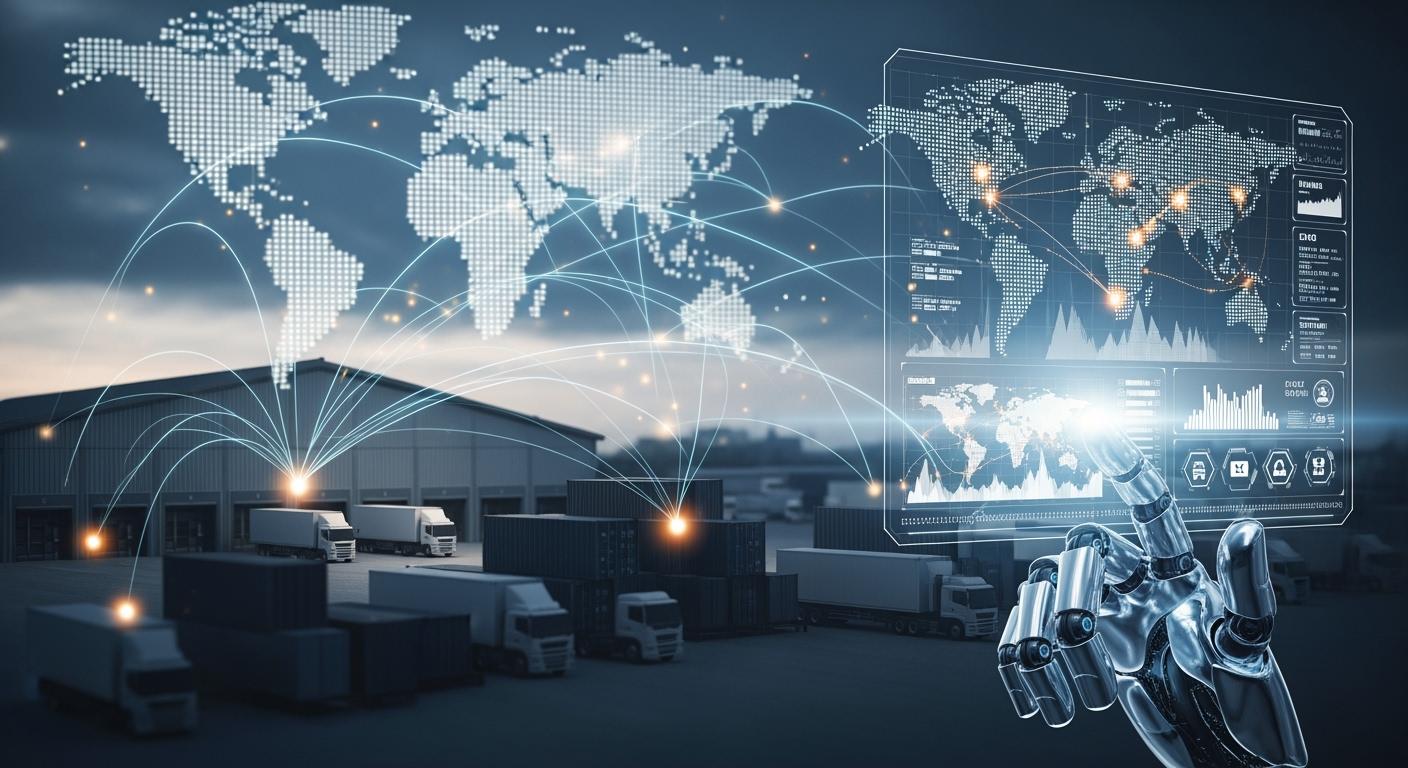
You see the impact of ai agents every day as they change supply chain management. These systems help you move from reacting to problems to acting before issues grow. Walmart uses ai to improve demand forecasting, which boosts customer satisfaction. Target’s ai cuts down on inventory costs and stockouts. UPS uses ai to find better delivery routes, saving fuel and money. By using ai, companies can lower logistics costs by 15%.
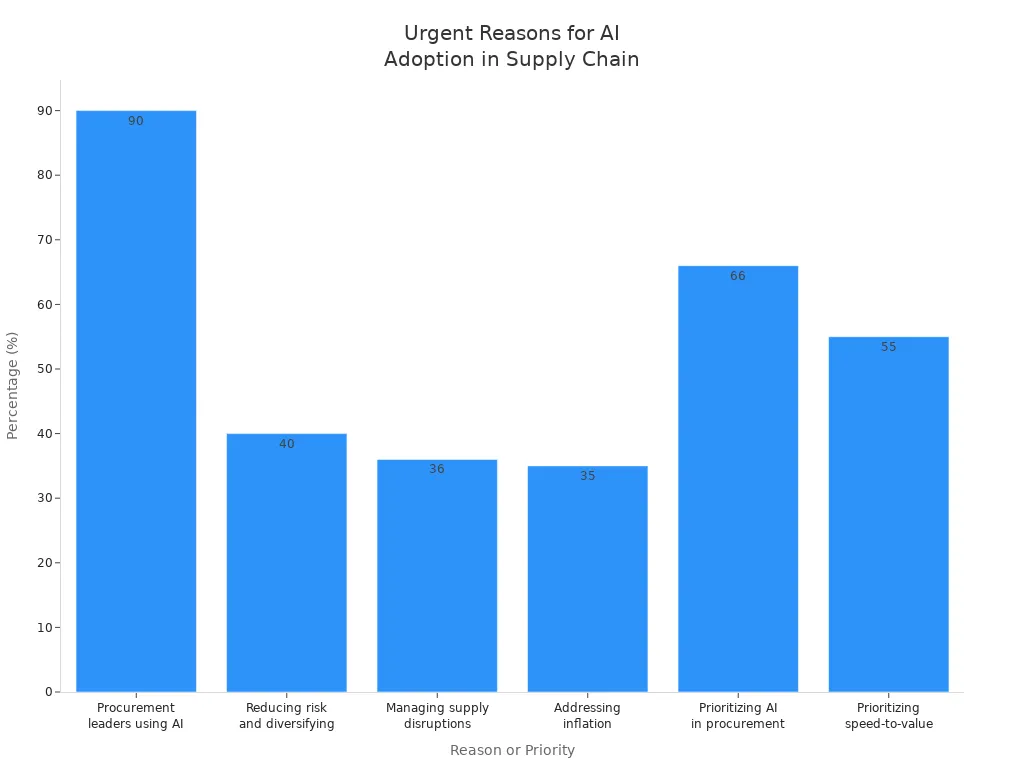
You need to understand these changes because 62% of leaders say ai helps them make decisions faster. Over half of organizations see more revenue growth when they use ai in their operations.
AI Agents in Supply Chain Management

Automating Complex Processes
You see many supply chain processes become easier when you use ai agents. These tools handle data-heavy and routine tasks that once took hours. You can now automate jobs like demand forecasting, inventory optimization, logistics management, and supplier automation. This means you spend less time on manual work and more time on value-driven activities.
- Demand forecasting
- Inventory optimization
- Logistics management
- Supplier automation
Agentic ai uses large language models to make dynamic decisions. These supply chain agents monitor real-time conditions and act quickly. They help you spot problems before they grow. You can trust these agents to provide insights and act on them, making your supply chain more agile and responsive.
| Key Findings | Description |
|---|---|
| LLM-based MASs | Used for inventory management in supply chains. |
| Optimal Ordering Policies | Some uncertainty exists about always finding the best policy. |
| AIM-RM Agent | Uses past experiences to improve adaptability and decision-making. |
| Performance | AIM-RM outperforms other methods in many supply chain scenarios. |
Proactive vs. Reactive Management
You no longer need to wait for problems to happen. With ai, you move from reactive to proactive supply chain management. Supply chain agents can detect risks early and respond fast. For example, if a supplier faces a fire, ai agents alert you right away. You can act quickly and recover 85% faster, saving money and keeping your supply chain running.
When ports get congested, ai agents reroute shipments before delays hurt your business. This proactive planning avoids 92% of costs and keeps production on track. You gain real-time supply chain visibility and can spot risks before they become big issues.
Tip: Use agentic ai for integrated business planning. This helps you see the whole supply chain and make better decisions.
Real-World Benefits and Impact
You see real results when you use ai agents in supply chain management. UPS’s ORION system shows how powerful these tools can be. It analyzes over one billion data points every day. This system finds the best delivery routes, saving 100 million miles each year. UPS saves $400 million and avoids over 100,000 metric tons of CO₂ emissions.
You can expect big improvements in your own supply chain:
- Logistics costs drop by 5-20%.
- Inventory levels fall by 20-30%.
- Companies using ai for route optimization see double-digit reductions in miles driven.
Many businesses report even more benefits:
- 15% reduction in logistics costs
- 35% decrease in inventory levels
- 65% improvement in service levels
| Benefit | Description |
|---|---|
| Lower Procurement Costs | Save money without hurting supplier relationships. |
| Reduced Transportation Costs | Deliver faster and spend less. |
| Increased Operational Efficiency | Cut labor costs and boost productivity. |
| Improved Working Capital | Waste less and use resources better. |
You also see higher revenue and lower operating costs. About 69% of retailers grow their revenue after using ai. Nearly three out of four lower their costs. Integrated business planning with agentic ai gives you better forecast accuracy and less inventory shrinkage. You build a supply chain that is strong, flexible, and ready for the future.
AI Agent Enablers and Frameworks
Digital Twins and Real-Time Data
You can boost your supply chain management by using digital twins and real-time data. Digital twins give you a virtual view of your supply chain. This helps you see problems before they happen. You can make quick decisions and keep your supply chain running smoothly. When you connect digital twins with agentic ai, you get even more value. Agentic ai uses real-time data from sensors and IoT devices. This lets you predict changes and respond fast. Companies that use data-driven strategies see a 5–6% rise in productivity and profits. Many leaders believe ai assistants will soon handle most supply chain tasks.
| Evidence Description | Impact on AI Agents in Supply Chains |
|---|---|
| Digital twin technology provides a virtual overview of the supply chain, enabling quick, informed decisions. | Enhances decision-making agility in response to changing conditions. |
| AI and predictive analytics process data from IoT devices to extract actionable insights. | Allows for predictive capabilities based on historical and real-time data. |
| Machine learning enables digital twins to evolve by learning from new data. | Continuously refines decision-making processes based on past performance. |
Decision Memory and Learning
You need ai agents that remember and learn from past actions. Decision memory lets these agents store and recall experiences. This helps them spot patterns and improve over time. When you use agentic ai, your supply chain becomes smarter with each decision. Decision traces show why an agent made a choice. These traces build a model of your supply chain. The model helps agents predict outcomes and check if their memory matches real results. This process makes your supply chain more reliable and ready for change.
- Decision memory allows agents to store and recall past experiences.
- This improves decision-making and overall performance.
- Agents can recognize patterns and adapt based on previous interactions.
Human-in-the-Loop Collaboration
You play a key role in making ai work well in your supply chain. Human-in-the-loop collaboration means you guide and teach ai agents. Your feedback helps them learn and adapt to complex workflows. This teamwork is important for integrated business planning. Ai brings speed and pattern recognition. You add judgment and ethical oversight. This mix helps your supply chain handle tough or sensitive situations. When you work with ai, you make sure your supply chain stays flexible and trustworthy. Integrated business planning gets better as both humans and ai learn together.
Tip: Use human feedback to help ai agents improve. This keeps your supply chain strong and ready for new challenges.
| Framework | Key Capabilities | Best Suited For |
|---|---|---|
| Plugin and skill model | Organizes capabilities into plugins and functions for structured tool use and orchestration | Engineering teams embedding agent capabilities in Microsoft-centric environments |
| Model-agnostic orchestration | Supports multiple model providers with a common abstraction layer for prompts, plans, and executions | |
| Enterprise alignment | Acts as middleware in production systems, integrating with existing application code and services | |
| LlamaIndex | Data-centric design for ingesting, indexing, and querying enterprise data | Knowledge-intensive applications like research assistants and domain-specific agents |
| RAG and agents | Offers retrieval-augmented generation pipelines and agent abstractions | |
| Event-driven workflows | Supports stateful workflows and custom agents over structured and unstructured data | |
| CrewAI | Role-based agents and crews for collaborative workflows | Teams structuring work as collaborative, role-based processes without building orchestration from scratch |
| Built-in guardrails and memory | Mechanisms for memory management and knowledge in multi-agent interactions | |
| Developer and UI tooling | Code-first experience and visual tools for designing multi-agent workflows |
AI Agents in Logistics and Planning
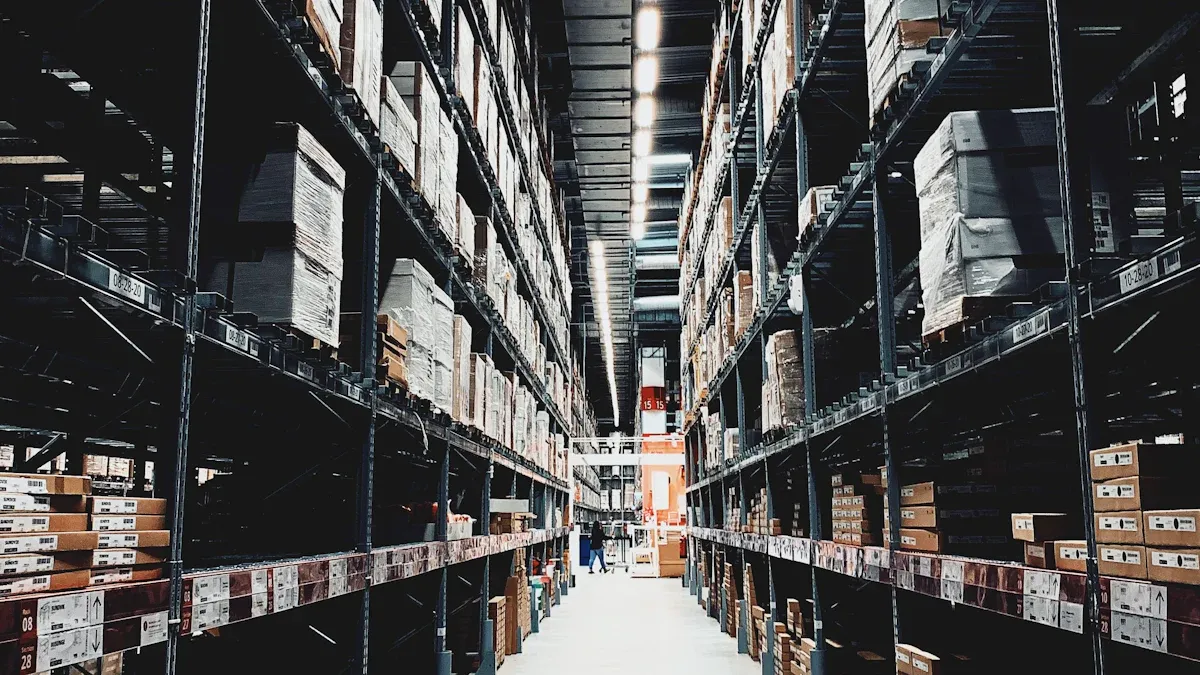
High-Friction Planning Tasks
You face many high-friction planning tasks in supply chain management. These tasks often slow down your processes and make it hard to keep up with demand. When you use ai agents, you can tackle these challenges head-on. Ai helps you automate routine tasks, predict future needs, and optimize routes. You save time and reduce errors.
- Automation of routine tasks lets you focus on higher-value work.
- Predictive analytics uses past data to help you plan for what comes next.
- Route planning becomes faster and more accurate with ai.
Maersk Line shows how powerful this can be. Their ai reduced route planning time from hours to minutes by using many data inputs. Ai-powered platforms process many variables at once. You can respond quickly to disruptions in logistics. This means you keep your supply chain moving, even when problems arise.
AI Agents in Logistics Operations
Ai agents in logistics give you new ways to interact with your supply chain. You can use natural language to ask questions or give instructions. The system understands your intent and responds with useful answers. This makes planning easier and more flexible.
| Key Concept | Description |
|---|---|
| Context-awareness | Ai agents keep track of conversations and understand complex questions with human-like accuracy. |
| Adaptability | Ai systems handle many logistics scenarios, making your operations more efficient. |
Ai agents perceive their environment and make smart decisions on their own. They learn from each interaction and get better over time. You see them combine natural language understanding, reasoning, and planning to meet your needs. This helps you manage logistics operations with less effort and more confidence.
When you use agentic ai, you get real-time visibility into your supply chain. You can track shipments, check inventory status, and spot issues before they grow. Ai agents in logistics help you adapt to changes fast. You improve supply chain efficiency and keep your business running smoothly.
Enhancing Stakeholder Collaboration
You need strong collaboration to succeed in integrated business planning. Ai agents support this by connecting people, data, and processes across your supply chain. You can share information quickly and make decisions together. This teamwork helps you solve problems faster and find new value.
Logistics agent solutions let you work with partners, suppliers, and customers in real time. You use natural language to communicate, so everyone stays on the same page. Agentic ai brings context-aware decision-making to your planning meetings. You can adjust plans as conditions change and keep your supply chain resilient.
The impact of ai in logistics operations is clear. You see faster dispatch planning, quicker order fulfillment, and improved warehouse picking. Automation reduces manual steps and boosts delivery times. Ai routing saves fuel and labor costs. You gain real-time visibility of shipments and inventory. Predictive demand planning helps you respond to disruptions and keep your supply chain stable.
| Improvement Type | Description |
|---|---|
| Increased Speed | Ai agents shorten dispatch planning and speed up warehouse picking. |
| Operational Efficiency | Automation cuts manual work and improves delivery times. |
| Cost Reduction | Ai routing saves fuel and reduces labor costs. |
| Real-time Visibility | Multi-point data gives you a clear view of shipments and inventory. |
| Predictive Demand Planning | Ai agents help you respond to disruptions quickly. |
| Enhanced Supply Chain Resilience | Fast response to issues keeps your supply chain reliable. |
You can expect cost reductions between 10% and 25% in different areas. Many companies see a 1% to 2% increase in earnings before income and taxes. Integrated business planning with ai agents in logistics brings you better results and a stronger supply chain.
Tip: Use logistics agent solutions to connect your team and partners. This helps you unlock more value from your supply chain and stay ahead of the competition.
Implementation Roadmap for AI in Supply Chains
Data Readiness and Quality
You need strong data to get the most from ai in supply chain management. Start by cleaning your data. Remove duplicates, fix errors, and fill in missing values. Next, transform your data. Normalize it and turn categories into numbers. Then, bring all your data together from different sources. Use data warehousing tools to manage this step. Good data helps ai agents make better decisions in your planning processes.
Steps for preparing your data:
- Clean your data by handling missing values and removing duplicates.
- Transform your data by normalizing and encoding categories.
- Integrate your data from many sources for a complete view.
Tip: High-quality data gives you more value from your ai projects.
Platform and Tool Selection
Choosing the right platform is key for your ai journey. Look for platforms with strong technical features, security, and support. Make sure the platform fits with your current systems and can scale as your supply chain grows.
| Criteria | Description |
|---|---|
| Technical capabilities | AI model sophistication, integration options, and performance scalability. |
| Security features | Access controls, audit capabilities, and compliance certifications. |
| Ecosystem compatibility | Existing system integration and data source connectivity. |
| Vendor support | Professional services, documentation quality, and community resources. |
You should also test your ai agents with real planning queries. Use containers like Docker to package your code. Set up monitoring to track how your agents work. Deploy your solution in the cloud or on your own servers.
Piloting and Scaling AI Agents
Start small with your ai projects. Pick one or two planning processes that have good data and clear value. Decide if you want to build or buy your ai solution. Run a 90-day pilot and set clear goals. Involve your supply chain teams in design and testing. This helps everyone trust the new tools.
- Identify high-impact planning use cases.
- Assign ai champions in each supply chain area.
- Partner with others for larger pilots and faster learning.
Set up strong rules for data access and keep audit trails. Link your pilot results to a 12-month plan for wider change. This step-by-step approach helps you scale ai across your planning processes and supply chain.
Challenges and Considerations
Reliability and Trust
You need to trust the decisions made by ai agents in supply chain management. Many companies worry about the reliability of these systems. Some main concerns include:
- AI systems can act like a "black box," making it hard to know how they reach decisions.
- You must keep human oversight for important choices to build trust.
- Poor or messy data can make ai less reliable.
- The quality of training data affects how well ai agents work.
- Many companies struggle with data that is siloed or unstructured.
To build trust, you should:
- Invest in high-quality, unbiased training data.
- Test and validate ai systems often.
- Set up feedback loops for continuous improvement.
A strong governance framework helps you keep control as ai technology changes. You also need to make sure your data is visible, accurate, and accessible. This approach increases operational value and helps you get better results from ai recommendations.
Security and Data Privacy
You must protect your supply chain from security risks when using ai. Some common threats include:
- Attackers may use prompt injection to trick ai agents into acting in harmful ways.
- Malicious actors can create fake packages that look real, leading to supply chain attacks.
- Weak authentication can let attackers pretend to be real agents.
- Agents might expose sensitive information by mistake.
To keep your data safe, you should:
- Collect only the data you need.
- Store data securely and use encryption for data at rest and in transit.
- Limit who can access data with strong controls.
- Use federated learning and differential privacy to protect personal information.
- Track and manage all data used by ai agents.
These steps help you maintain privacy and security, which are key for operational value and trust in your supply chain.
Human-AI Collaboration
You play a big role in making ai work well in your supply chain. For the best results, you should:
- Find tasks where humans and ai can work together.
- Train your team to use ai tools and understand ai recommendations.
- Build a culture that values both human and ai input.
- Design easy-to-use interfaces for smooth teamwork.
- Set up rules to make sure ai stays fair and transparent.
Change management helps your team adjust to new ways of working. When you support continuous improvement, you get more from your supply chain and see real improvement in operational value.
Tip: Keep humans in the loop to guide ai agents and make sure your supply chain stays strong and flexible.
You see how ai agents change supply chain management by making your operations faster, smarter, and more reliable. These tools help you move from manual work to strategic planning. You gain better efficiency, stronger collaboration, and improved sustainability.
| Aspect | Evidence |
|---|---|
| Efficiency Improvement | AI tools enhance operational efficiency and customer satisfaction while reducing costs. |
| Collaboration Enhancement | AI fosters trust among stakeholders, facilitating information exchange for problem-solving. |
| Sustainability Promotion | AI optimizes resource use, minimizes waste, and supports circular supply chain frameworks. |
To get the most from ai, you should:
- Build strong data foundations.
- Use systems that understand context.
- Choose interactive AI that adapts to your needs.
- Start with small changes and involve your team.
You need to keep learning and adapting as AI grows. Invest in training, follow ethical guidelines, and work with partners to stay ahead.
FAQ
What is an AI agent in supply chain management?
An AI agent is a software tool that helps you make decisions and automate tasks in your supply chain. It uses data and smart algorithms to solve problems and improve efficiency.
How do AI agents help reduce supply chain costs?
AI agents find better routes, predict demand, and automate routine work. You save money on transportation, inventory, and labor. Many companies report cost reductions of 10% or more.
Can you trust AI agents to make important decisions?
You should always keep humans involved. AI agents learn from data, but your oversight ensures safe and fair choices. Regular testing and feedback help build trust.
What skills do you need to use AI agents in your supply chain?
You need basic data skills and an understanding of your supply chain. Training helps you use AI tools. Many platforms offer easy interfaces, so you do not need to code.
See Also
Enhancing Business Flexibility Through Supply Chain Outsourcing
Gaining Competitive Edge via Supply Chain Outsourcing Solutions
The Essential Role of SaaS WMS in Modern Warehousing
Achieving Rapid, Sustainable Success with Lean Logistics
Driving Business Expansion Through Supply Chain Management Outsourcing