
Research shows 88% of AI pilots fail to reach production. You see this pattern in operations: teams prove the technology works, then stall. Data silos, weak governance, and no clear strategy block the path forward.
This article delivers a practical ai transformation roadmap. You will learn how to turn isolated experiments into reliable, production-ready workflows. It covers five phases: assess readiness, prioritize use cases, build the plan, establish governance, and measure success. Each phase connects your ai digital transformation goals to business outcomes.
An enterprise ai transformation roadmap is not a one-time project. It is a living capability. Your ai transformation becomes a repeatable engine for ai-powered transformation. That is how digital transformation succeeds.
Defining the ai digital transformation Roadmap
What Is an ai digital transformation Roadmap?
An ai transformation roadmap is a strategic, phased plan that links AI capabilities to operational outcomes. It differs from a traditional IT roadmap in one critical way: it focuses on business results, not just technology deployment. You are not scheduling software installations. You are sequencing capabilities that change how work gets done.
A digital transformation roadmap provides a structured view of how an organization will evolve over time through technology, process, business model, and organizational change. Unlike a simple project plan, it connects individual initiatives to broader business objectives and shows how those initiatives contribute to a desired future state.
This distinction matters for your operations. A traditional IT roadmap might list servers, licenses, and upgrade dates. An ai roadmap instead maps use cases to pain points, defines governance before scaling, and builds data foundations that serve multiple teams. The roadmap for digital transformation becomes a living document that guides decisions across departments.
Why Operations Needs a Structured Roadmap
The numbers tell a clear story. According to Gartner (2024), 85% of enterprises have active AI initiatives. Yet McKinsey (2024) reports only 35% achieve enterprise-wide AI deployment. VentureBeat (2024) found that 60% of AI pilots never reach production. This gap between experimentation and impact defines the challenge you face.
A structured roadmap solves this by addressing the root causes of pilot failure. Fragmented knowledge, siloed initiatives, weak governance, and unclear business alignment all undermine progress. Your digital transformation strategy roadmap must connect people, process, technology, and knowledge into one coherent plan. Without this structure, your operations teams duplicate effort and lose momentum.
Core Components of a Successful Roadmap
Every effective enterprise ai transformation roadmap contains eight essential elements. You need a clear vision and objectives, a current state assessment, prioritized strategic initiatives, a defined technology stack, a timeline with milestones, resource allocation, change management, and metrics with KPIs. These components work together to create accountability and direction.
A phased roadmap follows a crawl-walk-run approach. You start with lower-risk productivity gains, then expand to complex use cases that transform core functions. Your ai transformation plan should also address build versus buy decisions, platform architecture, and the people dimension through training and change agents. This structure turns your ai strategy into measurable operational value.
Assess Readiness for ai digital transformation
Before you commit budget to any use case, you must understand where your operations stand today. A readiness assessment surfaces technical debt, integration constraints, security gaps, and missing capabilities before they derail implementation. This step reduces downstream firefighting and sets realistic expectations across the organization.
The data supports this discipline. Gartner (2023) reports that 87% of US organizations consider a digital transformation readiness assessment critical to achieving transformation success. Baker Tilly (2023) found that 68% of US organizations that conducted a readiness assessment before transformation achieved higher ROI than those that skipped this step. A logistics company saved 20% on transportation costs by using a digital transformation assessment framework to implement AI for route optimization. These ai readiness assessments and roadmaps reveal where AI actually saves time and money.
Evaluate Technology and Data Maturity
Your data maturity level predicts your AI success more reliably than your technology budget. Organizations at the Data Aware stage face an 87% AI implementation failure rate. Organizations at the Data Driven stage achieve an 89% success rate. Skipping maturity stages, such as jumping from Data Aware to Data Driven in one project, pushes failure rates to 91%. Higher data maturity also correlates with 3.7 times better ROI from technology investments.
You should examine data quality, accessibility, and lineage across operational systems. Check whether your infrastructure runs in the cloud, on-premise, or in a hybrid model. Each choice affects latency, cost, and integration speed. Build each stage's capabilities before advancing to the next. This discipline forms the foundation of any credible ai transformation roadmap.
Gauge Workforce Skills and Culture
Your people determine whether AI adoption sticks. Assess AI literacy gaps across operations, IT, and leadership. Identify which roles need new skills and which employees can serve as change agents. Measure change readiness honestly. Teams that fear automation will resist tools they do not understand.
A proper assessment combines interviews, digital ecosystem mapping, and workflow analysis. This approach produces a customized readiness scorecard. It also builds stakeholder buy-in by giving leadership a shared view of organizational standing. That alignment addresses the siloed efforts and poor IT-business alignment that commonly undermine an enterprise ai transformation roadmap.
Identify Governance and Security Gaps
Governance failures kill more AI projects than technology failures do. Gartner predicts 60% of AI projects will be abandoned by 2026 due to lack of AI-ready data. Only 24% of organizations can control AI agent actions (Cisco 2025 AI Readiness Index). Only 28% of organizations have formal AI governance oversight (IAPP 2024), and only 36% have adopted a formal governance framework. RAND Corporation reports that misaligned leadership objectives and insufficient infrastructure cause over 80% of AI project failures.
Review your current data governance policies, compliance requirements, and risk assessment practices for AI decisions. Check whether you track all AI deployments or allow shadow AI to proliferate. A phased roadmap treats governance as an ongoing capability, not a one-time exercise. This mindset separates successful ai transformation from ai-powered transformation that stalls after the pilot.
Prioritize High-Impact Use Cases

A readiness assessment tells you what you can do. Prioritization tells you what you should do first. This step separates an ai transformation roadmap that produces results from one that produces activity. You need a repeatable method for ranking opportunities, and you need it before budget cycles force a decision.
Map Operational Pain Points to AI Opportunities
Start with the problem, not the technology. Walk the floor, review incident logs, and interview supervisors. You are hunting for friction that carries a measurable cost. Common patterns in enterprise operations fall into three groups. Automation pain appears when teams struggle to integrate multiple systems while keeping production running, or when sensors, cameras, and robots sit on separate networks that no AI can monitor together. Collaboration pain shows up as inconsistent assembly methods and documentation across dispersed sites, which creates quality and scheduling conflicts. Productivity pain follows labor shortages, inflationary pressure, and supply chain disruption, and it pushes you to raise output per labor hour and per unit of capital.
Ask sharper questions to expose hidden pain. What share of operational decisions do your teams make reactively rather than proactively? How accurate is your demand forecast at a 90-day horizon? Do you have real-time visibility into equipment utilization and health? Does inventory optimize itself or wait for manual review? What percentage of quality defects do you catch before the customer does? Each answer points to a candidate use case.
Prioritize Using Feasibility and Value
Score every candidate on three dimensions: business, experience, and technology. The BXT framework breaks these into subcomponents you rate separately, then average into a component score.
| BXT Dimension | Subcomponents | Evaluation Focus |
|---|---|---|
| Business | Strategic fit | Alignment with business strategy and value |
| Experience | Key personas | Identify end-users and stakeholders; confirm demand and commitment |
| Experience | Value proposition | Benefits such as efficiency, cost savings, productivity, and user experience |
| Experience | Change resistance | Willingness to adopt; plan training and mitigation |
| Technology | Implementation and operations risks | Technical issues, resource constraints, data security; mitigate through testing and contingency |
| Technology | Sufficient safeguards | Security, compliance, data protection, responsible AI standards |
| Technology | AI/LLM fit | How well the use case matches AI capabilities for automation and decision-making |
Weight the final ranking to reflect what your business rewards. Value typically carries 35–45%, feasibility 25–35%, time-to-value 10–15%, reusability 10–15%, and risk and compliance 5–10%. Four gates must pass before any score counts: data readiness, a named decision owner, security and ethics compliance, and safety boundaries for physical processes. No owner, no go.
A discrete manufacturer ranked four proposals this way. Predictive maintenance scored highest on both value and feasibility because vibration sensors were already installed. It was funded first and delivered measurable downtime reduction within the first quarter. That win justified funding a quality vision system the next year. Plants using a formal scoring process report 60% fewer stalled AI initiatives.
Build a Business Case with Clear Metrics
Quantify the problem before you pitch the solution. Total the direct and indirect cost of the pain point, then model impact using conservative estimates from comparable implementations. Include hidden costs such as data preparation and change management. Define success metrics before the first line of code.
Anchor your case in metrics a CFO recognizes. Cost-to-serve delta measures the change in fully loaded cost per unit before and after deployment. Cycle time compression captures how much faster a workflow runs. Error rate reduction tracks rework and compliance exposure. Throughput improvement shows how much more volume the same team handles. Revenue contribution covers faster quote-to-order conversion and reduced churn.
Payback period often persuades more than headline ROI. A 90% return with an 18-month payback beats 150% over five years, because it answers the real question: when does the money come back? Document baselines for cycle time, error rate, fully loaded cost per unit, and throughput over at least 90 days. Manufacturing AI returns typically range from 200% to 400%, and high-frequency processes with existing baseline data show measurable returns in 3 to 9 months. This discipline turns intelligent automation from a cost center into a funded capability, and it keeps your enterprise ai transformation roadmap grounded in evidence rather than enthusiasm.
Build a practical roadmap for ai transformation
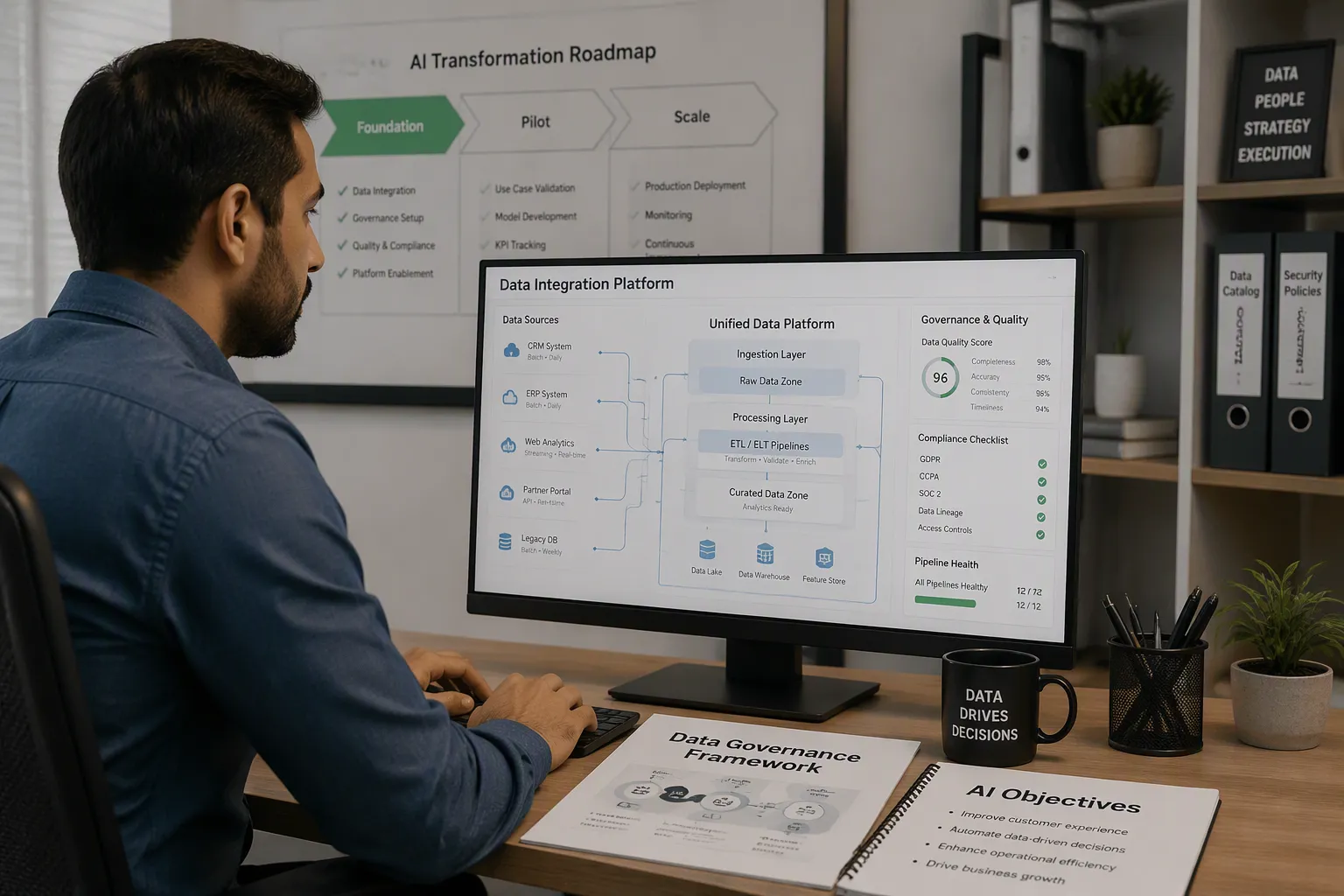
A practical roadmap moves through three phases: foundation, pilot, and scale. Each phase builds on the last. You cannot skip steps without paying a price later. This phased roadmap across people, process, technology, and knowledge keeps your ai transformation grounded in what operations can actually absorb.
Foundation: Data Integration and Platform Setup
Your data foundation determines how far your ai roadmap can travel. Start by assessing your current data landscape. Identify silos, refresh frequencies, and existing governance rules. This audit reveals what you have and what you lack.
Data quality forms the bedrock. Accuracy, completeness, and consistency make AI models reliable. Clean and standardize your data to reduce drift and improve model trust. Establish clear AI-driven business objectives to prioritize relevant datasets. This focus prevents over-collection and keeps costs down.
A scalable data architecture supports both real-time and batch ingestion. Modular components let you expand without rebuilding. Your integration tools should support ETL and ELT processes, offer pre-built connectors, and automate repetitive tasks. These choices accelerate time-to-AI through clean, cataloged, business-ready data.
Governance belongs here, not later. Build frameworks covering ownership, access, quality standards, and compliance with regulations such as GDPR and HIPAA. Embed lineage, audit logs, and jurisdictional checks into your data flows. Address bias through early audits and balanced datasets.
The table below shows the core components your platform needs.
| Key Component | Description |
|---|---|
| Single source of truth | Unifies all data sources into one accessible, secure, and governed source. |
| Diverse connectors and parsers | Pre-built connectors for databases, warehouses, cloud storage, FTP, SaaS apps, and APIs. |
| End-to-end data processing for AI | Converts structured, unstructured, and semi-structured data into vector embeddings. |
| Scalable RAG workflow support | Native combination of retrieval methods with LLMs. |
| Advanced transformation | Pre-built functions for math, IP transforms, conditional logic, and data masking. |
| Accessibility and security | Balances compliance, security, and quality with strict access controls. |
Create cross-functional collaboration models such as data councils. These groups align technical and business needs. Measure integration performance using metrics like data quality, timeliness, and adoption. This discipline turns your digital transformation roadmap into an operational asset.
Pilot: Deliver a Quick Win
Your pilot proves the concept works in your environment. Choose a use case with clear boundaries and measurable outcomes. Anchor the initiative to a defined problem, a clear success metric, and realistic scope. Vague objectives sink pilots before they deliver value.
Common pitfalls await you. Prototypes may achieve only 75% accuracy while production requires 90% or higher. Budget sufficient time for data preparation, tuning, integration, and human oversight. Poor data quality remains a persistent threat. Historical data is often incomplete, inconsistent, or siloed, and up to 80% of data scientist time goes to cleaning it.
Low adoption kills otherwise functional tools. Address resistance, change management, and user training from the start. Involve business stakeholders, end users, and IT from the beginning. Siloed teams that build without business input create solutions nobody uses.
Align leadership expectations before you deploy. Leaders may conflate ambition with direction, causing the AI to optimize for the wrong goals. Reach internal agreement on what success means. This alignment keeps your ai transformation plan on track.
Your pilot should deliver a quick win that builds momentum. Document what works and what fails. Gather feedback from operators who use the tool daily. This learning feeds directly into your scale phase.
Scale: Expand with Reusable Models
Scaling requires reusable components, not one-off solutions. Treat AI capabilities such as data extraction, document processing, and knowledge retrieval as modular building blocks. You can reconfigure these components for different contexts without rebuilding from scratch.
Containers and orchestration package model servers, dependencies, and configuration into repeatable units. These units deploy across environments without change. A hybrid cloud platform provides a consistent foundation to develop, tune, test, and deploy AI models the same way across on-site, edge, and cloud.
Separation of concerns makes scale possible. Decouple model selection from use-case implementation. Make data integration a shared service rather than per-project work. Unify observability across all AI applications. These choices support your scalable ai roadmap.
Governance by design embeds centralized visibility, consistent security, and compliance from the start. You can swap or retrain components without cascading changes. This flexibility keeps your enterprise ai transformation roadmap responsive to new requirements.
Move from pilot to production with gradual rollout. Standardize what works. Monitor models continuously for drift and performance degradation. Document best practices and build repeatable playbooks. This approach turns ai-powered transformation from a series of projects into a durable capability.
Your ai-powered transformation roadmap connects people, process, technology, and knowledge across every phase. The foundation enables the pilot. The pilot informs the scale. The scale delivers the ai digital transformation your operations need.
Establish Governance and Drive ai transformation Adoption
Set Up AI Governance and Ethical Guidelines
You need a governance framework before you scale any AI system. Several established options exist, and each serves a different purpose. The table below shows the core emphasis of each framework.
| Framework | Core Emphasis |
|---|---|
| NIST AI Risk Management Framework | Non-mandatory U.S. framework centered on identifying risks, promoting trustworthiness, and applying mitigation strategies |
| ISO/IEC 42001 | Globally recognized, certifiable standard for creating and sustaining an AI management system |
| EU Artificial Intelligence Act | Legally binding regulation that categorizes AI by risk level and imposes strict requirements on high-risk systems |
| OECD AI Principles | International baseline stressing fairness, transparency, accountability, and responsible use |
| Singapore Model AI Governance Framework | Applied, industry-focused guidance for ethical and responsible AI adoption |
Select your framework based on regulatory compliance, risk profile, industry standards, organizational capacity, and ethical alignment. A risk-based approach scales governance according to model risk. You conduct risk assessments at the design stage, perform ongoing model oversight, and apply continuous monitoring to detect drift, bias, and compliance issues. Your ai governance structure should include a governance committee, a CAIO or Head of AI, product teams, data stewards, legal and compliance, and business leaders. Each role carries clear ownership.
Drive Change Management and Training
Technology alone does not drive adoption. You must pair technical plans with a targeted change management playbook. This playbook includes structured communications, hands-on enablement, and culture-building activities. Transparent, ongoing communication addresses stakeholder concerns. Executive leadership must champion AI visibly. Early-stage co-design with pilot programs validates value and builds trust.
Start with targeted pilots where human expertise is indispensable. This approach proves the synergy between algorithms and people. Roll out role-specific enablement such as bite-size tutorials for frontline staff and deep-dive labs for data scientists. Use live scorecards of KPIs and pulse checks on adoption, readiness, and sentiment. Share and celebrate early wins to accelerate momentum. Build for adaptability through continuous learning, guilds, lunch-and-learns, and communities of practice.
Create Cross-Functional Accountability
A federated AI Center of Excellence model distributes ownership to business units while maintaining central governance through shared playbooks and embedded champions. This cross-functional accountability prevents fragmentation and siloed projects. It enables enterprise-scale value. McKinsey research identifies organizational coordination as a top-three success factor for AI at scale. This finding directly links cross-functional accountability to operational AI transformation success.
Your enterprise ai transformation roadmap must assign clear ownership across every phase. A governance committee provides strategy and oversight. The CAIO or Head of AI executes governance. Product and AI teams develop and deploy models. Data stewards manage data quality and security. Legal and compliance handle regulatory alignment. Business leaders provide human oversight and accountability. This structure keeps your ai transformation roadmap on track and ensures your phased roadmap delivers measurable results. Strong ai transformation depends on this accountability.
Measure Success and Improve Continuously
Define KPIs for Operations AI
You cannot improve what you do not measure. Start with a balanced set of metrics that cover efficiency, accuracy, performance, and financial impact. Efficiency metrics include throughput, resource utilization rates, and reduction in human intervention. Accuracy metrics track the correctness of AI outputs, such as the percentage of correct predictions. Performance metrics cover system uptime, response times, error rates, and the quality of user interactions. Financial impact metrics capture ROI, cost savings, revenue generated from AI-enhanced products, and overall financial contribution.
Organize these metrics into three layers so leadership sees the full picture. Layer one covers operational health: error rate, hallucination rate, automation rate, and cycle time. Layer two covers financial performance: cost per inference, total cost of ownership against plan, labor cost savings, and revenue attributed to AI. Layer three covers adoption and usage: active users, adoption rate, feature utilization, and satisfaction signals. Track cost per AI-assisted task weekly to catch compute cost creep before it erodes your returns.
| KPI | What It Measures |
|---|---|
| Total ROI of AI Investment | Net financial return divided by total investment, broken out by initiative |
| Time-to-Value (TTV) | Time from go-live to first measurable business return |
| Automation Rate | Share of a workflow completed start-to-finish without human intervention |
| Cycle-Time Compression | Reduction in elapsed time per completed process cycle |
| Model Drift Rate | Degradation of model performance over time |
| Human Escalation Rate | Frequency of tasks escalated from AI to human reviewers |
Pair leading indicators with lagging ones. Reduced employee time-on-task for tracked low-priority tasks leads to increased workforce productivity. Decreased time-to-market for new features leads to higher customer satisfaction and engagement. This pairing gives you early warning signals and confirms long-term impact.
Establish Feedback Loops and Iteration
Closed-loop learning turns your AI system into a self-improving asset. The system's outputs and user actions feed back to retrain models over time. Models learn from mistakes and adapt to evolving data patterns. Monitoring detects model performance drift, and MLOps tools enable automatic or on-demand retraining. You can deploy new models as challengers alongside existing champions to track live performance before full promotion to production.
Combine multiple feedback signals rather than relying on one. Thumbs-up ratings, customer satisfaction scores, and task completion rates each reveal different problems. Use version-aware timestamp cutoffs to discard obsolete data. Sample live traffic for evaluation instead of relying solely on hand-curated sets. This practice catches stale labels, training-serving skew, and bias amplification before they reach production.
Scale Lessons Across the Organization
Document what you learn so new team members ramp up quickly. Conduct retrospectives at the end of each project to identify which approaches worked and which caused problems. Standardize lessons learned through written documentation. Share results with colleagues running similar projects, because collaboration is the fastest path to knowledge.
Use structured methods to capture and spread insight. An After Action Review captures lessons during and after an activity. A Peer Assist lets you learn from others before starting a project. A Retrospect is a facilitated knowledge-capture meeting at the end of a project. Stories and podcasts carry more impact than text imperatives. Communities of practice let members learn from each other about successes, failures, and case studies. Document learnings, challenges, and progress on a recurring basis. Daily reflections capture small observations, weekly reflections identify patterns, and monthly reflections assess impact. This discipline turns your ai transformation roadmap into a living capability that strengthens your organization's operations over time. Every ai transformation depends on this cycle of measurement, learning, and improvement.
Your ai transformation roadmap for enterprises is not a one-time project. It is a living capability. It connects governance, trusted data, and operating models into one system. A digital transformation roadmap that ignores any of these parts will stall. The ai transformation roadmap you build must evolve as your operations change.
Successful work here shifts your teams from digital-first to truly intelligence-first. That move requires people, process, technology, and knowledge to advance together. Start with a readiness assessment. Then share your lessons with peers, because every ai transformation teaches the next one.
The most successful operations transformations are not about the technology alone — they are about people, process, and a relentless commitment to iterative improvement.
FAQ
How does an AI roadmap differ from a traditional IT roadmap?
An AI roadmap sequences capabilities that change how work gets done rather than scheduling software upgrades. It connects each use case to operational pain points. It builds data foundations for multiple teams and defines governance before scaling begins.
Why do most AI pilots fail to reach production?
Three root causes dominate: fragmented data silos that block model access, weak governance frameworks, and unclear business alignment. Without a structured roadmap connecting people, process, and technology, teams duplicate effort and momentum stalls.
How do I assess my operations readiness for AI?
Evaluate your data maturity stage first. Organizations at the Data Aware stage face an 87% implementation failure rate. Those at the Data Driven stage achieve 89% success. Check data quality, infrastructure, workforce AI literacy, and governance gaps before committing budget.
Which use case should I start with?
Score candidates on business value, user experience, and technical feasibility. Predictive maintenance often scores highest when sensor data already exists. Select a use case with clear success metrics and a named decision owner before funding begins.
What governance framework should I adopt for AI operations?
Your choice depends on regulatory requirements and industry standards. NIST AI RMF works for risk management. ISO/IEC 42001 offers a certifiable management system. Select a framework aligned with your compliance obligations and operational risk profile.
How quickly can I expect returns from an AI initiative?
High-frequency processes with existing baseline data show measurable returns within 3 to 9 months. Manufacturing AI returns typically range from 200% to 400%. Start with a targeted pilot that delivers a quick win and builds momentum for broader deployment.
How do I scale AI after a successful pilot?
Build reusable components rather than one-off solutions. Decouple model selection from use-case implementation. Make data integration a shared service. Embed governance by design from the start. Roll out gradually, standardize what works, and monitor continuously for drift.
See Also
Creative Ecommerce Enablement Tactics For 2025: A Practical Step-By-Step Guide
Creative Approaches To Simplify Retail Replenishment Operations: Leading Practices For 2024
Making Your Business-To-Business Order Fulfillment Plan Ready For Tomorrow
Groundbreaking Technologies Revolutionizing Shipping And Logistics Operations During 2025