
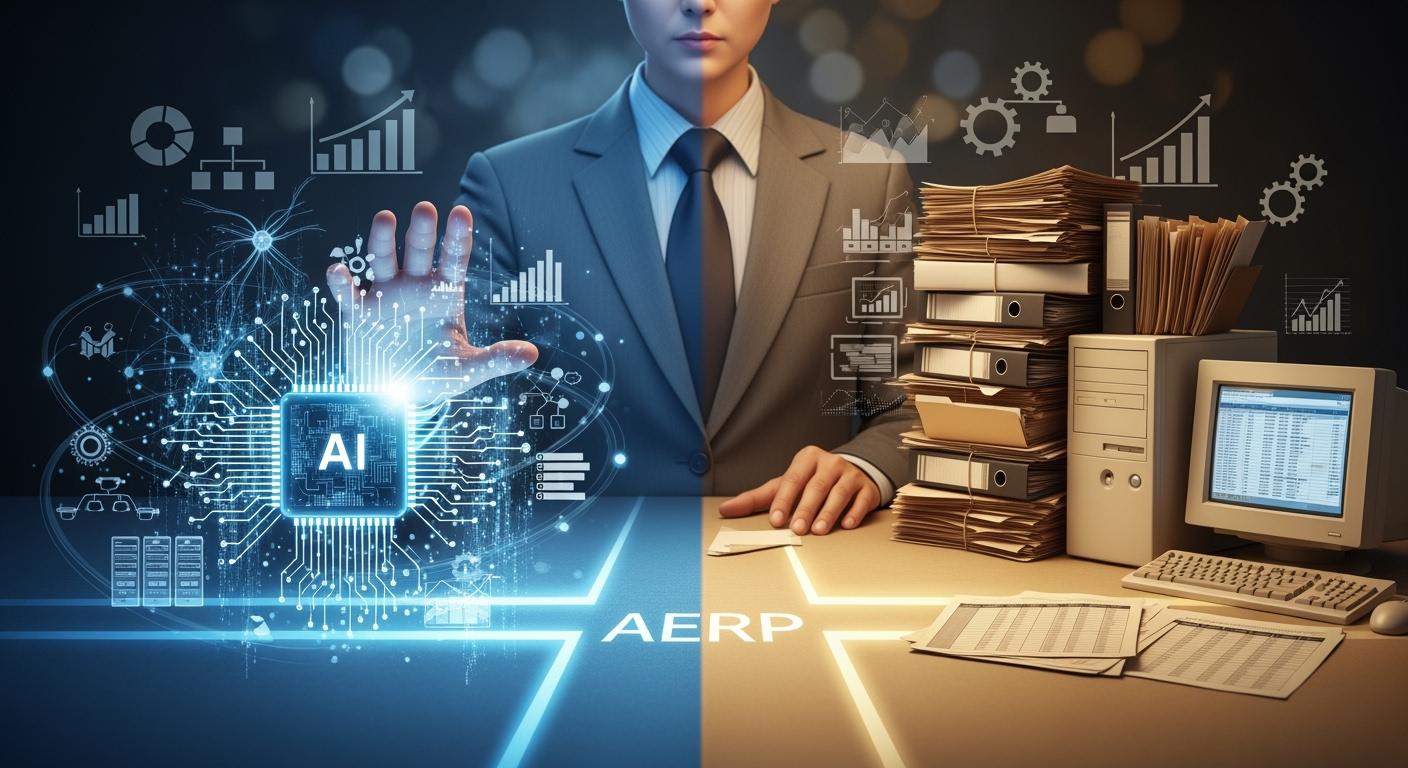
You need to choose an ERP system that matches your business needs. If your company values automation and real-time insights, AI ERP can boost efficiency and help you make better decisions. Selecting the right ERP system improves workflow and productivity.
Diamondback Energy faced operational complexities due to rapid growth and needed an ERP solution to improve efficiencies in their financial processes. They chose SAP S/4HANA® for its proven track record, which helped them streamline operations and support their expansion goals.
- Automation and integration of business processes improve operational efficiency.
- Accurate information enhances decision-making.
- Workflow automation reduces manual tasks and increases productivity.
Consider your business goals and growth plans before making a decision.
ERP System Overview
What Is AI ERP
You can use an ai erp system to manage your business with advanced technology. This type of enterprise resource planning uses ai to improve how you handle data and automate tasks. You get machine learning, natural language processing, and predictive analytics. These features help you analyze information quickly and make smart decisions. Ai erp gives you real-time monitoring, so you see what happens in your business as it happens. Ai assistants support you by answering questions and guiding you through processes.
| Technology/Capability | Description |
|---|---|
| Machine Learning | Enhances data analysis and automates workflows. |
| Natural Language Processing | Improves user interactions and enables more intuitive interfaces. |
| Predictive Analytics | Bolsters forecasting accuracy and sharpens planning precision. |
| Real-time Monitoring | Allows for immediate insights and adjustments in operations. |
| Autonomous Decision-Making | Facilitates independent operational decisions based on data analysis. |
| AI Assistants | Enhances user experience by providing support and information in real-time. |
You benefit from faster responses and fewer mistakes. Ai erp adapts to your needs as your business grows. You can save money because automation reduces manual work and errors.
What Is Traditional ERP
Traditional erp systems help you organize your business functions. You use them to manage accounting, customer relationships, human resources, supply chain, and inventory. These systems started in the 1990s and have changed over time. Early versions focused on inventory and production. Later, they included finance, HR, and supply chain management.
| Component | Function |
|---|---|
| Accounting and Financial Management | Manages financial transactions and reporting, ensuring accuracy and compliance. |
| Customer Relationship Management | Enhances customer interactions and manages sales processes. |
| Human Resources (HR) | Streamlines employee management, payroll, and benefits administration. |
| Supply Chain Management (SCM) | Oversees the flow of goods and services, optimizing supply chain operations. |
| Business Intelligence | Provides analytical insights to support decision-making and strategic planning. |
| Warehouse Management | Manages inventory levels, storage, and order fulfillment processes. |
| Inventory Management | Tracks inventory levels and manages stock replenishment. |
| Centralized Database | Stores data from all components, enabling real-time access and integration across functions. |
You get modular applications for each business area. Traditional erp gives you real-time access to information and helps you connect with other systems. Cloud technology makes these systems flexible and easy to use.
AI ERP Features
Real-Time Insights & Analytics
You gain a powerful advantage when you use ai erp systems. These platforms deliver real-time insights that help you understand your business as it happens. Ai analyzes data from every department, giving you instant feedback on performance. You see trends and patterns emerge, which lets you make decisions quickly. Intelligent analytics show you not only what happened in the past but also what might happen next. Ai capabilities allow you to predict future outcomes, so you can plan ahead and stay prepared. Intelligent automation processes data faster and with fewer mistakes. You get accurate information that supports your goals and keeps your business running smoothly.
Ai erp uses predictive analytics to forecast demand and optimize inventory levels. You can adjust your strategy before problems arise. Intelligent tools help you spot risks and opportunities early. Ai-driven insights make your operations more efficient and keep you ahead of competitors. Intelligent automation ensures that your data stays reliable and up-to-date.
Tip: Real-time analytics in ai erp systems help you anticipate market changes and adapt your plans quickly. This proactive approach gives you a competitive edge.
Automation & Predictive Capabilities
Ai erp systems transform your daily tasks with intelligent automation. You save time by automating accounting, expense categorization, and invoice matching. Ai models detect anomalies and fraud risks, protecting your business from costly errors. Intelligent automation improves procurement workflows by creating purchase orders and routing approvals based on market conditions. Ai analyzes supplier performance and pricing history, helping you choose the best partners.
You benefit from predictive analytics that forecast cash flow trends and optimize inventory levels. Ai anticipates supply chain disruptions, so you can plan for uninterrupted production. Intelligent automation enhances warehouse management and logistics efficiency. Ai tools automate supplier communication, making coordination faster and easier. Ai-driven insights help you mitigate risks and keep your operations stable.
| Application | Description |
|---|---|
| Automating accounting tasks | Invoice matching, expense categorization, and reconciliation to save time and minimize errors. |
| Detecting anomalies and fraud risks | Machine learning models analyze transaction patterns for irregular activity. |
| Forecasting cash flow trends | Predictive analytics support proactive budgeting and resource allocation. |
| Enhancing supplier selection | Evaluating performance data, pricing history, and lead times to identify the best-fit partners. |
| Improving procurement workflows | Automated purchase order creation and approval routing based on market conditions. |
| Anticipating supply chain disruptions | Ai-driven insights enable contingency planning and uninterrupted production. |
| Generating precise demand forecasts | Predictive analytics incorporate historical sales and market trends for accurate forecasting. |
| Optimizing inventory levels | Automating reorder points to reduce carrying costs and ensure product availability. |
| Enhancing warehouse management | Ai-driven strategies for space utilization and improved stock tracking. |
| Improving logistics efficiency | Route optimization tools identify cost-effective delivery methods. |
| Automating supplier communication | NLP-powered tools for faster coordination on orders and demand changes. |
| Mitigating risk | Ai-driven analysis of factors that could disrupt operations. |
Ai erp gives you intelligent tools that adapt as your business grows. You experience fewer manual errors and more reliable data. Intelligent automation and ai capabilities make your business more agile and responsive.
Traditional ERP Features
Record Keeping & Data Management
You rely on traditional erp systems to manage your business records and organize important data. These systems store information about finances, customers, inventory, and employees in a centralized database. You can access records quickly and keep your operations running smoothly. Traditional erp solutions often require on-premises deployment, which means you need physical hardware and regular maintenance. You gain more control over your data security, making these systems a good fit for industries with strict regulations.
You may notice that traditional erp systems offer high customization, but the process can be complex. Large corporations often use traditional erp because they handle sensitive data and need reliable record keeping. You face higher upfront costs for hardware and implementation, and you need dedicated IT staff for ongoing support. Modern cloud erp systems provide more flexibility and lower initial costs, but traditional options remain popular for their security and control.
| Feature | Traditional ERP Systems | Modern Cloud ERP Systems |
|---|---|---|
| Deployment | On-premises, requiring physical hardware and maintenance | Cloud-based, accessible via the internet |
| Customization | Highly customizable but complex to implement | Generally easier to customize and scale |
| Cost | High upfront costs for hardware and implementation | Subscription-based, lower initial costs |
| Maintenance | Requires dedicated IT staff for ongoing support | Managed by the service provider |
| Security | More control over data security, suitable for sensitive industries | Security managed by cloud provider, may vary |
| Flexibility | Less flexible, can be cumbersome to adapt | Highly flexible, can quickly adapt to changes |
| Typical Users | Large corporations in regulated industries | Businesses of all sizes seeking agility |
Note: You gain strong data protection with traditional erp, but you may sacrifice flexibility and ease of adaptation.
User Interface & Learning Curve
You interact with traditional erp systems through interfaces that vary in complexity. Some traditional platforms feature user-friendly screens, which help you navigate tasks and focus on your work. When the interface is intuitive, you make fewer mistakes and spend less time learning the system. You see improved productivity and faster adoption among employees.
Many traditional erp solutions require extensive training, especially if the interface is not modern. You may need extra support to understand all functions and features. A well-designed traditional erp reduces error rates and encourages employees to participate in training. You integrate the system into daily workflows more easily when the interface is simple.
| Evidence Point | Description |
|---|---|
| Intuitive Interfaces | When ERP interfaces are user-friendly, employees can navigate more efficiently, leading to improved focus on their tasks. |
| Reduced Error Rates | A well-designed ERP minimizes errors and the need for extensive training, enhancing overall productivity. |
| Enhanced User Adoption | Systems that are easy to learn encourage employee participation in training and integration into daily workflows. |
Tip: Choose a traditional erp with a clear interface to help your team learn quickly and avoid mistakes.
AI ERP vs Traditional ERP: Key Differences

Data Handling & Accuracy
You need accurate data to run your business well. AI ERP systems use intelligent tools to check and process information with high precision. These systems reduce mistakes because they use automation instead of manual entry. You can trust the numbers you see, which helps you make better choices. Traditional ERP systems often rely on people to enter data. This can lead to more errors and less reliable results.
| Feature | AI-Driven Data Management | Traditional Data Management |
|---|---|---|
| Error Rates | Reduced | Higher due to human errors |
| Data Handling Accuracy | Enhanced | Error-prone due to manual input |
When you use AI ERP, you see fewer mistakes and more accurate records. Intelligent data checks help you spot problems early. This means you spend less time fixing errors and more time growing your business.
Tip: Accurate data helps you avoid costly mistakes and keeps your business running smoothly.
Automation & Workflow
Automation changes how you work every day. AI ERP systems use intelligent automation to handle tasks like invoice matching, approvals, and report generation. You do not need to spend hours on routine jobs. Instead, the system completes them quickly and with fewer errors. Intelligent tools can even predict when you need to order more supplies or adjust your schedule.
- AI streamlines tasks such as invoice matching and approvals, while traditional ERP relies on manual inputs.
- Intelligent automation predicts demand spikes and adjusts procurement schedules automatically.
- Platforms like Microsoft Dynamics 365 and Oracle NetSuite show how AI features work in real businesses.
- AI automates complex, multi-step processes across ERP modules, making your operations more efficient.
- Intelligent systems generate reports and process invoices swiftly, freeing your team for important work.
When you use AI ERP, you see faster workflows and higher productivity. Automation lets your employees focus on strategic tasks instead of repetitive chores. Traditional ERP systems often require more manual work, which can slow you down and increase the chance of mistakes.
Note: Intelligent automation helps you save time and money by reducing manual work and improving accuracy.
Decision-Making Support
Good decisions help your business grow. AI ERP systems give you intelligent support by analyzing data and offering recommendations. You get real-time alerts when something needs your attention. Intelligent anomaly detection scans your records for outliers, so you can fix issues before they become big problems. The system uses predictive intelligence to suggest the best next steps.
| Feature | AI ERP Systems | Traditional ERP Systems |
|---|---|---|
| Anomaly Detection | Scans records for outliers, reducing noise and highlighting real issues. | Limited anomaly detection capabilities. |
| Decision Support | Provides contextual AI recommendations for actions. | Primarily passive data capture. |
| Workflow Automation | Automates key business sequences, reducing manual touchpoints. | Manual handoffs and fragmented processes slow operations. |
| Real-time Alerts | Sends notifications based on performance thresholds to prevent disruptions. | Lacks real-time capabilities, leading to delayed responses. |
| Predictive Intelligence | Anticipates patterns and suggests optimal next steps based on data analysis. | Relies on historical data without predictive capabilities. |
| Measurable Outcomes | Improves operational efficiency, accelerates decision-making, enhances productivity. | Limited measurable outcomes due to inefficiencies. |
You can save up to 25% on operating expenses with intelligent process optimization. AI predicts cash flow shortages weeks in advance, so you can act before problems arise. Intelligent monitoring of suppliers helps you build a stronger supply chain. AI also analyzes payment patterns, predicts shortages, and generates budget forecasts. By using these tools, you make faster and smarter decisions.
Tip: Intelligent decision support helps you stay ahead of risks and seize new opportunities.
Integration & Scalability
Your business needs systems that grow with you. AI ERP platforms offer intelligent integration with other tools and cloud services. This makes it easy to connect your ERP with sales, marketing, or customer service apps. Intelligent systems adapt as your business changes, so you do not outgrow your technology.
Recent case studies show that integrating AI with ERP boosts decision-making and operational efficiency. Cloud-based AI ERP gives you more flexibility and scalability. Over 70% of companies plan to use cloud-first strategies by 2025. This shift helps you use intelligent features and automation to meet new business needs.
Traditional ERP systems can be harder to scale. You may need more hardware or complex upgrades. AI ERP lets you add new features or users quickly, so your system grows as your business expands.
Note: Intelligent integration and scalability help you stay flexible and ready for future growth.
Benefits & Drawbacks
AI ERP Benefits
You gain many advantages when you use an ai erp system. AI automates routine tasks, which reduces errors and frees your employees for more important work. You see faster order processing and improved inventory management. Real-time analytics help you make smarter decisions and respond quickly to changes. AI analyzes data to uncover trends and forecast demand, so you can plan ahead and avoid shortages or overstocking. You save money because automation lowers labor costs and improves resource use. AI personalizes dashboards and workflows for each user, making your team more productive.
- Enhanced operational efficiency lets you streamline manual processes and reduce mistakes.
- Smarter, faster decision-making gives you real-time insights for proactive planning.
- Improved forecast accuracy helps you manage inventory and finances with confidence.
- Cost reduction and resource optimization allow you to use your resources wisely.
- Personalization and user experience adapt to your team’s roles and needs.
Tip: AI erp systems help you transition from reactive decisions to continuous optimization, improving delivery performance and lowering costs.
AI ERP Drawbacks
You may face challenges when you implement an ai erp system. Many businesses do not use all the available features because they lack expertise or find the system too complex. AI models sometimes use generic approaches that do not fit your industry, which can lead to poor predictions. Fragmented data sources limit the effectiveness of AI insights, especially if your system cannot integrate with other platforms. Built-in AI may not interact with external tools, restricting your flexibility. Employees may not trust AI recommendations if they do not understand how the system makes decisions, which can lower adoption rates.
- Underutilization of available features happens when your team does not fully understand the system.
- Generic, one-size-fits-all models may not meet your specific business needs.
- Data silos and quality issues reduce the accuracy of AI insights.
- Limited cross-platform integration restricts your enterprise agility.
- Low employee trust and adoption can slow down your progress.
Note: You need clear training and strong integration to get the most from your ai erp investment.
Traditional ERP Benefits
You benefit from traditional erp systems in several ways. These platforms automate manual functions, which increases efficiency and lets your employees focus on important tasks. You connect teams and improve communication, reducing silos and making project updates easier. Centralized data collection gives you real-time access to information, helping you make strategic decisions. Built-in compliance features help you track regulations and stay up to date with industry standards. Cloud accessibility allows you to use the system from anywhere, reducing IT burdens. You improve customer service by centralizing customer data, which leads to faster responses and better order accuracy. Modular design lets you choose applications that fit your needs, enhancing flexibility. Over time, you save money through optimized operations and improved efficiency.
| Benefit | Description |
|---|---|
| Increased Efficiency | Automates manual functions and standardizes processes, improving forecasting and reducing bottlenecks. |
| Improved Collaboration | Connects teams and provides on-demand access to operational data, reducing silos. |
| Real-time Data & Reporting | Centralizes data for strategic decision-making. |
| Built-in Compliance | Tracks regulations and ensures adherence to laws and guidelines. |
| Cloud Accessibility | Offers mobility and reduces IT burden. |
| Better Customer Service | Centralizes customer data for faster response times and improved order accuracy. |
| Flexibility | Modular design allows selection of needed applications. |
| Long-Term Cost Savings | Optimizes operations and improves efficiency for strategic investment. |
Callout: Traditional erp systems give you a stable foundation for business growth and help you adapt to changing needs.
Traditional ERP Drawbacks
You may encounter limitations with traditional erp systems. Monolithic architectures make updates difficult and expensive. Disjointed modules can cause data disconnects, leading to poor collaboration between departments. Complex interfaces discourage user engagement and result in low usage. Upgrades often disrupt operations and drain your budget. Traditional platforms struggle to adapt to new market demands and changes. Integration with modern technologies and data sources can be challenging. Users expect ERP systems to be as easy to use as consumer technology, but legacy systems often fail to deliver.
- Monolithic and hard-to-change architectures increase costs and slow updates.
- Disjointed modules cause data gaps and poor collaboration.
- Unintuitive user interfaces drag down adoption and reduce ROI.
- Upgrades disrupt operations and drain budgets.
- Changing market conditions test the rigidity of traditional systems.
- New tech and data sources create integration hurdles.
- User expectations evolve around consumer tech experiences, but legacy systems lag behind.
Alert: You need to plan carefully for upgrades and integration when you use traditional erp systems.
Implementation Considerations
Resources & Expertise
You need the right resources and expertise for a successful ERP implementation. AI ERP systems require you to focus on data quality and IT infrastructure. Clean data helps AI work well, and strong infrastructure supports fast processing. You must also plan for employee training and change management. Security and compliance matter because you handle sensitive business data. Scalability is important, so your system can grow with your business.
- Data quality and infrastructure: Make sure your data is accurate and your IT systems are ready.
- Change management and employee training: Prepare your team for new AI features and workflows.
- Security and compliance: Protect your data and follow industry rules.
- Scalability and future-proofing: Pick solutions that can adapt as your business changes.
Traditional ERP implementation also needs skilled IT staff, but you may spend more time on hardware and software setup. You still need to train employees, but the focus is often on learning the system rather than understanding AI.
Deployment Timeline
The deployment timeline for ERP implementation depends on your choice. AI ERP systems may take longer to set up because you need to prepare data and train AI models. You must also test automation features and make sure they fit your business. Traditional ERP systems often have a shorter timeline if you use standard modules, but customizations can add time. Cloud-based options can speed up the process for both types.
Tip: Plan your implementation timeline carefully. Set clear milestones and check progress often to avoid delays.
Change Management
Change management plays a big role in ERP implementation. You should document every change, communicate with your team, and track progress. This helps you spot problems early and adjust your plan. Use tailored training programs for different learning styles. Roll out the system in phases to reduce disruption. Keep communication open so employees can share feedback.
- Build a change management team to guide your project.
- Offer training that fits your team’s needs.
- Start with a pilot program to test the system before full rollout.
Callout: Good change management helps your team accept new systems and get the most value from your ERP implementation.
Matching ERP To Business Needs

Industry Requirements
You need to match your erp system to your industry’s unique needs. Different industries require special features and tools. For example, manufacturing companies benefit from predictive maintenance and quality control automation. Distribution businesses use demand forecasting and route optimization to improve delivery. Professional services rely on project profitability prediction and resource optimization. The right erp gives you flexibility to adapt to changing demands in your sector.
| Industry | AI ERP Functionalities | Traditional ERP Functionalities |
|---|---|---|
| Manufacturing | Predictive maintenance, quality control automation, supply chain intelligence | Basic production planning and inventory management |
| Distribution | Demand forecasting, route optimization, customer behavior analysis | Order processing and warehouse management |
| Professional Services | Project profitability prediction, resource optimization, client intelligence | Time tracking and basic project management |
Tip: Choose an erp that offers flexibility and supports your industry’s growth.
Company Size & Growth
Your company’s size and growth plans influence your erp selection. Larger companies often adopt erp systems early and see big benefits in financial management. Smaller firms report improvements in manufacturing and logistics. You may have different motivations and strategies based on your size. If your business expects rapid growth, you need an erp with flexibility to scale and add new features. Smaller businesses can start with basic modules and expand as they grow. You should consider how your erp will support your future goals and adapt to changes.
Callout: Pick an erp that matches your company’s size and gives you flexibility for expansion.
Budget & ROI
You must look at costs and expected returns when choosing an erp. AI platforms usually require lower initial investment and offer faster payback periods. Traditional systems may cost more upfront and take longer to deliver savings. Both options can help you save on labor costs, but AI erp often provides higher net present value and expected returns over five years. The table below shows typical costs and ROI for each system.
| Category | Traditional RPA | AI Platform |
|---|---|---|
| Year One Investment | €228,000 | €77,000 |
| Annual Savings (Labor) | €120,000 | €120,000 |
| Payback Period | 22 months | 8 months |
| 5-Year NPV | -€449,848 | €186,381 |
| Expected Value | -€50,000 | €166,024 |
Note: You gain more flexibility and faster ROI with AI erp, but you should always compare costs and benefits for your business.
Actionable Recommendations
Choosing The Right ERP
You need to select an ERP system that fits your business goals and supports your growth. Start by looking at flexibility. Choose a platform that adapts to your needs and scales as your company expands. Usability matters. Pick a system that lets your team complete tasks easily. Business analytics help you make informed decisions. Role-based dashboards and custom reporting let you track performance for different users.
| Criteria | Description |
|---|---|
| Flexibility | Fits current needs and grows with your business. |
| Usability | Makes tasks easy for all users. |
| Business Analytics | Analyzes data for better decisions. |
| Role-based Dashboards | Customizes views for each role. |
| Custom Reporting | Creates reports for your unique needs. |
| Integration | Connects with other applications. |
| Easy Configuration | Simplifies setup and changes. |
| Training and Support | Offers strong training and ongoing help. |
You should also check if the system supports automation and mobility. Look for easy customization and strong integration with third-party tools. Make sure the vendor provides quality training and support. Review the total cost of ownership and expected return on investment.
Tip: Always match the ERP system to your industry, company size, and future plans.
Steps For ERP Selection
You can follow clear steps to choose the best ERP for your business:
- Identify your business goals and align the ERP system with them.
- Assess technical requirements and ensure the solution fits your infrastructure.
- Validate all costs, including fees and licensing.
- Research vendors for financial stability and reliability.
- Create a shortlist of systems that meet your needs.
- Request demos to see how each system works.
- Check references from other clients.
- Evaluate user-friendliness and training options.
- Review security and data privacy features.
- Decide on cloud or on-premises deployment.
- Plan for implementation and training.
- Negotiate contracts and define services.
- Run a pilot phase and involve end-users.
- Monitor performance and gather feedback.
- Schedule regular updates and maintenance.
- Organizational alignment, technical fit, and user experience guide your selection.
- Cost and vendor viability help you make a smart investment.
Callout: Careful planning and evaluation ensure you choose an ERP system that delivers lasting value.
You see clear differences between AI ERP and traditional ERP. AI ERP boosts efficiency, accuracy, and decision speed. Traditional ERP often slows processes and increases costs. The table below shows how each system impacts your business:
| Aspect | AI ERP Benefits | Traditional ERP Limitations |
|---|---|---|
| Operational Efficiency | Reduces manual work by 60-80% | Longer processing times |
| Accuracy | Achieves 98%+ accuracy rates | Higher error rates |
| Decision Speed | Real-time insights | Slower decisions |
| Cost Reduction | Lowers expenses by 15-25% | Higher costs |
| Scalability | Future-ready architecture | Limited scalability |
You need to match your ERP choice to your business goals and industry trends. Ask yourself:
- What business challenges do you want to solve?
- What makes your business unique?
- What metrics show your success?
To make a smart decision:
- Map your processes and find where technology can help.
- Identify gaps between your current system and future goals.
- Choose an ERP that supports your vision and growth.
Tip: Review your current systems and future needs before you select an ERP. This ensures your business stays competitive and ready for change.
FAQ
What is the main difference between AI ERP and traditional ERP?
You see AI ERP use smart tools to automate tasks and give real-time insights. Traditional ERP relies on manual work and basic reporting. AI ERP adapts faster and helps you make better decisions.
Can small businesses use AI ERP systems?
You can use AI ERP even if your business is small. Many platforms offer flexible pricing and easy setup. You benefit from automation and quick data analysis without needing a large IT team.
How long does ERP implementation usually take?
You may finish traditional ERP setup in a few months. AI ERP can take longer because you need to prepare data and train models. Cloud options speed up the process for both types.
Is training required for employees using new ERP systems?
You need to train your team for any ERP system. AI ERP may require extra training for new features. Good training helps your employees use the system well and avoid mistakes.
See Also
Why WarpDriven ERP Is Essential for Smart Supply Chain Management
Utilizing AI to Improve Production Forecasting in 2024
The Essential Advantages of SaaS WMS for Modern Warehousing
Boosting Efficiency Through Innovative Ecommerce Warehouse Approaches