
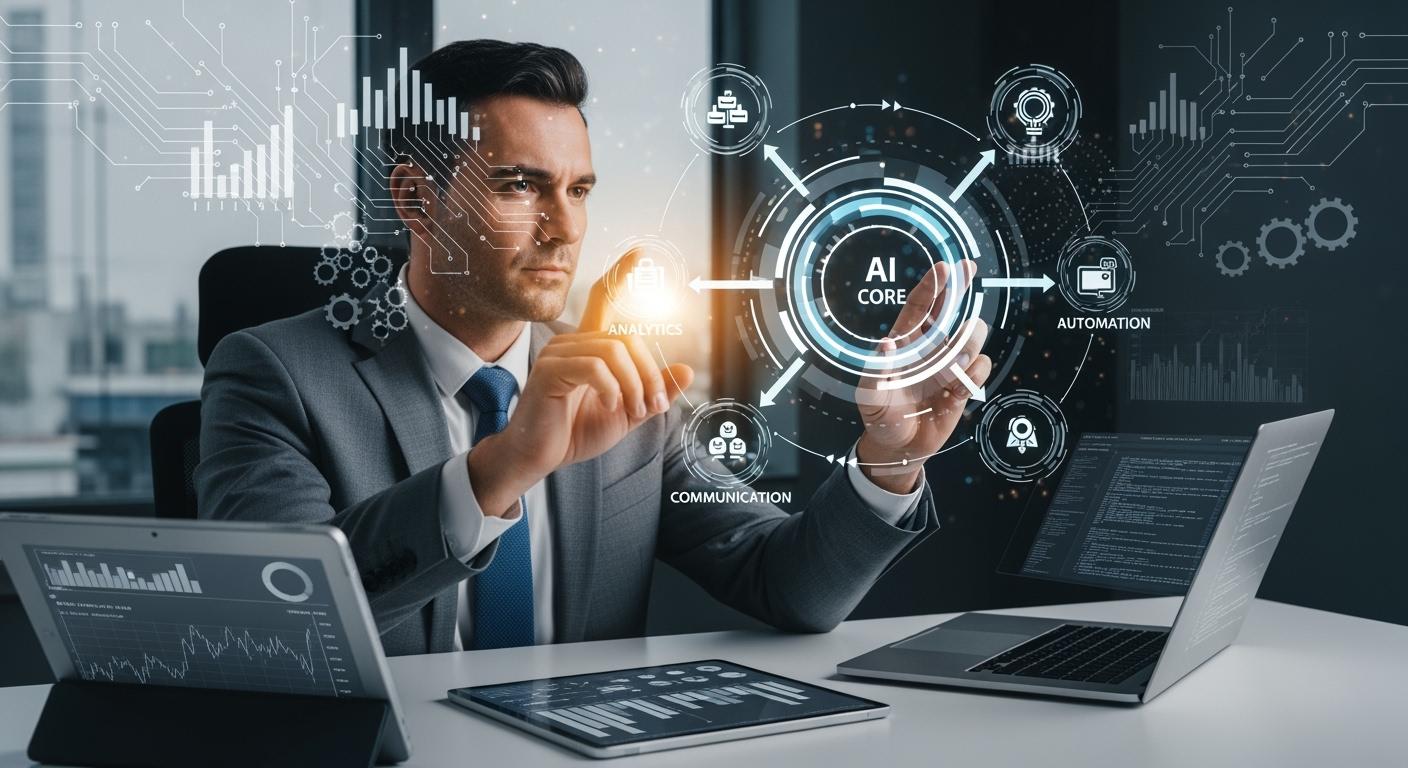
You interact with closed-loop business systems when you see technology that watches, decides, and corrects itself without much human help. These systems use ai to process data, make choices, and learn from results. Many businesses choose closed-loop automation for accuracy, adaptability, and efficiency. You can see why in the list below:
- Improved accuracy and self-regulation
- Less downtime and more productivity
- Fast adaptation to changes
- Better resource use
Data privacy and real-time optimization matter because they protect your information and keep operations smooth. As of 2024, the table shows how many companies use automation or ai:
| Statistic Description | Percentage |
|---|---|
| Businesses implementing automation solutions | 60% |
| Companies using AI in at least one function | 78% |
Closed-Loop Business Systems & AI

What Are Closed-Loop Business Systems
You can think of closed-loop business systems as smart cycles that watch, learn, and adapt. These systems use feedback to improve their actions and results. When you compare them to open-loop systems, you see a big difference.
Closed-loop systems watch, learn, and adapt. The difference between the two, called the actuating error signal, is fed back to the controller, which adjusts its actions to reduce error and improve output.
Closed-loop business systems keep checking their outputs and use feedback to make changes. This makes them more adaptive and resilient. You find these systems in many industries, from recycling to healthcare. For example, in recycling, the process follows clear steps:
- Collection and sorting: Used products are gathered and checked.
- Disassembly and recovery: Items are taken apart, cleaned, and sorted.
- The 3 Rs: Products are refurbished, remanufactured, or recycled.
- Integration into production: New products are made from recycled materials.
- Sales: Finished goods are sold to customers.
You see these steps in action when a company collects old electronics, recycles the parts, and sells new devices made from those materials. This cycle keeps resources in use and reduces waste.
Closed-loop business systems also show better results than open-loop systems. For example:
- Closed-loop BCIs show 27-50% better outcomes in Parkinson's treatment.
- They achieve double the speed for cursor control.
- There is a 75-82% reduction in seizures for epilepsy patients, compared to 40-56% for open-loop systems.
AI’s Role in Closed-Loop Automation
AI acts as the brain of closed-loop automation. You use ai to process data, make decisions, and learn from feedback. This helps your business respond quickly to changes and improve over time.
| AI Capability | Description | How it Supports Real-Time Decision-Making in Closed-Loop Systems |
|---|---|---|
| Real-Time Data Integration | Combines data streams from IoT, ERP, CRM, web analytics, and third-party sources into a unified, continuously updated view. | Provides a single, accurate operational picture enabling timely and informed decisions by reducing data silos and delays. |
| Predictive Analytics | Uses statistical and machine learning models to forecast outcomes, quantify risks, and detect emerging patterns. | Allows anticipation of future events and risks, enabling proactive decision-making and dynamic planning. |
| Prescriptive Modeling | Applies optimization and simulation to recommend specific actions considering constraints like budgets and regulations. | Translates predictions into actionable steps, accelerating decision-making with precise recommendations aligned to business goals. |
| Continuous Learning (MLOps) | Maintains model accuracy and relevance through automated retraining, monitoring, and bias detection. | Ensures AI models adapt to changing data and environments, sustaining reliable real-time decision support over time. |
| Accelerated Time-to-Decision | Combines continuous data analysis and AI insights to reduce human effort and speed up decision cycles. | Enables businesses to respond rapidly to market changes, supply disruptions, or regulatory shifts, maintaining competitive agility. |
| Integration with Digital Twins & IoT | Links AI with digital twins and IoT ecosystems for live simulation and strategy adaptation. | Facilitates dynamic interaction with real-world operations, enhancing real-time responsiveness and closed-loop control. |
You can see how ai helps your business make faster and smarter choices. For example, robots use sensors to gather data, learn from instructions, reason with logic, and act with precision. This cycle lets your systems adjust to new situations and work on their own.
Closed-loop automation uses ai to connect data, predict what will happen, and suggest the best actions. You get real-time updates and can react to problems before they grow. This keeps your business running smoothly and helps you stay ahead.
Key Components
You need several key parts to build a strong closed-loop business system. These include both hardware and software. Here is a simple table to show you the main components:
| Type | Examples |
|---|---|
| Software | Mobile applications, point-of-sale (POS) systems, backend systems |
| Hardware | Physical cards or tokens, mobile devices, specialized payment terminals |
| Financial infrastructure | Underlying financial network and payment processors |
Sensors play a big role. They collect data and send it to your system. Data analytics tools process this information and help you make decisions. Feedback mechanisms let your system adjust its actions to reach the right outcome.
- Sensors provide continuous feedback to the system.
- Data analytics processes this feedback to inform decision-making.
- Feedback mechanisms enable the system to adjust actions automatically to maintain the desired state.
In real-world use, you see machine learning and reinforcement learning at work. For example, a medical device can change its settings based on real-time data from a patient. This shows how sensors, analytics, and feedback work together.
You also need a strong foundation for ai. This includes tools for training models, updating them, and making sure they work well. Your system should unify data from equipment, control systems, and business apps. This supports predictive maintenance and helps you optimize your operations.
When you put all these parts together, you get a closed-loop business system that can watch, decide, act, and learn. You gain better control, faster responses, and improved results.
Closed-Loop System Functionality
Observe, Decide, Act, Learn Cycle
You can understand closed-loop business systems by looking at their core cycle. This cycle helps your business stay alert, make smart choices, and improve over time. The process has four main stages. Each stage plays a key role in closed-loop automation.
| Stage | Description | Implementation in Practice |
|---|---|---|
| Observe | Gathering data from the environment, competitors, and internal emotions. | This phase requires keen awareness and intel-gathering to avoid missing key information. |
| Orient | Interpreting observations through personal filters like culture and beliefs. | Building mental models to make sense of chaos and avoid misguided decisions. |
| Decide | Choosing a course of action quickly and clearly. | Emphasizing speed over perfection to make effective decisions in time-sensitive situations. |
| Act | Executing the decision and generating new data. | Testing actions in the real world to feed back into the Observe phase for continuous improvement. |
You start by observing. You collect data from sensors, customers, and your business environment. Next, you orient. You use your experience and business rules to make sense of the data. Then, you decide. You pick the best action based on what you know. Finally, you act. You carry out your plan and watch what happens. This cycle repeats, so your system keeps learning and adapting.
Continuous data feedback makes this cycle powerful. You help your ai system learn from its own performance. You see better accuracy and faster responses. As you retrain your models with new data, you keep your predictions sharp and your business ready for change. You can update your system at different levels, from quick sensor checks to long-term strategy reviews. This keeps your closed-loop integration strong and reliable.
Data Feedback and Privacy
You need to protect your data as you use ai and closed-loop integration. Data privacy is a top concern for every business. You want to keep your information safe while still using it to improve your operations.
Many methods help you protect privacy in closed-loop business systems. Here is a table that shows some common methods and how well they work:
| Privacy Method | Description | Effectiveness and Limitations |
|---|---|---|
| k-anonymity | Ensures each record is indistinguishable from at least k-1 others by merging feature values. | Widely used by government agencies; however, vulnerable to attacks and may reduce data utility due to generalization. |
| l-diversity, t-closeness | Extensions of k-anonymity providing stronger masking guarantees. | Provide improved privacy guarantees but still subject to certain privacy attacks. |
| Differential Privacy | Adds noise to data or query results to provide statistical guarantees on privacy. | Offers formal privacy guarantees; however, can be vulnerable to inferential attacks and requires balancing noise and utility. |
| Secure Multiparty Computation (SMC) | Cryptographic techniques enabling joint computation without revealing private inputs. | Demonstrated strong privacy protection in applications like classification and disease surveillance; computationally intensive. |
| Data Perturbation | Modifies data (e.g., adding noise) before sharing to protect privacy. | Can be tuned to balance privacy and data utility; effectiveness depends on perturbation level and method used. |
You can use k-anonymity to hide personal details. You can try differential privacy to add noise and protect sensitive information. Secure multiparty computation lets you work with partners without sharing raw data. Each method has strengths and limits. You must choose the right one for your needs.
Continuous data feedback also helps you keep your system accurate and safe. You retrain your ai models with new data. You adjust your system to match new rules and customer needs. You can trace every decision for audits and compliance. You combine automated feedback with human checks to make sure your system meets your goals.
Closed-Loop Integration
You connect ai with your business through closed-loop integration. This step lets you automate tasks and improve results without breaking your current processes. You can link sensors, software, and people to create a seamless flow of information.
You face some challenges when you start closed-loop integration:
- High initial costs can make it hard for small businesses to invest.
- You may find it difficult to connect new systems with old technology.
- Changing regulations can add risk and uncertainty.
You can use international standards to guide your closed-loop integration. Here are some common frameworks:
| Standard | Description |
|---|---|
| ISO 59004 | Establishes principles for circular economy activities, including systems thinking and resource management. |
| ISO 59010 | Focuses on transforming business models and value networks to support circular operations. |
| ISO 59020 | Provides methodologies for measuring circularity and specific indicators for performance evaluation. |
You can also follow best practices from projects like the NIST Circular Economy Closed Loop Recovery. These projects help you set up reliable material and information flows. They support recycling, remanufacturing, and reuse. You get tools and metrics to measure your progress.
When you use closed-loop integration, you make your business more flexible. You can respond to changes in the market. You can use machine learning to spot trends and adjust your strategy. You keep your data safe and your operations smooth. You build a system that learns, adapts, and grows with you.
Tip: Start small with one process. Test your closed-loop integration. Learn from the results. Then expand to other parts of your business.
You can see how closed-loop business systems, ai, and closed-loop integration work together. You get a smarter, safer, and more efficient business.
Business Benefits
Efficiency and Productivity
You can see real gains in efficiency and productivity when you use closed-loop automation. These systems help you attract the right audience, convert leads, analyze results, and optimize your strategies. Many businesses report improvements such as:
- Enhanced conversion efficiency
- Improved outbound reply rates
- Higher meeting show rates
- Shortened sales cycles
- Increased win rates in competitive deals
- Growth in deal size over time
- Better customer acquisition cost payback
Closed-loop systems use ai and machine learning to process feedback and make quick decisions. This means you spend less time on manual tasks and more time on growth. You can track every step, find what works, and adjust your approach for better results.
Control and Governance
You need strong control and governance to keep your business safe and compliant. Closed-loop business systems give you tools to manage risk and follow rules. When a regulator asks for proof, you can quickly show all the needed documents, policy updates, and logs. This shows you are always ready and compliant.
| Governance Structure / Mechanism | Description |
|---|---|
| Multidisciplinary Approach | Involves stakeholders from technology, law, ethics, and business for oversight. |
| Continuous Monitoring | Uses dashboards and metrics to detect bias, drift, and anomalies. |
| Accountability | Keeps audit trails and logs for transparency. |
| Compliance with Regulations | Ensures systems follow ethical and legal standards. |
| Integration and Flexibility | Connects with current tools and supports adaptability. |
| Performance Alerts | Sends alerts when models go outside set limits. |
| Custom Metrics | Uses metrics that match your business goals. |
Closed-loop automation helps you manage regulatory changes. You can update policies in real time and keep everyone informed. This reduces the risk of mistakes and keeps your business running smoothly.
Performance Optimization
You can measure and improve your performance with closed-loop business systems. These systems use ai-driven robotics and feedback loops to keep getting better. You can track key metrics like first call resolution, average handle time, and agent schedule adherence.
| KPI Name | Description |
|---|---|
| First Call Resolution (FCR) | Number of calls resolved in a single contact. |
| Average Handle Time (AHT) | Average total duration of a call. |
| Agent Schedule Adherence | How well agents stick to their schedules. |
| Right Party Contact (RPC) | Number of calls reaching the correct person. |
Closed-loop business systems create a cycle of ongoing analysis and adjustment. You can refine your decisions in real time and learn from every outcome. This helps you stay agile and reach your goals faster.
Tip: Use closed-loop automation to analyze your outcomes and refine your strategies. This keeps your business on the path to continuous improvement.
Implementation Strategies
Adoption Steps
You can start your journey with closed-loop business systems by following a few clear steps:
- Begin with small AI tools. Test their value in one part of your business before expanding.
- Modernize your data infrastructure. Make sure your systems can support new AI and machine learning projects.
- Upskill your team. Teach your employees how to work with AI-driven robotics and digital tools.
Tip: Focus on one process at a time. This helps you learn quickly and avoid big mistakes.
Best Practices
You can boost your success by following proven best practices:
- Get executive buy-in. Leaders must support your closed-loop system for it to work.
- Prioritize your projects. Choose the most important areas first.
- Use your business knowledge. Combine what you know with new AI insights.
- Solve problems quickly. Respond fast to issues and feedback.
- Stay agile. Change your approach when you see new trends.
- Make personal contact. Keep communication open with your team.
- Empower your employees. Give them the tools and trust to use AI.
Many companies use AI to spot and fix data errors. They use smart tools to check for mistakes, remove duplicates, and keep data clean. This keeps your system reliable and helps you make better decisions.
Overcoming Challenges
You may face some common challenges when you add AI to your closed-loop business systems:
- Security and privacy risks can grow if you do not set up strong controls.
- Change management is key. If you ignore your company culture, your team may resist new systems.
- Expecting instant results from AI can lead to disappointment. Progress takes time.
- Data centers may struggle with resource competition and power limits, especially as AI grows.
- AI systems can act like "black boxes." This makes it hard to explain decisions and assign responsibility.
You can solve these problems by using clear data governance. Set up cross-team leaders and assign data stewards. Use automated rules to control access and keep your data safe. Try explainable AI tools to make your system more transparent. Keep audit trails so you can track every decision.
| Challenge | Solution |
|---|---|
| Cultural resistance | Show how data governance helps teams and reduces manual work. Use champions in each group. |
| Unclear data ownership | Assign leaders and data stewards. Use charts to show who is responsible for each process. |
| Balancing access with security | Use automated controls and smart data tags to protect data while allowing easy access. |
Note: Closed-loop business systems give you a competitive edge and help you keep your customers loyal.
You see how closed-loop business systems and AI change the way organizations work. These systems move from small projects to core strategies, shaping culture and governance.
- Set clear goals and start with one area.
- Use feedback and train your team.
- Track results and show value to keep support strong.
Closed-loop integration boosts efficiency, supports sustainability, and helps you grow. Companies using ai-driven robotics report better planning and resource use. You can build a future-ready business by focusing on control, privacy, and continuous improvement.
FAQ
What is closed-loop system integration?
You connect different parts of your business with integration. Integration lets you share data and actions between systems. You use integration to make sure your closed-loop system works as one unit. Integration helps you get better results and faster responses.
Why does integration matter for AI in business?
You need integration to link AI with your business tools. Integration lets AI collect data, make decisions, and act. Integration helps you use feedback to improve. You get more value from AI when you use integration. Integration keeps your business running smoothly.
How do you start integration in your company?
You start integration by picking one process. You test integration with a small project. You learn from the results. You expand integration to other areas. You train your team on integration tools. You check your progress often. Integration grows step by step.
What challenges can you face with integration?
You may find integration hard at first. Old systems may not fit with new integration tools. You may need to update your data for integration. You must keep your data safe during integration. You solve problems by planning your integration and asking for help.
How does integration support data privacy?
You use integration to control how data moves. Integration lets you set rules for sharing data. You can track data with integration. You protect private information with integration. You follow laws and keep trust with integration. Integration makes privacy easier to manage.
See Also
AI-Driven Safety Stock Strategies for Fashion Retail in 2025
Best Practices for Accurate Production Forecasting Using AI in 2024
Is Your AI Analyzing Social Media Effectively?
Intelligent Fashion AI Solutions for Efficient Returns Management
How AI Accelerates Market Readiness by Shortening Lead Times