
Autonomous commerce platforms use AI and automation to minimize human involvement. These systems optimize and personalize every step in commerce, from buying to after-sales service. You see a shift from traditional methods to autonomous approaches in both B2B and B2C. Advancements in AI and robotics improve efficiency and lower costs. Agentic commerce, Autonomous Commerce Intelligence (ACI), and the Autonomous Execution Fabric drive this change. You may wonder: What is autonomous commerce? How does it work? What are its benefits? How does it differ from autonomous procurement? What does the future look like?
What Is Autonomous Commerce?

Core Principles and AI-Driven Execution
You experience a new way to buy and sell with autonomous commerce. This approach uses artificial intelligence and automation to create a self-managing shopping experience. You see fewer manual steps and more seamless transactions. Autonomous commerce builds intelligent networks that operate without much human help. These networks form autonomous value chains, which move beyond traditional supply chain management. They connect buyers and sellers in smarter ways.
You benefit from predictive and self-optimizing systems. These systems improve operational efficiency and customer satisfaction. They make decisions quickly and adapt to changes. You notice that tasks like product discovery, price comparison, selection, and payment processing happen automatically. This shift enables end-to-end automation and reduces the need for manual work.
| Segment Type | Description |
|---|---|
| Agentic Shopping Assistants | Assist consumers in their shopping tasks. |
| AI-Augmented Commerce Suites | Provide enhanced functionalities for commerce operations. |
| Agent Workflow & Orchestration Engines | Manage and coordinate various commerce workflows. |
| Enterprise Agent Execution Platforms | Facilitate complex, multi-domain operational logic execution. |
You interact with AI agents that perform shopping tasks for you. These agents handle everything from finding products to completing payments. You may hear terms like a-commerce, autonomous shopping, and AI-driven commerce. These describe the same idea: letting AI manage the buying process.
Key Technologies: ACI and Execution Fabric
Autonomous commerce relies on advanced technologies to deliver its promise. You use Autonomous Commerce Intelligence (ACI) to model, modify, and optimize commerce processes. ACI gives you visual process control, so you can change workflows without waiting for IT support. Intelligent automation boosts speed, efficiency, and flexibility in your transactions.
| Component | Description |
|---|---|
| Visual process control | Allows users to model, modify, and optimize commerce processes without IT delays. |
| Intelligent automation | Utilizes Agentic Commerce Intelligence to enhance speed, efficiency, and flexibility in commerce. |
"Go Autonomous tackles the deep structural complexity of modern B2B commerce. With the Execution Fabric, enterprises gain an intelligent orchestration that transforms fragmented processes into a unified flow—unlocking faster revenue, scalable operations, and the foundation for truly autonomous commerce."
You see how the Autonomous Execution Fabric connects different parts of commerce. It turns separate processes into one smooth flow. This technology helps businesses grow faster and scale operations. You get a foundation for truly autonomous commerce, where systems work together without manual effort.
Agentic Commerce and Self-Operating Marketplaces
Agentic commerce changes how you shop and manage purchases. You rely on autonomous AI agents that perform complex tasks for you or your business. These agents search for products, manage purchases, and adapt to your needs. Unlike traditional AI, agentic AI can start and finish tasks on its own. It learns from past actions and improves over time.
Agentic commerce involves autonomous shopping agents that operate through a decision pipeline, capturing user intent and executing shopping activities independently. These agents utilize large language models for reasoning, allowing them to assess various factors like constraints and preferences. They can also gather real-time data on product availability and pricing, making their decision-making process efficient. The execution phase involves secure transactions, while learning from past actions helps improve future decisions.
You see these agents in action across many areas:
- Autonomous Replenishment in Retail and D2C: AI agents monitor what you use and reorder products automatically.
- Dynamic Personalization and Intelligent Bundling: Agents create bundles based on your preferences.
- Automated Procurement in B2B Commerce: Buying agents analyze suppliers and manage repeat orders.
- Marketplace Optimization and Intelligent Comparison: AI agents compare platforms to find the best deals.
- Subscription Management and Churn Prevention: Agents help with renewals and upgrades by analyzing usage patterns.
Agentic commerce uses advanced AI for autonomous decision-making. You notice less human intervention and faster results. Operational efficiency improves by 35-50% in the first year. Customer experience gets better by 25-40%. You enjoy smoother transactions and higher satisfaction.
Features and Benefits
Automation and Efficiency
You gain many advantages when you use autonomous commerce. These systems use advanced automation to handle tasks that once needed human effort. You see features like self-running operations, auto-adapting products, and instant transactions. The table below shows some of the main features you can expect:
| Feature | Description |
|---|---|
| Autonomous Operations | Self-running systems that monitor, decide, and fix issues without human intervention. |
| Augmented Workforce | Humans oversee AI systems instead of doing repetitive tasks. |
| Auto-Adapting Products | Offerings that change based on usage data. |
| Machine Customers | Non-human buyers making purchasing decisions. |
| Programmable Economy | Smart contracts and digital twins enable instant, smooth transactions. |
| Zero-Click Shopping | Advanced technology allows instant purchases without manual steps. |
| Predictive Analytics | Recommends products based on your behavior. |
| Biometric Verification | Lets you buy with voice commands and biometric data. |
| Instant Transactions | Supports secure one-click or ambient computing transactions. |
| Automated Product Replenishments | Personalized, automated restocking of products. |
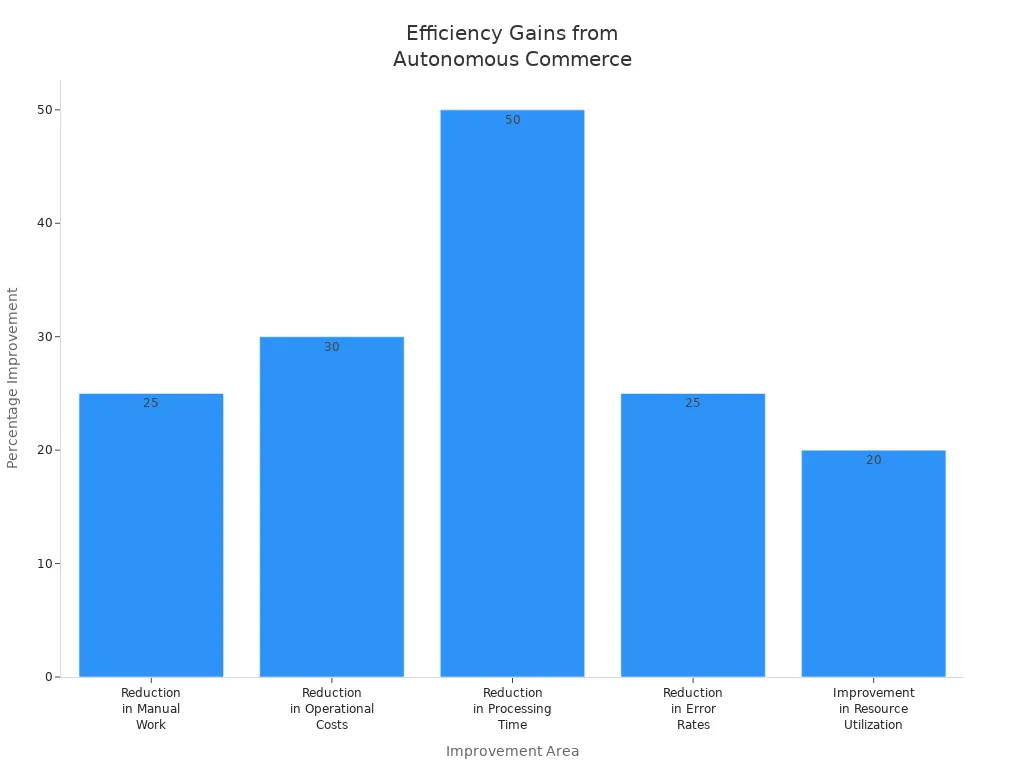
You notice big improvements in how you work. Autonomous commerce reduces manual work by 25%, cuts operational costs by 30%, and shortens processing time by 50%. You also see fewer errors and better use of resources.
Revenue Growth and Cost Reduction
You can boost your business results with autonomous systems. Most early adopters report positive returns. You may see up to 70% cost reduction when you let AI agents automate workflows. Many organizations have cut costs by 30%. Companies using agentic AI often see revenue grow by 6% to 10%. The table below highlights these results:
| Evidence Type | Statistic |
|---|---|
| Positive ROI from agentic AI | 88% of early adopters achieved positive ROI |
| Cost reduction | Organizations cut operational costs by 30% |
| Cost reduction through automation | Up to 70% cost reduction via AI agents |
| Revenue increase | Average revenue increase of 6% to 10% |
You can achieve strong growth and save money by adopting autonomous commerce. These gains help you stay ahead in a fast-changing market.
User Experience and Decision-Making
You enjoy a better shopping experience with autonomous commerce. The platform uses structured data and trust signals to give you smarter product recommendations. You get matched with the right suppliers or buyers based on your needs. Automation handles routine tasks, so you can focus on important decisions.
- You receive clear comparison summaries and helpful suggestions.
- The system explains its choices, which helps you feel confident.
- You move through the buying process smoothly and with less stress.
Autonomous systems make your decisions easier and more accurate. You spend less time on routine work and more time on what matters most.
Autonomous Commerce vs. Autonomous Procurement
Key Differences and Overlaps
You may wonder how autonomous commerce and autonomous procurement differ. Both use AI and automation, but they serve different needs. Autonomous commerce focuses on consumer-driven buying. For example, you can set up an AI agent to buy household items like detergent when you run low. The agent checks your preferences and urgency before making a purchase. Autonomous procurement, on the other hand, works in business settings. It automates purchasing for companies and often uses self-service models. You see this in retail with self-checkout systems, like those at Uniqlo, where you scan and pay for items without help.
- In autonomous procurement, AI acts on its own. It reviews data and starts actions, but you or your team can still oversee the strategy.
- In autonomous commerce, AI agents use structured data to make decisions. They focus less on brand image and more on facts.
| Aspect | Autonomous Commerce | Autonomous Procurement |
|---|---|---|
| Focus | Optimizing machine interactions with structured data | Acting as an autonomous agent evaluating context |
| Decision-Making | Relies on structured, queryable data | Makes decisions and executes tasks without human input |
| Interaction with Humans | Less human intervention required | Works in tandem with procurement teams |
Integration with Supply Chain Automation
You benefit when autonomous procurement and commerce connect with supply chain automation. An autonomous supply chain uses AI, multi-agent orchestration, and real-time data. This setup helps you respond faster and work more efficiently. For example, a retailer can link its e-commerce platform with inventory systems. When sales happen, the system checks stock and reorders products automatically. This reduces out-of-stock problems.
- You see better teamwork between businesses and suppliers through IoT connections.
- Communication and efficiency improve across the supply chain.
A strong digital core supports this process. It lets data move smoothly and helps you make decisions in real time.
Comparison with Traditional E-Commerce
You notice big changes when you compare autonomous commerce and traditional e-commerce. The table below shows the main differences:
| Attribute | Traditional Commerce | Agentic Commerce |
|---|---|---|
| User Interaction | You search, filter, and select manually | AI agents act for you based on intent and context |
| Personalization | Based on past purchases and demographics | Uses real-time, context-aware AI recommendations |
| Decision Making | You make all the choices | You share or delegate decisions to AI agents |
With autonomous commerce, you get proactive help. The platform anticipates your needs and manages tasks from start to finish. In traditional e-commerce, you do most of the work yourself.
Future Trends for 2026

Innovations and Agentic Platforms
You will see major changes in commerce by 2026. New agentic platforms let AI agents handle shopping tasks for you. These agents work with third-party systems, making your experience smoother and more connected. Younger shoppers now use social platforms and large language models for product discovery instead of traditional search engines. You notice that 40% of U.S. shoppers use agentic shopping assistants for research, but almost everyone still uses other channels. This shows that discovery is becoming more distributed.
Consumers aren’t looking for a single, generic shopping experience. They now expect personalized, guided discovery, and increasingly, conversational interfaces that mirror the intuitive, context-aware interactions they’re becoming accustomed to on LLM platforms.
During big sales events, agentic experiences boost efficiency. For example, sessions with Amazon’s Rufus chatbot saw over 100% growth in purchases compared to only 20% growth for sessions without it.
Challenges and Risks
You face new challenges as autonomous platforms grow. Bot traffic in e-commerce can cause problems. If you misjudge when to let machines make decisions, you risk costly mistakes and damaged relationships. Data integration and quality must improve. You need strong governance to keep decisions ethical and aligned with your brand. Organizations must change their culture, redefine sales roles, and encourage teamwork across departments.
The report illustrates the multifaceted nature of AI adoption, highlighting the need for integrated strategies to overcome barriers such as technical limitations and operational complexities.
The article discusses how autonomous shopping systems face psychological and cultural barriers due to the delegation of decisions and tasks to technology, which challenges ingrained human-machine relationships.
Regulatory frameworks are adapting. Policymakers use risk-based strategies and regulatory sandboxes to test AI technologies safely. International cooperation and ethical standards are becoming more important.
Opportunities for Businesses
You have many opportunities if you adopt autonomous commerce. AI is now a competitive necessity. Retailers use AI for personalized and efficient customer experiences. Investments in AI are rising because real-time decision-making is in demand.
| Statistic | Value |
|---|---|
| Organizations using AI in 2024 | 78% |
| Year-over-year increase in retail site traffic from chat interactions | 1,950% |
| Awareness | Action |
|---|---|
| B2B leaders recognizing AI's impact | 64% |
| B2B leaders feeling prepared | 20% |
You see a gap between awareness and action. If you act now, you gain long-term advantages. Nearly 60% of small businesses use AI, more than double the share in 2023. High-tech adopters report gains in sales and profits. AI tools change how you interact with customers. Businesses must adapt quickly to keep up with rapid advancements.
| Evidence | Details |
|---|---|
| Generative AI Traffic Growth | 4,700% YoY increase in July 2025 |
| Potential Revenue from Agentic Commerce | Up to $1 trillion in US B2C retail revenue by 2030 |
| AI-Driven Spending in E-commerce | More than $261 billion projected |
Retailers who redesign systems for agent-driven interactions capture algorithmic preference. Buyer journeys now start and end with algorithms, not websites. Forward-thinking businesses use autonomous commerce intelligence to transform operations and stay ahead.
You see autonomous commerce platforms changing global markets. The table below shows their growing economic value:
| Year | Economic Value Generated by Autonomous Corporations | Percentage of Global GDP |
|---|---|---|
| 2025 | Less than $100 billion | 0.1% |
| 2030 | Approximately $5 trillion | 5% |
| 2035 | Approximately $30 trillion | 25% |
| 2040 | Potentially $80–100 trillion | 60–70% |
To stay competitive, follow these recommendations:
- Assess readiness and clarify ownership.
- Structure product data for agent use.
- Develop API strategies and agent metrics.
Understanding agentic commerce and AI-driven automation helps you prepare for future growth. You benefit from efficiency gains, price reductions, and new opportunities.
FAQ
What is the main difference between autonomous commerce and traditional e-commerce?
You let AI agents handle tasks in autonomous commerce. In traditional e-commerce, you do most steps yourself. Autonomous platforms predict your needs and act for you. This saves you time and reduces errors.
How secure are autonomous commerce platforms?
You benefit from advanced security features. These platforms use encryption, biometric verification, and real-time monitoring. You can trust that your data and transactions stay safe.
Can small businesses use autonomous commerce?
You do not need a large budget to start. Many platforms offer scalable solutions. You can automate basic tasks and grow as your needs change.
Will autonomous commerce replace human jobs?
You will see job roles change, not disappear. People move from repetitive tasks to managing and improving AI systems. You gain new opportunities in technology and customer service.
See Also
Actionable Strategies for Ecommerce Success in 2025
The Evolution of Services in the Ecommerce Landscape
Top 10 E-commerce Platforms with Accounting Features