

An AI business operating system for 2026 is a smart platform that connects, automates, and manages your business processes using advanced AI. You will see its main value in how it helps you make quick decisions, boost efficiency, and lower costs. Market experts expect the operating systems market to reach $49.35 billion in 2026, showing steady growth.
- In 2026, you will rely on AI to automate tasks, improve accuracy, and focus on important projects.
- AI analytics will help you shift from reacting to problems to planning ahead.
| Aspect | Impact Description |
|---|---|
| Operational Efficiency | AI-driven automation cuts costs and reduces errors in areas like supply chain and finance. |
| Customer Experience | Personalized tools and chatbots make your customers happier. |
| Data-Driven Decisions | AI helps you find insights and make smarter choices faster. |
| Innovation in Products | AI speeds up how you create and improve products. |
| Risk Management | AI spots risks and helps keep your data safe. |
AI Business Operating System Purpose
Unified Platform
You need a single place to connect all your business tools and data. An ai business operating system gives you this unified platform. It brings together structured and unstructured data, so you see a complete and governed view of your business. You can embed ai into your workflows, which reduces manual work and improves consistency. This unified approach helps you make better decisions and act faster.
A unified platform lets you connect your existing systems, making it easier to manage everything in one place. For example, a logistics director at a global manufacturing company uses an ai operating system to coordinate ai agents across different platforms. This reduces supply delays by 40%. A marketing lead at a large retail brand uses the same system to streamline campaigns, which can double the speed of campaign launches and increase conversion rates by 30%. A compliance manager at a bank automates regulatory tasks, cutting manual review time by 70%.
Here are the main objectives of an ai business operating system:
| Objective | Description |
|---|---|
| Governance | Embedding ethical governance, security, and compliance by design. |
| Scalability | Adopting a scalable ai operating system model to support growth and efficiency. |
| Integration into Business Processes | Aligning ai initiatives with business priorities and standardizing data foundations. |
You get a flexible framework for building and managing ai agents. This platform also improves governance and compliance with built-in risk management.
Intelligent Orchestration
You want your business to run smoothly, even as it grows. Intelligent orchestration in an ai operating system helps you do this. It connects people, digital workers, ai, and tasks. This ensures the right work goes to the right resource at the right time. You can scale your ai solutions across many workflows without major changes.
| Benefit | Description |
|---|---|
| Enhances scalability | Orchestration helps you scale ai solutions across multiple processes and workflows. |
| Improved flexibility | You can add new ai solutions to existing processes easily. |
| Improves performance | Coordination between ai systems gives you more reliable results. |
| Efficient resource allocation | Connects people, digital workers, ai, and tasks for better resource use. |
| Facilitates collaboration | Promotes teamwork among tools and processes, making ai more effective. |
| Simplifies compliance | Tracks work and provides reports to meet rules and requirements. |
| Centralizes access | Gives you a full view of all processes for better insights and real-time monitoring. |
Intelligent orchestration lets you make real-time, context-aware decisions. Ai agents adapt to changes, so your business stays resilient. When you integrate decision-making into workflows, you respond quickly to new challenges.
- Ai delivers predictive forecasting and real-time optimization, which traditional software cannot do.
- Ai systems adapt based on historical and real-time data.
- Ai tools automate repetitive tasks, so you can focus on strategy.
- They analyze large datasets fast, finding insights that people might miss.
- Ai provides objective analysis, reducing human bias.
- Ai-driven automation helps you anticipate problems, not just react to them.
- It turns data into actionable insights, improving your decisions.
Agentic Computing
Agentic computing is a new way to use ai in your business. It means using ai agents that can act on their own. These agents do not just follow fixed rules. They learn from real-time data and adjust their actions. This makes your business more flexible and efficient.
Agentic ai can:
- Change its approach based on new data.
- Take action without waiting for you to tell it what to do.
- Handle complex, multi-step tasks.
For example, agentic computing reduces the need for IT help. CVS Health saw a 50% drop in live agent chats in just 30 days after using agentic ai. Employee productivity goes up because problems get solved in minutes instead of hours. New hires get up to speed faster. Agentic ai also scales across your organization without adding technical debt.
| Measurable Outcome | Description |
|---|---|
| Operational Efficiency | Agentic ai reduces IT intervention, as seen with CVS Health's 50% drop in live agent chats. |
| Employee Productivity | Time to resolution improves from hours to minutes, with faster onboarding for new hires. |
| Strategic Impact | Agentic ai scales without increasing technical debt, boosting productivity across the business. |
You can use agentic ai in many ways. Ai virtual assistants and ai-enabled virtual assistants help you automate tasks, answer questions, and support your team. The built world ai operating system uses these agents to manage physical and digital environments, making your business smarter and more responsive.
Key Features of AI Business Operating System

Data Integration
You need to connect data from many sources to make your business smarter. An ai business operating system uses data integration to bring together information from databases, storage, legacy systems, and IoT devices. This process turns scattered data into useful knowledge. You get high-quality data that helps ai models learn and make better predictions.
Data integration methods include:
- Personalized recommendations: Ai uses combined data from customer actions to suggest products or services.
- Fraud detection and prevention: Ai checks complex data in real time to spot problems and stop fraud.
- Legacy system modernization: Ai connects old systems to new ones, improving accuracy and lowering costs.
- Chatbots: Ai chatbots use integrated data to answer customer questions quickly.
- API integrations: APIs let systems share data instantly, which is important for training ai models.
- IoT data integration: Ai uses data from devices to predict events and make decisions.
When you integrate data, you make it accessible and trustworthy. Ai and machine learning models need good data to give reliable results. You can use this data to support business processes and make informed choices. Data integration also improves data quality by delivering complete, consistent, and timely information. This helps you rely on your data for every application.
Real-Time Analytics
You want to see what is happening in your business right now. Real-time analytics in an ai operating system lets you track and analyze data as it comes in. You can make decisions faster and stay ahead of problems.
| Capability | Description |
|---|---|
| Edge Computing | Moves data processing closer to the source, reducing latency for faster decision-making. |
| AutoML | Automates model refinement based on new data, enhancing decision-making in applications like Netflix. |
| Natural Language Processing | Enables instant insights through simple queries and real-time text analysis for customer feedback. |
Real-time analytics gives you live dashboards for instant insights. You can see critical data and act quickly. Ai helps you predict demand and manage inventory, so you deliver products faster and save money. Predictive analytics lets you spot trends early and adjust your plans. You can monitor cash flow and expenses in real time, which helps you manage budgets and reduce risks. Ai ensures that every decision is based on accurate data, making your business more efficient and collaborative.
Workflow Automation
You can automate tasks and processes to boost productivity. Ai workflow automation in an ai operating system goes beyond simple scripts. Ai-powered workflows think, learn, and improve over time. They use machine learning and natural language processing to recognize patterns and make predictions.
Unique features of ai workflow automation include:
- Ai workflow automation enables workflows that can think, learn, and improve over time.
- It leverages machine learning and natural language processing to recognize patterns and make predictions.
- This adaptability is particularly beneficial for complex processes with variable inputs.
- Ai-powered workflows are not limited to rule-based scripts like traditional automation.
- They offer intelligence and adaptability, processing large amounts of data effectively.
- This results in a more intelligent use of data across organizations.
- Core components include APIs for app connectivity.
- Machine learning is utilized for decision-making.
- Generative ai is employed to create content.
Ai workflow automation helps you save time and money. You can automate repetitive tasks, which frees up employees to focus on important work. This shift increases productivity and lets your team use their skills where they matter most. Businesses with high ai integration see greater labor efficiency growth. Automation also reduces errors and speeds up time-to-market, giving you a competitive edge.
Security & Compliance
You must protect your data and follow rules. An ai business operating system includes strong security and compliance features. You get built-in tools that help you govern, map, measure, and manage your ai systems.
| Compliance Standard | Description |
|---|---|
| EU AI Act | Governs the responsible development and deployment of AI technologies in the EU. |
| GDPR | Regulates data protection and privacy in the EU. |
| Continental AI Strategy | A framework proposed by the African Union for AI governance. |
| Artificial Intelligence and Data Act (AIDA) | A proposed regulation in Canada focusing on AI and data management. |
Ai business operating systems follow international standards. These standards help you build, manage, secure, and improve your ai management systems. You get a balance between strong security and fast development. Ai automates regulatory monitoring, so you stay compliant with changing laws. Ai-driven anti-money laundering solutions detect suspicious transactions better than old methods. Intelligent contract analysis checks contracts for legal standards, making reviews faster and more accurate.
Ai business operating systems help you adapt to new regulations and improve compliance across industries. You can trust your ai to keep your data safe and your business legal.
Tip: Use ai virtual assistants and ai-enabled virtual assistants to automate compliance tasks and support your team. The built world ai operating system uses these features to manage both digital and physical environments, improving efficiency and productivity.
AI Business Operating System vs. Traditional AI Tools

Holistic Approach
You need a solution that goes beyond simple automation. An ai business operating system gives you a holistic approach by connecting every part of your business. Traditional tools often use rule-based logic and work best for structured tasks. They react to problems but do not predict them. In contrast, ai automation learns from data, adapts to new situations, and makes decisions before issues arise. This approach helps you stay ahead and improve efficiency.
| Feature | Traditional Automation | AI Automation |
|---|---|---|
| Logic | Rule-based | Learns from data |
| Flexibility | Less flexible | Context-aware and adaptable |
| Decision-Making | Reactive | Predictive, reducing human oversight |
You can also use generative ai to handle both structured and unstructured data. This means you can solve complex, language-based tasks that require understanding and context.
Scalability
As your business grows, you want your systems to keep up. An ai operating system uses modular architecture, so you can scale each part as needed. You avoid bottlenecks and keep costs down. Custom solutions let you match your ai to your business structure, which boosts productivity and prevents slowdowns.
| Scalability Advantage | Description |
|---|---|
| Precise Resource Allocation | Custom solutions can implement strategies based on specific organizational priorities, preventing performance degradation. |
| Modular Architecture | Components can scale independently based on actual demand, leading to cost efficiencies. |
| Organization-Specific Data Strategies | Custom AI can align with business structures, preventing bottlenecks from generic solutions. |
You get precise resource allocation and better performance. The built world ai operating system uses these strategies to support large and small organizations.
User Experience
You want your team to enjoy using ai tools. An ai operating system focuses on clear instructions and easy onboarding. This reduces frustration and helps everyone use advanced features. Studies show that 73% of people engage more with applications that guide them well. If ai features confuse users, 60% will stop using the app. Good onboarding increases the use of ai features by 25%. Ongoing education helps 80% of users adapt to new capabilities.
| Improvement Aspect | Evidence |
|---|---|
| User Engagement and Satisfaction | 73% of consumers are more likely to engage with AI-powered applications that provide clear instructions. |
| Reduction in User Frustration and Abandonment | 60% of users are more likely to abandon an application if its AI features are confusing. |
| Increased Use of AI Features | Products with robust onboarding see a 25% higher adoption rate of advanced AI functionalities. |
| Continuous Learning and Adaptation | 80% of users appreciate ongoing education about AI capabilities, aiding adaptation. |
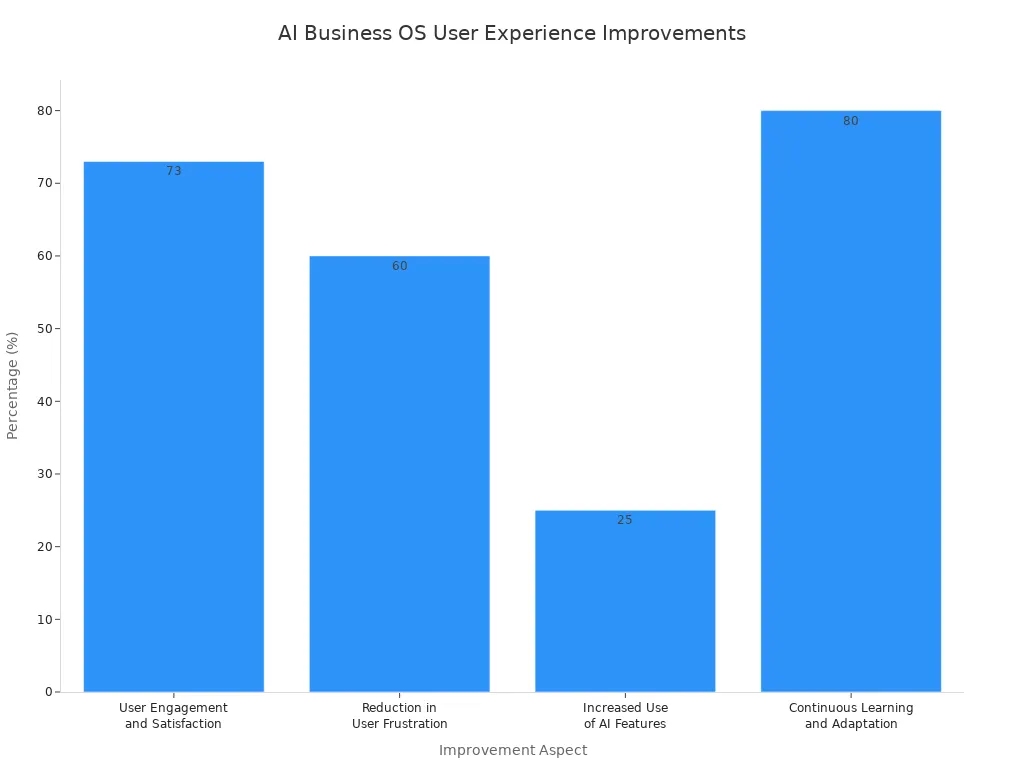
You can use ai virtual assistants to help your team learn and adapt. This leads to higher efficiency and better results for your business.
Use Cases & Adoption Considerations
Business Function Applications
You can use ai across many business functions to boost productivity and accuracy. The table below shows how different teams use ai and agent-driven automation to improve results:
| Business Function | AI Application Description |
|---|---|
| Marketing | Generative ai for creating marketing campaigns |
| Legal | Drafting legal documents using ai |
| Product Design | Generating product designs with ai |
| Software Development | Writing code at scale through generative ai |
| Operational Efficiency | Ai-driven hyper-automation reimagining workflows |
| Healthcare | Predictive diagnostics for early disease detection |
| Retail | Hyper-personalization recommendations |
| Finance | Fraud detection systems identifying suspicious patterns quickly |
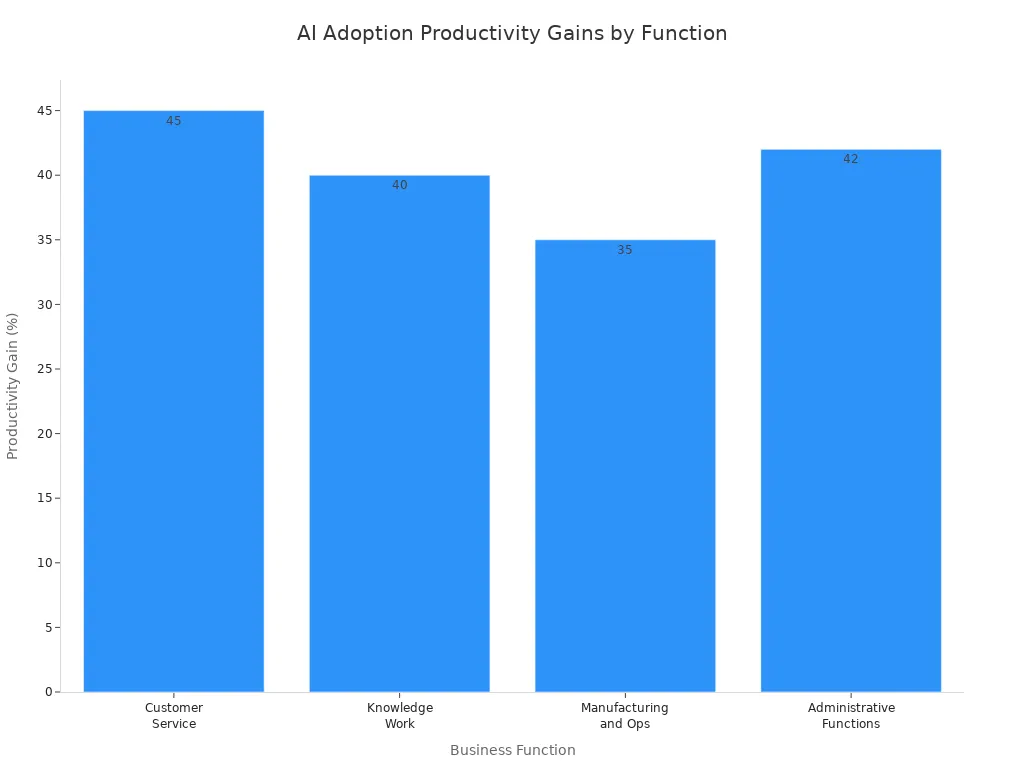
Agent-driven automation helps you reduce errors and speed up tasks. For example, ai virtual assistants can answer customer questions or help draft documents. You can see big productivity gains in customer service, knowledge work, and manufacturing.
| Business Function | Productivity Gain (%) |
|---|---|
| Customer Service | 45 |
| Knowledge Work | 40 |
| Manufacturing and Ops | 35 |
| Administrative Functions | 42 |
Industry Examples
Many industries lead in adopting ai operating system solutions. You can see agent-driven automation in:
- Distribution and supply chain: ai predicts demand and optimizes delivery.
- Automotive: ai powers autonomous agents for fleet management and production.
- Facilities management: ai monitors systems and automates routine tasks.
- Nonprofits: ai personalizes outreach and automates fundraising.
These industries use ai workflows and autonomous workflows to improve decision accuracy, scale operations, and cut costs. You can also find faster innovation cycles and better customer personalization.
Data Readiness
You must prepare your data before using ai. Clean, labeled, accessible, and traceable data ensures your ai and autonomous agents work well. You should:
| Characteristic | Description |
|---|---|
| Clean | Remove errors and noise from data. |
| Labelled | Tag data for ai learning. |
| Accessible | Make data easy to use across teams. |
| Traceable | Keep a clear record for compliance. |
You can use cloud solutions and scalable data lakes to support enterprise workflows.
Change Management
Change management helps your team adapt to ai and automation. You need to:
- Help employees understand how ai will change their work.
- Set clear goals and roles for the transition.
- Use structured models like Lewin’s or McKinsey’s 7S.
- Communicate openly about new responsibilities.
Organizations that invest in upskilling and ai literacy see adoption rates 3.5 times higher. Ongoing education leads to better results and higher returns on your ai investments.
You can use an AI business operating system to connect your tools, automate tasks, and manage your data. This system gives you a single platform for all your AI needs. The table below shows how you benefit:
| Benefit | Description |
|---|---|
| Unifies All Your AI Initiatives | Brings all your AI tools together for better management. |
| Enables Autonomous Agents | Lets agents make decisions and adapt on their own. |
| Future-Proofs Your AI Investments | Makes it easy to add new technology without starting over. |
You can future-proof your business and stay ahead in a changing world.
FAQ
What makes an AI business operating system different from regular AI tools?
You get a single platform that connects all your business data and tools. Regular AI tools work alone. An AI business operating system helps you automate, manage, and scale your business with less effort.
Can small businesses use an AI business operating system?
Yes! You can start small and grow over time. Many systems offer flexible options. You do not need a big IT team. Cloud-based solutions make it easy for you to get started.
How does an AI business operating system keep my data safe?
You use built-in security and compliance features. These systems follow global rules like GDPR. AI checks for risks and helps you protect your data. You get alerts if something looks wrong.
Will my team need special training to use it?
Most platforms offer simple onboarding and clear guides. You can learn step by step. Many systems include AI assistants to help you. Your team can adapt quickly with the right support.
See Also
Utilizing AI and Data for Demand Predictions in 2025
2025 Fashion Retail Solutions Through AI-Driven Safety Stock
Best Practices for Accurate Production Forecasting Using AI in 2024