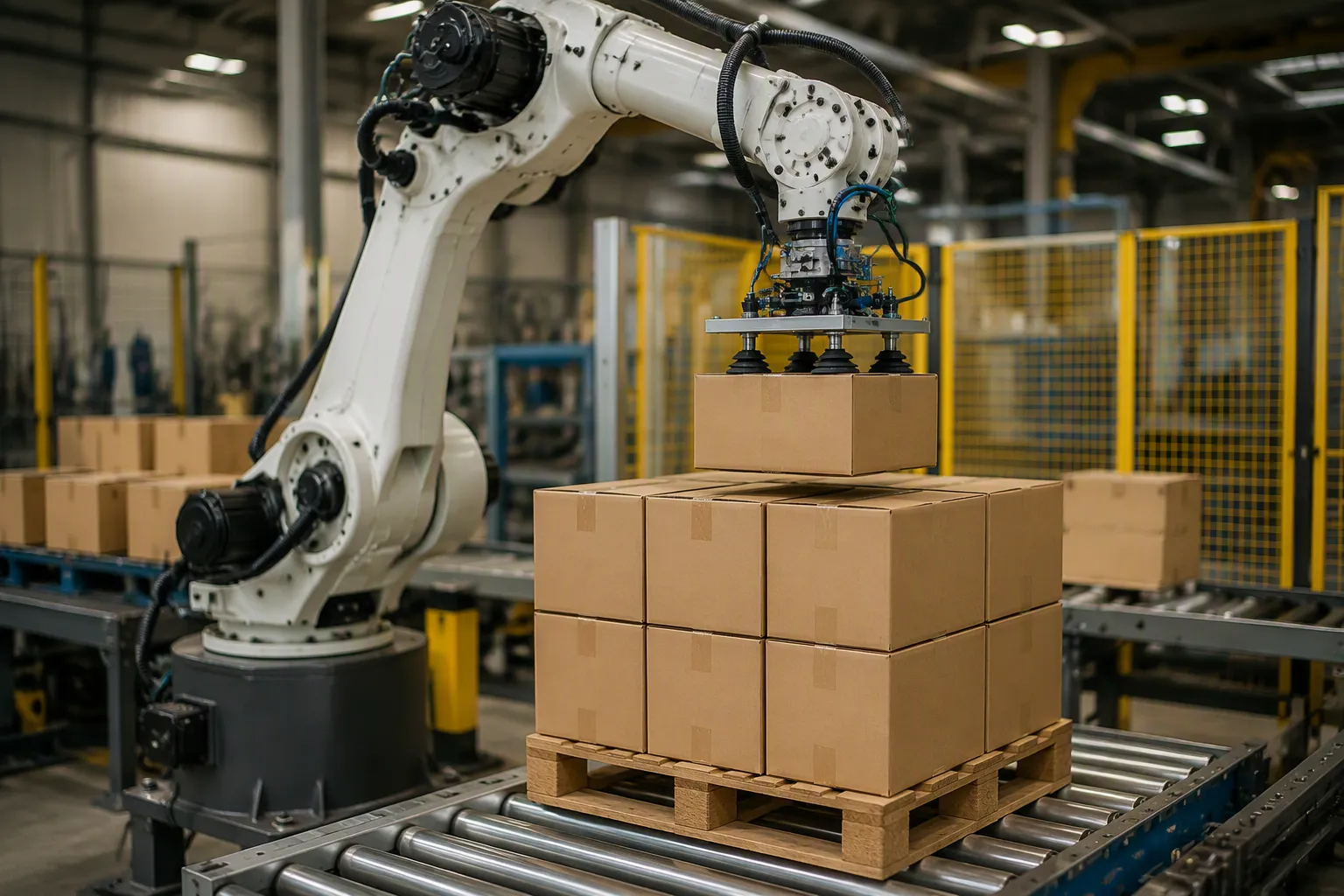
Robotic packing & palletizing relies on automated arms and grippers. Robotic packing & palletizing technology delivers automated palletizing benefits like speed and consistency. A modern palletizer handles complex stacking patterns with precision. Understanding packing and palletizing systems is crucial for operational planning. A palletizer relies on precise software for pattern formation. The following post details core components, the step-by-step process, system types, and costs. Palletizing automation reduces workplace injuries significantly. Many facilities adopt this robotic palletizing approach. Palletizers require less floor space than conventional methods. Palletizers continue to adapt to varying package sizes.
Robotic Packing & Palletizing Basics
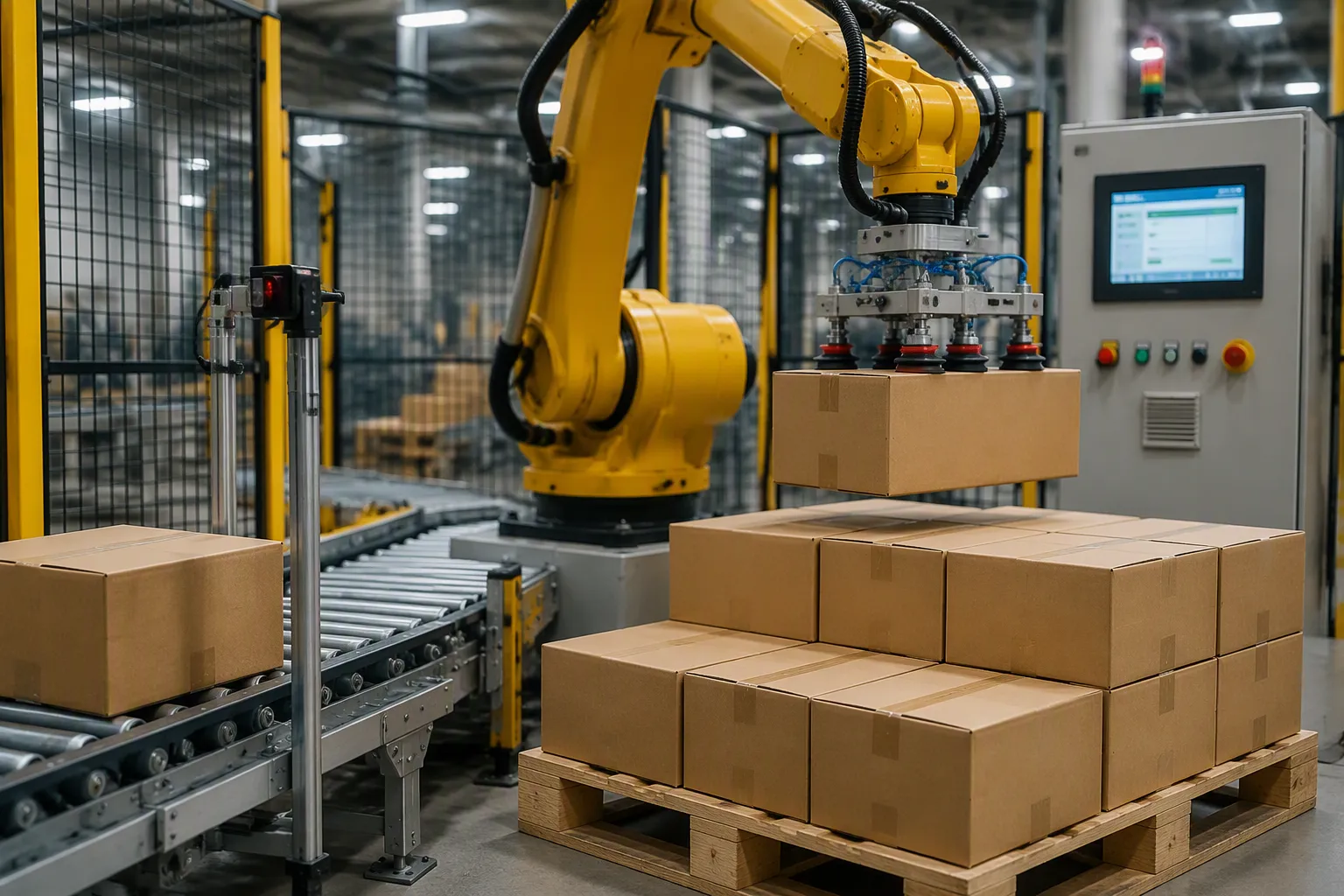
Robotic palletizing automates the arrangement of finished cases, trays, or packages onto pallets. This technology reduces repetitive manual labor. A robotic arm with end-of-arm tooling picks finished cases from a conveyor or in-feed system. The robot places each case onto a pallet in a pre-programmed, efficient pattern. Sensors detect incoming cases and guide the repeated placement until a complete layer forms. Subsequent layers stack precisely over previous layers. The process continues until the pallet is fully loaded and ready for transportation or storage.
Core Components Explained
Every automated palletizing system depends on several key components working together. The robotic arm provides the required motion, reach, speed, and payload capacity. It can be a traditional industrial robot or a collaborative robot depending on application needs. The end-of-arm gripper, or EOAT, serves as the direct interface to grasp and hold products. Common options include vacuum grippers for cartons, mechanical clamps for rigid products, fork-style tools for bags, magnetic grippers for ferrous components, and custom combination tools. End-of-arm tooling is selected based on product geometry, surface material, weight, and handling requirements. For cartons and boxes, vacuum cup arrays are common. For pails and rigid containers, clamp grippers are used. For bags, a bag-handling fork or pinch clamp is specified.
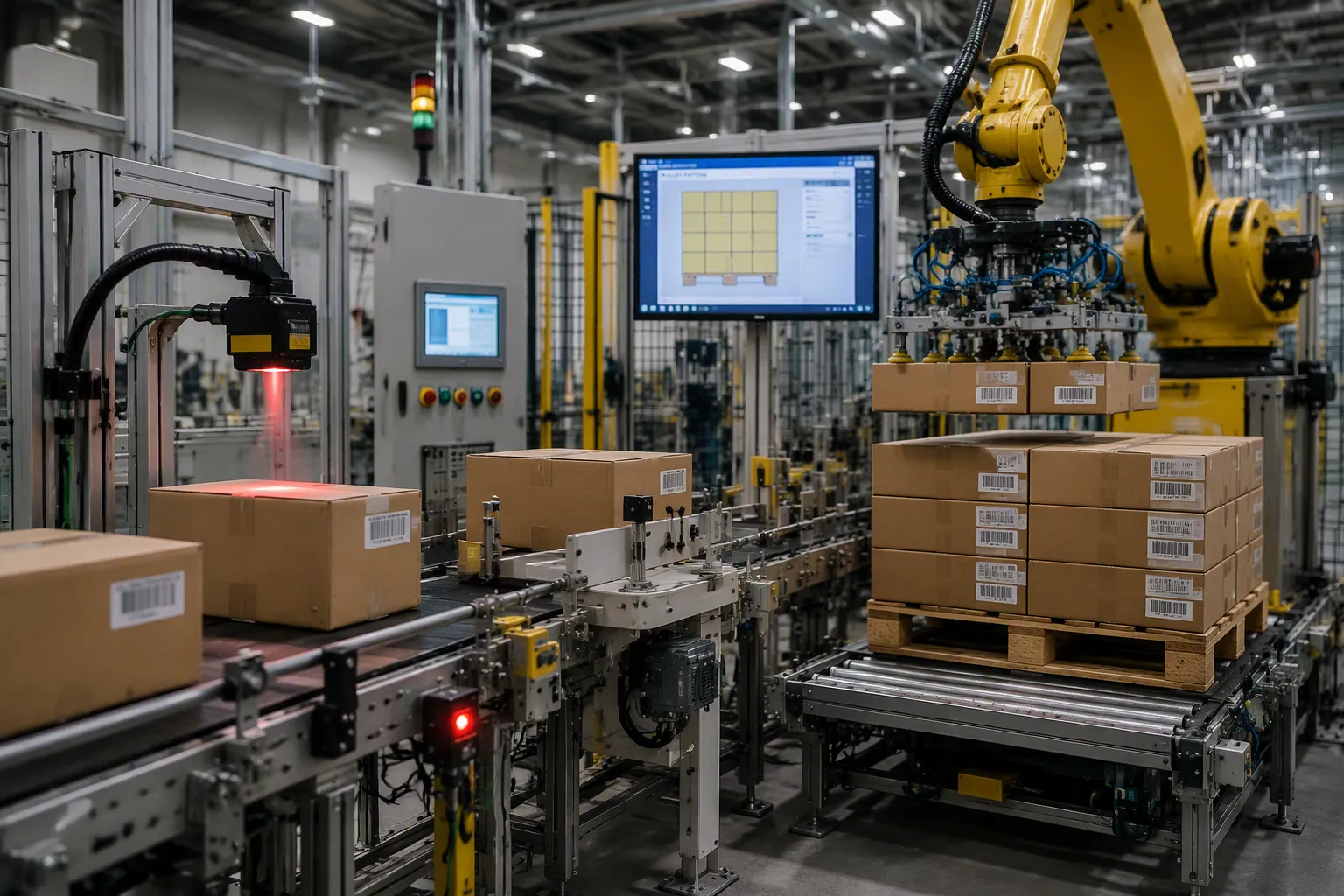
The infeed conveyor transports items into the robotic cell and presents them in a consistent position. Conveyors may also group products into rows or layers before picking. Sensors and machine vision, including photoelectric sensors, proximity sensors, encoders, barcode readers, and cameras, help detect products, confirm pallet position, identify SKUs, and monitor the process. Controller software manages robotic motion. A programmable logic controller coordinates the entire cell. The PLC communicates with conveyors, sensors, safety devices, upstream machinery, and factory systems.
Robotic case packing and palletizing handles box, case, and carton packing using collaborative robots, Viper robots, and i4 SCARA robots. Omron's i4L and i4H SCARA robots are compact four-axis robots with high inertia and high duty ratings, a 5 kg payload, and high repeatability. These robots suit packaging, pick-and-place, and material handling where parts are moved and rotated without additional articulation. Omron's Adept Viper is a six-axis articulated robot used for fast and precise automation, including applications where a part must be flipped while held or where a tool must be positioned at many different angles during the motion path.
How A Robotic Cell Builds A Load
The load-building sequence follows a clear path. Finished product first arrives via a coordinated infeed conveyor system for smooth flow. Products are then aligned and presented correctly, ensuring the robot can pick them consistently and place them per the required pallet pattern. The robotic arm lifts and positions each product with controlled movement, building stable and repeatable pallet loads. Completed pallets move to stretch wrapping, staging, or downstream handling through integrated pallet conveyor systems.
Vision technology integrated into AI-powered palletizing robots enables real-time SKU identification by detecting product dimensions, labels, and packaging. Robots can automatically adapt to unexpected or new SKUs without manual reprogramming or interruptions. Machine vision systems typically use 3D imaging combined with AI algorithms to classify products by shape, size, orientation, color, or barcode. AI palletizing robots analyze product size, weight, and packaging to dynamically generate stable, space-efficient pallet configurations. Vision-driven systems reduce errors such as incorrect SKU placement or improper stacking, and flag discrepancies during palletizing. These systems are scalable and future-proof, allowing businesses to add new product lines or scale for peak seasons without significant reconfiguration.
Automated Palletizing Step By Step
The packing & palletizing process follows a precise sequence. Each step builds upon the previous one to create stable, efficient pallet loads. Understanding this sequence helps operations teams optimize automated palletizing lines.
Infeed And Pattern Formation
Cases arrive from upstream packaging equipment on a conveyor. A barcode scanner reads each case to identify the SKU. The system selects the correct pallet pattern based on this reading. If reorientation is needed, a servo-driven turning device rotates the case before it reaches the pick position. For multi-line systems, merge conveyors with traffic management logic sequence cases from multiple lines into the correct picking order. The PLC tracks every case from scan point to pick point. This coordination forms the foundation of effective automated palletizing. Reliable palletizing requires accurate pattern formation.
Products arrive at a defined pickup position on a conveyor, roller, or staging table. Sensors verify that a product is present and correctly positioned. Several palletizing automation configurations exist depending on throughput requirements. The pattern formation software calculates the optimal arrangement for each layer. This software considers case dimensions, weight distribution, and pallet stability. Advanced systems store hundreds of pallet patterns and switch automatically between configurations. This flexibility supports mixed-SKU palletizing within a single stack for store-ready delivery models. Layer formation modules precisely arrange products into stable stacks. Each layer is gently placed onto the pallet to create a solid, uniform tower. The process repeats until the programmed number of layers or target load is reached. Layer orientation can change within the pattern to improve stability and use the pallet footprint efficiently. Modern robotic case packing and palletizing systems integrate vision guidance for real-time adjustments. Automated palletizing systems can handle multiple SKUs simultaneously. Efficient packing and palletizing reduces operational costs.
Pick, Place, And Pallet Discharge
The robot picks the product using a vacuum, mechanical, or application-specific gripper. Common EOAT options include vacuum grippers for cartons and clamp grippers for rigid or wrapped cases. Fork-style grippers handle full-layer picks by sliding under a pre-formed layer and placing the entire layer on the pallet in one move. This approach increases throughput significantly. A robotic palletizer selects the appropriate tool based on product geometry and weight.
The palletizer places the product in the correct position and orientation for the selected pallet pattern. Advanced motion control delivers consistent performance through continuous monitoring of position and velocity. Feedback devices such as encoders allow real-time adjustments, achieving absolute precision. Every package is placed identically, reducing damage and rework. Uniform packaging quality ensures optimal use of packaging materials. Palletizing automation reduces waste through precise placement. High-speed palletizing demands coordinated motion control.
The cycle repeats until the programmed layer and pallet configuration is complete. The completed pallet is removed and replaced according to the system layout and validated safety procedure. Several pallet discharge options exist:
- Single pallet location with manual replacement requires the robot to stop once the pallet is full.
- Two pallet locations allow the robot to switch to loading a second pallet while the first is removed.
- Manual hopper with automatic discharge uses a pallet hopper that holds multiple pallets. An automatic pallet discharge conveyor moves full pallets out of the cell. The robot then automatically places a new empty pallet from the hopper and continues building.
This case packing and palletizing approach maintains continuous operation.
Fully integrated systems can include stretch wrapping to enhance load stability and increase throughput. Automated stretch wrappers integrate with a palletizer to wrap loads while stacking. Incremental layer-by-layer wrapping locks each layer before the next is added. This approach nearly eliminates box shifting and load collapse. Coordinated robot-wrapper motion minimizes cycle-time pauses. Integrated palletizing and wrapping improves throughput. Additional palletizing automation features improve overall system reliability.
Safety systems protect workers through heavy-wall tubular frames, wire-crafter fencing, and light curtains. Collaborative palletizers support slower-speed, small-footprint applications where robots work alongside personnel. These palletizers adapt to changing production demands without extensive modifications. Many palletizers include automatic tool change capabilities.
The entire sequence delivers consistent packing and palletizing results. Operators can rely on automated palletizing to produce uniform loads shift after shift. Well-designed palletizing systems reduce labor strain and improve throughput. Consistent palletizing supports efficient warehousing.
Types Of Robotic Packing & Palletizing Systems
Robotic Arm, Gantry, And Layer Palletizers
Three main designs dominate the market. Each one suits a different mix of products, rates, and floor plans.
| Factor | Robotic Arm | Gantry | Layer Palletizer |
|---|---|---|---|
| Strong suit | Flexibility | Envelope and payload | Speed |
| Best for | Multi-SKU, up to 4 lines | Heavy loads | High-rate single lines |
| Footprint | Tight spaces, low ceilings | Expansive or compact | Grows with rate |
| Rate | Lower volume | Aggressive throughput | 10–200 CPM |
A robotic palletizer with an articulated arm offers the most degrees of freedom. It handles complex stacking patterns and varying package types with ease. These robotic arm palletizers manage multiple production lines at roughly 25 items per minute. Gantry units move along three Cartesian axes and carry heavier loads, though they run slower and cost more. Layer palletizers form full layers mechanically and excel at high, consistent output for a single SKU.
Choosing The Right System
Mixed case palletizing sets these systems apart. This process builds pallets holding different product types, sizes, and SKUs in an optimized sequence. Intelligent software and robotic palletizing technology create stable pallets that optimize transportation, store delivery, and shelf replenishment. AI-driven stacking with real-time motion planning solves the "3D Tetris" challenge of boxes with varying sizes and weights. The result minimizes mis-picks, shipping errors, and product damage.
Selection starts with product and packaging characteristics. Engineers document dimensional variation, weight, rigidity, and surface texture early. Required throughput matters next, because theoretical cycle time differs from sustained system output. SKU and pallet-pattern variability, product flow, available space, end-of-arm tooling, and controls all shape the decision. Robotic palletizing solutions beat conventional methods on footprint, multi-tasking, and changeover flexibility. A robotic case packing and palletizing cell retrains through software, while mechanical systems need physical retooling. That difference keeps packing and palletizing lines productive across seasonal shifts.
Industrial Automated Palletizing Benefits
Efficiency, Labor, And Safety Gains
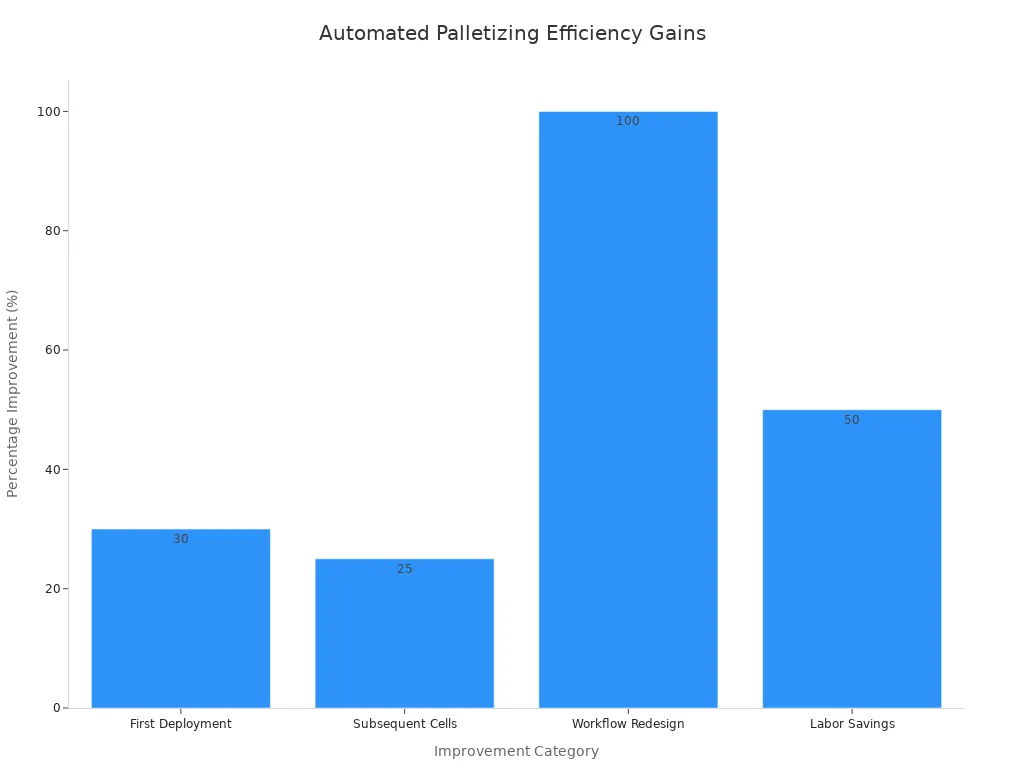
Industrial automated palletizing delivers measurable gains in speed, repeatability, and accuracy. Documented results show a 30% increase in palletizing productivity after first deployment and a 25% average gain for each subsequent cell. Redesigning workflow to combine two workstations doubles output per cell. Labor efficiency improves as well, with staffing dropping from two operators to one per cell. Consistent pallet patterns, stable loads, and repeatable product placement reduce training time and product damage during transport.
Automated palletizing has become a cornerstone of modern industrial operations, offering gains in efficiency, accuracy, and worker safety.
Safety improvements are equally clear. Workers' compensation claims from manual lifting fall by 40% after automation. At one L'Oréal facility in Pune, a Level 4 ergonomic risk from a single worker lifting 8,500 kg per shift was completely eradicated. Manual palletizing lines need 2–4 workers, while automated lines need 0–1 operators for oversight, a 50–75% labor reduction. A single back or shoulder injury costs $40,000–$100,000, and palletizing automation removes that root cause. Throughput rises from a fatigue-dependent 6–10 cases per minute to a consistent 20–35 or more.
Industries And Use Cases
Robotic palletizers serve food and beverage, consumer goods, logistics, and many other sectors. Food and beverage lines handle bottles, cans, shrink-wrapped packages, and cases. Beverage operations palletize 2,500–4,000 cases per hour using row and layer stacking. Logistics and e-commerce centers rely on vision-guided rainbow palletizing for mixed SKUs. Medical devices, automotive parts, furniture, cosmetics, and retail shipments all benefit from the same core technology.
End-of-line stacking covers cases, bags, crates, and pails. Clamp grippers handle pails from quart to 6-gallon sizes by gripping below the lid. Bag palletizers serve agriculture, chemicals, and construction, handling heavy industrial bags one at a time, by row, or by layer. Vacuum-cup tooling manages cartons and boxes. The integration of robotics with vision and software lets one cell palletize 12 case types at up to 48 cases per minute. Packing and palletizing robots bring flexibility across seasonal shifts and new product lines.
Industrial Palletizing Automation Costs
What Drives System Cost
Hardware alone does not determine the price of industrial palletizing automation. The robot arm typically accounts for only about 40% of total system cost. Specialized tooling and site integration make up the remaining majority of capital expenditure. A basic vacuum gripper costs less than a multi-function tool built for mixed products. Clamp grippers fall in the middle range. Fork-type grippers suit layer handling. Automatic pallet dispensers add roughly $25,000 to $45,000 to the budget. Safety fencing and sensors contribute another $5,000 to $20,000 for industrial robots. Software complexity also matters. Programming ten different pallet patterns requires far more engineering hours than a single standard configuration. High-speed systems with advanced controllers can cost two to three times more than basic setups.
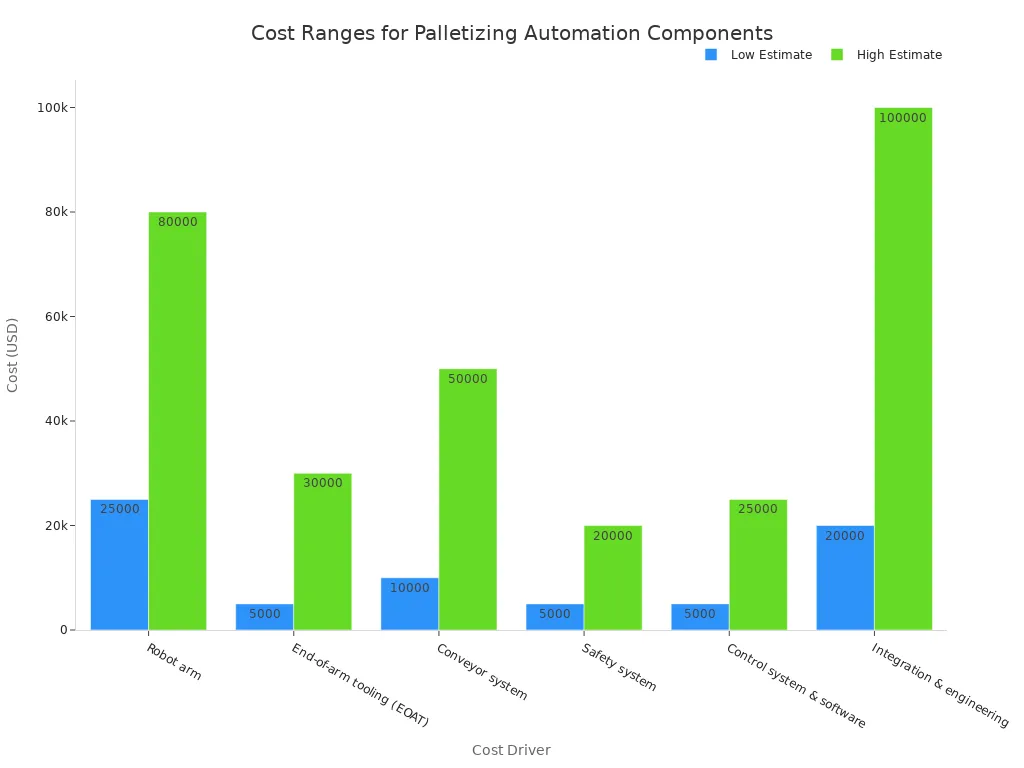
Integration with conveyors, ERP, and warehouse management systems adds tens of thousands of dollars. Multiple SKUs, complex patterns, and custom tooling for fragile items all raise engineering costs. Standardizing patterns and using modular tooling help control expenses. A palletizer sized incorrectly at the start often costs more to upgrade later than to specify properly upfront.
Buying, Leasing, And Robots-As-A-Service
Three ownership models serve different operational needs. Outright purchase demands the highest upfront investment. The buyer owns the equipment and carries all downtime risk. Leasing spreads payments over a fixed term with predictable costs. Early exit penalties apply. Robots-as-a-service shifts spending from capital expenditure to operating expenditure. The provider owns the robot and includes maintenance, software updates, and support in a recurring fee. One provider notes that most customers pay for usage, which keeps the risk with the provider.
"Most customers pay for usage, and that's the model we'd point you to first: it keeps the risk with us. But Cassie can also be purchased outright, with a low-cost annual service plan behind it and the same support, maintenance, and model improvements as every other robot in the fleet."
RaaS suits seasonal demand and companies testing automation for the first time. Purchase makes sense for stable, high-volume lines where long-term ROI matters. The real decision is whether the manufacturer wants to own integration and maintenance risk or transfer it to a provider. Packing and palletizing robots under RaaS often go live within weeks. That speed helps operations adapt without large capital commitments.
Sensors and grippers detect and hold each product. Software calculates the optimal stacking pattern. A robotic arm or gantry then builds each layer on the pallet. This core process powers modern industrial palletizing automation.
Automated palletizing delivers consistent loads and higher throughput. Robotic palletizing requires a smaller footprint than manual lines. Packing and palletizing systems create safer environments by removing repetitive lifting. These features reduce product damage and improve warehouse efficiency.
Operations can scale palletizing capacity without major retooling. This palletizing flexibility supports new product launches. Palletizing automation adapts to new SKUs quickly. Palletizers handle complex patterns with precision. Palletizer technology improves year over year. These palletizers continue to evolve with each product update. Teams should evaluate their own operations for these solutions.
FAQ
What grippers do palletizers use?
Robotic palletizers use vacuum grippers for cartons and clamp grippers for rigid cases. Fork-style tools handle bags. Selection depends on product weight and surface texture.
How does palletizing automation handle different SKUs?
Vision systems identify each product's dimensions and labels. Software selects the correct stacking pattern. The palletizing cell adapts without manual reprogramming.
What safety measures protect workers during palletizing?
Heavy-wall frames and light curtains guard industrial cells. Collaborative palletizers allow human interaction at slower speeds. These systems meet strict safety standards.
What throughput can a palletizer reach?
A robotic arm handles roughly 25 items per minute for a single line. High-speed automated palletizing manages up to 200 cases per minute with coordinated conveyors.
See Also
Cutting Edge Tech Boosts Warehouse Efficiency This Year
Flexible Slotting Methods Revolutionize Warehouse Workflows Today
Using Order Lists To Smooth Out Warehouse Processes
Boosting Output Through Intelligent Online Retail Warehouse Tactics
Novel Intralogistics Advances Define Tomorrows Warehouse Landscape