

AI for scaling gives you the power to grow your brand across borders with speed and precision. Many global brands use automation, localization, and data-driven insights to optimize every step of their expansion. For example, a recent study shows that 88% of marketers use AI tools daily, leading to a 44% increase in productivity and a 41% lift in conversion rates.
| Statistic Description | Value |
|---|---|
| Percentage of Marketers Using AI Tools Daily | 88% |
| Productivity Increase Reported by Marketing Teams Using AI | 44% |
| Conversion Rate Lift from AI-Driven Ads | 41% |
You can see real results, such as Welcome Pickups boosting bookings by 66% with localized pages powered by AI. These strategies help you reach new markets faster and improve operational efficiency at scale.
AI for Scaling: Core Strategies
Automation for Efficiency
You can use AI to automate many business processes. Automated workflows help you save time and reduce errors. For global brands, this means you can handle more tasks without hiring more people. AI for scaling lets you process orders, manage inventory, and answer customer questions faster.
Automation lightens the load of time-consuming manual tasks and brings a wide range of benefits. You will see enhanced operational efficiency, improved workforce satisfaction, and more chances for innovation and growth.
A recent study shows that automation can cut processing time by 75%, improve process accuracy by 90%, and lower operational costs by 60%.
| Metric | Improvement |
|---|---|
| Average reduction in processing time | 75% |
| Improvement in process accuracy | 90% |
| Reduction in operational costs | 60% |
According to a McKinsey survey, two-thirds of companies saw better quality control, higher customer satisfaction, and lower costs after using AI automation. When you use automated content production, you can keep brand consistency across all markets. AI-powered content tools also help you accelerate content creation, making it easier to launch new campaigns quickly.
Data-Driven Decisions
AI gives you the power to make smarter choices. With AI for scaling, you can analyze large amounts of data and spot trends before your competitors do. Teams using AI-driven decision-making report up to 40% faster and more accurate strategic decisions. AI enables leaders to act earlier and avoid costly mistakes.
- A billion-dollar pharmaceutical company improved decision-making by reducing manual audit errors through a machine learning pipeline. This led to fewer hours spent on manual classification and better leadership decisions.
- A global payments provider cut fraud decision times from days to minutes. This helped build trust and keep both merchants and consumers happy.
You can measure the impact of AI on your business using several metrics:
- Customer impact: Look at customer effort scores and digital containment quality to see how AI improves the experience.
- Business impact: Track conversion rates, collections, and customer lifetime value.
- Agent impact: Check speed-to-competency and satisfaction to see if AI helps your team.
- Innovation impact: Use AI to test new ideas and find new growth opportunities.
| Case Study | Description | Results |
|---|---|---|
| Gen AI Agent for Onboarding | A conversational agent assists website visitors through onboarding. | 22% increase in conversion rate, 17% reduction in client acquisition cost, 20% improvement in engagement. |
| Electronics Retailer | A chatbot enhances product discovery and streamlines purchases. | Improved customer assistance and sales through accurate product recommendations. |
AI-powered content tools help you with content creation by analyzing what works best in each market. This lets you adjust your strategy quickly and stay ahead.
Customer Experience with AI
AI helps you create a better customer experience. You can use AI-powered content to personalize messages and offers for each customer. This makes people feel valued and keeps them coming back. For example, BSH Group used AI to understand customers across many touchpoints. They saw a 106% increase in conversion rates and a 22% rise in add-to-cart rates.
- AI-driven predictive analytics can foresee customer interests and behaviors. You can offer personalized suggestions that improve the customer journey.
- AI can dynamically tailor content and experiences. This boosts satisfaction by creating interactions based on real-time data.
Most executives now use AI for customer communication. Many report better consumer service, streamlined workflows, and higher revenue. Ratings improve, and customers stay loyal. AI for scaling helps you reach more people and keep them happy as you grow.
AI Applications for Global Brands

Localization and Personalization
You can use ai for scaling to reach new markets quickly. Automated localization helps you adapt your content for different regions without long delays. This process makes content creation faster and keeps brand consistency strong. AI can translate and adjust your messages for local cultures, but you should always check for accuracy and compliance. Sometimes, ai can miss small errors or local rules. You need to balance speed with quality.
Global brands use ai to personalize marketing and product offers. You can deliver the right message to the right person at the right time. Many brands use ai to create real-time product suggestions and personalized experiences. This approach helps you build stronger relationships with your audience and keeps customers happy.
- Automate content creation and sales forecasting
- Localize content and personalize experiences at scale
- Deliver relevant content and product suggestions in real time
- Use predictive churn modeling to keep your customers happy
Almost all brands now use ai-powered personalization. Most shoppers say personalized experiences help them choose a brand. Making customer experiences more personal is a top goal for many companies.
Predictive Analytics
You can use predictive analytics tools like Google Analytics, Salesforce Einstein, and Adobe Analytics to guide your market expansion. These tools help you spot trends and make better decisions. With ai, you can improve lead quality, cut costs, and keep more customers.
| Outcome | Description |
|---|---|
| Conversion Rates | Higher conversion rates achieved through predictive marketing strategies. |
| Customer Retention | Improved customer retention as a result of targeted marketing efforts. |
| Reduced Churn | Reduction in customer churn due to effective predictive analytics. |
| Increased Lifetime Value | Enhanced customer lifetime value through personalized marketing. |
Supply Chain Optimization
You can use ai to improve your supply chain. It helps you forecast demand, manage inventory, and plan delivery routes. AI-driven systems analyze data to predict what you need and when you need it. This reduces costs and speeds up delivery. You can avoid running out of stock and keep your customers satisfied.
- Enhanced demand forecasting
- Improved inventory management
- Streamlined logistics and transportation
Productivity Gains
AI is changing how you work every day. It automates repetitive tasks and lets you focus on creative projects. Many companies see big gains in productivity and profit. For example, ai-based route optimization can cut logistics costs by up to 20%. Tools like Salesforce Einstein and Zendesk help you boost engagement and solve problems faster. When you use ai for scaling, you empower your team to do more in less time.
| Example | Sector | Productivity Gain |
|---|---|---|
| Salesforce Einstein | Marketing | Personalized marketing campaigns that boost engagement and conversion rates |
| Zendesk | Customer Support | Predictive customer support that reduces resolution time |
| boost.ai | Customer Service | 24/7 support through chatbots, enhancing user experience |
| Blue Yonder | Supply Chain | Demand prediction and inventory optimization |
| UiPath | Document Processing | Automation of repetitive tasks like data entry, improving productivity |
Real-World Success Stories

Case Study: E-Commerce Expansion
You can see how global brands use ai for scaling to reach new markets and boost results. Many e-commerce leaders have adopted ai to improve customer experience and drive sales. The table below shows how well-known brands use different ai tools to achieve impressive outcomes:
| Brand | AI Technology Used | Outcome |
|---|---|---|
| L’Oréal | ModiFace, SkinConsult AI | Over 1 billion virtual try-ons, tripled conversion rates |
| H&M | Chatbot | 25% increase in conversion rates |
| Domino’s | Dom voice assistant | 15% reduction in order time, higher customer satisfaction |
| Starbucks | Deep Brew AI | 15% increase in active members, loyalty members drive 41% of U.S. sales |
You can also improve key performance indicators with ai. These include higher conversion rates, increased average order value, lower customer acquisition costs, and better retention rates. Many brands see better inventory management and a higher return on investment after using ai for content creation and personalized recommendations.
SaaS Global Growth
You can use ai to help your SaaS company grow worldwide. Many SaaS brands use ai to speed up product development and share knowledge across teams. This helps you spot trends and adapt products for local markets. You can enter new markets without big investments in local offices. Ai also helps you target leads, automate sales, and choose the best market entry strategies.
Salesforce’s Einstein AI lets you predict customer behavior and improve sales outreach in many countries.
You can use ai to activate insights quickly and allocate resources more efficiently. This makes your team more productive and helps you reach more customers.
Lessons Learned
You should learn from both successes and challenges when using ai for scaling. Many brands face problems if they do not plan for scale or skip change management. Some companies, like Yum! Brands and McDonald’s, found that ai voice systems did not work well without clear goals and user alignment. Amazon’s recruiting tool showed that poor data can lead to bias.
- Define clear goals for your ai projects.
- Use high-quality data for better results.
- Start with small pilots before scaling up.
- Engage your team and measure progress often.
Brands that follow these steps see better results and avoid common pitfalls. You can achieve strong growth and innovation with the right approach.
Implementing AI for Scaling
Readiness Assessment
Before you start using ai to scale your brand, you need to check if your business is ready. Many global brands use structured frameworks to spot gaps and strengths. You can use a checklist or a questionnaire to guide your assessment. Here are some popular tools:
| Framework Name | Description |
|---|---|
| AI Readiness Checklist | A structured framework to assess capabilities and identify gaps for AI adoption. |
| Vodworks Data-First AI Readiness Questionnaire | Focuses on six data pillars essential for AI project success. |
| Deloitte’s AI Readiness Maturity Curve | Evaluates organizational readiness across various dimensions. |
| Riviera’s AI Readiness Quiz | Helps identify gaps in leadership structure and governance for AI scaling. |
You should review your data quality, leadership support, and technical skills. This step helps you avoid surprises later.
Tool and Partner Selection
Choosing the right tools and partners is key for success. Look for ai platforms that match your business needs. Some tools focus on content creation, while others help with marketing solutions or customer support. You should check if the tool supports your target markets and languages. Trusted partners can help you set up and manage your ai systems. Ask for case studies and references before you decide.
Tip: Start with a small project to test the tool’s fit before you scale up.
Overcoming Challenges
You will face challenges when you scale with ai. Some common issues include:
- Understanding local markets and customer preferences
- Addressing legal and regulatory challenges
- Adapting product features for different cultures
- Managing logistics and operational complexity
- Dealing with currency and pricing variations
- Building a global brand identity
- Navigating competition in each market
- Monitoring and measuring success in new markets
To overcome resistance, you can:
- Create a clear ai roadmap that aligns with your business goals.
- Communicate the benefits of ai to your team.
- Offer training programs to build new skills.
Measuring Impact
You need to track your progress to see if ai helps your brand grow. Many brands use these metrics:
| Metric | Value |
|---|---|
| Customer satisfaction | 84% |
| Improved consumer service | 69% |
| Streamlined workflows | 54% |
| Revenue increase | 34% |
| Ratings improvement | 40% |
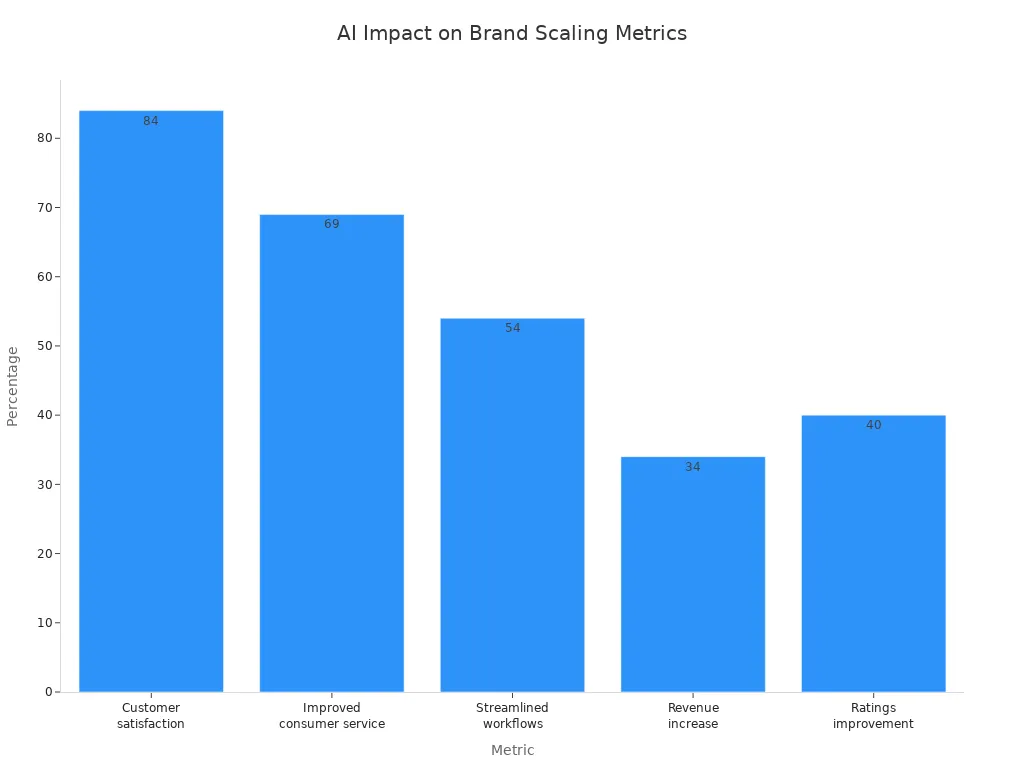
You should focus on customer satisfaction and system efficiency. Track sales growth and workflow speed. Listen to feedback and adjust your strategy as technology changes. This approach helps you get the most from your ai investment.
You have seen how automation, data-driven insights, and localization help brands grow worldwide. Responsible governance and regular audits keep your systems safe. To start, you can follow these steps:
- Create AI-safe data products.
- Build translation layers for easy data access.
- Gain leadership support.
- Foster trust in your team.
- Offer ongoing training.
AI will keep changing how you work, making your brand more efficient and ready for the future.
FAQ
What is the first step to using AI for scaling my brand?
You should start by checking your data quality and team skills. Use an AI readiness checklist. This helps you see where you need to improve before you invest in new tools.
How does AI help with localization?
AI can translate and adapt your content for different markets. You reach more customers faster. Always review AI translations for accuracy and cultural fit.
What are the biggest challenges when scaling with AI?
You may face issues like poor data, unclear goals, or team resistance. Start small, set clear targets, and train your team to overcome these challenges.
Can small businesses use AI for global growth? 🤖
Yes! Many AI tools offer affordable plans. You can automate tasks, personalize marketing, and analyze data without a big budget.
See Also
Effective Approaches to Merchandise Planning in Retail Success
How Top Brands Are Expanding Using WarpDriven Distribution
The Role of AI in Managing Fast Fashion Trends
Transforming Apparel: Strategies from Production to Brand Identity