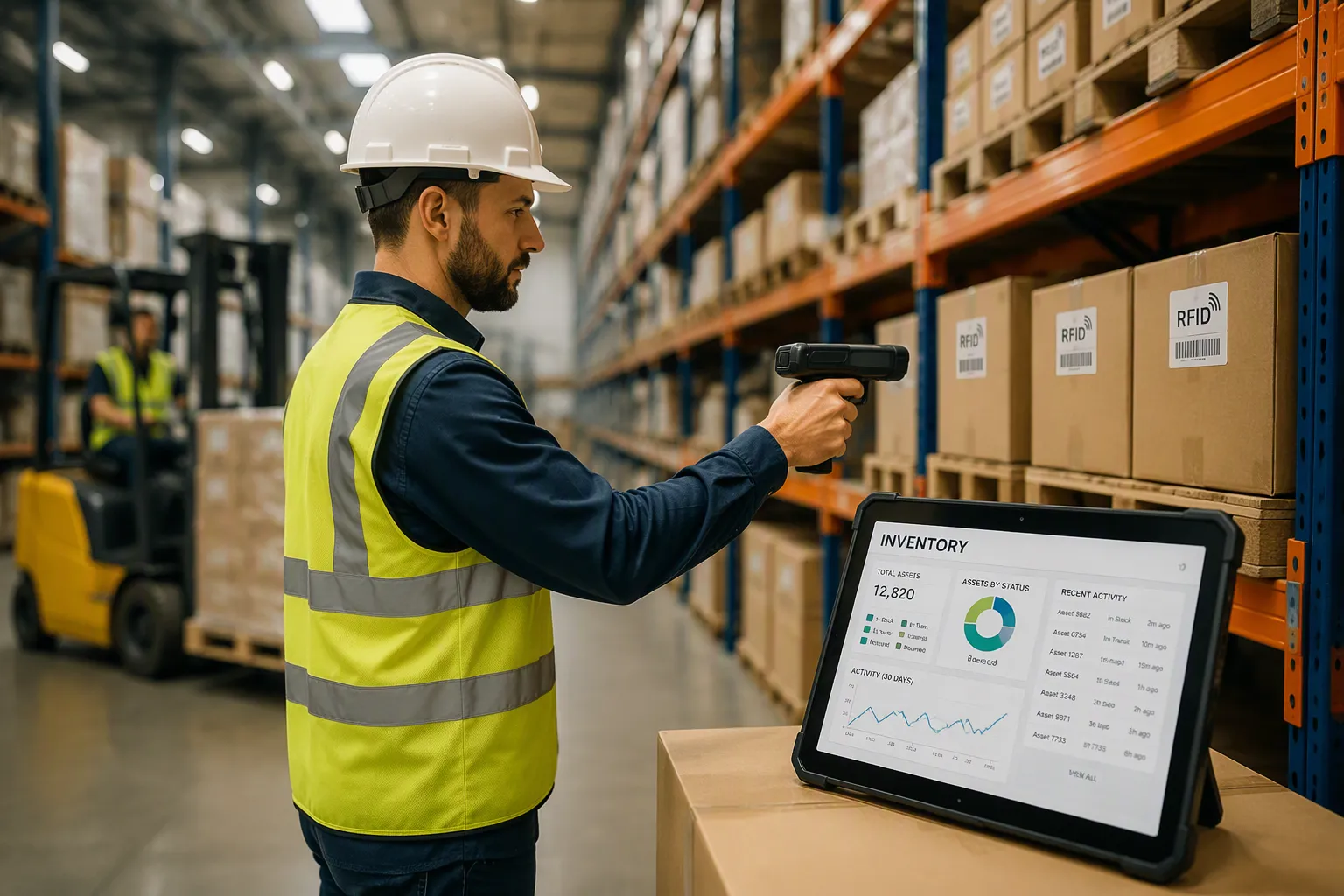
Radio frequency identification uses radio waves to identify and track tagged items automatically. This technology gives your warehouse continuous, real-time inventory visibility without manual scanning. Unlike barcodes, which need line-of-sight and one-at-a-time scanning, RFID reads many tags at once from a distance.
The core promise is simple: accuracy, speed, and cost savings that transform warehouse operations. A University of Arkansas study found a 13% improvement in inventory accuracy compared to manual barcode scanning. One department store saw inventory accuracy jump from about 65% to over 95% after implementing RFID technology.
What Is RFID and How Does It Work?
Tags, Readers, and Antennas
Radio frequency identification relies on three core components. RFID tags hold a unique identifier. RFID readers send and receive radio signals. Antennas bridge the two, converting electrical signals into radio waves and back again.
Passive RFID tags carry no battery. They draw power from the reader's signal. Active RFID tags contain their own battery, and their lifespan depends on usage and battery size. One source reports 5 to 10 years of normal battery life, while another notes about four years before replacement. Passive ultra high-frequency (UHF) tags reach 4 to 20 feet in warehouse settings, with mid-range reads of 1 to 6 feet for pallet tracking. UHF systems operate from 300 MHz to 960 MHz, and higher frequencies move large data volumes up to 25 feet.
How RFID Differs from Barcodes
Barcodes demand line-of-sight and one scan at a time. RFID technology reads many RFID tags at once, even through boxes and plastic. A single reader handles 400 to 500 tags per second in standard modules, and high-performance units reach 900 to 1,000 tags per second. Real-world warehouse conditions with decent gear achieve 200 to 400 tags per second.
Accuracy separates the two further. Barcodes hit 96 to 99 percent under ideal conditions, yet late-night cycle counts can drop accuracy by 5 to 10 percent. RFID technology reaches 98 percent or higher with proper tuning. Metal, liquids, and interference can reduce RFID accuracy, while barcode accuracy depends on label cleanliness and operator technique. Beyond RFID, BLE and UWB also track items, boxes, and pallets automatically. You can deploy RFID tags for inventory across fixed or handheld readers, and rfid systems scale from a single dock door to a full facility.
RFID in the Warehouse: Integration
Data Flow from Tag to WMS
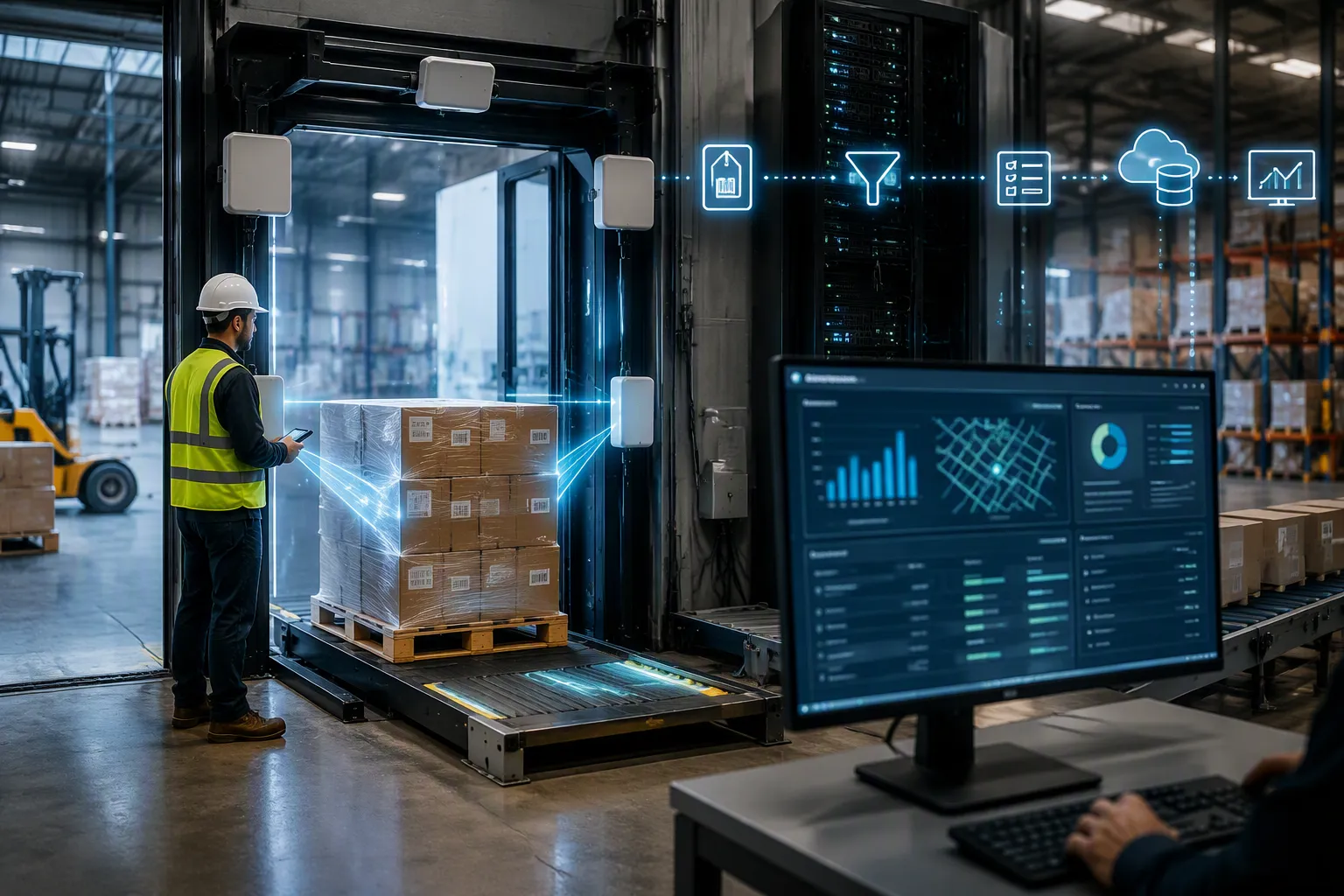
You connect rfid readers to your inventory and warehouse management systems through a middleware layer. This software translates raw tag reads into meaningful inventory events. Each time an item passes an rfid reader, the system logs its movement automatically. No one needs to scan a barcode or type a stock number.
The data flow follows a clear path. An rfid tag enters the read zone. The antenna captures the signal. The reader converts that signal into digital data. The middleware filters duplicates and sends clean records to your WMS. Your warehouse inventory management platform then updates stock counts, locations, and status in near real time.
Fixed portal readers make this process seamless. You install them at dock doors, receiving bays, and staging areas. Every pallet, case, or item that moves through those portals gets captured. Nothing slips past unnoticed. This constant capture builds a trustworthy record of everything inside your facility.
By capturing inventory events at receiving, storage, cycle counting, picking, replenishment, staging, and line-side supply points, RFID can help reduce discrepancies between the physical warehouse and the WMS or ERP record.
That reduction in discrepancies matters. Warehouses using rfid inventory management report up to a 25% reduction in shrinkage or inventory theft. Fewer errors mean fewer disputes and near-zero stock discrepancies.
Continuous Real-Time Data Streams
Your rfid inventory systems do not wait for a scheduled count. They stream data continuously. Every tag read becomes an event. Every event updates your real-time stock levels. This constant flow gives you real-time inventory visibility across the entire operation.
In optimized deployments, the latency from tag detection to WMS update stays under 1 second. That speed enables near real-time inventory synchronization across sorting zones. You see what happened moments ago, not what someone counted last week.
This continuous stream changes how you manage inventory. You stop guessing. You start knowing. Real-time inventory data supports faster decisions about replenishment, picking, and shipping. Your team spends less time hunting for stock and more time moving it.
The accuracy gains are substantial. RFID scanning in high-volume fulfillment centers improves inventory accuracy to 95–99%, which leads to:
- Fewer errors across all processes
- Fewer disputes with suppliers and customers
- Near-zero stock discrepancies
These results come from consistent, automated tracking. You deploy rfid tags for inventory across your entire facility. You use rfid tags on pallets, cases, and individual items. The rfid technology handles the rest.
Real-time tracking also improves inventory management at every stage. You gain better inventory visibility from receiving through shipping. Your rfid technology investment pays off through cleaner data and tighter control. For any warehouse serious about inventory tracking, this integration path delivers measurable results.
Achieving Real-Time Inventory Visibility
Real-Time Inventory Accuracy
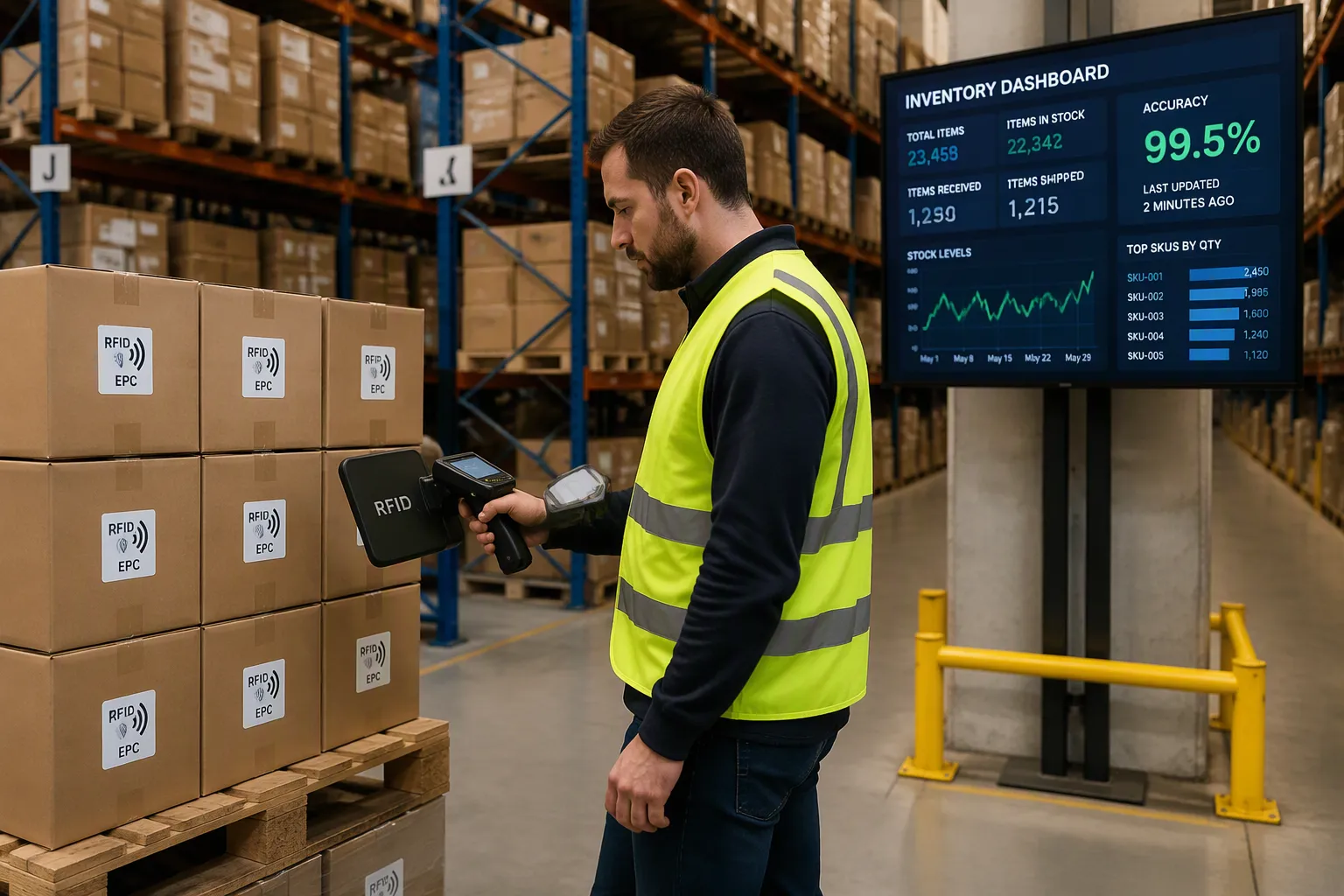
RFID delivers accuracy numbers that manual systems cannot match. Warehouses using RFID-enabled visibility achieve real-time inventory accuracy rates between 99.0 and 99.8 percent. This precision transforms how you manage stock. You know the exact status, location, and quantity of inventory at all times.
A global apparel brand proves this point. After deploying the technology across its warehouse-to-store chain, accuracy jumped from 76 percent to 98.5 percent. Stockout incidents dropped by 50 percent. The company gained the visibility it needed to sell more, not just stock more.
"RFID gave us the visibility we needed to sell more — not just stock more."
Manual processes suffer from errors. Miscounts happen. Scans get missed. Data entry mistakes creep in. RFID eliminates these problems by automating data capture. A regional distribution center achieved 99 percent accuracy after deploying RFID technology. Real-time access enabled faster replenishment and better inventory management.
The contrast between manual methods and RFID stands out:
| Aspect | Manual Method | RFID Solution |
|---|---|---|
| Inventory tracking | Error-prone, input mistakes common | Automated capture improves accuracy |
| Cycle counting | One at a time, time-consuming | Multiple tags captured simultaneously |
| Stock discrepancies | Physical vs system divergence | Real-time updates minimize gaps |
Automated Cycle Counting
Cycle counting used to consume hours of your team's labor. Workers walked aisles with barcode scanners. Counting 1,000 items took 2 to 3 hours. RFID changes that completely.
With RFID, counting 1,000 items takes under 10 minutes. That represents a labor reduction of 80 to 90 percent. A large fulfillment facility integrated the system with its WMS and saw cycle counting time drop by 70 percent. Labor costs fell by 20 percent. Staff productivity increased.
| Metric | Manual (Barcode) | RFID | Savings |
|---|---|---|---|
| Time to count 1,000 items | 2–3 hours | Under 10 minutes | 80–90% labor reduction |
| Counting speed | 200–400 items/hour | 20,000 items/hour | Up to 96% time reduction |
Retail clothing brands using passive tags across distribution centers reduced out-of-stock issues by up to 50 percent. That reduction comes from real-time tracking. You see what you have. You ship what you promised.
RFID technology makes cycle counting practical. You deploy RFID tags for inventory across your facility. Your rfid inventory management system updates automatically. No one scans labels.
This automation frees your team for better work. Your warehouse becomes faster. Your rfid inventory tracking system provides the foundation.
You gain real-time inventory visibility across every zone. You monitor inventory in real time without extra labor. These systems deliver consistent real-time visibility of inventory. Every stage of your operation benefits from improved inventory management.
Real-Time Inventory Using RFID: Benefits
RFID transforms your warehouse operations through concrete gains in speed, cost, and decision-making. The technology eliminates manual scanning tasks that consume hours each day. Your team no longer walks aisles with handheld scanners. RFID reads hundreds of tags per second automatically. This automation frees workers for higher-value activities like order fulfillment and quality checks.
Speed, Cost, and Efficiency Gains
Real-time inventory using RFID delivers measurable improvements in your daily workflow. Your team processes receiving, put-away, and shipping faster because RFID captures every movement automatically. No one scans labels. The speed translates directly into labor savings. Most deployments reach ROI within 12 to 18 months. Those savings come from reduced labor hours and lower inventory shrinkage.
Accurate records reduce costs substantially. You avoid overstocking slow-moving items. You prevent stockouts on fast-selling products. RFID technology gives you the data to optimize storage locations. Items move to optimal pick zones based on velocity. The result is fewer touches and lower operational costs.
Your warehouse inventory management improves through streamlined transshipment. RFID reads pallets and cases flowing through cross-dock zones. You know what arrived and what needs to ship immediately. This inventory visibility eliminates staging delays. RFID technology in cross-dock reduces dwell time.
Better Decision-Making
Real-time inventory visibility feeds into smarter planning. Your warehouse management system provides real-time data for demand forecasting. This improves accuracy. Demand sensing reduces forecast error by one-third. Companies report up to 17 percent reduction in total inventory and 15 percent reduction in surplus stock.
Major retailers show the power of real-time tracking. Walmart cut inventory costs by 15 percent. The retailer reduced stockouts by 30 percent and increased sales by 20 percent. Unilever reduced forecast errors by 25 percent and lowered safety stock by three days. Demand sensing improved perfect order rate by 14 percent. RFID inventory management provides similar visibility. You see inventory levels at every stage.
These results come from RFID inventory systems that stream accurate data continuously. You see how market changes impact demand across your network. You make proactive adjustments instead of reacting to problems. Your inventory tracking becomes a strategic tool rather than a chore. RFID gives you confidence for faster decisions about replenishment and allocation. Your inventory management shifts from reactive to proactive. You act on real-time inventory data that reflects actual conditions.
Real-World Applications and Challenges
Real-Time Inventory Applications
Retailers use rfid to track inventory in real time across stores and distribution centers. They manage stock, count items, and identify products without manual scans. A store associate waves a handheld device and captures every tagged item on a shelf in seconds. This real-time tracking reduces stockouts and improves shelf availability.
Manufacturers apply rfid technology to track raw materials, work-in-progress, and finished goods. They monitor component flow through assembly lines. Logistics providers use rfid at cross-dock facilities to route pallets and cases. Each scan updates the warehouse management system instantly. These applications share one goal: continuous visibility of every item.
Overcoming RFID Challenges
Cost remains the top concern. RFID systems cost more than barcode systems upfront. You can lower this barrier with several strategies:
- Start with a barcode system to build solid inventory practices, then add rfid for high-value or high-turnover products.
- Use handheld rfid readers (starting around $1,000) instead of fixed infrastructure.
- Choose cloud-based rfid-compatible software with monthly subscriptions.
- Join supplier programs where manufacturers provide pre-tagged inventory.
- Consider RFID-as-a-Service (RaaS) to pay per scan rather than owning equipment.
- Run rfid alongside barcodes during the pilot phase to protect data integrity.
Integration and training also pose hurdles. Your warehouse team needs time to learn new workflows. Middleware must connect rfid readers to your inventory management platform cleanly.
Start with a clearly defined use case with measurable ROI before expanding implementation.
Identify priority inventory for rfid first. High-shrink items, serialized products, and high-velocity SKUs deliver the most value. This targeted approach keeps spending focused. Your inventory management improves where it matters most. A phased rollout builds confidence and protects your budget.
RFID shifts your warehouse from periodic counts to continuous, real-time inventory visibility. You gain accuracy, speed, and cost savings through automated tracking. RFID technology supports better inventory management and smarter decisions. Evaluate this system for your warehouse operations today. This scalable solution improves inventory visibility and real-time inventory tracking. RFID plays a growing role in modern supply chains. Stock becomes a strategic asset with RFID. You trust your tracking and management system completely. Accurate inventory management drives efficiency across your supply chain. The future of efficient operations relies on this technology. Adopt RFID now for lasting competitive advantages in your operations.
FAQ
How accurate is RFID compared to manual counting?
RFID-enabled warehouses reach 99.0 to 99.8 percent accuracy. Manual barcode counts often fall short because miscounts and missed scans happen. One apparel brand jumped from 76 percent to 98.5 percent accuracy after deployment. You gain cleaner records and fewer stock discrepancies across your facility.
How fast does an RFID system update inventory records?
In optimized deployments, the latency from tag detection to WMS update stays under 1 second. Every tag read becomes an event. Your system logs each movement automatically. You see current stock levels instead of last week's count.
Can RFID replace barcode scanning entirely?
Not always. Many teams run rfid alongside barcodes during the pilot phase to protect data integrity. Barcodes still work well for low-value items. You can start with barcodes, then add rfid for high-value or high-turnover products.
What does an RFID rollout cost?
RFID systems cost more than barcode systems upfront. You can lower this barrier with handheld readers starting around $1,000, cloud-based software subscriptions, supplier pre-tagged inventory, or RFID-as-a-Service. Most deployments reach ROI within 12 to 18 months through labor savings and lower shrinkage.
Which items should I tag first?
Start with a clearly defined use case with measurable ROI. High-shrink items, serialized products, and high-velocity SKUs deliver the most value. This targeted approach keeps spending focused. Your inventory management improves where it matters most, and a phased rollout builds confidence.
See Also
Revolutionary EDI Tracking Technologies Enhancing Future Shipment Visibility Globally
Essential Strategies for Successful Warehouse Inventory Transfer Management
Cutting-Edge Technologies Revolutionizing Warehouse Productivity Throughout The Year 2025
Advanced Intralogistics Innovations Defining Future Warehouse Operations And Management
Boosting Efficiency Through Intelligent Ecommerce Warehouse Strategy Implementation