

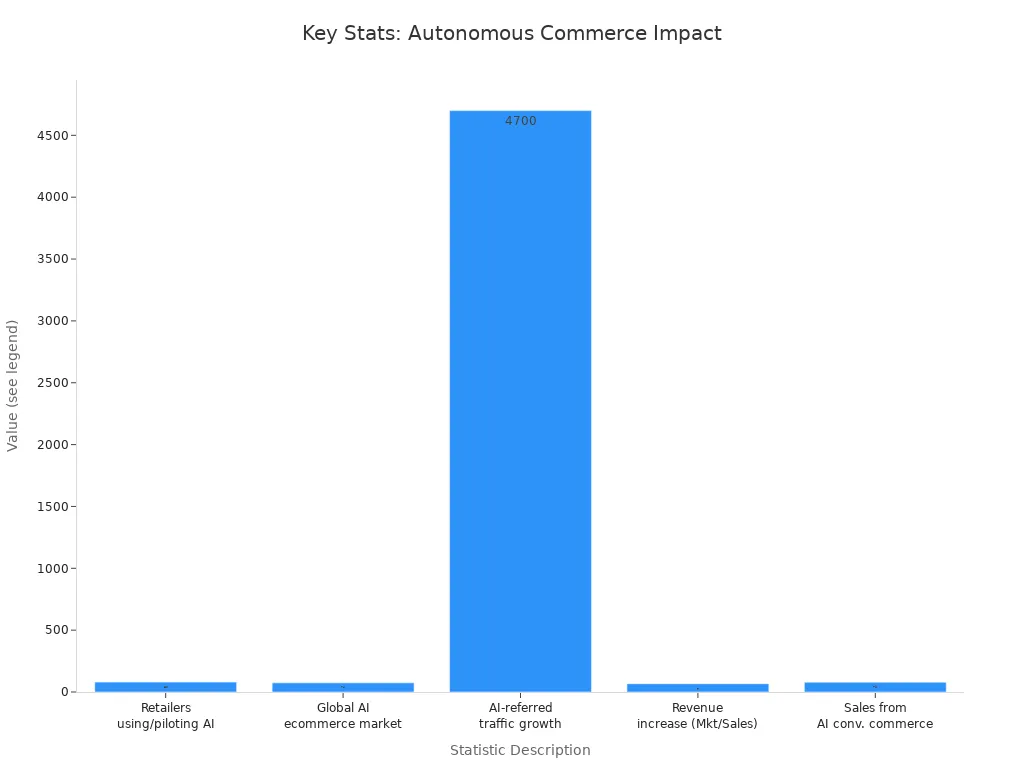
Autonomous commerce changes how you experience e-commerce. AI, automation, and integrated systems now help platforms work on their own. These technologies let you manage resources smarter and respond faster. Studies show that orchestration intelligence in autonomous systems reduces manual work and cuts costs for your business. You see benefits if you are a manufacturer, distributor, or buyer—faster order processing and better service. The impact grows every year, as shown below:
| Statistic Description | Value | Source |
|---|---|---|
| Percentage of retailers using or piloting AI | 80% | NVIDIA, 2025 |
| Projected global AI ecommerce market by 2034 | $74B | Precedence Research, 2026 |
| Year-over-year growth in AI-referred traffic to U.S. retail sites | 4,700% | Adobe, 2025 |
| Revenue driven by agentic commerce by 2030 | $3–$5 trillion | N/A |
| Revenue lift from AI personalization | 5–15% (up to 25% for top performers) | N/A |
Autonomous Commerce Explained

What Is Autonomous Commerce
You may notice that autonomous commerce changes how you buy and sell products. Experts describe it as a system that automates business transactions from start to finish. Unlike traditional commerce, you do not need to handle every step by hand. The platform uses advanced technologies to manage orders, pricing, and even customer support. This approach removes friction and speeds up every process. Artificial intelligence plays a key role by learning from data and making smart decisions. You can trust that the system adapts to your needs and absorbs human knowledge to improve over time.
Note: Trust is essential in autonomous commerce. Businesses must protect your data and keep you informed about how they use it. Most people want to know their information is safe before they buy or sell online.
Key Features and Technologies
You will find that autonomous commerce relies on several important components. These parts work together to create an intelligent platform that operates with little human help.
| Component/Process | Description |
|---|---|
| AI & Machine Learning | Algorithms that analyze data for demand forecasting, pricing optimization, and personalized recommendations. |
| Process Automation | Automated execution of tasks such as procurement and order routing without human intervention. |
| Composable Commerce | Modular architecture that allows integration of various best-of-breed solutions via APIs. |
| Data Collection | Continuous aggregation of data from various sources like ERP, CRM, and IoT devices. |
| Orchestration Layer | API-first platforms that manage data flow and ensure smooth operation of processes. |
| Continuous Improvement | AI refines processes based on outcomes to enhance efficiency and customer satisfaction. |
You benefit from features like AI integration, autonomous operation systems, and full-chain integration. These technologies let the platform handle complex tasks, from marketing to logistics. AI agents can answer questions, automate post-sale support, and even create marketing campaigns. You see faster service and fewer errors. As a result, autonomous commerce helps you focus on strategy while the system manages daily operations.
Autonomous Marketplace & Self-Operating Marketplace
Platform Types and Functions
You see many types of marketplace platforms today. An autonomous marketplace uses advanced AI to manage tasks with little human help. A self-operating marketplace goes even further. It handles seller onboarding, product updates, and pricing without manual steps. You find these platforms in industries like retail, finance, and manufacturing. For example, Johnson & Johnson uses a self-operating marketplace to speed up drug development. Moody’s built a marketplace that improves financial research with AI agents. eBay created a large-scale marketplace where AI helps sellers list products and buyers find what they need.
Here is a table showing the main components of a modern autonomous marketplace:
| Component | Description |
|---|---|
| Intelligence | Uses AI to plan, create tasks, and understand context. |
| Agent memory | Stores and retrieves data for better decisions. |
| Tools and plugins | Adds features like web scanning and desktop access. |
| Multi-agent communication schemas | Lets AI agents talk and learn from each other. |
| Multi-agent playgrounds and protocols | Sets rules for agent networks, like IFTTT for agents. |
| Monitoring, security, and budgetary | Keeps the marketplace safe and manages costs. |
| AgentOps marketplaces | Distributes AI models and agents, similar to HuggingFace for models. |
You notice that a large-scale marketplace needs these features to support many sellers and buyers. The platform must keep onboarding simple and secure. This helps marketplace growth and keeps operations smooth.
AI-Driven Operations
A self-operating marketplace uses AI to make every step easier. You see this in seller onboarding, where AI guides new sellers and checks their information. AI-driven onboarding saves time and reduces errors. The marketplace also uses AI to transform product listings. It finds gaps in the market and helps sellers improve their offers. Dynamic pricing is another key feature. AI watches competitors and demand, then changes prices to stay competitive.
Here is how AI-driven operations help a self-operating marketplace:
| Feature | Description |
|---|---|
| Vendor Onboarding | AI guides sellers through onboarding and checks compliance. |
| Product Transformation | AI improves listings and finds new market opportunities. |
| Dynamic Pricing | AI changes prices based on market trends and demand. |
| Inventory Monitoring | AI tracks stock and alerts sellers to restock or update listings. |
| Performance Insights | AI reviews seller data and suggests ways to improve sales. |
You benefit from a self-operating marketplace because it supports multi-channel sales. The platform uses headless architecture and content federation. This means you get the same experience on every channel. The marketplace keeps customer and inventory data in one place. You avoid overselling and get better service. As a seller, you find onboarding fast and easy. As a buyer, you see accurate listings and fair prices. These features make a large-scale marketplace run smoothly and help everyone succeed.
Impact of Autonomous Commerce in E-Commerce

Automation and Efficiency
You see the biggest changes in e-commerce when automation takes over routine tasks. Autonomous commerce platforms use AI to handle inventory management, order processing, and shipping. This means you do not need to spend time on repetitive work. You can focus on growing your marketplace and finding new opportunities for growth.
Here are some ways automation and autonomous systems improve efficiency:
- Improved customer experience through personalized buying journeys.
- Competitive advantages by providing faster and more efficient services.
- Automation of tasks leading to increased efficiency and cost savings.
You notice that autonomous commerce platforms help you launch new features quickly. You can bring products to market in months instead of years. Lower operating costs come from fewer errors and less manual work. Your sales growth increases because the marketplace can target buyers with better follow-ups. Transparent rules make it easy to expand your marketplace across the globe.
| Improvement Type | Description |
|---|---|
| Faster time to market | Implementations can be completed in months instead of years. |
| Lower operating costs | Reduced manual intervention leads to fewer errors. |
| Increased sales growth | Higher conversion rates and targeted follow-ups enhance sales potential. |
| Enhanced scalability | Transparent rules facilitate secure, global rollouts. |
You also see how automation changes the speed of your daily operations. For example, quote processing drops from 10 minutes to less than one minute. Inquiry handling takes only two minutes instead of six. The workload for customer service drops by up to 90%. The marketplace becomes more accurate and consistent, so you avoid mistakes and missed upselling chances.
- Automates repetitive tasks such as inventory management, order processing, and shipping.
- Increases efficiency and leads to cost savings.
- Allows companies to focus on innovation and expansion.
Personalization and Customer Experience
You want every customer touchpoint to feel unique. Autonomous commerce platforms use AI to personalize the shopping experience for each buyer and seller. These platforms gather data about your preferences and use it to suggest products, adjust prices, and even negotiate on your behalf. This makes your marketplace stand out and keeps consumers coming back.
AI agents automate tasks and personalize interactions. They gather your requirements and compare products based on your needs. Agentic commerce lets you scan multiple retailers in real time, so you find the best deals without extra effort. AI agents can research and negotiate purchases for you. They adapt recommendations when prices change and connect with other AI systems to automate tasks across your marketplace.
The use of generative and agentic AI has changed how you interact with e-commerce. A recent survey shows that 42% of retailers use some form of AI, and 64% of large retailers have adopted it. This shows that many businesses believe AI can improve customer experience and help their marketplace grow.
You see the benefits after you buy something, too. The AI agent keeps you updated about shipping, notifies you of delays, and manages returns. This proactive service makes your experience smooth and satisfying.
Scalability for B2B and Global Operations
You need your marketplace to grow with your business. Autonomous commerce platforms make it easy to scale for B2B and global operations. You can handle more buyers and sellers without adding more staff. The platform uses AI to manage complex logistics, track inventory, and keep everyone informed.
A good example is Maersk, which uses Microsoft Azure to power its global marketplace. Predictive insights help Maersk deliver on time and use assets more efficiently. The platform scales across the world, so clients of all sizes benefit. Employees can focus on strategy while the system handles daily tasks. This leads to stronger client relationships and more growth.
Autonomous commerce also simplifies purchasing for international buyers and sellers. The AI agent finds the best product and price, navigates checkout, applies discounts, and processes payments securely. After the sale, the agent tracks shipping and manages returns. This makes your marketplace more attractive to global buyers and helps you compete in new markets.
You gain a competitive edge by offering faster service and better customer satisfaction. Automation and AI help you grow your marketplace without losing control or quality.
Challenges & Comparison with Traditional E-Commerce
Common Misconceptions
You may hear many myths about using an autonomous marketplace. Some people think only big companies can use AI. Others believe AI costs too much or needs special skills. These ideas stop small businesses from joining the marketplace. Many worry about losing control or facing language barriers. You can see how these misconceptions affect adoption rates in the table below:
| Misconception | Impact on Adoption Rate |
|---|---|
| AI is only for large enterprises | Prevents MSMEs from recognizing that modern AI solutions are designed for small businesses. |
| AI is not affordable | Leads to missed opportunities due to perceived high costs, while inefficiencies grow without AI adoption. |
| AI requires deep technical expertise | Creates a barrier as MSMEs feel they need technical knowledge, which is not necessary with modern AI systems. |
| Language and communication barriers | Hinders adoption as MSMEs may struggle with technology that does not support their regional languages. |
| Fear of losing control | Results in reluctance to adopt AI, misunderstanding its role as a supportive tool rather than a replacement. |
Tip: You can find marketplace platforms that offer easy onboarding and support for many languages. AI tools now help small businesses, not just large ones.
Barriers to Adoption
You face several barriers when you try to use an autonomous marketplace. Old systems make it hard to connect new technology. Data silos block information from moving between departments. Integrating AI with custom systems can be tricky. You need strong governance and security to protect your marketplace. Human oversight remains important for safety and business goals. Here is a table showing the main barriers:
| Barrier Type | Description |
|---|---|
| Legacy Infrastructure | Constraints imposed by outdated systems that hinder integration with new technologies. |
| Data Silos | Deeply entrenched data silos that prevent seamless data flow and collaboration across systems. |
| Complexity of AI Integration | The difficulty of integrating modern AI with highly customized, decades-old enterprise systems. |
| Governance Frameworks | The need for rigorous governance frameworks to manage AI systems effectively. |
| Security Architectures | Attention to security architectures is crucial for protecting data and operations. |
| Human-in-the-Loop Oversight Mechanisms | Ensuring human oversight to maintain alignment with safety standards and business objectives. |
You also see regulatory, technological, and organizational challenges. Rules for drones and registration can slow down deployment. Connecting autonomous systems to warehouse management needs strong IT support. Your team must learn new skills to operate and maintain these systems.
| Challenge Type | Description |
|---|---|
| Regulatory | Compliance with airspace rules and registration protocols for drones creates deployment obstacles. |
| Technological | Integration of autonomous systems with existing warehouse management systems requires robust IT infrastructure. |
| Organizational | Workforce transformation necessitates new skill sets and training for operating and maintaining systems. |
Autonomous vs. Manual Systems
You notice big differences between an autonomous marketplace and a manual one. In a manual marketplace, you handle tasks like onboarding, pricing, and inventory by hand. This takes more time and leads to mistakes. An autonomous marketplace uses AI to automate these steps. You get faster service, fewer errors, and better insights. You can scale your marketplace without hiring more staff. You spend less time on routine work and more time growing your business.
Note: You can trust an autonomous marketplace to support your goals. Human oversight and strong security keep your data safe.
You see how autonomous commerce changes e-commerce for everyone. You gain faster service, better personalization, and easier global expansion.
- AI improves your decision-making and automates routine tasks.
- Chat-based interfaces and visual tools make shopping simple.
- You can scale your business with less effort.
| Future Trends | What to Expect |
|---|---|
| Agentic commerce | Smarter product discovery and loyalty |
| AI-driven platforms | Real-time pricing and data-driven buying |
You can prepare your business for the future by adopting these platforms today.
FAQ
What is the main benefit of using an autonomous commerce platform?
You save time and reduce errors. The platform handles routine tasks for you. You can focus on growing your business.
Tip: Automation helps you scale faster and serve more customers.
Can small businesses use autonomous commerce platforms?
Yes, you can use these platforms even if you run a small business. Many solutions offer easy onboarding and support.
| Feature | Benefit |
|---|---|
| Simple setup | Quick start |
| Language support | Wider reach |
How does AI improve the customer experience?
AI learns your preferences and suggests products you like. It answers questions and helps you find the best deals.
You get a shopping experience that feels personal and fast.
Is my data safe on autonomous commerce platforms?
You stay protected with strong security features. The platform uses encryption and regular updates to keep your data safe.
Note: Always check the platform’s privacy policy before you sign up.
See Also
The Evolution of Ecommerce Services for Future Success
Actionable Ecommerce Strategies for 2025: Innovation Guide
The Role of Micro Fulfillment Centers in E-Commerce Expansion
Top Ten E-Commerce Platforms for Seamless Accounting Integration