

You see businesses change fast when they use AI Multi-Agent platforms. These platforms let several AI agents work together to automate tasks, organize workflows, and boost results. Today, companies move beyond testing AI agents. They use production-ready tools that improve productivity. The numbers show strong gains. For example, workers who use AI tools finish 66% more tasks, and programmers code 126% more projects.
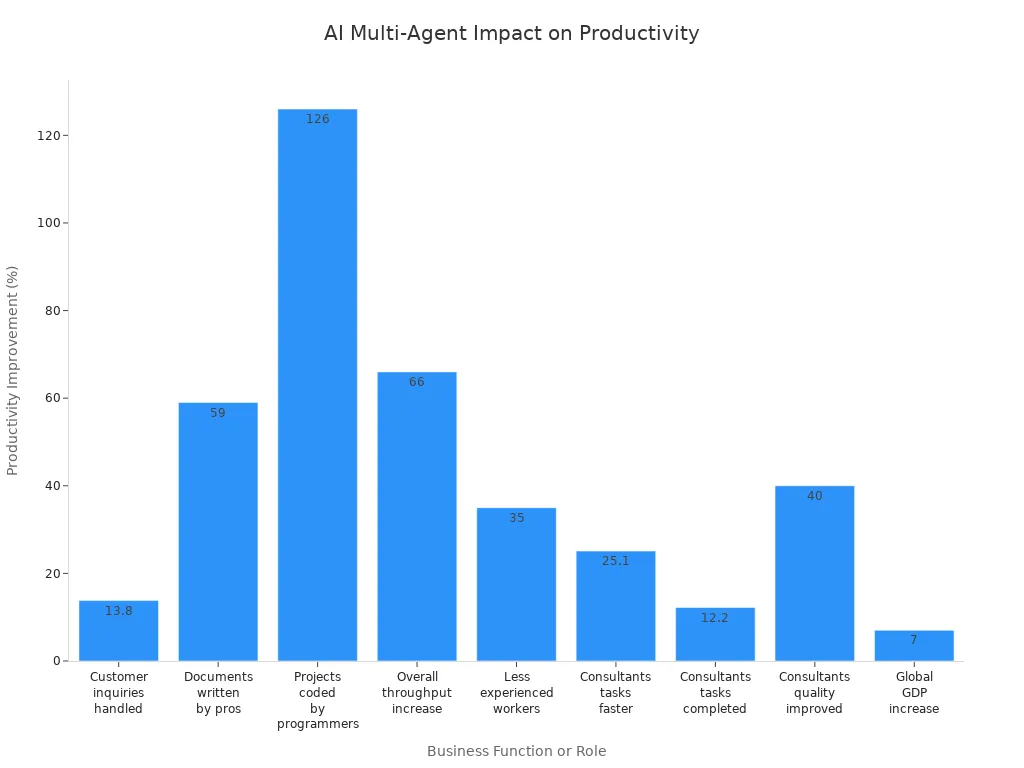
You can see that these platforms help you measure real improvements in how your business runs.
| Statistic Description | Percentage Improvement |
|---|---|
| Customer inquiries handled by support agents | 13.8% |
| Work-related documents written by business professionals | 59% |
| Projects coded by programmers | 126% |
| Overall throughput increase for workers using AI tools | 66% |
| Productivity improvement for less experienced workers | 35% |
| Management consultants completing tasks more quickly | 25.1% |
| Increase in tasks completed by management consultants | 12.2% |
| Quality improvement in tasks by management consultants | 40% |
| Potential global GDP increase from GenAI | 7% |
AI Multi-Agent Platforms and Productivity

Business Efficiency Gains
You can see big improvements when you use AI Multi-Agent platforms in your business. These platforms help you handle tasks faster and more accurately. Many industries report strong efficiency gains. For example, finance teams process risk assessments and detect fraud 70% faster. Healthcare organizations cut costs by 50% through clinical support and administrative automation. Manufacturing companies reduce downtime by 40% with predictive maintenance and quality control. Retailers boost revenue by 30% with inventory optimization and personalized customer experiences.
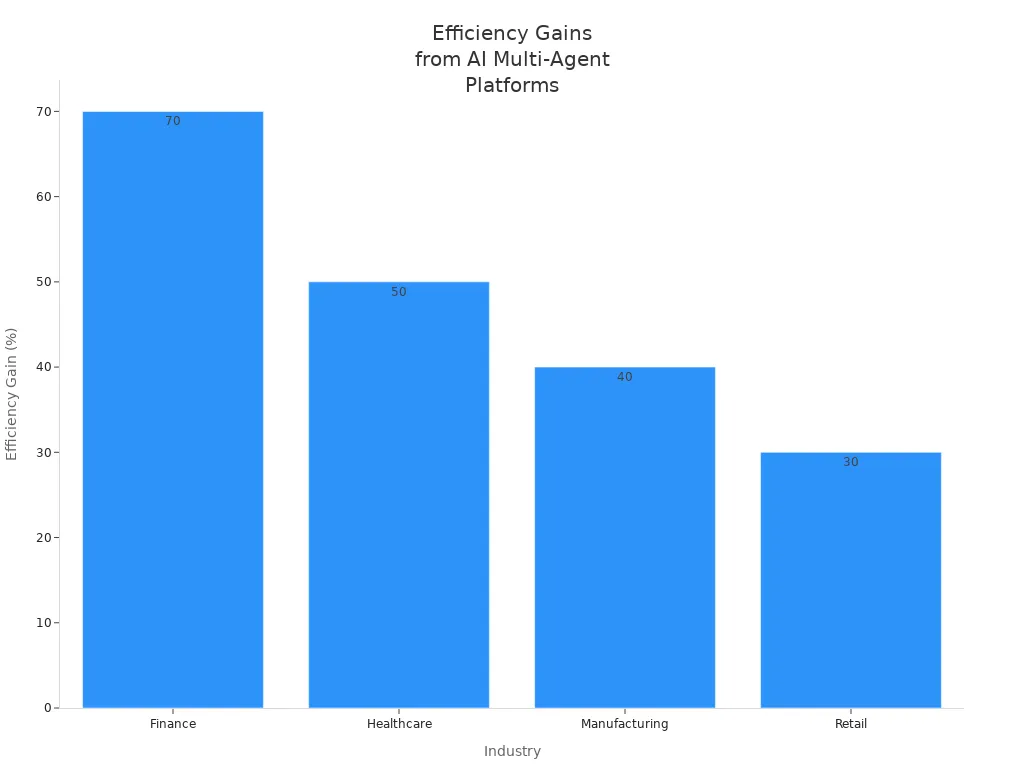
You can also see efficiency improvements in customer service, sales, and HR operations. Many businesses report up to 50% better performance in these areas. Automated processes often lead to 30-50% lower operational costs. Here is a table that shows how different industries benefit:
| Industry | Primary Use Cases | Efficiency Gains |
|---|---|---|
| Finance | Risk assessment, fraud detection | 70% faster processing |
| Healthcare | Clinical support, administrative automation | 50% cost reduction |
| Manufacturing | Predictive maintenance, quality control | 40% downtime reduction |
| Retail | Personalization, inventory optimization | 30% revenue increase |
You can use AI Multi-Agent platforms to detect anomalies in supply chains, trigger automatic adjustments, ensure compliance in finance, streamline recruitment in HR, and maintain security in IT. These platforms help you monitor real-time data for inventory, optimize routes in logistics, and automate fraud detection in financial transactions.
Automation and Orchestration
AI Multi-Agent platforms automate and orchestrate complex workflows for you. You do not need to manage every step yourself. Specialized agents work together to handle tasks like customer-service triage, sales lead outreach, finance reconciliations, HR onboarding, IT service desk, and order-to-cash workflows. You can also automate marketing campaigns, compliance reporting, DevOps, and knowledge management.
Tip: You can use AI Multi-Agent platforms to manage complex tasks with minimal human input. These platforms adapt in real-time and handle exceptions automatically.
Enterprises that use multi-agent orchestration report efficiency gains of 40-60%. These gains are much higher than traditional automation tools, which often follow fixed rules and require manual intervention. Here is a table that compares features:
| Feature | AI Multi-Agent Platforms | Traditional Automation Tools |
|---|---|---|
| Adaptability | High - can adapt to changing conditions and workflows | Low - follows predefined rules |
| Coordination | Specialized agents work together for complex tasks | Limited coordination, often siloed processes |
| Error Handling | Autonomous exception handling and recovery | Manual intervention often required |
| Efficiency Gains | 40-60% efficiency improvements reported | Varies, generally lower than AI platforms |
You can see real-world examples. A multinational bank used multi-agent orchestration to streamline month-end close processes. The bank reduced the time from three weeks to four days and achieved over 99.8% accuracy. Siemens improved production schedules and equipment effectiveness by 18% and reduced unplanned downtime by 35% with smart robotic agents.
Faster Decision-Making
You can make decisions faster with AI Multi-Agent platforms. These platforms use multiple specialized agents that collaborate and streamline complex business processes. You get quicker responses to changing conditions because the agents distribute decision-making tasks.
Here is a table that shows productivity gains, cost savings, and faster decisions in different business processes:
| Business Process | Productivity Gains | Cost Savings | Faster Decisions |
|---|---|---|---|
| IT | 66% | 57% | 55% |
| Marketing | 66% | 57% | 55% |
| Finance | 66% | 57% | 55% |
| Service | 66% | 57% | 55% |
You can use AI Multi-Agent platforms to monitor real-time data, optimize routes, automate fraud detection, and screen resumes. These platforms also help you respond to incidents quickly in IT operations. For example, automotive insurance companies scale customer acquisition efficiently with intelligent lead management. Third-party insurance firms process complex claims at scale, optimize costs, and reduce errors with intelligent document processing.
Note: AI Multi-Agent platforms reduce decision latency in enterprise environments. You get faster and more accurate decisions, which improves operational efficiency.
Defining AI Multi-Agent Business Platforms
Core Features and Characteristics
You see AI Multi-Agent business platforms stand out because they offer advanced features that help your business run smoothly. These platforms connect with tools like CRMs and ERPs. They keep your data safe using security protocols such as single sign-on and encryption. You can manage complex workflows because agents share tasks and context. Human-in-the-loop functionality lets you oversee decisions, which is important in regulated industries. Real-time action combines smart reasoning with fast workflows. You get prebuilt connectors and APIs that make integration easy. These platforms support the full lifecycle of your agent workforce. They also give secure access to organizational memory, so agents can use the right data when needed.
Here is a table that shows the main features:
| Feature | Description |
|---|---|
| Robust Data Pipelines | Integrates with CRMs, ERPs, and knowledge bases while ensuring security. |
| Complex Workflow Support | Manages complex processes, enabling agents to hand off tasks and share context. |
| Human-in-the-Loop Functionality | Allows human oversight for decision-making, ensuring accountability. |
| Real-Time Action | Combines reasoning from language models with real-time workflows. |
| Seamless Integration | Offers prebuilt connectors and APIs for easy integration. |
| Full Lifecycle Support | Facilitates development and evolution of agentic workforce. |
| Secure Access to Organizational Memory | Ensures agents can access necessary data securely. |
Tip: You can use these features to automate tasks, improve accuracy, and keep your business data safe.
Multi-Agent vs. Single-Agent Systems
You may wonder how AI Multi-Agent platforms differ from single-agent systems. Single-agent systems focus on one task at a time. They work well for simple jobs, but they struggle with complex processes. Multi-agent platforms use several agents that work together. Each agent specializes in a task. They share information and coordinate actions. You get better performance because agents handle different parts of a workflow. This teamwork leads to faster results and fewer errors.
-
Single-agent systems:
- Handle one task at a time
- Limited adaptability
- Less collaboration
-
Multi-agent platforms:
- Manage many tasks at once
- High adaptability
- Strong collaboration
You can choose a platform based on your business needs. If you want to automate complex workflows and boost productivity, AI Multi-Agent platforms give you more power and flexibility.
Key Capabilities for Productivity
Integration with Enterprise Tools
You need your business tools to work together. AI Multi-Agent platforms connect with systems like CRMs, ERPs, and knowledge bases. This integration lets you move data between platforms without manual work. You can set up connections using prebuilt APIs or connectors. These tools help you keep your information up to date and reduce errors. When your systems talk to each other, you save time and avoid duplicate work. You also keep your data secure with features like single sign-on and encryption.
Tip: Seamless integration means you can automate tasks across departments, making your business run smoother.
Collaboration and Communication
You want your teams to work together easily. AI Multi-Agent platforms make this possible by letting agents and data sources collaborate through a single interface. This unified approach removes barriers between teams and cuts down on repeated logins or access checks. You get better knowledge sharing and faster decisions.
- Agents work together like virtual experts, each handling a part of the job.
- You see a 30% drop in costs and a 35% boost in productivity when teams use these systems.
- The platform simplifies how you interact with your tools and keeps everything transparent.
- You can break down silos, so everyone has the information they need.
| Study Type | Findings | Context |
|---|---|---|
| Systematic Review (37 studies) | Developers spent less time on boilerplate code but faced code-quality regressions | Software Development |
| Meta-analysis (83 studies) | Generative models match non-expert clinicians but trail experts | Diagnostic AI |
| Randomized Controlled Trial (5,000+ agents) | 35% throughput lift for bottom-quartile reps, no gain for veterans | Tech Support Desk |
Note: These platforms help you share knowledge and make decisions faster, which leads to better teamwork and higher productivity.
Workflow Orchestration
You can use AI Multi-Agent platforms to manage complex workflows. These platforms let you design and control how tasks move from one step to the next. You do not need to write a lot of code. Many platforms offer low-code tools, so you can build workflows even if you are not a programmer.
| Unique Capability | Description |
|---|---|
| Context Maintenance | Agents keep track of conversations across channels, so users get smooth service. |
| Specialized Agents | You can use agents for different customer groups or products, improving service. |
| Low-Code Platform | Build workflows without deep programming skills. |
| Rule-Based Decision Automation | Automate complex decisions, especially in finance and retail. |
| Flexible Architecture | Mix and match different AI models for the best results. |
| Dynamic Scaling | The system adds or removes agents as needed, so you always have enough help. |
| Graph-Based Workflow Definition | See and adjust how tasks flow using visual tools. |
| Role-Based Teams | Organize agents like human teams, with clear roles and communication. |
You can automate tasks like order processing, customer support, and compliance checks. The platform keeps context, so agents know what happened before and can pick up where others left off. This makes your workflows faster and more reliable.
Adaptability and Scalability
Your business changes over time. AI Multi-Agent platforms help you keep up. You can add or remove agents as your workload grows or shrinks. The system adapts to busy seasons or slow periods without stopping your operations. If one agent fails, others step in to keep things running. This setup makes your business more reliable.
| Aspect | Description |
|---|---|
| Scalability | Add or remove agents based on how much work you have. |
| Flexibility | Adjust to new needs or changes in your business quickly. |
| Fault Tolerance | If one part fails, others take over, so you avoid downtime. |
| Real-time Collaboration | Agents work together instantly, so you can respond to changes right away. |
- You get decentralized decision-making, so agents do not wait for one central command.
- Real-time collaboration means your business can react fast.
- This approach gives you a more reliable and scalable solution.
Tip: When your platform adapts and scales, you stay ahead of changes and keep your business productive.
AI Multi-Agent Use Cases in Business

Finance: Risk Analysis and Reporting
You can use AI Multi-Agent platforms to improve risk analysis and reporting in finance. These platforms automate tasks like invoice processing and expense report generation. You see fewer errors and faster reporting. This helps your team manage risks more effectively.
| Use Case | Description |
|---|---|
| Autonomous invoice processing | Automates invoice data flow, reduces manual effort, and improves accuracy in reporting. |
| Automated expense report generation | Simplifies expense reporting, reduces errors, and boosts efficiency in risk analysis. |
Platforms such as Google Vertex and Amazon Bedrock AgentCore support these features.
Retail: Inventory and Customer Service
You can optimize inventory and enhance customer service in retail with AI Multi-Agent platforms. These tools help you reduce carrying costs, fulfill orders quickly, and cut waste.
| Benefit | Metric |
|---|---|
| Stock Optimization | 15% reduction in carrying costs |
| Service Levels | 98% order fulfillment rate |
| Waste Reduction | 50% decrease in obsolete inventory |
| Cash Flow | Improved working capital management |
- 24/7 automated customer support improves service quality.
- Multi-channel integration gives seamless experiences across platforms.
Microsoft Copilot Studio and CrewAI offer these capabilities.
Manufacturing: Supply Chain Optimization
You can boost supply chain performance in manufacturing by using AI Multi-Agent platforms. These platforms help you manage inventory, plan production, and collaborate with suppliers. Companies achieve better inventory turns and lower planning costs. You get faster production planning and improved forecasting. AI agents identify urgent supply chain issues and recommend solutions using real-time data.
Healthcare: Patient Data and Scheduling
You can enhance patient data management and scheduling in healthcare. AI Multi-Agent platforms automate patient monitoring and treatment planning. These tools improve administrative coordination and reduce clinician burnout.
- Automation of patient monitoring and diagnostic assistance.
- Optimization of scheduling and documentation.
- Enhanced patient communication through generative AI.
AutoGen and CrewAI support these healthcare workflows.
Other Industries: Marketing, Logistics, HR
You can use AI Multi-Agent platforms in marketing, logistics, and HR. These platforms automate recruitment, improve candidate matching, and reduce bias. In logistics, you optimize inventory and increase efficiency. In procurement, you streamline sourcing and supplier risk assessments.
| Sector | Use Case Description | Impact |
|---|---|---|
| Procurement | Automating sourcing and supplier risk assessments | Streamlines workflows |
| Logistics | Predictive maintenance and inventory optimization | Boosts efficiency and resilience |
| HR | Automating recruitment and candidate matching | Improves hiring and reduces bias |
Platforms like Google Vertex and CrewAI help you manage these tasks.
Choosing and Implementing AI Multi-Agent Platforms
Assessing Business Needs
You start by understanding what your business needs. Look at your goals and the problems you want to solve. Use a checklist to help you decide:
| Criteria | Description |
|---|---|
| Technical capabilities | Check if the platform uses smart reasoning and adapts to your business rules. |
| Security features | Make sure the platform has strong access controls and audit tools. |
| Ecosystem compatibility | See if it connects with your current systems and data sources. |
| Vendor support | Find out if the vendor offers good help, guides, and community resources. |
You also want systems that understand context and user intent. Multi-agent systems let specialized agents work together, so you get better results.
Evaluating Platform Features
You compare platforms by looking at their features. Make a list of what matters most:
| Evaluation Criteria | Description |
|---|---|
| Technical Capabilities | Does the platform support agent teamwork and control at scale? |
| Governance | Can you balance agent independence with oversight? |
| Integration | Will it fit with your current tools and systems? |
| Scalability | Can it grow as your business grows? |
| Total Cost Implications | What is the real cost, including setup and support? |
You can choose platforms with code or no-code options. No-code tools let you build workflows without programming. Code-based platforms give you more control if you have technical skills.
Tip: Match platform features to your business needs and workflows for the best results.
Integration and Security
You need your platform to connect smoothly and stay secure. Use a modular architecture so you can add agents as your business changes. Build strong data pipelines for real-time access and quality checks. Choose platforms with API-first integration, so your systems talk to each other easily.
| Consideration Type | Description |
|---|---|
| Modular AI Agent Architecture | Lets you scale and optimize resources quickly. |
| Strong Data Pipelines | Keeps data flowing and prevents failures. |
| API-First Integration Strategy | Uses standard interfaces for easy communication. |
| High Availability and Reliability | Ensures your business keeps running, even if something fails. |
| Identity and Access Management | Protects your data with strict controls for agents. |
| Audit Trails | Tracks agent actions for compliance and troubleshooting. |
You also need monitoring systems to track agent behavior and secure development practices to keep your platform safe.
Training and Change Management
You prepare your team for new technology. Offer training programs so employees learn how to work with AI agents. Manage change resistance by talking about job security and workflow changes. Involve stakeholders in planning and decision-making. Roll out changes in small steps, not all at once. Celebrate successes and share achievements to build confidence.
- Employee training helps everyone work with AI agents.
- Change management addresses concerns and builds trust.
- Stakeholder engagement makes adoption smoother.
- Gradual rollout keeps changes manageable.
- Success communication motivates your team.
Note: Good training and change management make your AI Multi-Agent platform successful.
Strategies to Maximize Productivity
Measuring Success
You need to track the right metrics to see how well your AI Multi-Agent platform works. Good measurement helps you find what works and what needs fixing. You can use many metrics to check productivity, accuracy, and safety. Here is a table that shows important metrics you should watch:
| Metric | Description |
|---|---|
| Action completion | Counts how many tasks agents finish successfully. |
| Agent efficiency | Checks how fast and well agents do their jobs. |
| Tool selection quality | Looks at how well agents pick the right tools. |
| Tool error | Tracks mistakes made by tools during tasks. |
| Context adherence | Measures if agents keep track of conversations. |
| Correctness | Checks if agent answers are right. |
| Instruction adherence | Sees if agents follow your instructions. |
| Conversation quality | Rates how well agents talk with users. |
| Completeness | Checks if agents give full answers. |
Tip: Review these metrics often. You will spot problems early and keep your platform running smoothly.
Continuous Improvement
You can boost productivity by making small changes over time. Start by expanding what works in one team to other teams. This is called horizontal expansion. Next, connect your agents across different business areas. This step is vertical integration. You get end-to-end automation and better results.
| Phase | Description |
|---|---|
| Horizontal Expansion | Use successful ideas in new teams or departments. |
| Vertical Integration | Link agents across business functions for full automation. |
| Monitor, Learn, Iterate | Watch performance, learn from results, and make changes to improve. |
- Real-time teamwork helps you make decisions faster.
- Multiple agents checking each other reduces mistakes.
- Automated handoffs save time and cut delays.
- Smart task sharing uses your resources better.
Note: Train your staff well and explain how AI agents help them. Good training and clear communication make everyone more comfortable with new tools.
You see AI Multi-Agent platforms boost productivity by automating tasks, improving accuracy, and speeding up decisions. You can start by finding workflow bottlenecks and setting clear goals. Use the table below to guide your steps:
| Phase | Actionable Steps |
|---|---|
| 1 | Find a high-volume, low-risk workflow. Set success metrics. |
| 2 | Deploy with human review on a small dataset. |
| 3 | Expand tool access as accuracy improves. |
| 4 | Build a multi-agent ecosystem with clear KPIs. |
Stay informed about new AI agent technologies. You will keep your business ahead.
FAQ
What is an AI Multi-Agent business platform?
You use an AI Multi-Agent business platform to let several AI agents work together. These agents automate tasks, share information, and help your business run faster and smarter.
How do AI Multi-Agent platforms improve productivity?
You see productivity rise because agents handle tasks quickly and accurately. They automate workflows, reduce errors, and help your team focus on important work.
Tip: You can track productivity gains by measuring completed tasks and faster decisions.
Can you integrate AI Multi-Agent platforms with your current tools?
Yes, you connect these platforms to tools like CRMs and ERPs. You use APIs or prebuilt connectors to move data and automate processes across your business.
Are AI Multi-Agent platforms safe for your business?
You keep your data safe with strong security features. These platforms use encryption, access controls, and audit trails to protect information.
| Security Feature | Benefit |
|---|---|
| Encryption | Keeps your data private |
| Access Controls | Limits who can see data |
| Audit Trails | Tracks agent actions |
Do you need coding skills to use AI Multi-Agent platforms?
You do not always need coding skills. Many platforms offer no-code or low-code options. You build workflows using simple tools and drag-and-drop features.
See Also
Revolutionizing Fashion Retail With AI-Driven Safety Stock
Top 10 E-commerce Platforms That Integrate Accounting Seamlessly
Enhancing Warehouse Efficiency Through Intelligent E-commerce Solutions
The Role Of Outsourcing In Boosting Supply Chain Agility
Strategies To Ensure Your B2B Order Fulfillment Is Future-Ready