

You see a new era in commerce as autonomous commerce platforms use artificial intelligence to make decisions and complete tasks without human help. These platforms move beyond traditional e-commerce by using AI agents that learn and act on their own. Businesses worldwide now adopt these systems at a rapid pace.
| Year | Market Size (USD Billion) | Projected Growth Rate (CAGR) |
|---|---|---|
| 2024 | 1.82 | 26.0% |
| 2030 | 6.91 | 26.0% |
You notice North America leads the market, while Asia Pacific grows the fastest.
Autonomous Commerce Explained

AI Agents And Core Features
You see autonomous commerce platforms powered by artificial intelligence. These platforms use AI agents that can make decisions and complete tasks without your help. You can trust these agents to handle inventory tracking, pricing analysis, and even product searches. They use a secure and accurate data foundation to support every decision. You notice that these agents connect with many systems, so everything works together smoothly. They also learn from feedback, which helps them improve over time.
Tip: You can let AI agents manage routine tasks, so you have more time for important work.
Here are the defining characteristics of AI-powered agentic systems:
- AI agents handle tasks like inventory tracking and pricing analysis on their own.
- They use secure and accurate data for decision-making.
- They connect with different operational systems for seamless work.
- They use feedback loops to learn and optimize decisions.
| Characteristic | Explanation |
|---|---|
| Goal-directed behavior | Agents set goals and make decisions based on those goals. |
| Proactive decision-making | Agents act on their own without waiting for your input. |
| Multi-step reasoning | Agents can solve complex problems by thinking through several steps. |
| Integration of tools and APIs | Agents use different systems, like inventory and payment gateways, to make smart choices. |
You benefit from these features because AI agents can complete entire shopping journeys. They can find products, check prices, and finish purchases without you needing to step in. This makes your operations faster and your customers happier.
Agentic Ecosystem And Infrastructure
You need a strong ecosystem to support autonomous commerce. This ecosystem includes special tools and systems that help AI agents work well. You use programmable payment assets, like stablecoins, so agents can pay for things automatically. You rely on scalable transaction processors that handle millions of small payments quickly and at a low cost. You also use SDKs and AI toolkits to help agents interact with people and other services.
| Infrastructure Component | Description |
|---|---|
| Programmable Payment Assets | Machine-compatible payment mediums, such as stablecoins, let agents make payments without human help. |
| Massively Scalable Transaction Processors | These systems process millions of microtransactions quickly and cheaply, making real-time commerce possible. |
| Seamless Human and Agent Integration | SDKs and AI toolkits help agents and people work together smoothly. |
| Open Marketplaces | Protocols and registries let agents find and choose service providers on their own. |
| Pay-per-use Service Providers | Vendors offer services like data and storage that agents can buy as needed, supporting many small transactions. |
You see that agentic ecosystems use open and flexible designs. These designs include broad APIs, clean product data, and secure checkout systems. You can connect different platforms, so agents work well together. Orchestration engines help agents manage workflows across many systems, making sure everything runs smoothly.
Some leading platforms in this space include:
- BigCommerce
- Kibo Commerce
- Mirakl Nexus
B2B Applications And Use Cases
You find that autonomous commerce changes how you do business in b2b e-commerce. In manufacturing and supply chain management, you use these platforms to automate procurement flows. You can talk to catalogs using natural language, which makes finding products easier. You also see personalized offers and dynamic pricing that adjust to market changes. AI agents can even negotiate deals for you.
| Use Case | Description |
|---|---|
| Procurement Flows | Automated systems make buying supplies faster and easier. |
| Conversational Catalog | You can search and order using simple language, just like talking to a person. |
| Personalization | Offers and recommendations match your needs and preferences. |
| Dynamic Pricing | Prices change in real time based on the market. |
| Automated Negotiation | AI agents handle negotiations, saving you time and effort. |
You notice big improvements in procurement processes. Autonomous commerce platforms reduce procurement cycles from weeks to days. You get better data for comparing suppliers, which helps you make stronger decisions. You also see better teamwork between procurement, finance, and operations. Built-in tools help you spot risks and keep everything transparent and compliant.
Note: You can use autonomous commerce to boost efficiency in b2b e-commerce by 35-50% in the first year and improve customer experience by 25-40%.
Autonomous Commerce vs. Traditional Models
Key Differences In Automation
You see a big shift when you compare autonomous commerce to traditional e-commerce models. Traditional automation uses rule-based scripts and fixed workflows. These systems need you to set up rules and often require your help to keep running. Autonomous commerce uses AI agents that understand your intent and act on their own. These agents make decisions based on real-time data and can handle tasks like product discovery, cart recovery, and checkout without your input.
Here is a table that shows the main differences:
| Aspect | Traditional Automation | Agentic Commerce |
|---|---|---|
| Response logic | Rule-based scripts | Contextual AI that understands intent |
| Personalization | Segment-based | Individual customer data |
| Actions available | Pre-defined workflows | Autonomous decisions within boundaries |
| Channel coverage | Often single-channel | Unified across touchpoints |
| Primary goal | Support cost reduction | Direct revenue generation |
You notice that agentic workflows operate independently. They learn and adapt over time, which means they get better at their jobs. For example, in b2b e-commerce, agents can manage inventory, adjust orders, and even negotiate terms with suppliers. In B2C, you see retailers using AI agents to help customers find products using natural language, making the customer experience smoother and more personal.
Value Proposition For Businesses
You gain many benefits when you use autonomous commerce platforms. These systems help you save money and grow your business faster. You can see reductions in procurement cycle times by 40-60% and operational cost reductions by 40-60%. In b2b e-commerce, you also get better inventory turnover and lower excess inventory costs. Revenue can increase by 15-30% in the first year.
Here are some examples of how agentic commerce works:
- Retailers use AI agents for product discovery, letting customers search with simple prompts.
- Customers use agents in apps like ChatGPT to find gifts or skincare products.
- In b2b e-commerce, agents negotiate deals and manage complex purchasing workflows.
You can even see AI agents in banking, where they help customers apply for loans by talking to different banks’ systems. Autonomous commerce gives you tools that work for you, making your business more efficient and your customers happier.
Benefits Of Autonomous Commerce
Enhanced Efficiency And Speed
You gain faster operations when you use autonomous commerce platforms. These systems let you deploy new processes quickly. You can reduce setup time from months to days. You also see a 60-70% faster time-to-market because you control processes without coding. Autonomous platforms work around the clock. They do not need human approvals, so transactions happen instantly. AI-driven supply chains respond to changes in demand right away. You save time and reduce mistakes.
- You handle transactions without human help, which lowers operational overhead.
- You improve accuracy and speed in every step.
- You see instant responses to demand changes.
You can measure efficiency gains with several metrics. For example, you track conversion rate uplift, support tickets reduced, and forecast accuracy. Here is a table that shows how these metrics impact your business:
| Metric | Description | Impact on Efficiency |
|---|---|---|
| LTV: CAC Ratio | AI reveals profitable channels. | Lets you move spend to better channels. |
| Conversion Rate Uplift | Personalized product pages increase conversions. | Shows marketing effectiveness. |
| Support Tickets Reduced | AI chatbots lower support volume. | Improves customer satisfaction. |
| Stockouts and Forecast Accuracy | Better demand forecasting reduces stockouts. | Saves lost sales and shipping costs. |
Improved Customer Experience
You create a better customer experience with autonomous commerce. AI-driven personalization engines customize recommendations, pricing, and offers for each shopper. Real-time data and behavioral signals help you adjust the shopping journey for every person. Predictive analytics let you anticipate what customers need. You move beyond simple segmentation and deliver a personalized buying experience.
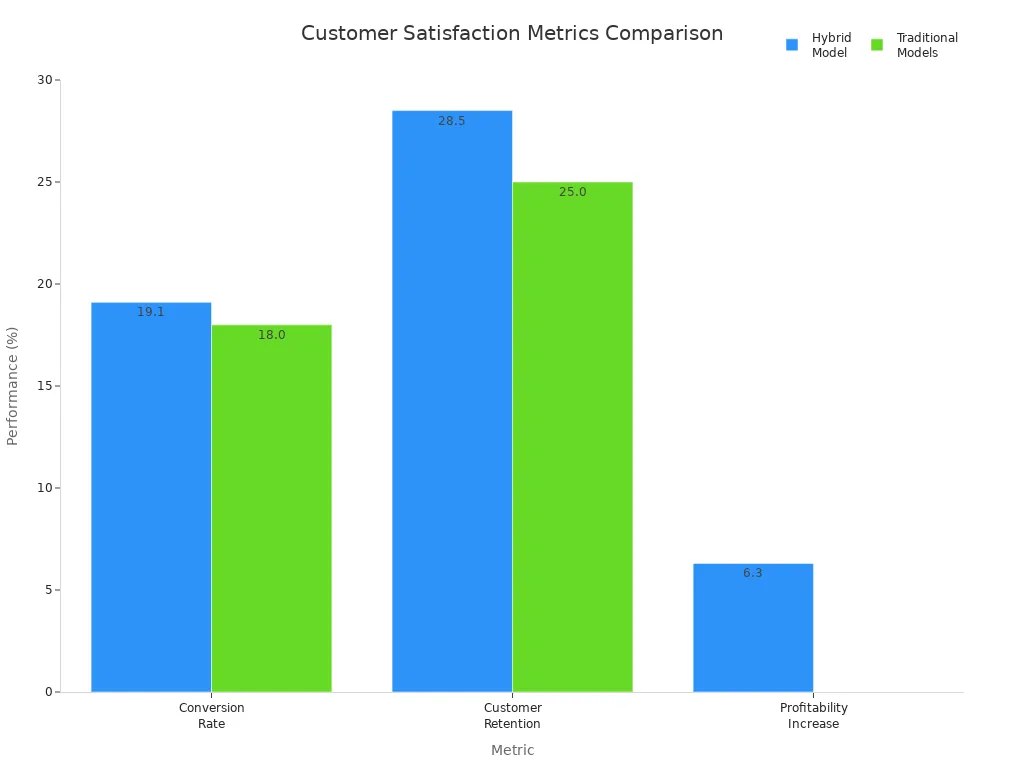
Hyper-personalization uses real-time data to tailor each experience. You adjust offers based on intent and context. This makes shopping more relevant and enjoyable. You see higher conversion rates and retention. The hybrid model shows a conversion rate of 19.1%, which is 1.1% higher than traditional models. Customer retention also improves by 3.5%. These gains show that autonomous platforms boost satisfaction.
Scalability And Growth Opportunities
You scale your business easily with autonomous commerce. You keep a consistent shopping experience across all locations. You use standardized tools and minimize technical maintenance. You develop a multifunctional app that combines customer interactions, purchase history, and store functions. You offer flexible payment options, including app-linked cards, traditional cards, and cash.
You use cloud-based platforms like Microsoft Azure or AWS. These platforms let you grow from one store to a large network. You gain unlimited scaling and technical support. You also unlock new growth opportunities. You deliver faster and more efficient services. You automate inventory tracking, order processing, and fulfillment. You focus on innovation and expansion.
You can provide a personalized buying experience and predictive maintenance alerts. For example, a B2B company selling 3D printers uses autonomous commerce to offer automatic ordering of replacement parts. This shows how AI integration drives business growth.
Artificial Intelligence In Commerce Platforms

AI-Driven Automation
You see artificial intelligence changing how you run your business. These systems use smart agents that can handle many tasks without your help. You can trust them to manage shopping journeys, answer customer questions, and keep track of inventory. Here are some common ways artificial intelligence drives automation in autonomous commerce:
- AI agents guide shoppers from finding products to negotiating prices and completing purchases.
- Customer service chatbots answer questions and solve problems quickly, making customers happy.
- Inventory management bots watch stock levels and reorder supplies when needed, so you never run out.
- Negotiation bots talk with suppliers and secure the best deals for your company.
You notice that artificial intelligence makes order processing and inventory management much easier. It connects all your supply chain data in one place. You do not need to enter orders or shipping details by hand. The system updates inventory and shipping information automatically. Artificial intelligence uses real-time data to choose the best delivery routes, which saves time and money. It also spots problems, like low stock or too many returns, before they become big issues. You get clear insights that help you plan better and keep customers satisfied. AI-based personalization also helps you offer the right products to the right people at the right time.
Real-Time Management And Execution
Autonomous commerce platforms utilize artificial intelligence and automation to streamline processes, reduce manual intervention, and enhance operational efficiency.
With the Execution Fabric, you gain an intelligent orchestration that transforms fragmented processes into a unified flow—unlocking faster revenue, scalable operations, and the foundation for truly autonomous commerce.
You benefit from predictive and self-optimizing systems that improve operational efficiency and customer satisfaction. They make decisions quickly and adapt to changes.
To achieve real-time execution, you need a strong technical setup. A headless architecture gives you fast APIs that connect every part of your e-commerce system. You use an orchestration layer to keep all agents working together. This setup lets you update inventory in real time, often in less than 10 milliseconds. You can also use micro-reservations and dynamic pricing to handle many transactions at once. Artificial intelligence makes your business more responsive and ready for growth.
Challenges And Considerations
Data Integration And Security
You face important challenges when you connect autonomous procurement systems to your existing supply chain and e-commerce platforms. Many businesses struggle to link new AI tools with legacy systems. You must ensure that data flows smoothly and securely between all parts of your operation. Mastercard highlights the need for strong identity verification, data privacy, and transaction security. You can use multi-factor authentication to verify users, advanced encryption to protect sensitive data, and strict protocols to prevent fraud. Some solutions use computer vision and machine learning for anonymous tracking. These systems do not store biometric data, which helps you comply with privacy laws like GDPR and CCPA. Data processing happens securely inside your stores, so you can learn about customer behavior without risking privacy.
Balancing Automation With Human Input
You need to find the right balance between full automation and human oversight in autonomous procurement. For simple, high-volume tasks, you can let AI agents work alone. For more complex or sensitive decisions, you should keep humans involved. You can use a hybrid approach. Let AI handle routine actions, but require human approval for important steps like contract changes or large refunds. This model keeps your operations efficient and builds trust with your customers. You should always keep people in the loop for financial, legal, or brand-critical decisions. Unchecked automation can lead to mistakes or compliance issues, so you must set clear boundaries.
Adoption Barriers
You may face several barriers when you try to adopt autonomous procurement. Many mid-sized businesses need strong leadership to align technology with real business needs. You might find it hard to integrate new systems with your current supply chain tools. Building trust in data security is also key. Employees want to know that their information stays safe. To overcome these challenges, you should:
- Evaluate platforms with a structured process.
- Start with pilot programs and measure results.
- Train your staff and provide clear educational materials.
- Roll out new systems in phases to reduce risk.
- Test integrations before going live.
- Monitor performance and collect feedback.
- Avoid over-automation and keep communication open.
Tip: Strategic planning, careful technology selection, and ongoing measurement can help you achieve up to 40% cost reductions and 50% performance gains within a year.
Autonomous Commerce Revolution And Future Trends
Impact On Business Operations
You will see big changes in how you run your business as autonomous commerce grows. These platforms make buying goods and services as easy as shopping online. You can expect faster decisions and smoother workflows. Many companies now use automation to handle more than half of their network activities. By 2026, this number will reach 30% of all enterprises. You will notice that your team spends less time on manual tasks and more time on important projects.
"Organizations expect clarity, transparency, and adherence to standards from any autonomous platform they implement. The transition succeeds only when the technology fits seamlessly into an organization’s environment without disruption."
You will find that autonomous commerce creates a connected and smart ecosystem. The buying process becomes simple and quick. In b2b e-commerce, you can connect with suppliers, compare prices, and place orders without delays. You will see fewer mistakes and better use of resources. Your business will become more flexible and ready for new challenges.
Vision For Fully Autonomous Shopping
You will experience a new kind of shopping with fully autonomous stores. These stores use advanced technology to understand what you need and help you right away. The market for retail automation is growing fast. In 2020, it was worth $13.97 billion. By 2028, it will reach $31.81 billion, with a growth rate of almost 11% each year.
Here are some key technologies shaping the future of shopping:
| Technology Type | Description |
|---|---|
| Machine Vision | Stores use cameras and AI to learn about your behavior and give you personal experiences. |
| Sensor Fusion | Stores combine data from many sensors to help you and answer questions in real time. |
| Real-time Edge Analytics | Stores use fast computers to study your needs and automate tasks right away. |
You will see these tools in both b2b e-commerce and regular e-commerce. You will get help as soon as you walk into a store or log in online. Shopping will feel easy and personal. You will spend less time waiting and more time finding what you want.
You see the autonomous commerce revolution changing how you run your business. You gain faster enterprise buying process and more personalization for every customer. You start with pilot projects to test new systems and ensure strong AI integration. You build a self-governing commerce experience that adapts to your needs. You notice the autonomous commerce revolution brings new ways to personalize shopping. You prepare for the next autonomous commerce revolution as artificial intelligence shapes the future of personalization.
You unlock new growth by embracing the autonomous commerce revolution and making your business smarter.
FAQ
What is an autonomous commerce platform?
You use an autonomous commerce platform to automate buying and selling. AI agents handle tasks like inventory, pricing, and customer service. You do not need to manage every step. The system learns and improves over time.
How do AI agents improve my business?
AI agents save you time by handling routine tasks. You see faster order processing, better inventory control, and more accurate pricing. Your team can focus on important projects.
Tip: Let AI agents manage repetitive work so you can focus on growth.
Is my data safe with autonomous commerce platforms?
You benefit from strong security features. Most platforms use encryption, identity checks, and privacy controls. You should always review a platform’s security standards before you start.
| Security Feature | Benefit |
|---|---|
| Encryption | Protects your data |
| Identity Checks | Verifies users |
| Privacy Controls | Keeps info confidential |
Can I use autonomous commerce with my current systems?
You can connect most autonomous platforms to your existing tools. Many offer APIs and integration kits. You may need help from IT for setup, but you do not have to replace everything.
See Also
Ecommerce's Future: The Evolution of Service Offerings
Top 10 E-commerce Platforms That Integrate Accounting Solutions
2025 Ecommerce Enablement: Strategies For Success You Can Implement
The Importance of SaaS WMS Benefits for Modern Warehousing
Advantages of Blind Shipping for Today's E-commerce Retailers