

You now face a new era where digital transformation and ai work together to shape business success. Digital transformation means changing how you operate and deliver value using technology. Ai transformation takes this further by using intelligent systems to power growth and innovation. This shift from digital-first to intelligence-first strategies brings real results. Ai now helps you make faster decisions, spot new revenue streams, and improve customer loyalty. The numbers show this change:
| Statistic | Value | Source |
|---|---|---|
| Organizations using AI in at least one business function | 78% | McKinsey's State of AI report |
| Asia-Pacific GenAI adoption rate | 45% | BCG's 2025 research |
| Companies with $1B+ revenue nearing GenAI solutions | 60% | McKinsey's GenAI timeline analysis |
- Ai gives you insights to adapt quickly.
- Companies using ai in their strategy find new ways to grow.
- Intelligence-first thinking treats technology as a key business partner.
You need a clear, step-by-step approach that turns digital transformation and ai into measurable business value.
Digital Transformation And AI: Why Now
Defining Digital Transformation
You see digital transformation as a way to change how your business works and creates value. Leading organizations treat digital transformation as a strategic goal. This process goes beyond technology. It also requires you to rethink your business model and engage your employees. You must focus on both technology and people to succeed. Many companies now use digital transformation to improve profits and stay ahead of competitors.
Digital transformation means more than just adding new tools. You need to redesign your operations and make big changes. Businesses that invest in digital transformation often see faster growth and better results. When you combine digital transformation with ai, you unlock even more potential.
The Role Of AI In Transformation
Ai plays a key role in digital transformation. You use ai to automate tasks, analyze data, and make smarter decisions. Ai helps you connect systems and improve workflows. For example, ai agents can find important information in both structured and unstructured data. This makes your decision-making faster and more accurate.
You also use ai to automate high-volume tasks and reduce bottlenecks. In human resources, ai can handle onboarding and answer common questions. This frees up your team for more important work. Ai helps you break down silos and create a better experience for employees.
Note: Research shows that companies investing in ai see a faster pace of digital transformation. Ai speeds up automation and improves data-driven decisions.
| Definition | Description |
|---|---|
| Business Transformation | Focuses on changing processes and technology. Involves redesigning how your business operates. |
| AI Transformation | Involves adding ai to your operations, products, and services. Uses machine learning and automation to drive growth and efficiency. |
Business Value And Customer Experience
You want to see real business value from digital transformation and ai. Ai helps you reduce costs, increase revenue, and improve customer satisfaction. Many companies report a 50% reduction in response time and a 5% increase in revenue after using ai. You can also save thousands of productivity hours by automating support and routine tasks.
Ai improves customer experience in many ways:
- Ai chatbots answer questions quickly and accurately.
- Ai personalizes shopping experiences, which increases loyalty.
- Ai handles routine requests, so your team can focus on complex issues.
- Customers expect you to know their preferences, and ai helps you meet these needs.
You must act now because the need for better customer experiences and rapid technology changes drive digital transformation and ai adoption. Companies that use ai in their core processes stay competitive and deliver measurable results.
Building Your Digital Transformation Roadmap
You need a structured digital transformation roadmap to guide your ai transformation journey. Many organizations start with scattered ai experiments. You can move from isolated projects to a scalable framework by following clear steps. This approach helps you unlock business value and build a strong foundation for ai digital transformation.
Assess AI Readiness
You must assess your ai readiness before launching any ai transformation roadmap. This step helps you understand your current capabilities and identify gaps. You can use several criteria to evaluate your readiness for digital transformation and ai transformation.
| Criteria | Description |
|---|---|
| Data Readiness | Check data availability and accessibility. Review data quality and consistency. Identify gaps and set governance policies. |
| Technical Infrastructure | Review computing power and storage. Evaluate cloud readiness. Find integration points and plan upgrades. |
| Workforce Capabilities | Assess ai and data science skills. Identify key roles. Check ai literacy and plan upskilling. |
| Organizational Culture | Measure openness to ai-driven change. Evaluate data-driven decision making. Gauge executive support and spot resistance. |
You can use tools like Truesight, Arize Phoenix, and LangSmith to benchmark your ai maturity. These tools help you measure compliance, deployment, and readiness for ai transformation. You can also try self-assessment tools to evaluate your ai maturity across strategy, data governance, and leadership alignment.
Tip: Executive sponsorship from day one ensures your ai transformation roadmap gets the support it needs. Cross-functional governance committees help you manage risks and keep your digital transformation on track.
Align AI With Business Goals
You must align ai with your business goals to maximize impact. Many organizations make the mistake of chasing ai for innovation without solving real business problems. You should identify specific business challenges that ai can address. Analyze workflows to find areas where ai delivers quick, measurable results.
One of the biggest mistakes enterprises make is chasing ai for the sake of innovation rather than identifying real business problems that ai can solve.
Impact chaining links ai outputs to business outcomes. This method helps you set clear ROI expectations and ensures your ai transformation roadmap supports broader business objectives. You can reimagine business processes around ai enhancements instead of adapting ai to existing setups. This approach leads to scalable, consistent, and efficient operations.
Successful organizations like Key Group connect ai initiatives to strategic priorities and embed governance into their processes. Age Partnership starts with targeted pilots, shows measurable value, and expands ai capabilities across the business.
You should:
- View ai as a catalyst for industry transformation.
- Focus on data integrity for successful ai implementation.
- Emphasize experimentation and collaboration to unlock ai potential.
Prioritize High-Impact Use Cases
You must prioritize high-impact use cases to drive your ai transformation roadmap. The Three Horizons Framework helps you balance immediate needs with future opportunities. You can focus on short-term improvements while planning for long-term initiatives. This framework manages risk by starting with low-risk projects and aligns ai initiatives with your digital transformation strategy.
| Framework | Description |
|---|---|
| BCG | Assesses generative ai opportunities and factors affecting task automatability. |
| Uses a matrix to plot ai use cases based on expected value, actionability, and feasibility. | |
| OpenAI | Employs the Impact/Effort method for prioritizing ai use cases efficiently. |
| Capgemini | Measures areas amenable to generative ai and identifies roadblocks. |
| PwC | Evaluates ai use cases for value and feasibility using industry benchmarks. |
| Anthropic | Selects optimal use cases leveraging data and expected ROI. |
| Gartner | Maps ai ambitions to help prioritize use case opportunities. |
| Microsoft | Links cost control to value narratives for executive buy-in. |
| WRITER | Measures real business impact across use cases. |
| KPMG | Assesses ai investments factoring various resources and outcomes. |
| IDC | Builds an opportunity portfolio based on business value and feasibility. |
| Scan AI | Identifies agentic ai use cases aligning with core value streams. |
You should consider:
- Value: Make sure use cases align with business objectives.
- Ease of implementation: Check technical requirements and data availability.
- Stakeholder buy-in: Evaluate support from leadership and experts.
Some common high-impact ai use cases in digital transformation include:
- Intelligent Document Processing (IDP): Use machine learning and large language models to analyze and summarize information from documents. Turn unstructured data into actionable insights.
- Chatbots, Knowledgebases & Assistants: Enhance user interaction with products. Provide context-aware responses that improve over time.
- Generative Business Intelligence (GenBI): Adjust forecasts in real time and automate operational actions based on external signals.
You can anchor your ai transformation roadmap on one business KPI. Audit your data readiness and bridge IT/OT infrastructure. Select a high-value, low-risk starting use case. Run pilots with human baselines to build trust. Establish ai governance and guardrails before scaling. Templatize and add new ai agents. Roll out proven templates across multiple facilities. Treat ai as a product and optimize continuously.
Note: Unrealistic expectations and unclear ownership can lead to misalignment. Lofty ambitions without strong problem statements result in scattered efforts. Costly ai and data skill gaps slow delivery. Immature governance exposes you to risks. Unprepared foundations cause unreliable outputs.
You can build a digital transformation roadmap that supports enterprise-wide ai integration. This structured approach helps you move from scattered experiments to a scalable framework. You unlock measurable business value and improve customer experience with a strong ai transformation roadmap.
The 4-Phase AI Transformation Framework

You need a clear framework to guide your enterprise ai transformation. A phase-based approach helps you move from small pilots to full-scale ai business transformation. Many organizations struggle to scale ai beyond experiments. You can avoid this "missing middle" by following four distinct phases. Each phase builds on the last, helping you unlock value at every step.
Here is an overview of the four phases:
| Phase | Description |
|---|---|
| Phase 1: Streamlining Operations with AI | Optimize operations and improve efficiency using ai tools. This includes ai-assisted coding, ai for operations and marketing teams, and internal support chatbots. |
| Phase 2: Elevating Customer Experience with AI | Use ai to create innovative customer-facing solutions. Examples include ai-powered customer support and intelligent knowledge management. |
| Phase 3: Innovating Products with AI | Integrate ai into product development. Enhance existing products or create new ones that use ai capabilities. |
| Phase 4: Transforming Business Models with AI | Rethink and reshape your business model to fully use ai for competitive advantage and market leadership. |
You can see that each phase brings you closer to a true ai digital transformation. Now, let’s break down each phase with practical steps, tips, and common pitfalls.
Data And Technology Foundations
You must start with strong data and technology foundations. High-quality, well-governed, and accessible data is essential for scalable enterprise ai transformation. Many leaders face challenges with data maturity and governance. You should treat data as a first-class asset and create a single source of truth.
Follow these best practices:
- Set up a unified data strategy. Form a Data Council to improve data quality and governance.
- Build centralized expertise hubs. These hubs ensure standards and governance stay consistent.
- Create shared ai service platforms. Standardize processes to support enterprise digital transformation.
- Begin with a readiness assessment. Check your data maturity and infrastructure capacity.
- Embed architecture reviews and design validation into your engineering lifecycle.
- Launch company-wide training and upskilling programs. Raise ai literacy across your teams.
- Establish a Center of Excellence. Empower ai champions and drive adoption.
- Define clear, measurable success metrics for all ai initiatives. Review outcomes often.
- Treat ai adoption as a people-first transformation. Plan for robust deployment and support.
- Keep a dynamic backlog of ai opportunities. Prioritize those with the greatest impact.
You should also implement quality controls. Trace the origin and usage of your data. Make sure your data is clean, accurate, and traceable. This builds trust in your ai business transformation.
Tip: Poor governance and low data maturity can block your progress. Siloed systems and unclear data ownership often lead to inconsistent data. Avoid centralized approval bottlenecks by using automated governance frameworks.
Neglecting your data infrastructure can turn ai projects into patchwork solutions. You want a cohesive, scalable approach for your enterprise ai transformation.
Pilot AI Initiatives
You should start with pilot ai initiatives that solve real business problems. Pilots help you test ideas, measure value, and build support for larger projects. Many organizations see less than 40% of automation initiatives deliver measurable value. You can improve your odds by following a structured approach.
Key strategies for successful pilots include:
| Area of Focus | Key Strategies |
|---|---|
| Strategic Alignment and Value | Define a business problem, set measurable success criteria, establish baseline metrics, build a business case early. |
| Technical Foundation | Use secure infrastructure, automate data pipelines, apply ML Ops practices. |
| Governance and Compliance | Build oversight into workflows, ensure leadership understands risks, use systems for compliance reporting. |
| Organizational Readiness | Communicate changes, provide tailored training, share early wins, encourage ai insights usage. |
You should measure pilot success with clear metrics. Here are some examples:
| Metric Type | Specific Metrics |
|---|---|
| Financial | Cost per successful task, cost-to-serve, model-switch savings, total cost of ownership. |
| Operational | Time-to-complete tasks, quality uplift index, hallucination rate. |
| Customer & Employee Experience | Agent-assisted resolution rate, average handle time, first-contact resolution rate. |
| Adoption & Behavior | Active users, usage frequency, tasks covered, prompt reuse rate. |
| Risk & Governance | Policy-violation rate, safety incident mean time to resolve, data-leakage events. |
| Outcome-Centric for Agentic AI | Task success rate, autonomy level, cycle time, error recovery rate. |
You should share early wins and encourage teams to use ai insights. This builds excitement and trust in your ai business transformation.
Note: Always align pilots with business goals. Set clear ROI expectations. Use predictive analytics to track progress and adjust quickly.
Scale AI Across The Enterprise
You can now scale ai across your organization. This phase turns successful pilots into enterprise-wide solutions. Many companies struggle to move from pilots to full-scale enterprise ai transformation. You can close this gap with the right strategies.
Follow these steps:
- Invest in modern ai and data infrastructure. Make sure your systems are scalable, secure, and integrated.
- Build responsible ai capabilities. Focus on trust, reliability, and risk mitigation.
- Develop an ai strategy designed for enterprise scale. Identify high-value use cases to accelerate ROI.
- Secure the right talent and expertise. Reskill and empower teams for ai fluency.
- Align ai investments with business impact. Commit to use cases that support your strategy.
- Focus on core business processes for quick ROI. Use predictive analytics to improve decision-making.
- Ensure C-suite sponsorship. Leadership must align around common value metrics and strong data governance.
C-suite leaders play a key role in enterprise digital transformation. They must address data challenges and support workforce readiness. Only a small number of leaders feel their data maturity can support ai at scale. Most say their data management needs improvement. You need executive support to drive successful ai digital transformation.
Tip: Start with trust. Focus on data governance and security. Lay the foundation for trust in ai design and function.
Governance And Change Management
You must manage governance and change to ensure long-term success. Effective governance models help you scale ai safely and efficiently. Change management ensures your teams adopt new ways of working.
Here are common governance models:
| Governance Model | Characteristics | Benefits | Implementation Requirements |
|---|---|---|---|
| Center of Excellence (CoE) | Centralized team providing expertise and best practices for ai initiatives. | Streamlined decision-making and resource allocation. | Requires dedicated resources and executive support. |
| Business Unit Lighthouse Projects | Pilot projects within business units to demonstrate ai value. | Encourages innovation and tailored solutions for specific needs. | Needs alignment with business objectives and stakeholder buy-in. |
| Platform-First Foundation | Infrastructure-focused approach prioritizing ai governance platforms. | Ensures compliance and risk management through structured frameworks. | Involves setting up governance systems and approval workflows. |
You should use frameworks like ISO/IEC 42001:2023 for proactive risk management and stakeholder trust. Most organizations struggle with data governance, which impacts ai value realization. Scalable architecture and flexible cloud approaches support future growth.
Change management is just as important as technology. Ai provides insights and automation, but you need effective change management to ensure adoption. You can use models like Prosci ADKAR. This model focuses on awareness, desire, knowledge, ability, and reinforcement. It helps you align ai initiatives with your goals and prepare employees for change.
Example: In healthcare, reframing ai as a way to reduce patient wait times helped teams support the project. This shows the power of aligning ai with real business needs.
You should communicate clearly, provide training, and reinforce new behaviors. Treat ai business transformation as a journey, not a one-time project.
You can now see how each phase of the ai transformation framework supports your enterprise ai transformation. By following these steps, you build a strong foundation for ai digital transformation and unlock measurable business value.
Maximizing Business Value And Customer Experience
Best Practices For AI Transformation
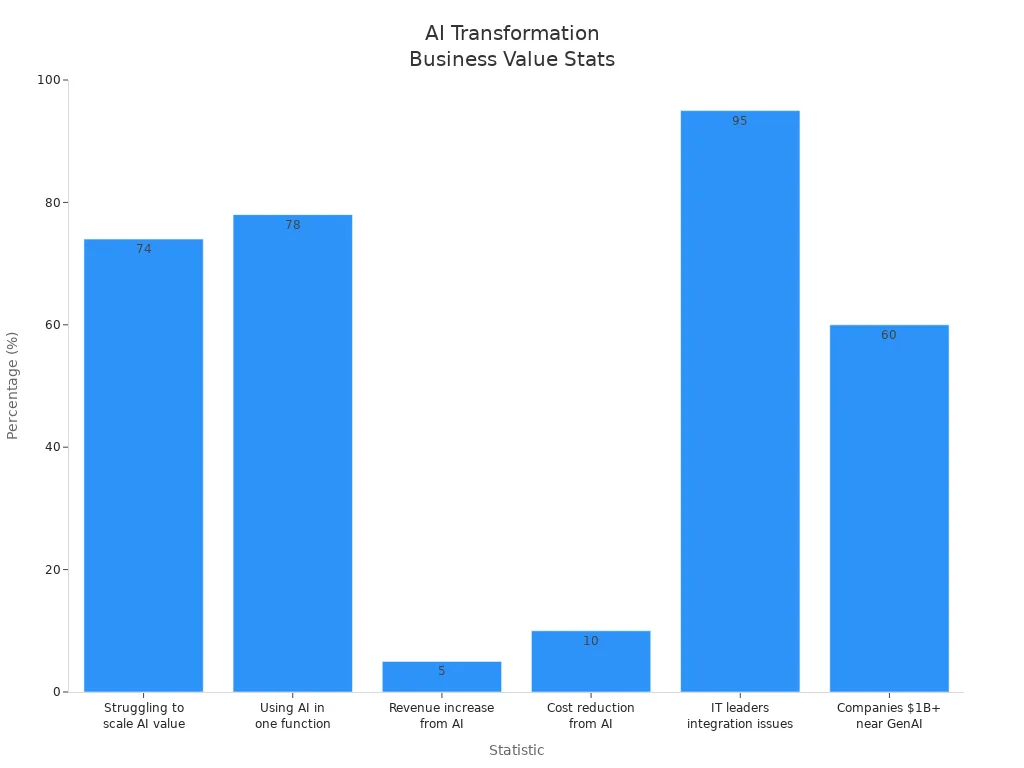
You can unlock the full value of digital transformation by following best practices for ai. Start by setting clear goals for every ai project. Connect these goals to your business strategy. Make sure you measure results with simple metrics. You should focus on both cost savings and new revenue. Many companies see a 5% increase in revenue and a 10% reduction in costs after using ai. Most organizations use ai in at least one business function. The table below shows how ai impacts business value:
| Statistic | Value | Source |
|---|---|---|
| Companies struggling to scale AI value | 74% | BCG's AI research |
| Organizations using AI in at least one function | 78% | McKinsey's State of AI report |
| Average revenue increase from AI | 5% | McKinsey's State of AI report |
| Average cost reduction from AI | 10% | McKinsey's State of AI report |
| IT leaders reporting integration issues | 95% | Salesforce's connectivity research |
| Companies with $1B+ revenue near GenAI solutions | 60% | McKinsey's GenAI timeline analysis |
| DataOps platform market growth | $4.22B to $17.17B by 2030 | Grand View Research projections |
You should build strong data foundations and train your teams. Use ai to improve customer support, automate tasks, and find new insights. Share early wins to build trust. Keep your digital transformation roadmap flexible so you can adapt to changes.
Avoiding Common Pitfalls
Many companies face challenges during digital transformation. You can avoid common mistakes by learning from others. Do not start ai projects without a clear business problem. Make sure you have enough data and the right skills. Most IT leaders say they have trouble with integration. You should involve both business and technical teams from the start.
Tip: Start small with pilot projects. Measure results and scale up only when you see value.
You should also avoid chasing every new ai trend. Focus on use cases that improve customer experience and business outcomes. Remember, 74% of companies struggle to scale ai value. Only 20% become ai ROI leaders. You can join the top group by staying focused and building strong foundations.
Continuous Optimization
You need to keep improving your digital transformation efforts. Use feedback from customers and employees to make ai systems better. Track metrics like customer satisfaction and churn. Ai-driven personalization and faster service can boost customer loyalty. For example, one software company saw a 40% drop in support tickets reaching human agents after using ai chatbots. This led to a 25% rise in customer satisfaction scores.
- Ai chatbots answer questions 24/7.
- Knowledge retrieval tools reduce wait times.
- Sentiment analysis helps you improve service across channels.
You should review your ai projects often. Update them as technology changes. This helps you stay ahead and deliver the best customer experience. Continuous optimization turns digital transformation into a long-term advantage.
Preparing For The Future Of AI

Emerging Trends In AI
You will see new trends shape the future of digital transformation. Generative ai will become more advanced. You will use it to create content, design products, and solve problems. Edge ai will process data closer to where you collect it. This will help you make faster decisions and keep your data safe. You will notice more companies use ai to improve automation and personalize customer experiences.
You should watch for ai that understands emotions and context. This will help you build better relationships with your customers. Responsible ai will also become important. You must make sure your ai systems are fair and safe. Many leaders now use digital transformation to connect ai with business goals. This helps you stay ahead in a changing market.
Tip: Stay curious about new ai tools. Test them in small projects before using them across your business.
Fostering Innovation Culture
You need a strong culture of innovation to succeed with digital transformation. Encourage your teams to try new ideas and learn from mistakes. Give them time and space to experiment with ai. Celebrate small wins and share lessons learned.
You can set up workshops and training sessions. These help your employees understand how ai supports digital transformation. Invite experts to share their knowledge. Create cross-functional teams to solve real business problems with ai.
Use a simple table to track your innovation efforts:
| Action | Owner | Status |
|---|---|---|
| AI Workshop | HR Team | Planned |
| Pilot Project | IT Team | Ongoing |
| Success Sharing | All Teams | Monthly |
You will build trust and excitement for digital transformation by making innovation part of your daily work. This prepares you for the future of ai.
You now have a clear roadmap for digital transformation with ai. Start by assessing your readiness, align ai with your business goals, and focus on high-impact use cases. Build strong data foundations and scale ai across your organization. Leadership and structured planning drive success. Measure outcomes at every step. Take action today to lead your industry with digital transformation and ai.
Begin your ai journey now. The future of digital transformation starts with you.
FAQ
What is an AI roadmap and why do you need one?
You need an ai roadmap to plan your steps for using artificial intelligence in your business. This plan helps you set clear goals, track progress, and measure results. It keeps your team focused and helps you avoid wasted time.
How does ai-powered digital transformation help your company?
Ai-powered digital transformation lets you use smart tools to improve your work. You can automate tasks, find patterns, and make better choices. This approach helps you grow faster and serve your customers better.
What are ai-powered features in business software?
Ai-powered features use artificial intelligence to add smart actions to your tools. For example, you can get quick answers from chatbots or see smart suggestions in your apps. These features make your work easier and faster.
How do data-driven operations improve business results?
Data-driven operations use facts and numbers to guide your actions. You can spot trends, fix problems, and make smart choices. This method helps you save money and work more efficiently.
Why should you use ai analytics?
You should use ai analytics to understand your data better. These tools find patterns and give you insights you might miss. With ai analytics, you can make decisions that help your business succeed.
See Also
Predicting Future Demand Using AI and Data Insights
Utilizing AI to Improve Production Forecasting Accuracy in 2024
Effective Ecommerce Strategies for 2025: A Practical Guide
Accelerating Market Entry: AI's Role in Shortening Lead Times
Sustainable Fashion Innovations: AI Solutions for Environmental Improvement