
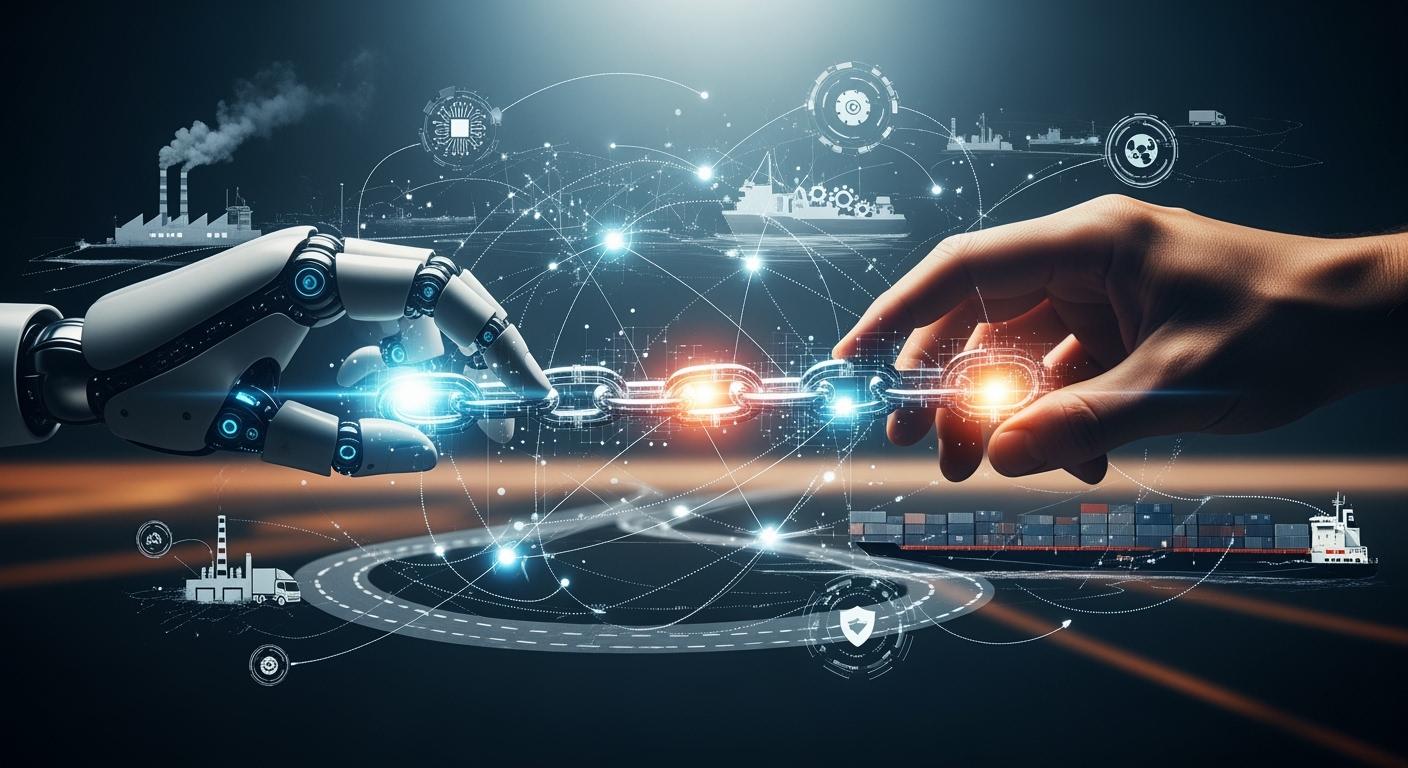
You see artificial intelligence making supply chain operations stronger and more reliable. AI in supply chain uses predictive, generative, and agentic capabilities to anticipate disruptions, manage risks, and improve decision-making. Many companies in competitive markets invest more in AI, which helps them build resilience.
- AI agents shift from reacting to problems to anticipating them before they happen.
- They help you identify and reduce risks.
- Continuous learning lets AI adapt and make better choices.
Firms that use AI in supply chain gain a clear advantage, especially when facing tough competition.
Supply Chain Management Challenges
Common Disruptions
You face many challenges when you manage a supply chain. Disruptions can happen at any time and often come without warning. These events can slow down your business, increase costs, and make it hard to meet customer needs. You need to understand what types of disruptions are most common so you can prepare for them.
Note: Even small disruptions can add up and cause big problems for your business over time.
Here is a table that shows the most frequent disruptions in supply chain operations:
| Disruption Type | Frequency of Occurrence |
|---|---|
| Parts shortages | High |
| Delivery disruptions | High |
| Infrastructural events | High |
| Unplanned IT outages | Consistently high |
| Adverse weather | Consistently high |
| Transport network disruption | Consistently high |
| Cyber-attacks | Increasing since 2014 |
| Natural disasters | Low probability, high impact |
| Unanticipated demand | Moderate impact |
| Rush orders | Moderate impact |
| Shortage in supply | Moderate impact |
| Delivery coordination | Moderate impact |
| Sourcing constraints | Moderate impact |
You see that disruptions like parts shortages, delivery problems, and IT outages happen often. Even rare events, such as natural disasters, can have a huge impact. Studies show that these disruptions can lead to a drop in profitability and lower sales growth. Recovery can take weeks or even months, and your business may feel the effects for years.
Traditional Methods Limitations
Traditional supply chain management methods often fall short when you try to handle these challenges. Many companies work in isolation, which means you have limited visibility into the whole supply chain. You may rely on extra inventory or multiple suppliers, but these steps do not always solve the problem.
- You may notice slow responses to market changes.
- Manual risk identification takes too much time.
- Forecasting based only on past sales can miss new trends.
- Lack of coordination between supply chain partners makes it hard to react quickly.
You need better tools and strategies to keep up with today’s fast-changing world. Modern disruptions require more than just old solutions. You must look for ways to improve speed, accuracy, and collaboration in your supply chain.
AI in Supply Chain Resilience

Predictive Analytics
You can use predictive analytics to make your supply chain stronger and more reliable. This technology helps you look at past data and real-time signals to spot patterns. You can then use these patterns to predict what might happen next. For example, you can forecast demand more accurately and avoid running out of stock. You can also manage your inventory better, which means you do not have to keep too much or too little on hand.
Here is a table that shows how predictive analytics can help you manage risks and improve your operations:
| Key Benefit | Description |
|---|---|
| Improved Demand Forecasting | Enhances accuracy by analyzing historical patterns and real-time signals, reducing forecasting errors by up to 50%. |
| Enhanced Inventory Management | Optimizes inventory levels, reducing holding costs by up to 30% and improving service levels through dynamic redistribution. |
| Proactive Risk Management | Identifies potential disruptions by monitoring external factors, allowing companies to mitigate risks effectively. |
| Cost Reduction & Operational Efficiency | Streamlines operations and reduces costs through optimized logistics and predictive maintenance strategies. |
| Sustainability & Waste Reduction | Optimizes resource use and minimizes waste by accurately predicting demand and improving logistics. |
Many companies have already seen the benefits of using predictive analytics in their supply chain. DHL uses AI to optimize workflows and predict order volumes. This has helped them deliver on time more often and lower their costs. Coca-Cola uses machine learning to forecast demand in different areas. This helps them avoid having too much or too little stock. BMW uses AI to check product quality and improve logistics in their factories. This keeps their products consistent and reduces mistakes.
Real-Time Decision-Making
You can make better decisions in your supply chain when you use AI for real-time insights. AI in supply chain lets you see what is happening right now, not just what happened in the past. You can spot problems as they come up and act quickly to fix them. This means you do not have to wait days or weeks to make changes.
The table below shows some of the main benefits you get from real-time decision-making:
| Benefit | Description |
|---|---|
| Reduced Operational Costs | AI helps in identifying inefficiencies and optimizing resource allocation. |
| Improved Forecast Accuracy | AI-driven demand forecasting achieves 85% accuracy compared to 60-70% with traditional methods. |
| Enhanced Customer Satisfaction | AI analyzes customer data to provide personalized and reliable service. |
| Increased Efficiency | Decision-making time is reduced from days or weeks to minutes. |
You can see these benefits in action at companies like Walmart and FedEx. Walmart uses AI to find the best routes for drivers in real time. This reduces the miles they drive and cuts down on CO2 emissions. FedEx uses AI to track vehicles and send alerts if there are delays. This gives you better visibility and helps you keep your supply chain running smoothly.
Tip: Use real-time data to react quickly to unexpected events and keep your supply chain on track.
Generative AI Use Cases
You can use generative AI to solve many supply chain challenges. This technology can help you forecast demand, manage inventory, and even talk to suppliers and customers. Generative AI can also suggest ways to improve your operations and make your supply chain more sustainable.
Here are some of the most impactful ways you can use generative AI in supply chain management:
- Demand forecasting: You can use generative AI models to predict how much product you will need.
- Inventory evaluation: You can get suggestions on how to optimize your inventory and reduce storage costs.
- Supplier and customer communication: You can automate messages to improve coordination during disruptions.
- Operations: You can receive ideas for making your processes more efficient and saving money.
- Logistics: You can find the best travel routes and spot possible delays before they happen.
- Sustainability and scalability: You can get insights on making your supply chain greener and more cost-effective.
- Analytics: You can run simulations and assess risks to support better decisions.
- Supplier sourcing: You can find and evaluate new suppliers quickly.
- Predictive maintenance: You can predict when equipment might fail and schedule maintenance to avoid downtime.
Many companies have already seen cost savings and better user experiences from generative AI. Walmart uses an AI chatbot to negotiate contracts, which has saved them money. Unilever uses AI to manage emails and analyze customer feedback, which has made their staff more efficient and improved customer satisfaction. Mercedes-Benz uses voice-based AI to optimize production and spot errors faster. General uses generative AI to personalize recommendations for customers, making the buying experience better.
Note: Generative AI can help you save money, work faster, and give your customers a better experience.
Implementing AI in Supply Chain Management
Strategy and Planning
You need a clear plan before you start using ai in supply chain. Begin by checking your current AI maturity with models like Gartner’s AI Maturity Model. Set your goals and make sure they match your supply chain management strategy. Many companies see success when they create a roadmap for AI projects. This helps you focus on the most important areas, such as demand forecasting and reducing first-mile inefficiencies. A strong plan also makes it easier to measure progress and adjust as you go.
Here are the main steps you should follow:
- Assess your AI maturity and readiness.
- Treat your data as a valuable asset.
- Set up hybrid governance with clear policies.
- Upskill your leaders and teams on AI basics.
- Build teams with different skills and create centers of excellence.
- Make ethical rules and track your results.
A well-defined strategy helps you avoid common mistakes and speeds up your AI journey.
Data Preparation
Good data is the foundation for ai in supply chain management. You must clean, organize, and check your data often. Many companies face problems with data silos and different formats. You can solve these by setting up strong data governance and using regular audits. AI data cleaning tools help keep your data reliable.
| Best Practice | Description |
|---|---|
| Data Governance Framework | Set rules to keep data safe and high quality. |
| Data Cleaning Processes | Use tools to remove errors and keep data accurate. |
| Regular Data Audits | Check your data often to make sure it is complete and correct. |
| Data Engineering Practices | Use good methods to keep data quality high. |
| Centralized Data Platforms | Store data in one place for easy access and management. |
Leading companies always build a solid data foundation before starting automation or AI projects.
Tool Selection
Choosing the right tools is key for ai in supply chain. Start by checking if your data is ready and your systems can support new technology. Pick AI solutions that fit your industry and have proven results. Begin with small pilot projects to test value, then scale up if they work well. Train your teams so they can use the new tools with confidence.
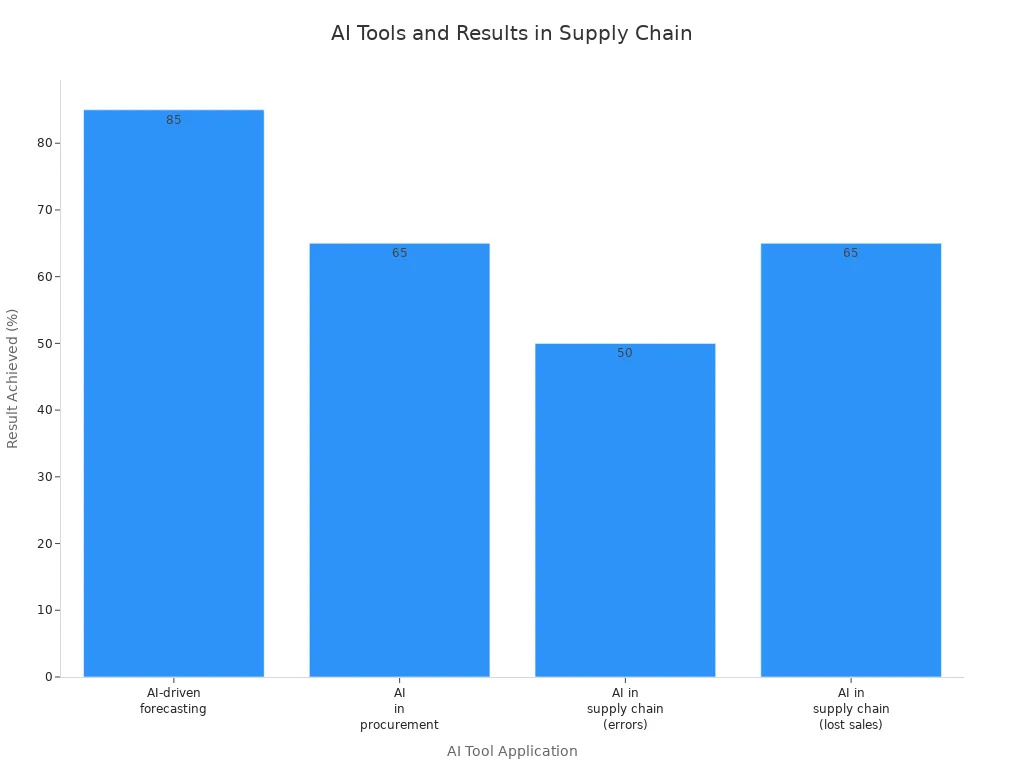
Many companies use AI-driven forecasting, which improves accuracy by 85%. Others use AI for procurement, cutting manual tasks by 65%. Early adopters report a 35% drop in inventory levels.
Talent and Change Management
You need the right people and culture for ai in supply chain to succeed. Get support from top leaders and involve employees early. Train your staff on AI tools and show them how AI can help, not replace, their work. Encourage teamwork across departments. Track progress and share results to build trust.
Open communication and ongoing training help everyone feel confident about using AI.
When you focus on people and process, you make your supply chain management stronger and more resilient.
Benefits and Challenges of AI in Supply Chain
Operational Efficiency
You can improve your supply chain by using AI to boost operational efficiency. AI gives you real-time visibility into your operations. This helps you make faster decisions and avoid delays. You can spot problems early and fix them before they grow. AI also helps you use your resources better. You can reduce waste and keep your supply chain running smoothly.
Here is a table that shows how AI improves efficiency and reduces costs:
| Improvement Type | Description | Impact on Costs |
|---|---|---|
| Decision Velocity | Real-time visibility speeds up decision-making. | Accelerated decision-making |
| Resource Optimization | AI finds inefficiencies in your operations. | Reduces costs by 15-25% |
| Market Responsiveness | You can react quickly to market changes. | Improved responsiveness |
AI tools can predict demand and track inventory in real time. This helps you keep the right amount of stock and avoid running out or having too much. You can also use AI to plan better routes for deliveries and manage suppliers more effectively.
Cost Savings
You can save money in many ways when you use AI in supply chain management. Early adopters have seen a 35% drop in inventory levels. This means you spend less on storage and lower the risk of products becoming outdated. AI-driven route planning can cut transportation costs by 22%. You can also see a 15% improvement in logistics costs and a 65% boost in service levels.
Here are some ways AI helps you save money:
- AI reduces costs in supply chain and inventory by up to 43%.
- Predictive models and smart routing can save a logistics provider between $220,000 and $500,000 each year.
- Automation of repetitive tasks lowers labor costs and increases efficiency.
- Accurate forecasting means you do not overstock, which cuts storage costs.
- Predictive maintenance prevents expensive breakdowns.
| Factor | Description |
|---|---|
| Automation | Automates tasks, reducing labor costs and boosting efficiency. |
| Improved Forecasting | Makes demand predictions more accurate, lowering storage costs. |
| Predictive Maintenance | Stops breakdowns before they happen, saving on repairs. |
| Optimized Logistics | Fine-tunes schedules and reduces downtime. |
Overcoming Adoption Barriers
You may face challenges when you start using AI in your supply chain. Common barriers include data quality, high costs, and system integration. You can solve data problems by running regular audits and using standard formats. Middleware helps connect new AI tools with your current systems. A cost-benefit analysis shows if your investment will pay off.
Here are steps you can take to overcome these barriers:
- Improve data quality with strong management practices.
- Use middleware and phased rollouts for smooth integration.
- Analyze costs and benefits before starting.
- Train your team and communicate openly to reduce resistance.
- Protect your data with encryption and regular security checks.
Tip: Start small and scale up as you see results. This approach helps you manage risks and build trust in AI.
You can make your supply chain management more resilient by addressing these challenges early.
You can make your supply chain stronger with AI automation. Start by auditing your current processes and focus on areas like demand forecasting and logistics. The table below shows practical steps you can follow:
| Practical Steps for Implementing AI in Supply Chain Management |
|---|
| Audit current processes: Identify inefficiencies, bottlenecks, or repetitive tasks. |
| Assess which areas could benefit most from AI solutions: Focus on high-impact areas like demand forecasting, inventory management, and logistics optimization. |
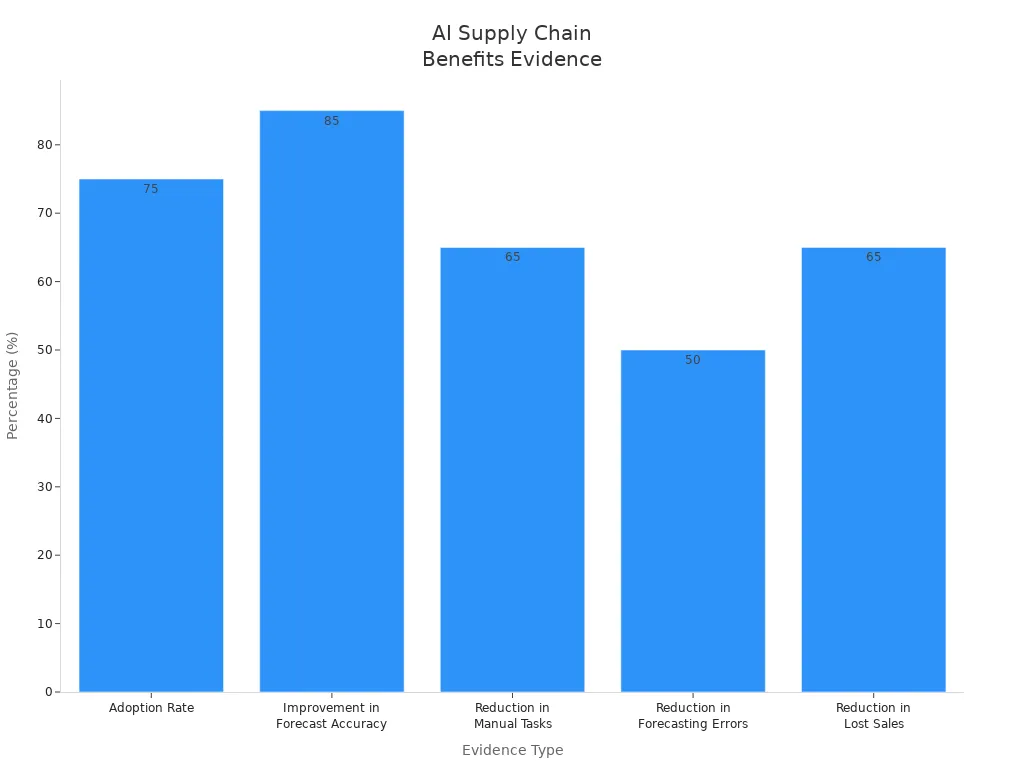
AI helps you cut manual tasks, improve forecast accuracy, and reduce lost sales. Many companies see better inventory levels and lower costs. The chart below shows how AI brings long-term benefits:
Explore how AI can help your supply chain stay resilient and ready for the future.
FAQ
What is AI supply chain automation?
You use AI supply chain automation to let machines handle tasks like forecasting, inventory checks, and route planning. This technology helps you make faster decisions and reduce errors.
How does AI help you manage supply chain risks?
AI spots risks early by analyzing data from many sources. You get alerts about possible delays, shortages, or disruptions.
Tip: Use these alerts to act before problems grow.
Is AI expensive to implement in supply chains?
You may see high upfront costs, but AI often saves money over time. Start with small projects.
- Test results
- Scale up if you see value
This approach lowers risk and cost.
Can AI replace human workers in supply chain management?
AI supports your team by handling repetitive tasks. You still need people for strategy and problem-solving.
AI works best when you combine it with human skills. 🤝
See Also
Essential Importance of Supply Chain Coordination for Resilience
The Impact of Supply Chain Outsourcing on Business Flexibility
Efficient Logistics Enable Quick and Sustainable Supply Chain Success
Gaining Competitive Edge Through Supply Chain Outsourcing Solutions
Driving Expansion Through Effective Supply Chain Management Outsourcing