
An ai-native erp is not erp software with a chatbot attached. Buyers often confuse ai-native with ai-powered or ai-enabled systems. The difference matters. Think of a purpose-built electric vehicle versus a gas car with an aftermarket navigation system. One design centers on intelligence from the start. The other adds features later.
This guide serves three goals. First, it clarifies what makes an erp truly built around ai. Second, it explains where these systems fit. Third, it offers actionable shortlisting criteria. Buyers who understand these distinctions make better decisions.
What Makes an ERP AI-Native? The Core Distinction
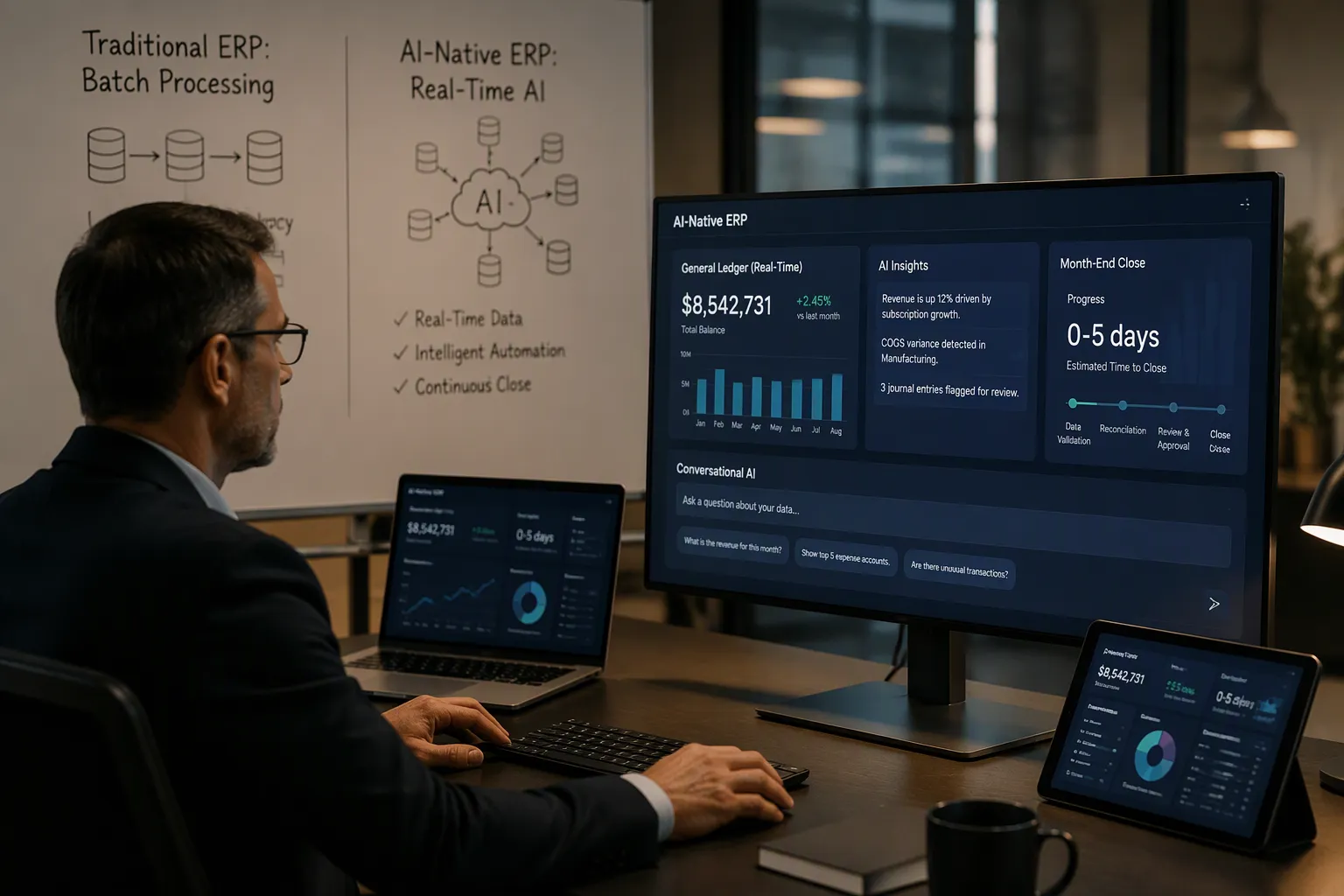
Built for AI from Day One
The core distinction between an ai-powered erp or an ai-native erp comes down to architecture. AI-native erps were built with machine learning models at their foundation. These systems process transactions and map data from day one. The AI acts on live general ledger data rather than waiting for batch updates.
AI-native systems were built with machine learning at the core, so the AI acts on live data. That's an architectural difference that retrofitted systems cannot replicate without starting over.
This represents a fundamental architectural question for buyers. Traditional erp systems process data in batches at period end. AI-native erp systems operate in real time continuously. The month-end close reflects this gap. Traditional systems require a manual sprint lasting 10-14 days. AI-native erps maintain always-current books and close in 0-5 days.
| Feature | Traditional ERP | AI-Native ERP |
|---|---|---|
| Data Processing | Batch-based at period end | Real-time continuous |
| Month-End Close | Manual sprint 10-14 days | Always-current books, close 0-5 days |
| AI Foundation | Bolted on top of batch layer | Acts on live GL data |
| User Experience | Menu navigation, manual reports | Conversational queries, automated workflows |
| Implementation | 6-18 months, $150-400k | 4-8 weeks, ~$20k |
The structural differences extend to configuration. AI-native systems are configurable, not customizable. They prioritize data quality and often sit alongside legacy systems via API. This approach differs from ai-powered erp systems that add AI features on top of existing transaction layers.
AI Agents vs. Bolted-On Copilots
What makes an erp truly intelligent goes beyond adding a chatbot. The difference between ai-native vs. ai-powered erp systems becomes clear when examining how agents operate.
An add-on gives them a copilot without touching the core, but the copilot inherits years of inconsistent records. A native platform asks them to move onto one foundation, which is more disruptive up front and cleaner afterward.
Copilots assist humans with recommendations and drafts. They rely on human initiation through prompts. AI agents operate from defined goals without prompting. They plan and execute multi-step workflows automatically across multiple systems.
| Dimension | Copilots in ERP | AI Agents in ERP |
|---|---|---|
| Trigger | Rely on human initiation | Operate from a defined goal |
| Execution scope | Assist with recommendations only | Plan and execute multi-step workflows |
| Autonomy | Rarely execute complex workflows | Carry out tasks across systems autonomously |
| Net effect | Make ERP smarter | Make ERP autonomous |
True efficiency is structural, not conversational. Genuinely agentic systems do not execute writes directly to production tables. They compile unstructured data into structured, isolated staging states. This preserves transactional integrity while enabling adaptive, conversational, and intent-driven workflows.
Modern erp architectures must support this agentic approach. The real AI opportunity involves smarter orchestration across the enterprise. Value is created in the handoffs between systems. An enterprise can deploy capable AI agents across CRM, erp, and service management and still leave order-to-cash partly manual. The limitation becomes visible at the handoffs where no single platform owns the process.
Vendors building ai-native erp systems from the ground up include Campfire, Rillet, and DualEntry. AI-enhanced incumbents like NetSuite, Sage Intacct, and Intuit Enterprise Suite add AI to legacy architectures. Ship Angel represents another ai-native example, purpose-built for supply chain management.
The underlying architectures reveal why this matters. In AI-native erps, the machine learning model was trained on the database schema from the beginning. It understands transactions at a structural level. In traditional erp systems, AI is added as a copilot feature on top of existing workflows. This distinction shapes everything about how ai in erp delivers value.
Where AI-Native ERP Fits: Market and Scale
Ideal Candidates and Use Cases
An ai-native erp serves complex companies operating across multiple entities and geographies. These organizations need consolidated, real-time data. The mid-market and enterprise segments represent the most attractive targets for ai-native erp systems. A representative example is an AI-native ERP targeting the mid-market with advanced integration automation and significantly reduced implementation timelines.
According to a recent survey, a significant share of large organizations reported scaling AI agents, with a notable increase over the previous year.
AI-native ERPs are typically best suited for SaaS, tech, and venture-backed firms, while AI-enhanced incumbents like NetSuite and Sage Intacct cover broader profiles.
Legacy ERP systems like NetSuite offer broad industry coverage. In contrast, ai-native solutions have narrow coverage. Most vendors focus on SaaS, tech, and venture-backed firms. A few vertical specialists exist. This narrow focus means buyers must assess whether their industry fits the vendor's target market.
When AI-Native Is Not the Right Fit
An ai-powered erp or ai-enabled system may serve certain organizations better. AI-native platforms are explicitly not ideal for large enterprises with deeply customized erp environments, complex manufacturing workflows, or organizations requiring on-premise deployment. These scenarios demand the breadth of a full-suite erp system.
AI accuracy degrades when master data is inconsistent across entities. This reveals a strong data quality dependency in highly customized legacy landscapes. Retrofitted AI modules often degrade as data volume and entity count scale because they are not built on a unified real-time data layer. If AI cannot write back to the core general ledger and instead outputs to a separate reporting layer, it requires manual export and import steps. This defeats automation in customized close workflows.
Organizations with significant operations, supply chain complexity, or manufacturing needs should consider a full-suite erp with AI capabilities. The breadth of modules justifies the overhead. Finance-focused ai-native erps typically lack supply chain optimization layers such as predictive maintenance, demand forecasting, inventory management, and logistics. This tradeoff is reasonable if primary pain points are in financial consolidation, close cycles, and reporting. However, companies needing end-to-end operations coverage may find these architectures insufficient.
Implementing an AI-Native ERP: Data, Time, and Risk
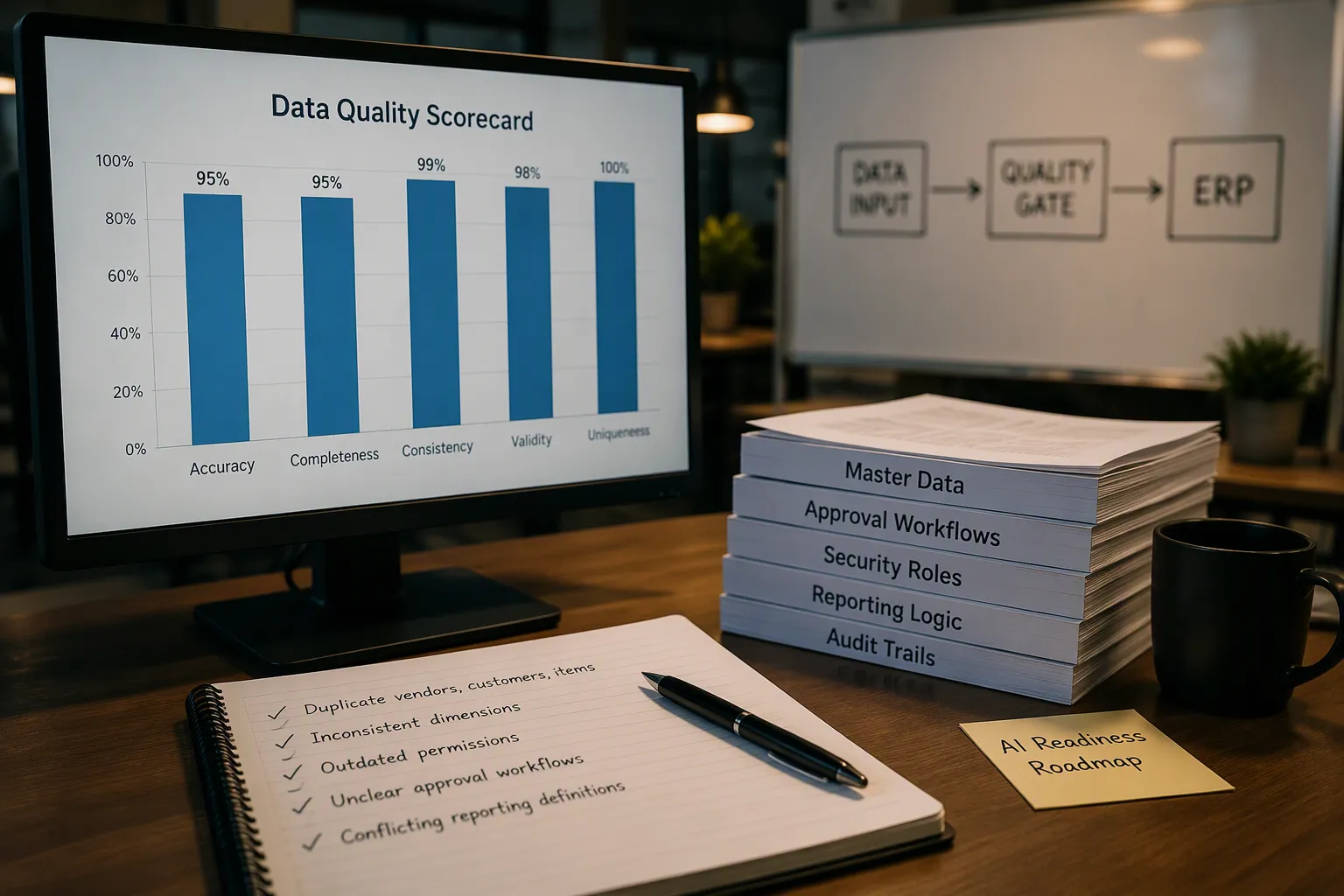
Data Cleanup as a Prerequisite
Machine learning models depend on clean, complete data. Dirty data fed into an ai-native erp produces unreliable predictions regardless of how sophisticated the model is. Clean data is therefore not a nice-to-have for ai initiatives but a prerequisite. Quality gates that validate data before it reaches downstream consumers prevent data quality challenges from undermining analytics investments.
Before adopting advanced erp automation, businesses should confirm that master data, approval workflows, security roles, reporting logic, and audit trails are ready to support it. These findings shape the first phase of an ai-enabled readiness roadmap because they determine whether automation can be trusted and scaled safely.
| AI Readiness Issue | Why It Matters |
|---|---|
| Duplicate vendors, customers, or items | AI may summarize or act on bad master data |
| Inconsistent dimensions, classes, departments, or segments | Reporting and forecasting outputs become unreliable |
| Outdated permissions | AI may surface data users should not access |
| Unclear approval workflows | Automation can accelerate bad processes |
| Conflicting reporting definitions | AI may produce different answers depending on the source |
Data quality has several measurable dimensions. Accuracy means data correctly represents the actual entity. Completeness targets a high percentage for required fields. Consistency expects related values to align across tables and systems at a high percentage. Validity requires values to conform to expected formats at a high percentage. Uniqueness demands no duplicates for primary keys.
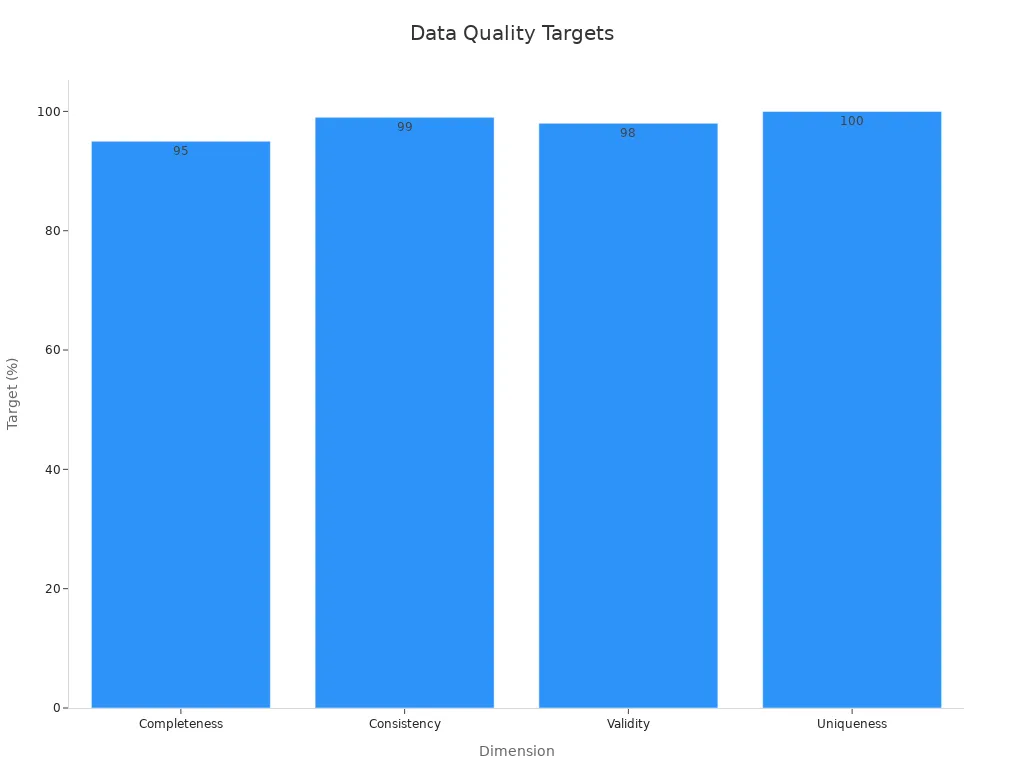
Companies frequently skip the foundational work of process documentation, data cleanup, and governance. An ai-powered system acts as a magnifier: clean data and good processes yield great insights, while dirty data and broken processes expose problems everywhere. If processes are not clean enough to hand off to someone in another country, the organization is not ready for AI automation.
Phased Rollout and Realistic Timelines
An erp implementation follows a phased migration rather than a big bang approach. This sequence lets each module be validated for data quality and user adoption before the next domain begins.
configured by ai and live in about 8 weeks
The first phase covers the initial period. Teams build core infrastructure including the event bus, database, and API gateway. Inventory and procurement modules migrate first. This low-stakes phase validates the architecture and builds team confidence before touching financial data.
The next phase adds HR records and extends procurement automation with supplier intelligence. Teams tune the demand forecasting agent on historical sales during this stage. Parallel running of financial data begins for side-by-side reporting. This practice helps ai-native erps validate their outputs against the legacy system before full cutover.
The final phase cuts over finance modules including accounts payable, accounts receivable, general ledger, and close. The AI orchestration layer activates for cross-module workflows. Teams decommission the legacy erp or reduce it to read-only status. Full ai-native operation begins with continuous reconciliation and autonomous purchasing within policy limits.
A phased migration adds cost through parallel systems but provides a safety net. Organizations that skip the foundation work or rush the timeline risk unreliable AI outputs and broken processes. The key is to validate each phase thoroughly before moving to the next.
Shortlisting an AI-Powered ERP: Key Criteria
AI Capability Maturity and Safety
Buyers need a disciplined framework for separating useful capability from vague promise. A maturity model helps assess AI capability levels, from ad hoc use to fully adaptive enterprise.
Vendor evaluation criteria should probe what happens when the AI is wrong. A genuinely ai-native erp shows its source data, confidence level, and a reversible audit trail back to the original transaction. Buyers should ask whether the vendor uses a proprietary model trained on accounting data or a general-purpose language model. That answer predicts accuracy and hallucination risk.
Governance and safety features to demand include AI inventory management, automated risk assessment, real-time monitoring, regulatory compliance mapping, audit trails, human oversight mechanisms, explainability, and workflow automation. These controls protect transactional integrity as processes scale.
Evaluation should also test real-time versus batch intelligence. Daily-only updates mean recent orders or missed payments will not appear until the next day. Buyers should ask what the system does with an unfamiliar invoice layout. If it adapts and explains its output, that is genuine intelligence. If it errors out, it is a fixed rule with an AI label.
"Play with it. … Get in there, try it, play with it, do your day-to-day in that environment, feel it out, ask those questions you maybe have wanted to ask your ERP through AI."
Financial Closing Speed and Vendor Roadmap
Closing speed separates real capability from marketing. A vendor who has done this at scale can give a day-by-day breakdown of the first close cycle: what remains manual, what is automated, where friction sits, and what the team's involvement looks like week by week. A vendor selling a vision gives a high-level roadmap that commits to everything by month six and nothing before it.
Buyers should require production evidence in RFP responses. AI capability answers must include customer name with permission, automation rates, deployment timeline, and governance framework description. Responses without production evidence should receive reduced scores.
The roadmap question matters for what makes an erp truly built around intelligence. AI-native means the system was designed around AI doing the work: a real-time ledger, native sub-ledgers so agents can reach the whole workflow, and controls built for attributable agent actions. Buyers must weigh governance, scalability, transactional integrity, implementation complexity, and long-term maintainability together.
A live demonstration is the only acceptable proof. Buyers need a complete evidence chain, timestamped, attributed, and fully reconstructable, from the AI decision through human review to the ledger. A confidence claim is not enough. This hands-on approach to ai-native erp selection reveals whether ai in erp delivers real value or just a polished interface.
Choosing an ai-native erp is a strategic shift, not a software upgrade. The architecture, data-first design, and agentic workflows separate these systems from an ai-powered erp with added features. Adopting an ai-native erp can accelerate payback compared to a traditional cloud erp.
Buyers should build a shortlist using the criteria above. Demand a live demonstration of ai-driven processes, not slides. Ask what makes an erp ready for agents that book invoices end-to-end.
Start with a data readiness assessment, then schedule vendor presentations now.
An ai-enabled or ai-powered erp software may fit some organizations better. The right choice depends on data quality and process maturity.
FAQ
What separates an AI-native ERP from an AI-powered system?
Architecture makes the difference. AI-native systems embed AI models at the core, processing live data. AI-powered systems add features on top of legacy ERP transaction layers. This architectural distinction affects real-time capability and close speed.
How does data quality affect AI-native ERP performance?
Clean data is essential. AI models need accurate ERP data. Companies must achieve high completeness and consistency before deploying automation. Dirty inputs produce unreliable outputs regardless of model sophistication.
How long does an AI-native ERP implementation typically take?
Core ERP setup can go live in about eight weeks. Full AI-powered migration with all modules and legacy decommissioning spans several months. A phased approach validates each module before moving to the next domain.
Is an AI-native ERP suitable for manufacturing companies?
Not typically. Most AI-native ERPs focus on finance and consolidation. They lack supply chain AI optimization layers like demand forecasting and inventory management. Manufacturing firms may need a full-suite ERP with AI capabilities.
What safety measures protect against AI errors in ERP?
Genuine AI-native ERP systems provide audit trails, explainability, and human oversight. They show source data and AI confidence levels. Buyers should demand reversible actions and a clear path back to original transactions.
See Also
Key Features That Set WarpDriven Supply Chain ERP Apart For Smart Enterprise
Using Artificial Intelligence To Boost Production Forecast Precision In 2024
How Brands Can Use Artificial Intelligence For Strategic Capacity Planning
Intelligent Safety Stock AI Solution For Fashion Retail By 2025
Innovative Fashion AI Technologies That Promote Environmental Sustainability