

You need to focus on flexibility, scalability, security, and solutions when choosing an ai platform. Enterprise ai adoption is growing fast. Generative ai will add huge value, boosting revenue growth and competitive advantage. The overview of enterprise ai platforms shows more enterprises use ai platforms every year. You should use a structured enterprise ai platform approach. The table below shows how enterprise ai solutions will become more common in the next few years.
| Year | Statistic |
|---|---|
| 2026 | 40% of enterprise applications will feature task-specific AI agents, up from less than 5% in 2025. |
| 2027 | One-third of enterprise AI implementations will combine autonomous agents with different skills. |
What Is an Enterprise AI Platform?
Enterprise ai platforms give you the tools to build, deploy, and manage ai solutions at scale. These platforms stand apart from other ai solutions because they focus on the needs of large organizations. You get features that support security, compliance, and integration with business systems. The table below shows how enterprise ai platforms differ from other ai solutions:
| Characteristic | Enterprise AI | Other AI Solutions |
|---|---|---|
| Contextual Awareness | Understands roles and access levels within an organization | Focuses on processing data without nuanced understanding |
| Architectural Integrity | Designed to work securely within an enterprise ecosystem | May not prioritize security in the same way |
| Security and Compliance | Requires rigorous validation and safeguards against risks | Prioritizes ease of use and seamless adoption |
Core Capabilities of AI Platforms
You need enterprise ai platforms that offer a wide range of core capabilities. These platforms let you develop, test, and deploy ai models in a centralized way. You can use multiple frameworks and handle both structured and unstructured data. Enterprise ai platforms manage the ai lifecycle, monitor performance, and enforce governance. The table below highlights the main capabilities:
| Core Capability | Description |
|---|---|
| Centralized development | Unified development, testing, and deployment of AI models |
| Support for multiple frameworks | Use various frameworks, models, and AI workloads |
| Data pipelines | Handle structured and unstructured enterprise data |
| AI lifecycle management | Manage versioning and rollback of AI models |
| Performance monitoring | Ensure observability and optimization of AI systems |
| Governance | Enforce policies and auditability for compliance |
| Predictive analytics | Provide insights for proactive business operations |
| Robotic process automation | Streamline repetitive tasks to enhance efficiency |
| Advanced analytics | Identify patterns and analyze data from raw sources |
- Enterprise ai platforms support full life-cycle algorithm development.
- You can use your preferred programming languages, such as Python, R, Scala, or Java.
- These platforms enable deployment of machine learning algorithms without translation errors.
- APIs allow you to trigger predictions and re-training.
Why Enterprise AI Platforms Matter
Enterprise ai platforms help you improve operational efficiency and make better decisions. You gain real-time access to accurate insights across your organization. This speed lets you respond quickly in a fast-paced environment. Enterprise ai platforms automate repetitive tasks, so your employees focus on high-value work. You can optimize resource allocation and reduce manual effort. These platforms also drive digital transformation, helping your enterprise stay competitive. Ai platforms enable data-driven decisions, which improve customer satisfaction and streamline operations. Legal firms, for example, use ai platforms to review thousands of contracts quickly, showing clear efficiency gains. You benefit from solutions that maximize value and support your business goals.
Key Factors for Choosing AI Platforms

Choosing the right ai platform for your enterprise means looking at many factors. You want to make sure the platform delivers business value, supports your strategy, and helps you reach your goals. The following sections break down the most important factors to consider.
Flexibility and Scalability
You need enterprise ai automation platforms that can grow with your business. Flexibility lets you adjust to new use cases and changing needs. Scalability means you can handle more users, more data, and more complex ai agent orchestration without starting over.
A flexible ai automation platform adapts to new business goals. A scalable solution processes both small and large data volumes. You can expand users or complexity without major redesign.
| Feature | Description |
|---|---|
| Flexibility | Adapts to new objectives and changing business needs |
| Scalability | Handles growth in users, data, and complexity without major changes |
When you choose enterprise ai automation platforms with these features, you set your business up for long-term value and success.
Integration with Business Systems
You want your ai automation platform to connect smoothly with your current systems. Many enterprises face challenges when linking ai platforms to legacy systems. These older systems often lack modern APIs and create data silos. This can slow down deployment and increase costs.
| Impact Area | Business Risk |
|---|---|
| Data Silos Persist | AI models fail due to incomplete or inconsistent data |
| High Implementation Costs | Long engineering cycles inflate budgets |
| Security Vulnerabilities | Weak integration points increase cyber risks |
| Workflow Breakdowns | AI outputs cannot trigger downstream systems reliably |
| Slow Time-to-Value | AI initiatives take months or years to deliver value |
You should look for ai automation platform solutions that offer strong integration tools. This helps you unlock data, reduce workflow disruptions, and speed up time-to-value.
Security and Compliance
Security and compliance are critical for enterprise ai. You must protect sensitive data and follow industry rules. Enterprise ai automation platforms should offer end-to-end encryption, multi-factor authentication, and single sign-on. Data loss prevention and compliance certifications like SOC 2, GDPR, HIPAA, and ISO 27001 are also important.
| Requirement Type | Description |
|---|---|
| End-to-end encryption | Data stays safe in transit and at rest |
| Multi-factor authentication | Extra security for admin access |
| Single Sign-On | Easy and secure user management |
| Data Loss Prevention | Controls to stop unauthorized data sharing |
| Compliance certifications | Proof that the platform meets industry standards |
You gain trust and reduce risk when your ai automation platform meets these requirements.
Usability and User Experience
You want enterprise ai automation platforms that are easy to use. Good usability helps your team adopt new solutions faster. A clear interface shows what the ai agent orchestration is doing. Natural language explanations help users understand results. You should have control to override or pause automation when needed.
| Usability Heuristic | AI Shift Example |
|---|---|
| Visibility of System Status | Live updates like "Searching..." or "Reading..." |
| Match Between System and Real World | Plain language explanations for anomalies |
| User Control and Freedom | Ability to unlink or pause incorrect matches |
- Good user experience builds trust and confidence.
- Meeting user needs increases productivity.
- Usability testing and feedback lead to better solutions.
Vendor Support and Ecosystem
You need strong vendor support for successful deployment. Some vendors offer hands-on help, while others provide only documents. You should choose ai automation platform solutions with audit trails, data lineage tracking, and compliance certifications. Easy integration with your existing tools is also key.
- Security and compliance features must be present.
- Integration capabilities should match your business systems.
- Implementation support speeds up deployment and increases value.
Cost and ROI
You want to see clear business value from your ai automation platform. Look at labor cost reduction, process acceleration, error reduction, customer satisfaction, and revenue enhancement. Many enterprises report efficiency gains of 30-50% and faster processing by 40-60%. Error rates can drop by up to 90%. Customer satisfaction scores and revenue can also rise.
| Benefit Category | Typical Metrics | Average Impact |
|---|---|---|
| Labor Cost Reduction | FTE hours saved, automation rate | 30-50% efficiency gain |
| Process Acceleration | Cycle time, throughput | 40-60% faster |
| Error Reduction | Accuracy, rework | 70-90% fewer errors |
| Customer Satisfaction | NPS, resolution time | 15-25 point increase |
| Revenue Enhancement | Upsell, retention | 10-20% uplift |
Many large enterprises see ROI over 100% from agentic ai implementations. U.S. companies average 192% returns.
Pre-Built Solutions and Adaptability
Pre-built solutions help you get results faster. You can deploy enterprise ai automation platforms in 4-6 weeks with pre-built options. Custom solutions may take 6-9 months. Fast deployment gives you a competitive edge and lets you adapt quickly to new use cases.
Pre-built solutions speed up time-to-value and reduce risk. You can focus on business value instead of long development cycles.
Alignment with Strategic Goals
You should align your ai automation platform with your business strategy. Start by mapping use cases to your goals. Build an AI roadmap that fits your digital transformation plan. Define success metrics that measure more than cost savings, such as customer satisfaction and process efficiency.
- Map use cases to business goals for maximum value.
- Create a phased roadmap for ai agent orchestration and deployment.
- Set metrics that track business value, not just cost.
When you match your ai automation platform to your strategy, you unlock the full value of enterprise ai.
Choosing the right enterprise ai automation platforms means looking at flexibility, scalability, integration, security, usability, vendor support, cost, pre-built solutions, and alignment with your goals. These factors help you meet diverse business needs and deliver lasting value.
AI Platform Comparison Framework
Choosing the right enterprise ai automation platforms requires a practical framework. You need to compare ai platforms based on strengths and weaknesses. This helps you make informed decisions and maximize business value.
Building a Feature Checklist
Start by creating a checklist that covers the most important features. You want solutions that deliver value and support your strategy. Your checklist should include technical capabilities, integration, deployment, user experience, and accessibility. Here is an ordered list to guide you:
-
- Natural language processing
- Machine learning infrastructure
- Predictive analytics
- Automation orchestration
- Multi-modal processing
-
Integration and Deployment Features
- API accessibility
- Pre-built connectors
- Data pipeline management
- Cloud-native architecture
- Security compliance
- Single sign-on
- Deployment flexibility
-
User Experience and Accessibility
- No-code interfaces
- Transparent decision-making
- Performance dashboards
- Training and support
You can use this checklist to evaluate enterprise ai automation platforms for ai powered workflows and ai agent orchestration. This ensures you select solutions that fit your enterprise needs.
Scoring and Weighting Criteria
Assign scores and weights to each feature. This helps you compare ai platforms objectively. Use a table to organize your criteria:
| Criteria | Weight (%) | Description |
|---|---|---|
| Prompt Accuracy | 30 | Quality of model responses |
| Latency | 20 | Speed for real-time applications |
| Model Openness | 15 | Transparency and licensing |
| Multi-language Support | 15 | Support for multiple languages |
| Documentation Quality | 10 | Clear guides and API references |
| Community Size | 10 | Developer support and collaboration |
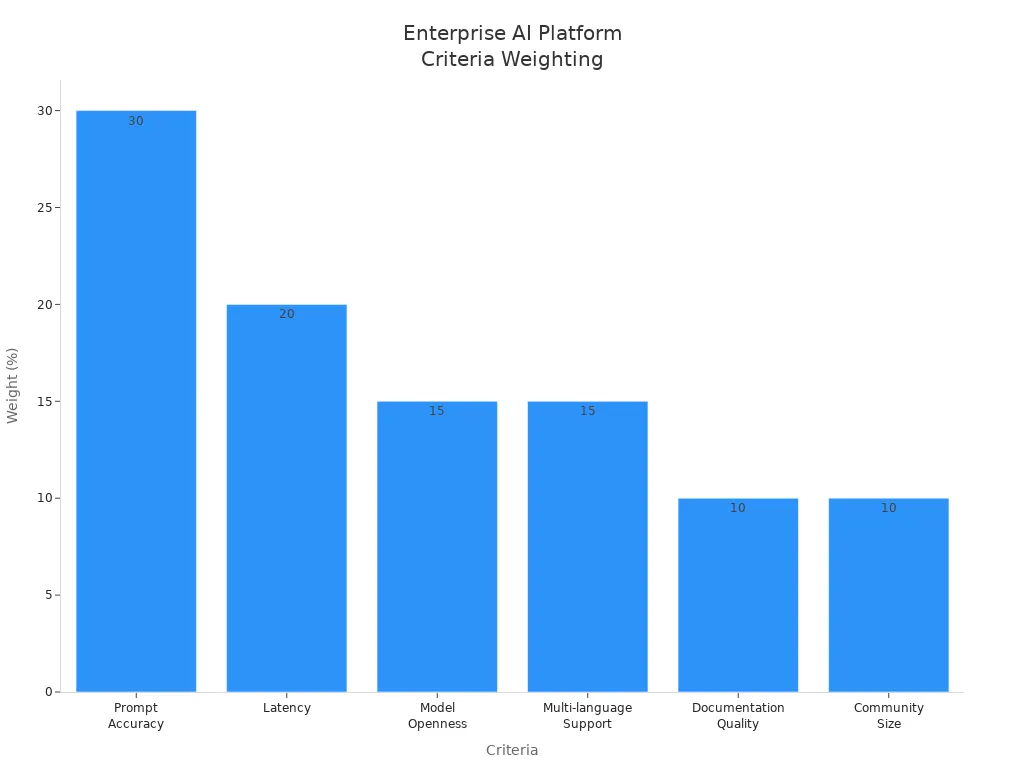
You can adjust these weights based on your enterprise strategy and use cases. This scoring system helps you focus on business value and ai capabilities.
Running Pilots and Demos
Run pilots and demos to test ai automation platform solutions in real-world scenarios. You want to validate business value and see how ai agent orchestration works. Follow these steps:
- Identify and prioritize use cases
- Run focused pilots with measurable KPIs
- Assess data management and governance
- Design production paths and workflow changes
- Prepare for scaling and continuous optimization
Embed subject-matter experts in your teams. Automate repeatable tasks. Monitor performance and retrain models as needed. Pilots help you see the value of enterprise ai automation platforms before full deployment.
Tip: Tie each pilot to an executive sponsor to ensure alignment with enterprise goals and strategy.
You gain confidence in your ai platform choice by following this framework. You unlock solutions that deliver lasting value for your enterprise.
Matching AI Automation Platform Features to Needs
Identifying High-Impact Use Cases
You want to get the most business value from enterprise ai automation platforms. Start by finding high-impact use cases that matter to your enterprise. Focus on the areas where automation will make a real difference. Here is a step-by-step approach:
- Prioritize use cases based on business value and technical feasibility.
- Align each project with goals like revenue growth, cost reduction, or risk control.
- Pick two or three high-impact use cases with clear, measurable outcomes.
- Map your current workflows to spot automation opportunities.
- Define success metrics before you begin.
- Set clear deployment criteria from the start.
For example, JPMorgan used an ai automation platform to reduce contract analysis time by 85%. They focused on legal workflows that delivered the most value.
Mapping Features to Business Objectives
You need to connect ai platform features to your enterprise goals. This helps you see how enterprise ai automation platforms deliver value. Use the table below to guide your planning:
| Method | Description |
|---|---|
| Start Small with Pilot Projects | Test solutions on a small scale to lower risk and build a base for larger deployment. |
| Focus on ROI | Show how ai platforms help reach financial and operational goals to gain support. |
| Prioritize Employee Training | Train your team to use ai automation platform tools for their roles. |
| Utilize External Expertise | Work with consultants or vendors to use their experience for better deployment. |
| Monitor and Optimize | Check and improve solutions often to keep getting value. |
You can use these methods to make sure your ai automation platform supports your business value goals.
Stakeholder Involvement
You need strong teamwork to get the most from enterprise ai automation platforms. Bring together leaders from IT, operations, finance, and business units. This helps you match solutions to the needs of your whole enterprise. Set up a governance framework to define roles and decision rights. Keep everyone informed with regular updates. This approach builds trust and supports successful deployment. When you involve all stakeholders, you increase the value of your ai automation platform and make sure your solutions deliver lasting business value.
Trends and Future-Proofing Enterprise AI Automation Platforms

Market Growth and Innovation
You see rapid change in the enterprise AI space. New trends shape how you use automation platforms. Many enterprises now use AI agents that handle complex tasks on their own. Trust and security matter more than ever. You find platforms built for different needs, such as ecosystem-centric, purpose-built, developer-focused, and horizontal solutions. Each type fits a unique user profile. You want to scale your operations while keeping control and strong governance. Trust in AI agents helps drive adoption across your organization.
- Enterprises adopt AI across many operations.
- AI changes job roles by helping people work smarter, not by replacing them.
- Ethical governance and transparency build trust and leadership.
- AI sparks new ideas in research, product development, and personalization.
- Generative AI, multimodal models, and advanced agents push the market forward.
- Scalable and flexible infrastructure, with unified data and strong governance, is key for success.
Iterative Adoption and Experimental Mindset
You need to approach AI adoption as a journey. Create safe spaces for your teams to experiment and learn. You may need to refine your solutions over time. Manage resistance early with formal programs. This helps you spot and fix problems before they slow you down. When you invest in cultural readiness, you can shorten your AI rollout by about 30%. Keep a steady flow of experiments and measure value clearly. Enterprises must balance exploration with control. Use controlled environments to test ideas, then move only proven systems into production. This approach ensures you get lasting value from your AI investments.
Evaluating Vendor Roadmaps
You want to choose vendors who support your future needs. Use the table below to guide your evaluation:
| Criteria | Description |
|---|---|
| Use case alignment | Supports your business problems and shows success in similar industries. |
| Integration and data connectivity | Connects to your data sources with APIs, connectors, and plugins for smooth output. |
| Security and compliance | Offers SSO, data encryption, and certifications for regulated industries. |
| Flexibility and openness | Lets you use multiple AI models and easily extract trained models and data. |
| Scalability and sustainability | Grows with your data and users, with pricing that fits enterprise-wide rollout. |
Tip: Review vendor roadmaps often. Make sure they match your enterprise goals and can adapt as your needs change.
When you select an ai platform, focus on architecture, cost, integration, and scalability. Make sure your choice fits your enterprise goals and can grow with your needs. Use the checklist and comparison framework to guide your decision. Bring together a cross-functional enterprise team and set clear evaluation steps. Schedule vendor demos to see real-world performance. This approach helps your enterprise gain value, improve workflows, and stay ready for the future.
FAQ
What is the main benefit of using an enterprise AI platform?
You gain faster decision-making and improved efficiency. AI platforms automate tasks and provide real-time insights. Your team can focus on important work instead of manual processes.
How do you ensure security in an AI platform?
You should choose platforms with end-to-end encryption, multi-factor authentication, and compliance certifications. These features protect your data and help you meet industry standards.
Can you integrate AI platforms with existing business systems?
Yes, most enterprise AI platforms offer APIs and pre-built connectors. You can link your AI platform to your current systems and unlock data for better workflows.
How do you measure ROI for an AI platform?
Track labor cost reduction, process acceleration, error reduction, and customer satisfaction. Use clear metrics like cycle time, accuracy, and revenue uplift to see the value.
See Also
Utilizing AI To Improve Production Forecasting Precision In 2024
Why WarpDriven ERP Is Unique For Smart Supply Chain Management
Dynamic Pricing Techniques Enhanced By Artificial Intelligence
Top 10 E-commerce Solutions For Seamless Accounting Integration