

You may wonder what misconceptions surround ai multi-agent platforms. Many business owners believe myths that limit their knowledge and choices. Misunderstanding ai multi-agent systems can affect your business in several ways:
- You might face inefficiencies in daily operations.
- Risks increase when you implement ai without the right knowledge.
- Missed innovation happens if you do not redesign workflows with agents.
- Silos form when you layer agents over old processes, hurting collaboration.
- Ignoring effects on metrics like Net Promoter Score can damage brand trust.
Keep an open mind as you explore how ai multi-agent platforms can support your business and expand your knowledge.
AI Multi-Agent Platforms: Not Just for Big Tech

Why This Myth Exists
You may think only large tech companies use ai multi-agent platforms. This idea comes from early stories about big brands using advanced ai. Many small business owners believe they need huge budgets or technical teams to use these tools. In reality, you can access ai agent platforms designed for all business sizes. Today, you do not need to write code or hire expensive experts to get started.
Small Business Benefits
You can use ai agent platforms to automate repetitive tasks and save time. These platforms help you with onboarding, invoicing, and follow-ups. For example, Zapier connects your favorite apps and triggers actions, so you do not have to send reminders by hand. Make gives you a visual way to build workflows for onboarding and invoicing. You can use ai-powered automation flows to handle customer questions, schedule meetings, and manage emails. This means you can focus on growing your business instead of doing the same tasks every day.
Tip: Use a digital assistant to answer common questions and route support tickets. This improves customer service and lets your team work on bigger projects.
Adoption Examples
Many small businesses use ai agent platforms every day. You can see how different platforms fit different needs in the table below:
| Platform | Key Features | Best For | Pricing |
|---|---|---|---|
| ChatGPT Team | 24/7 Availability, Scalability, Data-Driven Insights | Team collaboration, content generation | Per-user subscription with team management |
| Zapier AI Agents | Cross-platform automation, Workflow optimization, Data synchronization | Workflow optimization, data synchronization | Tiered plans based on task volume |
| Salesforce Einstein | Sales automation, Customer insights, Predictive analytics | Sales automation, lead scoring | Add-on to Salesforce CRM plans |
| HubSpot’s AI Assistant | Content marketing, Email campaigns, Social media management | Content marketing, lead nurturing | Included with HubSpot subscriptions |
| Intercom’s Fin AI Chatbot | Customer support, FAQ handling, Multilingual support | Customer support, ticket routing | Usage-based model |
| Notion AI | Documentation, Project management, Knowledge management | Documentation, process documentation | Add-on to Notion workspace subscriptions |
| QuickBooks AI Assistant | Bookkeeping automation, Financial forecasting, Tax preparation | Financial management | Included with QuickBooks subscriptions |
| Otter.ai | Meeting transcription, Action item tracking, Knowledge management | Meeting transcription, team collaboration | Free tier available with premium features |
| Claude | Content creation, Business analysis, Strategic planning | Content creation, customer communication | Flexible plans starting at professional tiers |
| Bardeen AI | Lead generation, Web scraping, Browser automation | Lead generation, research tasks | Free tier available with generous automation |
You can use multi-agent systems for project management, task management, and workflow automation. These platforms help you automate repetitive tasks and connect your business tools. With ai-powered automation, you can improve your workflow and make your business more efficient.
AI Agent Platform Costs and Complexity
Breaking Down Expenses
You may worry about the price of ai agent platforms. Many business owners believe these tools cost too much. In reality, you can find affordable options that fit your budget. For example, Tidio Lyro costs $69 per month, Apollo.io Professional costs $79, and Reclaim.ai Starter costs $30. The total monthly cost for these three platforms is $178. You can see the comparison in the table below:
| AI Platform | Monthly Cost |
|---|---|
| Tidio Lyro | $69 |
| Apollo.io Professional | $79 |
| Reclaim.ai Starter | $30 |
| Total | $178 |
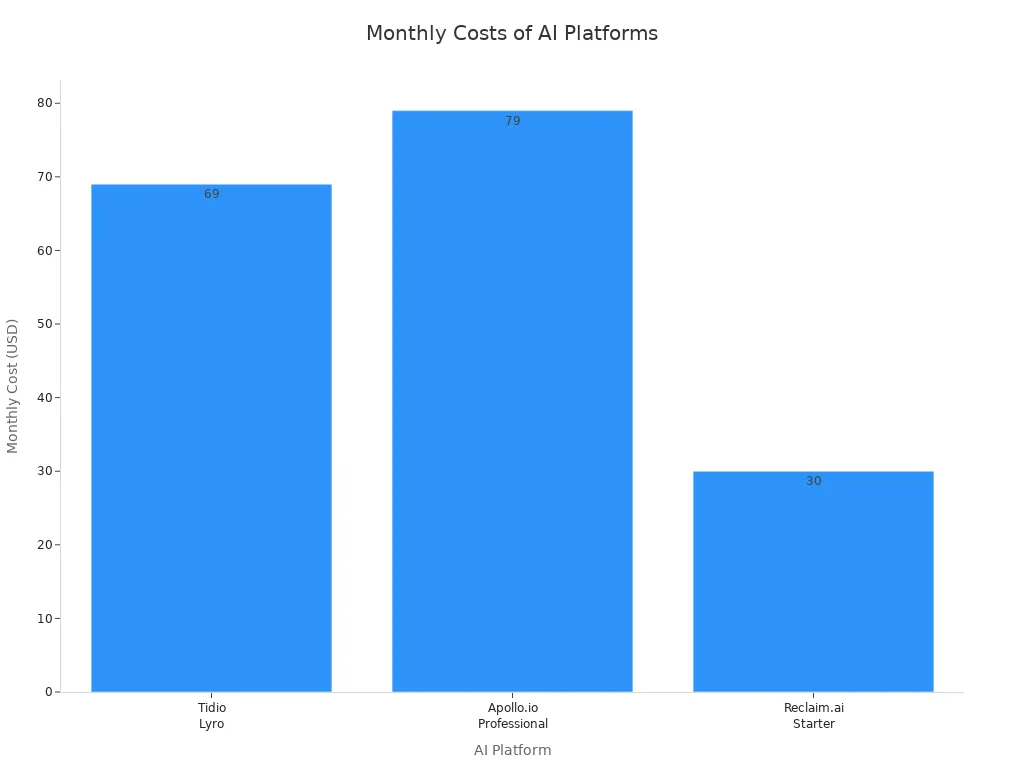
You can save between $500 and $2,000 each month by using ai agents for automation. These savings come from reducing manual work and improving efficiency.
Usability and No-Code Options
You do not need to be a programmer to use ai agent platforms. Many platforms offer no-code and low-code options. You can build agents with visual tools, templates, and easy integrations. The process feels like creating a document, not writing code. You can deploy agents instantly and scale as your needs grow. The table below shows how these features help you:
| Feature | Benefit for Non-Technical Users |
|---|---|
| Visual Tools | Simplifies the creation of AI agents without coding skills. |
| Templates | Provides starting points for users to customize their agents easily. |
| Easy Integrations | Allows connection to various services without technical knowledge. |
| Instant Deployment | Enables immediate use without managing servers or code. |
| User-Friendly Interface | Makes the process feel like document creation rather than coding. |
| Support in Business Language | Offers help that is relatable and understandable for non-tech users. |
| Scalability | Users can start simple and add complexity as needed. |
You can use an ai agent builder to automate complex workflows. No-code tools let you focus on project management and task management without learning programming.
Affordable Solutions
You can choose between no-code, low-code, and code-first development. No-code platforms give you the fastest time-to-value, often in less than an hour. You save up to 60% on upfront costs compared to custom development. Operational costs stay predictable with monthly fees. You can use tool integrations to connect your ai agent platform with your existing systems. Integration challenges, such as bridging the gap between old and new systems, are solved with APIs and middleware. You can also connect multiple large language models for advanced automation. The table below shows the differences between development options:
| Feature | No-Code Platforms | Low-Code Platforms | Code-First Development |
|---|---|---|---|
| Speed to Market | Fastest time-to-value, 15-60 minutes | Weeks for production-ready applications | Months, typically 3-6 months |
| Technical Requirements | Minimal technical knowledge required | Some technical expertise needed | Requires specialized AI expertise |
| Customization Capabilities | Limited customization options | Moderate customization with custom scripts | Unlimited customization available |
| Upfront Development Costs | Up to 60% savings compared to custom | Moderate initial costs | High upfront costs, $15,000-$1,000,000+ |
| Operational Costs | Predictable monthly fees, scales with use | Better long-term economics for complex workflows | Ongoing maintenance investments required |
| Ideal Use Cases | Straightforward AI applications | Suitable for moderately complex requirements | Ideal for core product differentiators |
You can use ai agent platforms to automate complex workflows, improve workflow automation, and support tool integrations. Integration with multiple large language models helps you access advanced features. You can manage data, automate tasks, and connect your business tools with ease.
Tip: Start with a no-code ai agent platform to test automation in your business. You can scale up as your needs grow.
AI and Human Roles in Business

Job Replacement Fears
You may worry that ai will take over jobs and leave people without work. This fear is common, but it does not match what happens in most businesses. Ai agent platforms change how you work, but they do not always replace you. Instead, they help you do your job better and faster. Many companies see ai as a way to boost productivity and make smarter decisions. In fields like software development, customer service, and finance, ai agents have increased productivity by 50% or more. You can use ai to handle routine tasks, so you have more time for creative work and problem-solving.
- Ai agents help you make strategic moves quickly.
- You can rethink how you use your skills and knowledge at work.
- Ai boosts meeting productivity by taking notes and tracking action items.
Collaboration with AI Agents
You can work with ai agents in many ways. Sometimes, ai acts as your assistant and helps you with simple tasks. Other times, ai works as a co-pilot, helping you write emails or manage your calendar. As you use ai more, it can take on bigger tasks with your guidance. The table below shows how this collaboration grows over time:
| Stage of AI Integration | Description | Benefits |
|---|---|---|
| AI as an assistant | You use ai to improve task accuracy. | Increases efficiency in routine tasks. |
| AI as a co-pilot | Ai helps with complex tasks like writing emails. | Boosts productivity and creativity. |
| AI agents executing tasks | Ai does specific jobs with your oversight. | Frees you for strategic work. |
| AI agents operating autonomously | Ai manages tasks from start to finish. | Lets you focus on important projects. |
| AI fully replacing roles | Ai takes over some roles. | Streamlines operations and reduces costs. |
You can use a collaboration hub to connect with ai agents and your team. This helps you share knowledge and improve meeting productivity.
Enhancing Human Work
Ai does not just replace jobs. It makes your work more meaningful. When ai automates routine tasks, you can focus on helping customers and solving problems. Ai-driven personalization lets you give better service and improve customer satisfaction. In customer service, ai-powered chatbots answer simple questions, while you handle complex issues that need empathy and deep knowledge.
- Ai transforms the job market, but it does not cause mass layoffs.
- Ai platforms automate simple tasks, so you can work on creative projects.
- In security, ai agents review documents, and you focus on questions that need human judgment.
- Ai improves meeting productivity by tracking decisions and sharing knowledge with your team.
You can use ai to build a stronger business and create new opportunities for growth.
AI Agent Platforms: Security and Privacy
Common Concerns
You may worry about how ai agent platforms handle your data. Many business owners share these concerns. The most common issues include:
- Meeting data protection rules like GDPR and CCPA. Failing to comply can lead to large fines.
- Ensuring safe transfers of data between countries, especially under frameworks like the EU-US Data Privacy Framework.
- Protecting payment data by following PCI DSS standards.
- Following international security standards such as ISO 27001 for information security.
- Addressing new ai risks, including bias and transparency, with standards like ISO 42001.
- Detecting unusual behavior using tools like anomaly detection and behavioral analytics.
- Keeping detailed audit trails for compliance and incident review.
- Preventing attacks such as prompt injection, which can trick ai agents into sharing sensitive data.
You need to know that ai agent platforms face unique threats. These threats require strong security and privacy controls.
Risk Mitigation
You can reduce risks by following a few key steps:
- Use technical safeguards during model training, testing, and deployment.
- Test your ai agents with red teaming to find weaknesses before launch.
- Add runtime protections like input checks and output filters.
- Control what data enters the agent’s reasoning to lower the risk of leaks.
- Give agents only the permissions they need for their tasks.
- Keep sensitive data in separate contexts to avoid misuse.
- Monitor agent behavior for strange actions.
- Run regular audits to make sure agents follow your rules.
Tip: Always tag and review your models and datasets for sensitivity. This helps you spot risks early and protect your business.
Best Practices
You can follow industry best practices to keep your ai agent platforms secure:
- Set up human-in-the-loop guardrails so important actions need your approval.
- Offer a secure, company-owned ai option for handling confidential data.
- Block or control access to public ai tools to keep your data safe.
- Limit who can access sensitive data by enforcing least-privilege access.
- Classify your data so agents only see what users are allowed to view.
- Train your team on what information should never go into public ai tools.
- Make sure ai systems are opt-in for critical operations.
- Update your policies and training often to keep up with new threats.
You can also look for platforms with top certifications. The table below shows some important standards:
| Certification | Focus Areas |
|---|---|
| ISO/IEC 27001 | Information security management |
| ISO/IEC 27701 | Information privacy standards |
| ISO/IEC 42001 | Responsible AI development and use |
By following these steps, you can use ai agent platforms with more confidence and keep your data safe.
AI Multi-Agent Results: Setting Expectations
Realistic Timelines
You want to see results from ai multi-agent platforms quickly. Timelines depend on your approach. Custom-built ai agents may take several months to launch. Platform-based solutions with prebuilt connectors can go live in a few weeks or even days. You can start with simple ai-powered insights and expand as your knowledge grows. Many businesses begin with pilot projects to test ai and measure productivity gains. You should set clear expectations for each phase.
- Custom solutions: Several months to implement.
- Platform-based solutions: Weeks or days to launch.
- Pilot projects: Fastest way to gain initial insights.
Tip: Start small and scale up as you build knowledge and confidence.
Training and Integration
You need to prepare your team for ai integration. Transparent communication helps address employee concerns. You can create safe zones for ai experimentation to build trust. Gradual integration allows your team to adapt organically. Establishing an ai Center of Excellence gives you centralized expertise. Federated governance balances decision-making across departments. You must address technical infrastructure, including data quality programs. Talent development through ai apprenticeship and buddy systems helps your team gain knowledge. Financial strategies like stage-gate investments keep your ai projects on track. Risk management with ai-specific security protocols and regulatory compliance protects your data.
- Transparent communication campaigns
- Safe zones for ai experimentation
- Gradual integration
- Centers of Excellence
- Federated governance
- Data quality programs
- Talent development
- Stage-gate investments
- Security protocols
Measuring Success
You measure success by tracking clear metrics. The 30% rule suggests starting with low-risk pilots that automate repetitive tasks. This approach demonstrates ROI and builds confidence. You can achieve measurable benefits, such as a 30% reduction in costs and a 35% increase in productivity. Define success metrics for each agent deployment and align them with business objectives. Executives recognize value when you connect ai-powered insights to workflow improvements and productivity gains.
- Start with low-risk pilots
- Track cost reduction and productivity increases
- Align metrics with business goals
- Use ai-powered insights to inform decisions
Note: Set clear goals and measure knowledge growth to maximize the impact of ai multi-agent platforms.
Choosing the Right AI Agent Platform
Evaluation Criteria
You need to choose an ai agent platform that fits your business goals. Start by clarifying your current and future use cases. Decide if you want to solve one problem or manage several workflows. Assess if the platform can support growth in volume and complexity. Look for flexibility, such as support for different models and deployment environments. Make sure the platform offers strong governance and security. Check if pricing matches your rollout pace and long-term plans. Review proof points like customer outcomes and analyst coverage.
Here are key criteria to help you evaluate:
- Clarify use cases for ai in your business.
- Assess scale and reliability for future growth.
- Check flexibility for models and environments.
- Prioritize governance and security.
- Consider pricing and commercial fit.
- Verify platform maturity and validation.
| Criteria Category | Key Evaluation Points |
|---|---|
| Platform & Engineering Teams | System reliability, deployment safety, runtime stability, versioning, rollback support |
| Data & Analytics Teams | Transparency, traceability, visibility into data usage, connection to source systems |
| Business & Operations Teams | Outcomes focus, risk management, predictable behavior, approval workflows, policy enforcement |
| Orchestration & Scalability | Agent context sharing, workflow handoff management, handling increased agent count |
| Governance & Security | Monitoring, access control, auditability, decision traceability, lifecycle controls |
Tip: Consider your operational environment and define how you will monitor agent performance.
Moving Past Myths
You can move past common ai myths by starting small and scaling strategically. Focus on one process at a time. Foster human-ai collaboration so ai handles repetitive tasks and you focus on decisions. Choose tools that fit your needs instead of flashy options. Train and customize ai agents to match your business operations. Measure ROI and adjust your strategy based on data.
Many believe ai will replace humans or cost too much. In reality, ai enhances your work and boosts efficiency. Strategic implementation helps you gain value without risk.
- Start with a clear purpose for ai adoption.
- Build a strong vision so your team knows what success looks like.
- Align ai projects with your business priorities.
Informed Decisions
You make better decisions when you align ai adoption with your business needs. Ensure you have the right technical personnel to launch and manage solutions. Build a solid data foundation, especially as agent autonomy increases. Set clear governance protocols to monitor performance and manage risks.
Orchestration, integration, and scalability play a big role in platform selection. A well-designed platform manages workflows, connects with your systems, and adapts to growing workloads. Reliable operation lets agents and humans work together smoothly.
| Aspect | AI agent platforms |
|---|---|
| Orchestration | Built-in agent and multi-agent orchestration |
| Tool integration | Native tool and API integration layers |
| Scalability | Scales agent behavior and coordination |
Note: Choose a platform that supports continuous operation and reliable collaboration between humans and agents.
You have seen that many myths about ai multi-agent platforms are not true.
- Some believe only large companies can use ai, or that it needs big engineering teams.
- Others think ai agents work like old ai, but they learn and act on their own.
You gain real benefits when you use ai, such as a 30% cost reduction and a 35% boost in productivity. Companies like JPMorgan and DHL use ai for better insights and smarter decisions. To get started, define your needs, check your systems, and look for platforms that offer strong insights and security. Stay updated by reading expert articles, joining webinars, and following industry newsletters. These steps help you use ai for better insights and growth.
FAQ
What is an AI multi-agent platform?
You use an AI multi-agent platform to automate tasks with several AI agents working together. These agents can handle different jobs, share information, and help you run your business more smoothly.
Do I need coding skills to use these platforms?
You do not need coding skills. Many platforms offer no-code or low-code options. You can use drag-and-drop tools, templates, and simple menus to set up your automation.
How do AI agents protect my business data?
AI agent platforms use strong security features. You get encryption, access controls, and regular audits. Look for platforms with certifications like ISO 27001 for extra peace of mind.
| Security Feature | What It Does |
|---|---|
| Encryption | Protects your data |
| Access Controls | Limits who sees information |
| Audits | Checks for safety |
Can AI agents work with my current business tools?
Yes, you can connect AI agents to tools like email, CRM, and accounting software. Most platforms support easy integrations with popular business apps.
Tip: Start with one workflow, then add more as you see results.
Will AI agents replace my team?
AI agents help your team by handling repetitive tasks. You and your team can focus on creative work and customer service. AI supports people, not replaces them.
See Also
The Essential Advantages of SaaS WMS in Modern Warehousing
AI-Driven Safety Stock Strategies for Fashion Retail in 2025
Enhancing Business Agility Through Supply Chain Outsourcing Solutions
Boosting Efficiency Using Intelligent Strategies for Ecommerce Warehousing
Actionable Ecommerce Strategies for 2025: An Innovative Guide