
How can you guarantee that every inch of fabric meets your quality standards before it reaches the production line? Full-surface fabric inspection provides the answer. This method examines every visible area of the material, catching defects that spot-checks miss.
You need to know which defect types matter most. You also need a clear process for examining rolls efficiently. Most importantly, you must decide between manual and automated surface inspection methods.
This guide explains the definition, common problems, and practical steps for fabric inspection. You will learn how to improve your quality control system. The information helps you reduce waste and protect your brand's reputation.
Full-Surface Fabric Inspection Defined
Definition and Importance
Full-surface fabric inspection means examining every visible inch of a textile roll—woven, knitted, nonwoven, or technical—against your documented quality standards. You scan the entire material surface, not just random samples. The primary purpose is straightforward: catch defects before cutting and sewing turn them into finished goods.
Why does this matter so much? Consider where quality problems actually begin. Approximately 20% of garment defects originate at the fabric level. When you skip thorough inspection, you allow those flaws to travel downstream. A study of 8,000 military garments revealed that 85% of quality problems were textile-related. Fabric shading alone accounted for 38% of all non-conformances. These numbers show a clear pattern: fabric quality drives final product quality.
| Evidence Type | What It Shows |
|---|---|
| Statistical data | 20% of garment defects start at the fabric stage |
| Case study | 85% of quality issues in 8,000 military garments traced to textiles |
| Expert opinion | Technical fabrics (airbags, HEPA filters) with surface defects risk safety failures |
For safety-critical textiles, the stakes rise even higher. A tiny flaw in airbag fabric can cause burn-through during deployment. A pinhole in a HEPA filter allows virus bypass. Full-surface fabric inspection catches these hidden dangers before they reach end users.
Cost of Defects
Skipping proper inspection creates a compounding cost problem. Undetected defects grow more expensive at every production stage. Products that fail customer expectations cause 47% of vendor chargebacks, with fees reaching up to 20% of invoice value. The Cost of Poor Quality averages 5-8% of the FOB product purchase price across the industry.
The financial case for thorough inspection is compelling. A mid-size weaving mill processing 500,000 meters monthly can achieve:
- Total annual savings of $316,800 through full-surface fabric inspection
- Inspection labor reduction of 60-75%, saving $108,000 annually
- Defect waste reduction of 10-15% of fabric value, saving $67,200 yearly
- Rework and seconds downgrade cost reduction of $84,000 annually
- Customer claims and returns reduction of 70-80%, saving $57,600 each year
The typical return on investment timeline spans 12-18 months. High-volume mills often see faster payback. When you calculate your own numbers, remember that every defect caught during surface inspection costs far less than the same defect discovered after garment assembly or customer delivery.
Common Fabric Defects in Surface Inspection
Every defect you find during inspection falls into one of two categories. Visual defects affect the fabric's appearance. Structural defects affect its strength. A single defect in the final product can trigger a return. Each defect caught early saves time. Knowing the difference helps you choose the right detection method.
Visual Defects
You can spot visual defects with your eyes or with simple touch. Start by rubbing the fabric against your hand or cheek. This technique reveals rough spots, uneven texture, or hidden slubs that your eyes might miss. Professional inspectors use this method every day.
Woven fabrics show many visual defects. Horizontal lines appear across the width. Shade variation makes one section look different. Dirt and stains create visible marks. Uneven dyeing produces color patches. Holes punch through the material. Defective selvage shows frayed edges. Snags pull yarn loops out of place. Bowing or skewing distorts the pattern. Neps and slubs create small bumps or thick spots.
Knitted fabrics have their own visual defects. Drop stitches leave missing loops. Needle lines run vertically from a damaged needle. Snags appear just as they do in woven goods.
These visual problems matter because customers see them first. A shirt with a stain or a hole fails quality standards immediately. Your surface inspection process should catch every one.
Structural Defects
Structural defects change the fabric's physical makeup. They weaken the material even when the surface looks normal. Thick and thin places create uneven strength. Broken yarns leave gaps that compromise the weave. These defects often hide until stress is applied.
You need different tools for structural defect detection. Tension tests reveal weak spots. Light tables show thin areas. Your inspection process must include both visual checks and structural testing. A fabric that looks perfect but has hidden flaws will fail during cutting or sewing.
The cost of missing a structural defect is high. A garment assembled from weak fabric may tear during use. No defect should reach the customer. That means returns, chargebacks, and damaged reputation. Full fabric inspection catches both visual and structural problems before production.
Fabric Inspection Process Steps
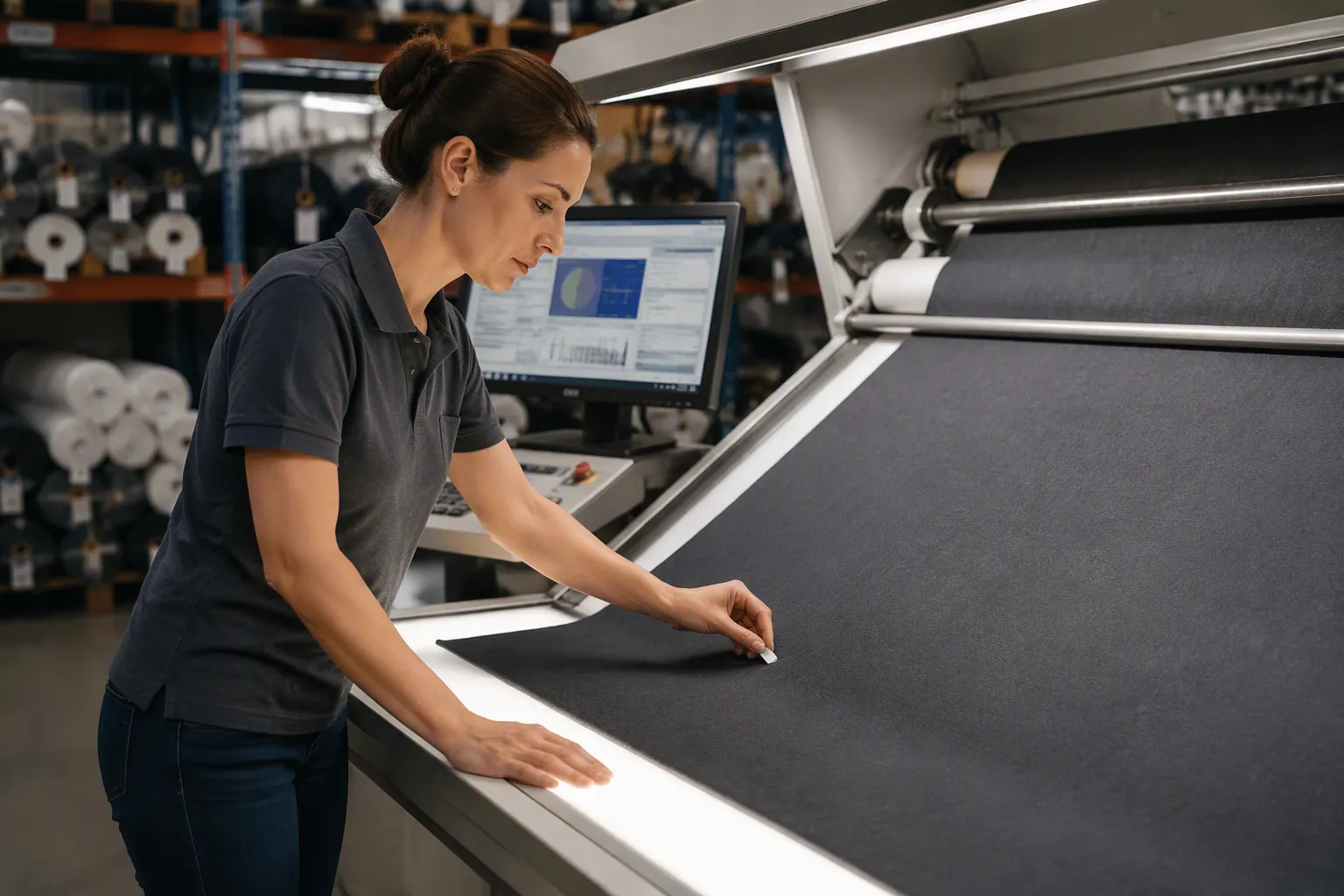
A reliable process follows a logical sequence. You unroll the fabric, examine it under proper lighting, mark each flaw, and record your findings. Each step builds on the previous one. Skipping any stage creates gaps in your coverage.
Setup and Illumination
Your inspection begins before you touch the first roll. You need a clean, flat surface. An inspection table or machine lets you unroll the fabric evenly. You control the speed so nothing escapes your view.
Lighting determines what you can see. The right illumination reveals flaws that ordinary room light hides. Industry standards from ASTM D5430 and AATCC EP9 set clear benchmarks. Your light source should deliver 1000–2000 lux at the fabric surface. For audit acceptance, you need at least 1500 lux. Premium fabrics demand 1500–2000 lux. Technical textiles require 1500–2500 lux. Shade detection needs 2000 lux or more.
Color quality matters just as much. Your light source should measure 5000–6500 K in color temperature. The Color Rendering Index must reach 90 or higher. Cool white LED bulbs meet these requirements. Uniformity variation should stay below 20 percent across the table.
Different fabrics respond to different lighting angles. Woven materials benefit from low-angle raking light at 15–20 degrees. This angle highlights warp and weft irregularities. You add diffuse overhead lighting for shade and color checks. Backlighting reveals holes and thin spots. Knitted fabrics need diffuse dome lighting as your base. You then add moderate-angle directional light at 30–45 degrees. This setup exposes dropped stitches and snags without exaggerating normal texture.
Grading and Documentation
Once you spot a flaw, you mark it immediately. Many systems use colored stickers or chalk. You note the defect type and location on the roll. This marking lets downstream teams find and remove the problem area during cutting.
Grading assigns a score to each roll. You compare the number and severity of flaws against your quality standards. A roll with minor, scattered issues may pass. A roll with concentrated or severe problems gets downgraded or rejected. The grading system you choose should match your customer's required specifications.
Documentation completes the process. You record the roll number, length, width, and weight. You list every defect found during the examination. You note the grade assigned. This record creates a paper trail for your factory and your buyer.
Your documentation also feeds your improvement efforts. Frequent broken picks or misweaves point to loom problems. Repeated stains suggest handling issues. Tracking these patterns helps you fix root causes, not just symptoms.
A complete inspection report includes your findings and conclusions. You verify quantity, labels, and product consistency. You examine packaging and identification. You produce a detailed summary that supports your shipment decision.
The entire sequence—setup, illumination, marking, grading, and reporting—forms your full-width fabric inspection routine. When you follow these steps consistently, you catch problems before they reach your cutting tables. You protect your quality reputation and reduce costly returns.
Manual vs. Automated Surface Inspection
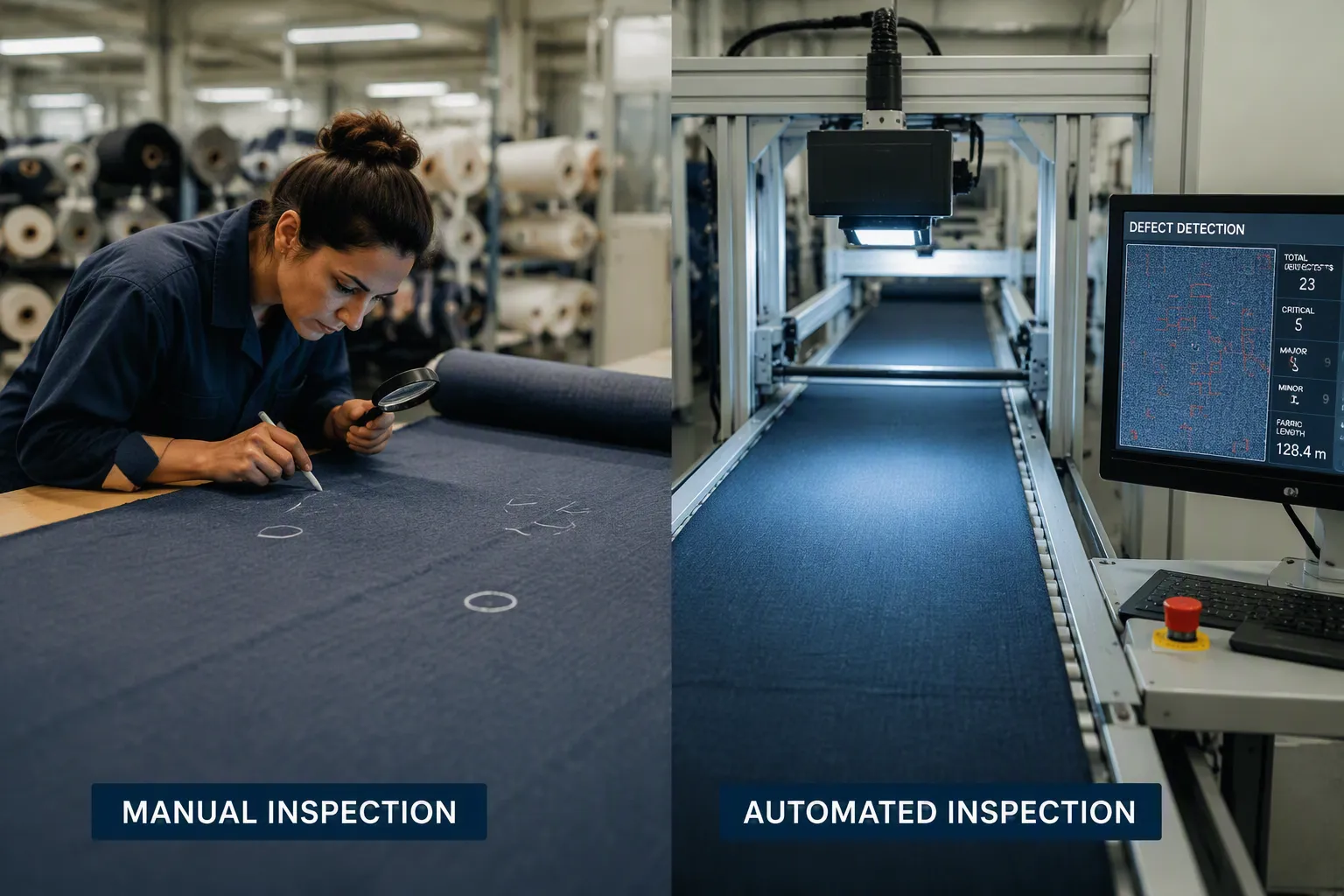
You now face a critical decision. Your choice between manual and automated surface inspection determines your defect capture rate. It also affects your long-term costs. Understanding the limits of human inspection is the first step.
Limits of Human Inspection
Manual fabric inspection depends entirely on human skill. Operators train for weeks. But humans have limits. Fatigue sets in after a few hours. Attention wanders. Experience varies between shifts. This instability creates a high false negative rate. A tired inspector misses more defects. Studies show manual detection accuracy sits at 60-70%. You miss 30-40% of all defects in practice. This is the reality of manual inspection.
Grading systems provide a consistent language for manual work. You assign penalty points for each defect you find. The choice of system depends on your buyer.
| Feature | 4-Point System | 10-Point System |
|---|---|---|
| Primary users | US apparel/retail buyers | Military, industrial, technical buyers |
| Max points per defect | 4 pts | 10 pts |
| Max points per yard | 4 pts | 10 pts |
| Acceptable limit | 40 pts / 100 yd² | Varies by fabric type |
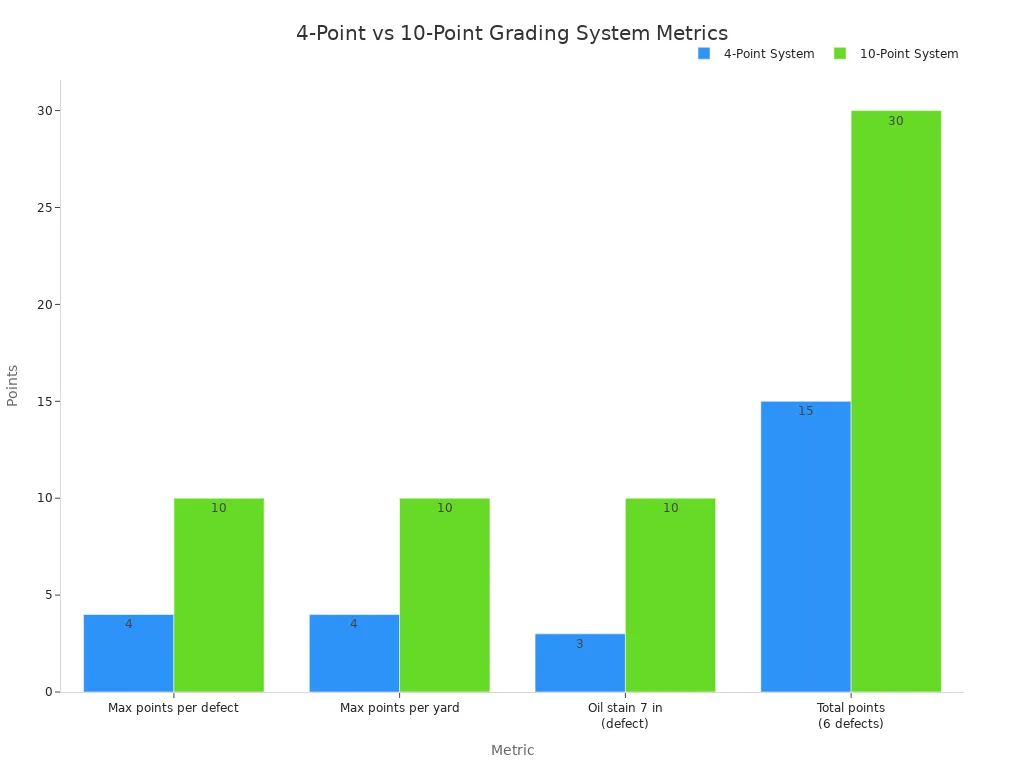
Your team documents every flaw in an inspection report. They track the roll ID, grade, and points. This process creates a record for quality control. But it cannot overcome the fundamental limits of human attention. The consistency of the data depends on the operator.
Automation Consistency
Automated inspection systems do not get tired. They use algorithms that maintain peak accuracy from start to finish. AI detection accuracy reaches 95% or higher. This consistency transforms your fabric inspection process.
The financial impact is clear. Consider a typical circular knitting mill. It operates with a 3% defect rate. This means 15,000 defective meters each month. Your manual team catches 9,750 meters. The AI system catches 14,250 meters. The difference is 4,500 meters of escaped material. This material moves downstream. It gets cut, sewn, and finished. At a downstream cost of $3 to $8 per meter, manual inspection costs you $13,500 to $36,000 more each month. This is a direct hit to your bottom line. Over one year, this cost difference alone pays for the AI system.
| Metric | Value |
|---|---|
| AI detection accuracy | 95%+ |
| Manual detection accuracy | 60-70% |
| Effective inspection throughput improvement | 3x |
| Typical payback window (mid-scale deployment) | 12-18 months |
| Reduction in customer-side quality complaints | 20-35% |
| Line speed increase once inspection bottleneck lifts | 10-15% |
| Fabric coverage | 100% vs sampled manual inspection |
The payback window is typically 12-18 months. High-volume plants see faster returns. As one industry source notes, "a return on investment is typically realized within a relatively short cycle."
You can integrate tailored fabric inspection machines into your surface inspection workflow. These systems provide 100% fabric coverage. They lift inspection bottlenecks. You can increase line speed by 10-15%. This is the power of automatic fabric inspection. It provides consistent, reliable data for every roll.
The choice between manual and automated surface inspection depends on your volume and quality standards. For high-volume production, automation provides the consistency you need to protect your fabric and brand.
AI and Machine Vision for Fabric Inspection
Key Features
AI-powered systems bring three features that change your surface inspection process. Real-time identification means the system finds problems as fabric moves at full production speed. The FabricMamba algorithm processes images instantly. This speed lets you correct issues before they compound. You catch problems at the source instead of finding them later.
Scalability allows you to deploy the same system across multiple lines. Whether you run one station or twenty, the AI maintains its accuracy. The COMVIS Profiler handles wide uniform materials. Cognex systems verify patterns. Each tool fits your specific production needs. You can scale up without retraining operators.
Defect classification takes this further. The AI categorizes each flaw into a specific type: holes, stains, broken yarn, slubs, or misweaving patterns. This classification helps you trace problems to their source. A repeated broken yarn pattern points to a mechanical issue. Stains suggest handling problems in your production area. You get actionable data, not just alerts.
The numbers prove the value of these features. Here is a comparison of detection rates and consistency.
| Metric | Human Inspector | Automated AI System |
|---|---|---|
| Defect detection rate | 50-65% | 95-98% |
| Consistency over shifts | Degrades after 2 hours | Identical across all shifts |
Your manual team captures 50-65% of defects. The AI system captures 95-98%. That difference means fewer defective meters reach your cutting tables. You protect your downstream operations from hidden flaws.
Integration Workflow
Adding an automated inspection system to your line follows a clear sequence. You start by assessing your current surface inspection setup. Identify your bottlenecks and quality pain points. Determine which fabric types cause the most problems. This assessment tells you which system fits your production volumes.
Next, you install the machine vision hardware. Cameras and lighting mounts attach to your existing frame. The system calibrates to your material width and speed. Deep learning AI models train on your defect examples. You feed the system images of your common defects. This training phase takes days, not weeks. The model learns to recognize your specific patterns.
You then test the integration. Run sample rolls through the system. Compare the AI results against your surface inspection standards. Adjust the sensitivity settings until the false positive rate meets your standards. Your team learns to read the system's reports. They understand what each classification means for production.
Once validated, you move to full production. The system runs continuously. Your operators monitor the system instead of scanning every inch. The AI handles the repetitive work. Your team focuses on root cause analysis. This workflow turns your fabric inspection into a quality advantage.
Full-surface fabric inspection delivers three clear benefits. You reduce waste by catching defects early. You improve quality across every production run. You build a stronger brand reputation with fewer customer returns.
The trade-off between manual and automated methods comes down to consistency. Manual surface inspection catches 60-70% of defects. AI-driven systems reach 95% accuracy. For high-volume production, technology offers the most reliable results. The integration workflow follows four steps:
- Connect the inspection system to your MES and ERP software.
- Enable real-time defect detection. The AI sends data instantly to the MES.
- Trigger automated responses. The MES adjusts the process or alerts operators, creating a closed-loop quality control system.
- Use IIoT protocols like OPC UA and MQTT for seamless data flow.
Now take action. Audit your current fabric inspection process. Calculate your defect costs. Evaluate whether upgrading to automated surface inspection fits your operation.
FAQ
How does manual inspection compare to automated systems?
Manual inspection catches 60-70% of defects. Automated systems reach 95% accuracy. You get consistent results with automation. Your operators do not tire. Your surface inspection process becomes reliable shift after shift.
What is the typical payback period for an AI system?
You can expect a return on investment in 12-18 months. High-volume mills see faster payback. The system reduces defect waste and inspection labor costs. You improve quality and cut customer returns.
Can automated inspection handle different fabric types?
Yes. Systems like the COMVIS Profiler handle wide materials. Cognex systems verify patterns. Your full-surface fabric inspection works for woven, knitted, and technical textiles. The AI trains on your specific defect examples.
How do you set up lighting for proper surface inspection?
You need 1000-2000 lux at the fabric surface. Color temperature should reach 5000-6500 K. The Color Rendering Index must be 90 or higher. Uniformity variation stays below 20 percent.
See Also
Forecasting Textile Equipment Failures Using AI by 2025
How AI Sensors Will Transform Fashion Supply Chains in 2025
Using Intelligent AI to Simplify Fashion Product Returns Today
Achieving Precise Fashion Trend Predictions Through Sales Analytics
Leveraging Data to Sense Demand for Limited Edition Fashion Drops