

You see ai changing how every business works in 2026. Ai business operating system tools are no longer just ideas. Companies now use them to boost speed and accuracy.
- In 2026, 76% of large companies use ai, up from fewer in 2020.
- North America leads with 70% of organizations using ai.
- Global spending on ai systems will reach $300 billion.
Ai operating system for business helps you connect teams, automate tasks, and build new ways to work. You now need ai operating system tools to stay ahead.
What Is an AI Business Operating System?
Definition and Strategic Importance
You see the ai business operating system as the new foundation for every modern workplace in 2026. This system acts as the digital brain for your company. It connects people, data, and tools in one place. You use an ai operating system for business to manage tasks, automate workflows, and make decisions faster. This is not just a trend. You now rely on aios to run daily operations and drive growth.
The ai operating system for business matters because it changes how you work. You get real-time data from every part of your workplace. This means you can make better choices quickly. You also see aios learning from how your teams move and interact. The system helps you use space better and save money. Your employees get answers before they even ask. The ai operating system for business can predict when machines need fixing, so you avoid costly breakdowns.
Key Benefits of an AIOS in 2026:
- You improve decision-making with real-time data integration.
- You optimize space by learning from behavior patterns.
- You boost employee experience by giving proactive support.
- You manage assets better with predictive maintenance.
You see the ai operating system for business as a core part of your strategy. It is not just a buzzword. The market for agentic ai is growing fast. Experts predict it will jump from $6.96 billion in 2025 to $57.42 billion by 2031. Companies like PwC have launched AgentOS to redesign how you run your business. Researchers at Rutgers University now call this the "LLM-as-an-OS" model. This means ai agents can plan and act on their own, making aios the backbone of your workplace.
How AI Operating Systems Transform Business Models
You notice that the ai operating system for business changes everything about how you work. It does not just speed up tasks. It reshapes your whole business model. You see aios driving automation in every department. You get more done with fewer mistakes. Your teams spend less time on routine jobs and more time on creative work.
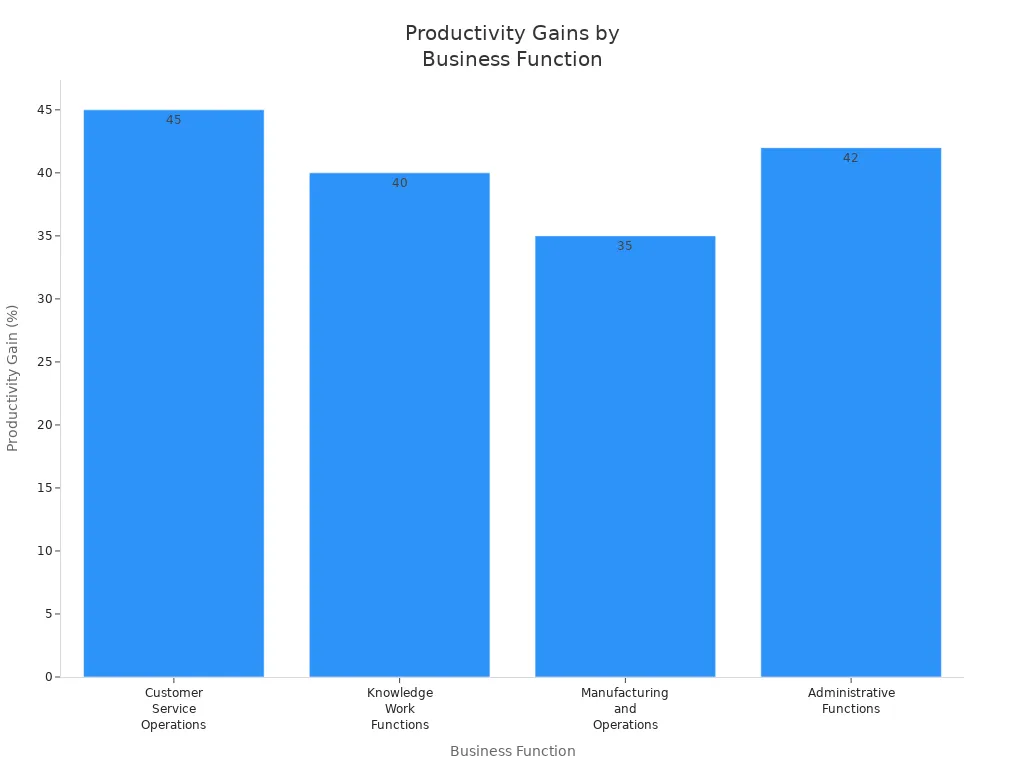
Here is how aios boosts productivity across your workplace:
| Function | Productivity Gain (%) |
|---|---|
| Customer Service Operations | 45 |
| Knowledge Work Functions | 40 |
| Manufacturing and Operations | 35 |
| Administrative Functions | 42 |
You also see big changes in costs. The ai operating system for business cuts routine decision-making costs by up to 40%. You need fewer people for repetitive jobs. At the same time, you create more strategic roles. This shift helps you focus on growth and innovation.
| Cost Structure Impact | Reduction (%) |
|---|---|
| Routine Decision-Making | 25-40 |
| Headcount in Routine Roles | 30-45 |
| Strategic Role Increase | 15-20 |
You find that aios powers the built world ai operating system. This means you can connect physical spaces, digital tools, and people in new ways. Companies like Amazon, Netflix, and Spotify use ai-powered recommendations to drive up to 40% of their revenue. You can use these same insights to improve workplace performance and customer satisfaction.
You now see aios as the heart of your business. It gives you automation, better insights, and a smarter workplace. You stay ahead because you use the ai operating system for business as your main tool for change.
AI Operating System for Business: Core Functions

Centralized Workflow and Data Integration
You use an ai operating system for business to bring all your workflows and data together. This system acts as a data intelligence platform that connects every part of your workplace. You do not need to switch between different tools. You see all your business information in one place. This makes your work faster and more accurate.
The ai operating system for business uses several layers to help you. These layers include:
- Context Layer: Teaches the ai about your business goals and priorities.
- Data Layer: Gives the ai real-time data from your workplace.
- Intelligence Layer: Summarizes business activities for you every day.
- Automation Layer: Handles routine tasks so you save time.
- Build Layer: Lets you use extra time for business growth.
You see big improvements in your business processes when you use centralized workflow and data integration. Here is how different parts of your business benefit:
| Business Process | Benefits of AI Integration |
|---|---|
| Finance | Automates invoice classification, anomaly detection, and report generation. |
| Supply Chain | Enhances forecasting, exception detection, and demand prediction. |
| Customer Service | Automates inquiry interpretation, response suggestions, and sentiment classification. |
| IT Management | Improves incident classification, prioritization, and remediation workflows. |
You notice that ai data integration removes manual bottlenecks and reduces errors. You get smarter task delegation and real-time visibility. Your business scales faster because you do not need to rebuild workflows. You make decisions quickly because the ai handles exceptions and routing. You also lower operational costs since you need less manual work.
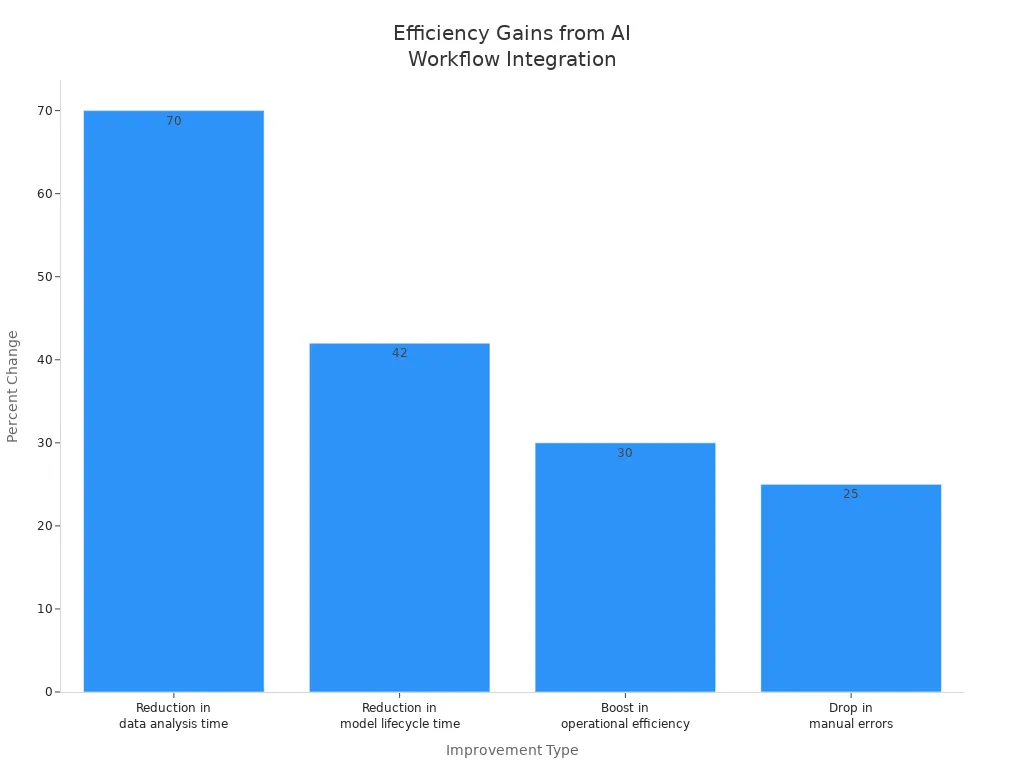
You see measurable gains in efficiency after you use an ai operating system for business. You spend up to 70% less time on data analysis. You cut the time spent managing model lifecycles by 42%. Your operational efficiency goes up by 30%. Manual errors drop by 25%.
You also find that ai-powered predictive maintenance reduces unplanned downtime. The ai operating system for business improves data quality in important areas like healthcare and finance. This leads to better collaboration and faster decisions across your teams.
AI-Driven Automation and Orchestration
You use ai-driven automation to handle routine tasks in your workplace. The ai operating system for business automates jobs in development, supply chain, customer service, and workforce management. You do not need to spend time on manual scripting or repetitive work. This saves you money and lets you focus on more important tasks.
You see that ai automation reduces operational costs by streamlining workflows. Tools like Kubiya AI automate DevOps tasks, so you do not need as many specialized skills. Domo helps you adjust resources, which means you do not waste money on idle systems. When you use ai-based scenario modeling, you cut budget waste by up to 25%. Forecasting with ai improves cost predictability by almost 30%.
You also see real-world results. UPS saved about 10 million gallons of fuel each year by using ai-based route optimization. Ai-driven reconciliation and anomaly detection find supplier overcharges and duplicate invoices with over 94% accuracy. This leads to direct savings for your business.
Orchestration platforms now act as the backbone of ai architectures. You use these platforms to connect different ai models and tools. They help you manage complex systems that include large language models and automation tools. You get seamless workflows across hybrid environments. These platforms offer automation, governance controls, and easy use for both technical and business users.
Enhanced Collaboration and Visibility
You improve collaboration in your workplace with an ai operating system for business. The system gives you real-time insights and keeps your teams connected, even if they work in different places. You see important information right away, so your teams move from decision to action quickly.
Here is how an ai operating system for business boosts collaboration and visibility:
| Benefit | Description |
|---|---|
| Faster execution | AI surfaces important information in real time, helping teams move from decision to delivery. |
| Smarter resource use | Predictive insights reveal bandwidth issues and suggest reallocation for effective distribution. |
| Less manual work | Automation of repetitive tasks allows teams to focus on high-impact initiatives. |
| Stronger alignment | Smart dashboards and automated workflows keep everyone informed about priorities and next steps. |
| Enhanced security | Strict access controls and encrypted data handling ensure compliance while moving fast. |
You see that ai operating systems help you use resources better and reduce manual work. Smart dashboards keep everyone on the same page. You also get strong security with strict access controls.
Many companies have improved their business outcomes with enhanced collaboration. For example, Rachio used Crescendo.ai to reach up to 99.8% response accuracy and cut costs by 30%. Duolingo used GitHub Copilot to increase developer speed by 25% and reduce code review time by 67%. Starbucks used Deep Brew for personalized recommendations and automated inventory management. Zoom used Synthesia to produce videos 90% faster and save up to $1,500 per employee each month.
| Company | AI System | Key Outcomes |
|---|---|---|
| Rachio | Crescendo.ai | 95% to 99.8% response accuracy, 30% cost reduction, managed support for 1 million customers |
| Duolingo | GitHub Copilot | 25% increase in developer speed, 67% reduction in code review time, 70% increase in pull requests |
| Starbucks | Deep Brew | Hyper-personalized recommendations, increased same-store sales, automated inventory management |
| Zoom | Synthesia | 90% faster video production, $1,000 to $1,500 monthly savings per employee, 200 micro-videos in 6 months |
You see that the ai business operating system gives you better employee experience, smarter insights, and stronger performance. You connect your built world ai operating system with digital tools and people. This makes your workplace more efficient and ready for the future.
Implementation Steps for AI Business Operating Systems

Assessing Readiness and Setting Objectives
You start your ai journey by checking if your business is ready. Look at your technical infrastructure and see if it can support ai. Review your data and make sure it is accurate and available. Think about your workplace culture and if your team is open to change. Get support from your leaders and set a clear strategy for ai.
- Evaluate technical infrastructure
- Assess data readiness
- Consider organizational culture
- Ensure executive support
- Develop a clear strategy
You also need to align leadership on the role of ai in your business. Identify use cases where ai can add value. Set up risk governance and decide if you want to build or buy ai tools.
- Align leadership on ai's role
- Identify valuable use cases
- Establish risk governance
- Decide on in-house vs. external ai tools
Use frameworks from cloud providers like AWS or Azure, or create your own plan. Make sure your ai goals match your business goals. A strategic approach helps you get real value from ai and empowers your people to lead the change.
Integrating AI Solutions and Training Teams
You integrate ai solutions by understanding the technologies that fit your business. Learn about machine learning and natural language processing. Evaluate vendors to find the best match for your workplace. Keep your data quality high with regular checks. Start with pilot projects to test ai before using it everywhere.
| Best Practice | Description |
|---|---|
| Understand AI Technologies | Learn about machine learning and natural language processing. |
| Evaluate Vendors | Check vendor reputation and fit for your business needs. |
| Ensure Data Quality | Use profiling and validation for reliable ai insights. |
| Conduct Pilot Tests | Try small projects before full deployment. |
| Foster Continuous Learning | Train your team to build ai skills and knowledge. |
Leading companies train teams with targeted programs. Google Cloud, for example, offers courses for both beginners and advanced users. You should also set up ai guidelines so everyone in your workplace knows how to use ai tools safely and ethically. Strong governance helps your business avoid risks and get the most from ai.
A recent survey shows that 91% of small and mid-sized companies using ai report higher income. This proves that ai can boost your business performance and workplace experience.
Managing Change and Scaling Operations
You manage change by getting executive sponsorship and investing in data quality. Train your team and use step-by-step deployment. Set up ethical governance before you launch ai in your workplace.
- Commit to executive sponsorship
- Invest in data quality and governance
- Develop internal capabilities
- Use iterative deployment
- Establish ethical governance
- Implement change management practices
AI implementations trigger changes across your business processes, decision-making, and workplace structure. You need an enterprise-wide view to succeed.
Companies that invest in data infrastructure see 2.3 times better results. Those that focus on change management have user adoption rates 3.5 times higher. When you scale ai, choose a deployment model that fits your business.
| Deployment Model | Advantages | Disadvantages |
|---|---|---|
| Centralized | Core team manages all systems, shares knowledge | May not meet unique needs, can slow response |
| Federated | Local teams move fast, tailor solutions | Risk of fragmentation, inconsistent governance |
| Hybrid | Mixes both for balance | Harder to manage, more complex |
You can start with one ai agent for a single function, then add more agents for each department. Later, connect agents across your business for full orchestration. High-quality data is key for scaling ai in your workplace. Use api-based integration, middleware, or plugins to connect your built world ai operating system with other tools. This gives you better automation, insights, and business results.
Overcoming Challenges and Measuring Success
Common Obstacles and Solutions
When you bring aios into your business, you face some common obstacles. Many organizations struggle with poor data quality and availability. In fact, 68 percent of businesses say this is their biggest ai challenge. You may also find it hard to hire or keep people with ai skills. Connecting new ai systems with your current business tools can take time and effort. Employees sometimes resist change, which slows down adoption. Measuring the return on investment for ai can also be difficult.
- Data quality and availability issues
- Skills gap for ai talent
- Integration complexity with existing business systems
- Change management and employee resistance
- Difficulty measuring ai ROI
You can overcome these challenges with the right approach. Assigning daily ai tasks to employees helps them learn and share experiences. Workshops can clear up misunderstandings about ai and build trust. Starting with small pilot projects lets your team see the benefits without big risks. Involve your team early in the process to build ownership. Provide hands-on training and address ethical concerns to gain support.
Companies that involve employees in ai decisions are 2.5 times more likely to succeed. You can boost adoption by making everyone part of the journey.
Key Metrics for Efficiency Gains
You need clear metrics to measure the success of aios in your business. These metrics help you see how ai improves your workplace and drives business results. Use the table below to track your progress:
| Metric Category | Key Metrics |
|---|---|
| ROI and Accountability Metrics | Productivity improvements, cost savings, revenue impact, ROI by tool and department, executive confidence |
| Investment Visibility Metrics | Cost per productive outcome, investment efficiency, spending allocation, forecast accuracy, portfolio optimization |
| Productivity and Impact Metrics | Time savings, quality improvements, output increases, competitive advantage, business outcome achievement rates |
After you deploy aios, you can expect strong results. A McKinsey study found that core business functions saw a 37% productivity boost. Customer service operations improved by 45%, and knowledge work functions by 40%. Financial services firms reported a 340% median return on ai investment over three years. Operational costs dropped by 32%, and error rates fell by 85%. These gains show the power of aios in transforming your business.
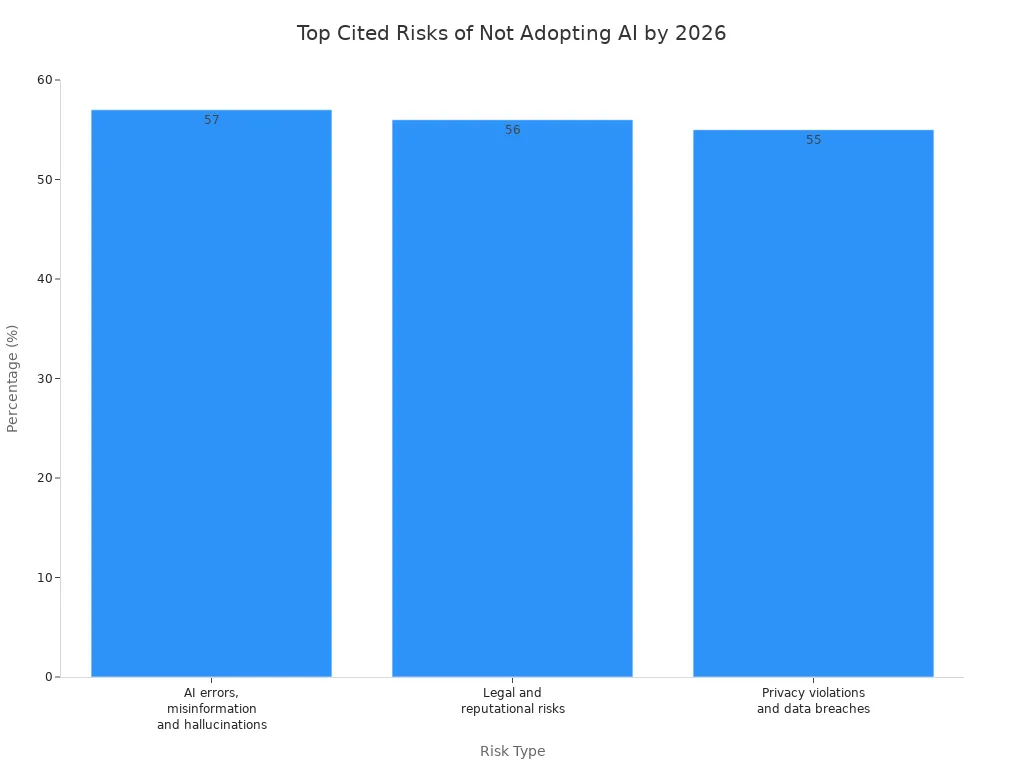
If you do not adopt ai business operating systems, you face risks like misinformation, legal issues, and privacy breaches. You also risk lower employee engagement and missed business opportunities. Tracking the right metrics and addressing challenges early helps you unlock the full value of aios in your business. Use these insights to guide your next steps and stay ahead in the changing business world.
You see how adopting an ai business operating system brings big changes to your workplace. The table below shows the main benefits you gain:
| Benefit Type | Description |
|---|---|
| Productivity Improvements | Efficiency gains such as time savings, increased throughput, and enhanced quality. |
| Strategic Value | Competitive advantage and faster innovation. |
| Leading Indicators | Higher user adoption rates and better data quality. |
| Lagging Indicators | Financial returns and improved customer retention. |
| Real-World Implementations | Success stories from healthcare, finance, manufacturing, and education. |
You notice that ai helps your business move faster and make smarter decisions. Companies using ai achieve quicker execution and better customer retention. If you wait, your business faces slower growth and higher costs. The landscape in 2026 demands speed and high customer expectations. Ai is now a core part of your business infrastructure.
To get ready for ai integration, follow these steps:
- Define the problem you want to solve.
- Check if ai adds measurable value.
- Align ai with your business goals.
- Make sure your data is clean and accessible.
- Confirm that ai can scale with your business.
- Review vendor credibility.
You should develop a clear vision for ai, re-engineer your processes, and align leadership with your priorities. Focus on efficiency, innovation, and staying ahead of trends. Now is the time to act. Embrace ai-driven efficiency and unlock new opportunities for your business.
FAQ
What is an AI business operating system?
You use an AI business operating system to connect your teams, automate tasks, and manage data. This system acts as the digital brain for your workplace. It helps you make faster decisions and improves efficiency.
How do you start using an AI business operating system?
You begin by checking your data quality and technical setup. You set clear goals for AI. You train your team and run pilot projects. You choose tools that fit your business needs.
What benefits do you get from AI business operating systems?
You see faster workflows, fewer errors, and better collaboration. You save money by automating routine tasks. You gain real-time insights that help you make smarter choices.
How do you measure success with AI business operating systems?
You track productivity, cost savings, and revenue growth. You check how much time you save and how many errors you reduce. You look at user adoption rates and customer satisfaction.
What challenges should you expect when using AI business operating systems?
You may face issues with data quality, team training, and system integration. You need to manage change and address employee concerns. You solve these problems with strong leadership and clear communication.
See Also
Enhancing Productivity Through Pick to Cart Solutions in 2025
Revolutionary Tech Boosting Warehouse Efficiency in 2025
The Advantages of SOPs for Warehouse Operations in 2025
Achieving Success with AI-Driven Just-In-Time Delivery in 2025