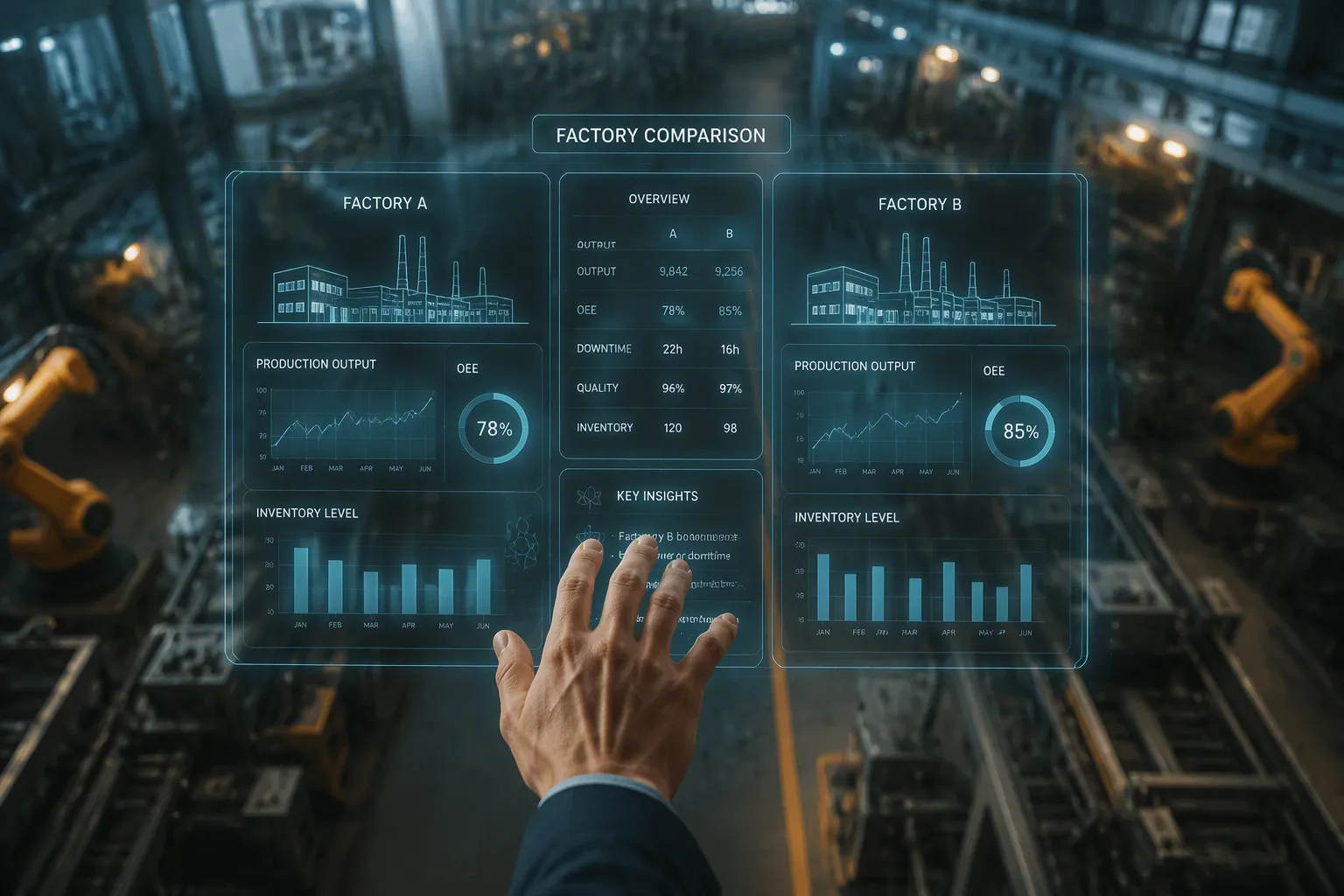
Manufacturers face demand volatility, labor shortages, and margin pressure daily. A dedicated manufacturing erp solves these problems. These systems learn from real-time data to optimize planning and cut downtime. Demand swings make robust planning essential. Labor shortages compound the challenge. The right platform depends on your unique needs. Traditional systems cannot adapt. AI-driven predictions prevent disruptions. This guide provides a criteria framework, a section titled "Comparing Leading AI ERP Platforms", and a selection playbook. The framework weights AI depth, integration, scalability, and governance. The comparison covers three leading platforms evaluated for shop-floor fit. The playbook includes data readiness, pilot steps, and change management. Use these tools to shortlist your best option.
Why AI ERP Matters for Manufacturers
Limits of Traditional ERP
Static Planning, Volatile Demand
Traditional manufacturing erp systems rely on fixed rules and historical averages. These systems cannot adjust when demand shifts suddenly. A planner sets reorder points months in advance. A spike in orders then triggers stockouts. A drop leaves warehouses full of unsold goods. Static planning fails in volatile markets.
Manual Reordering Risks
Manual reordering depends on human judgment and spreadsheets. Buyers miss signals hidden in daily operations. They react to problems after they occur. This reactive approach raises costs and slows production. The best industrial ai platform replaces guesswork with real-time detection.
What AI Adds to ERP
Pattern Detection Across Operations
Industrial ai platforms analyze cycle-time signals across every produced unit. They find deviations even when no formal downtime event is recorded. Recurring 8-second interruptions that cost 200 units per shift become visible. The system classifies these patterns and ranks root causes by throughput impact. This shifts analysis from reactive firefighting to continuous improvement.
Traditional manufacturing often struggles with workflow bottlenecks, especially at junctions between departments or systems where manual coordination is required. Human error, delays in data transfer, and the time needed for repetitive administrative tasks can slow operations significantly.
Continuous Learning vs. Rules
Rule-based erp systems follow fixed logic. They cannot learn from new data. Industrial ai platforms improve over time. They process large volumes of manufacturing data from multiple sources in real time. This enables detection of production bottlenecks and prediction of machine failures before they occur. The system adjusts its models as conditions change.
ROI Manufacturers Actually See
Downtime and Inventory Savings
The financial returns are measurable. A case study of an electronics manufacturer reports a 62% reduction in unplanned downtime across 6 plants after implementing AI-driven solutions. Deloitte's 2026 Manufacturing Industry Outlook notes that integrating AI with ERP, MES, and PLM systems can support up to 40% downtime reduction. AI-powered predictive maintenance platforms reduce unplanned downtime by 35% while improving inventory accuracy by nearly 30%. Inventory carrying costs, which typically run 15% to 30% of inventory value, drop by 25% to 30% with AI-driven material requirements planning.
Faster Scheduling Cycles
AI compresses scheduling from days to hours. The best industrial ai platform evaluates finite capacity, material availability, and labor constraints simultaneously. Planners receive optimized schedules without manual iteration. This speed improves quote-to-cash cycles and helps manufacturers respond to customer requests faster.
Manufacturing ERP Use Cases for AI
Each use case ties directly to a pain point that manufacturers face daily. An industrial ai platform embedded in manufacturing erp changes how plants handle these problems. Manufacturing erp systems connect erp, supply chain and manufacturing planning into a single foundation.
Predictive Maintenance
Sensor-Driven Failure Models
Vibration sensors, temperature probes, and current monitors feed data into industrial ai platforms. These models learn normal operating ranges for each machine. The best industrial ai platform detects deviations and quantifies remaining useful life. Industrial ai transforms raw sensor data into actionable maintenance intelligence.
Automated Work Orders
When a model flags elevated risk, the system creates a work order automatically. The work order includes the likely failure mode and priority level. This reduces the gap between detection and response. Industrial ai makes maintenance a scheduled activity rather than a fire drill.
AI-Driven MRP and Reordering
Demand Sensing Beyond History
Traditional manufacturing erp systems rely on historical averages for material planning. Industrial ai augments MRP with real-time signals. The erp system adjusts material requirements daily. This advanced production planning and scheduling prevents stockouts and reduces excess inventory. Production planning and scheduling becomes more responsive.
Dynamic Safety Stock
Safety stock buffers against uncertainty during lead time. Static safety stock fails when variability shifts. The industrial ai platform recalculates safety stock continuously using real-time consumption trends. The system monitors inventory against the production schedule and auto-generates purchase requisitions when stock falls below safe thresholds. In discrete manufacturing assembly, this ensures all components arrive on time. Dynamic safety stock prevents costly line stoppages. Plants report reducing unexpected production downtime by up to 40% with proactive shortage alerts. Lower inventory carrying costs follow from optimized safety stock levels.
Scheduling and Quality
Finite Capacity Optimization
An industrial ai platform evaluates finite capacity, material availability, and labor constraints simultaneously. It produces optimized schedules in hours instead of days. Production planning, scheduling, and shop floor control becomes data-driven rather than reactive. Planners spend less time firefighting.
Inline Defect Detection
Industrial ai enables inline defect detection using vision systems and sensor data. The model classifies defects in real time and triggers corrective actions. Process manufacturers use spectral analysis. Discrete manufacturers use camera-based systems. Manufacturing operations become more consistent when AI monitors every unit.
These use cases demonstrate how erp and manufacturing systems integrate purchasing, production, inventory, and finance into a unified view. The best industrial ai platform connects these functions so that manufacturing, inventory, and financials are visible in real time. This integration defines modern manufacturing erp approach to manufacturing planning. Businesses evaluating erp, supply chain and manufacturing platforms should judge erp vendors on these capabilities. Industrial ai platforms deliver measurable returns when they target specific production gaps.
Comparison Criteria for Manufacturing ERP Systems
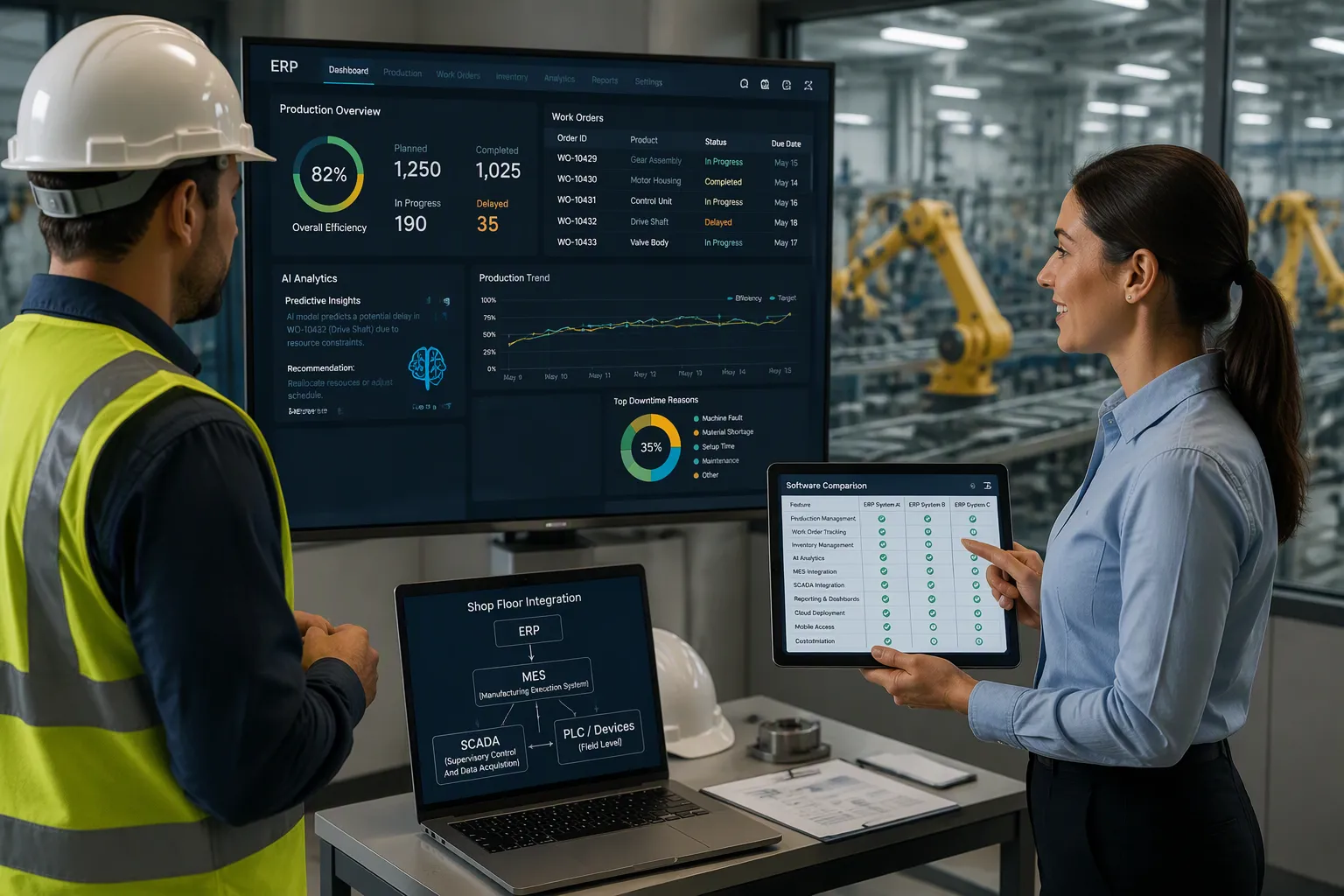
Generic ERP checklists focus on general ledger depth, payroll, and reporting. These criteria miss the manufacturing decision. A plant needs to know how well a system handles finite capacity, shop-floor data, and machine-level events. Buyers comparing manufacturing erp software should weight criteria by plant type and deployment model. A process plant values batch traceability. A discrete plant values work-order flow. The same scorecard produces different rankings for each.
AI Depth vs. AI Marketing
Native Models vs. Bolt-Ons
Vendors often label dashboards as "AI." Buyers must separate native models from bolt-on analytics. The two differ across data integration, workflow automation, ROI measurement, and deployment timeline.
| Dimension | Native AI model | Bolt-on analytics |
|---|---|---|
| Data integration | Real-time semantic layer | Scheduled batch ETL |
| Workflow automation | Agentic across modules | Tasks within separate silos |
| ROI measurement | Built-in telemetry, per-action cost tracking | Manual matching of separate logs |
| Deployment timeline | Typically 3–4 months | Typically 9–12 months |
A native model reads live production data. A bolt-on waits for a nightly extract. That gap matters when a line runs at high speed.
Data and Model Transparency
Transparency determines whether an industrial ai platform can be governed. Buyers should ask how a model was trained, what data it accesses, and who owns each decision. An AI Information Data Model captures operators, products, and deployments. This supports traceability across multi-layer supply chains. Robust identifier allocation assigns unique IDs to AI systems, similar to the GLEIF model. Standardized measures and AI Registers let the public compare systems. Organizations must explain how AI makes decisions and disclose AI involvement to internal reviewers and affected parties.
Shop-Floor and OT Integration
MES, SCADA, and PLC Links
Integration gaps between ERP, MES, and SCADA/PLC layers are the most common reason a pilot fails to scale beyond a single line. Problems surface when a second or third data source connects. The ISA-95 model clarifies the handoff. ERP handles business planning across weeks to months. MES tracks production, quality, and OEE in seconds to minutes. SCADA monitors multiple machines in seconds. PLCs control machines in milliseconds. SCADA reports that a machine stopped. MES explains why, for how long, and the OEE impact.
Empowered Automation Solutions is a narrowly focused integrator built specifically around the MES-PLC-ERP handoff. That specialization can make a smaller specialist attractive when the problem is clearly specified.
IoT and Edge Pipelines
Edge AI and cloud AI serve different roles. Edge latency runs 1–10 ms. Cloud latency runs 50–200 ms or more. Edge devices process sensor and image data near equipment, so defect detection runs without cloud dependency. Cloud handles long-term analytics and model training. A hybrid architecture connects IoT sensors, machine vision, edge computing, and cloud analytics with MES, ERP, and QMS. Server deployment inside a fab suits latency-sensitive work and protects proprietary process data. Manufacturers using IIoT predictive maintenance reduced unplanned downtime by an average of 45%.
Scalability, Cost, and Governance
Multi-Plant and Multi-Entity
A manufacturing erp solution must handle multiple plants, entities, and currencies. Buyers should test consolidation speed, intercompany flows, and role-based access across sites. A system that works at one plant may fail at five.
Cloud, Hybrid, and On-Prem
Deployment model shapes cost and control. Cloud lowers infrastructure spend. Hybrid keeps latency-sensitive workloads local. On-prem suits strict data residency. Buyers should match the model to each plant's constraints.
AI Governance and Compliance
Governance is now a selection criterion. NIST AI Risk Management Framework functions — Govern, Map, Measure, Manage — align risk tiers. ISO 42001 is becoming a procurement requirement. The EU AI Act imposes high-risk obligations, and ERP quality or predictive maintenance modules may qualify. Multi-state operators must track jurisdiction-specific controls. Buyers should review vendor AI roadmaps and audit trails before signing.
Your ERP, quality management system, and predictive maintenance platforms likely all include AI features you didn't build but are accountable for managing.
Comparing Leading AI ERP Platforms for Manufacturers
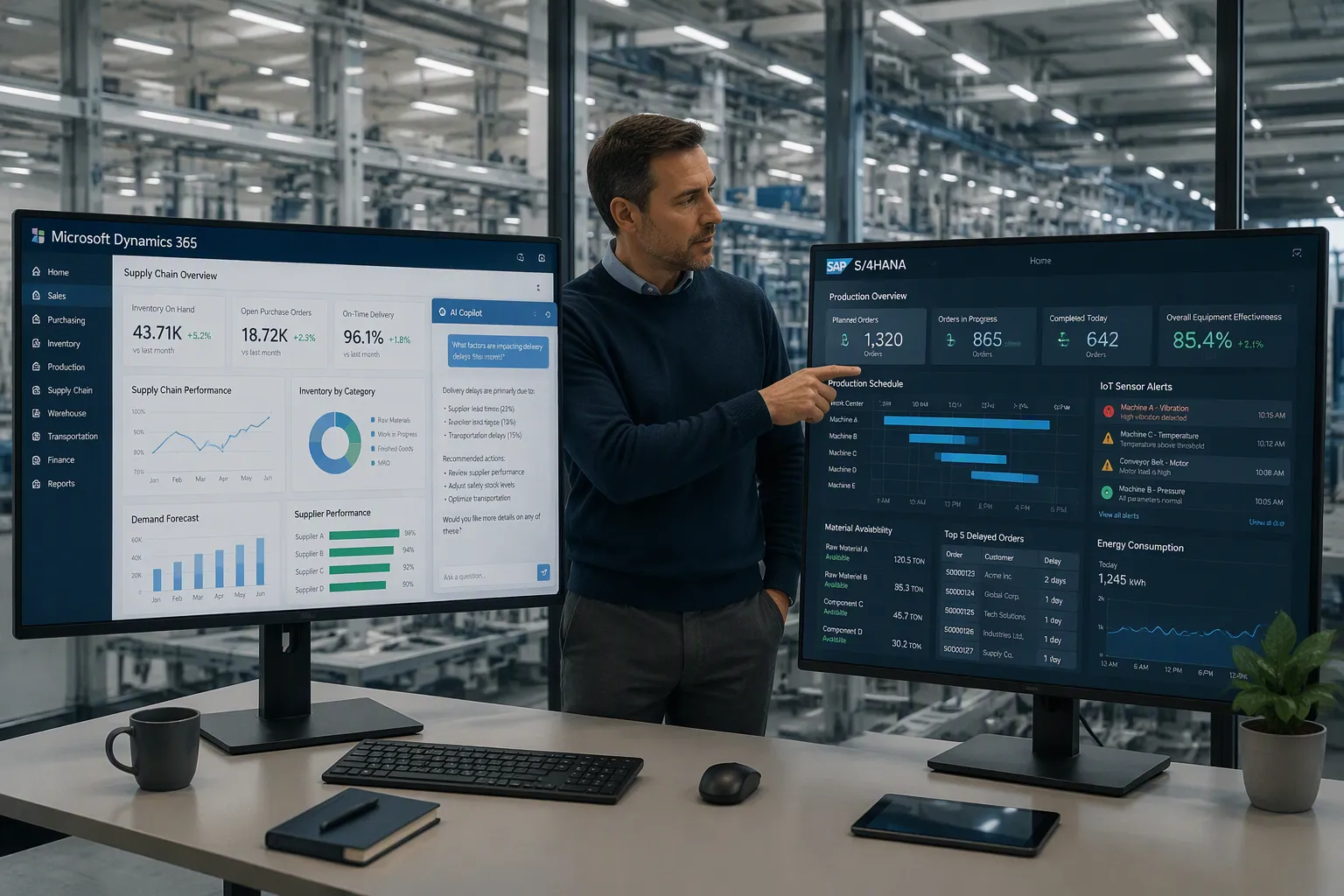
This section ranks three platforms by manufacturing fit, not by overall market size. Each vendor entry covers product overview, AI highlights, pricing, benefits, and downsides. A side-by-side table follows the vendor profiles.
Microsoft Dynamics 365
Overview and Manufacturing Fit
Dynamics 365 is a cloud-based erp platform for small and mid-size businesses through Business Central, and for enterprises through Finance and Supply Chain Management. Microsoft Cloud for Manufacturing pre-integrates five capabilities: Fabric for unified data, Dynamics 365 apps, Azure AI, Power Platform, and Copilot. This stack suits mid-to-large manufacturers already on Microsoft infrastructure.
AI and Copilot Highlights
Copilot embeds conversational AI across Power BI, Fabric, and Dynamics 365. Users ask plain-language questions such as "Show me invoices over $10,000 that are overdue." Copilot retrieves, summarizes, and drafts reports inside the workflow. In Supply Chain Management, AI improves demand forecasting, warehouse optimization, and production scheduling. IoT sensor insights detect equipment failures before they happen. Copilot Studio builds custom agents as an add-on.
Pricing and Licensing
Base licenses start from $70 per user per month. Finance and Supply Chain Management run roughly $180–$210 per user per month. Attach licenses cost about $20–$30. Implementation for a mid-size manufacturer runs $200,000 to $1M over 18 to 24 months.
Benefits and Downsides
Benefits include rapid deployment for SMBs, tight Teams and Outlook integration, and AI-driven insights. Downsides include high cost, required technical expertise, and long implementation.
SAP S/4HANA Manufacturing
Overview and Manufacturing Fit
SAP S/4HANA is an enterprise-grade erp system built on the HANA in-memory database. It runs cloud, on-premise, or hybrid. It fits large global manufacturers needing the deepest manufacturing AI capability on an enterprise ERP.
AI, Joule, and Industry Cloud
Joule is SAP's conversational AI assistant, supported by more than 40 specialized AI agents and Joule Studio for custom agents. Agents cover finance, procurement, manufacturing, sales, and leadership. The chart below shows the feature spread across business areas.
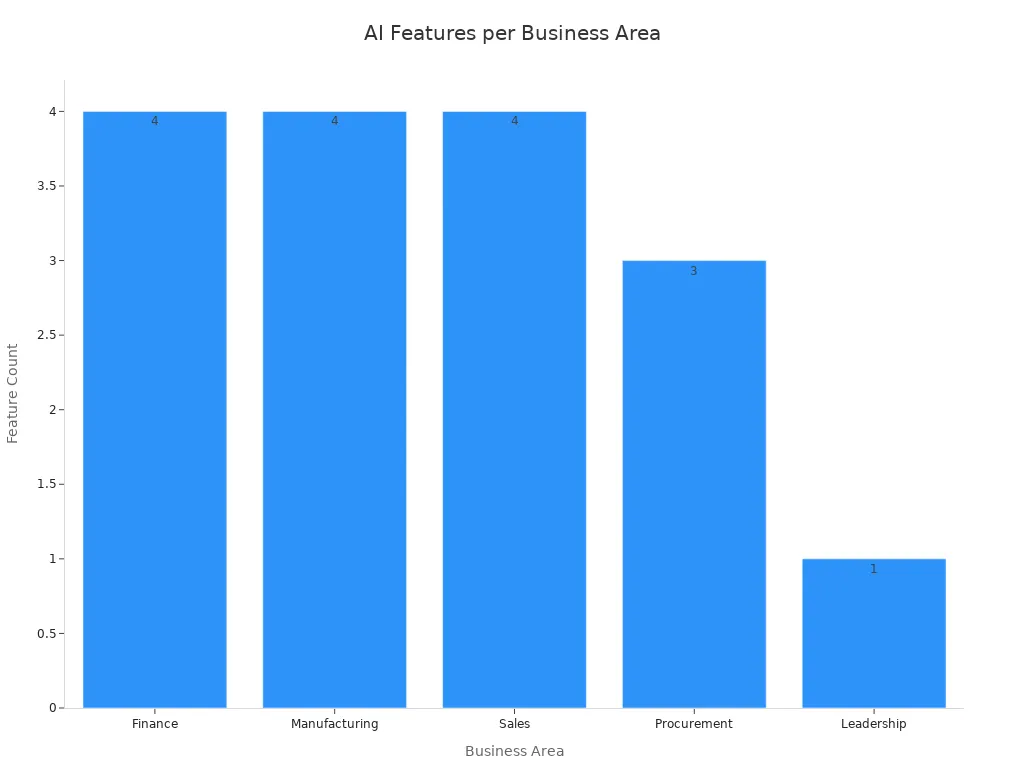
Manufacturing agents handle material gap detection, batch issue alerts, and production exception handling. A Production Planning and Operating Agent releases orders and tracks them in real time.
Pricing and Licensing
Base licenses run $150–$250+ per user per month. Implementation for a mid-size manufacturer runs $500,000 to several million dollars over 18 to 24 months.
Benefits and Downsides
Benefits include enterprise functionality across 20+ plants, AI-driven forecasting, and industry-specific modules. Downsides include high cost, a steep learning curve, and heavy IT demands.
Oracle ERP Cloud
Overview and Manufacturing Fit
Oracle ERP Cloud is an enterprise-grade platform focused on finance, supply chain, and HR. It suits enterprises seeking advanced AI-driven finance and supply chain automation with scalable, role-based agents.
AI and Fusion Applications
Oracle Fusion Applications embed AI across operations. More than 50 generative AI use cases span resource planning, human capital management, supply chain logistics, and customer experience. Capabilities include maintenance repair assessment, repair cost advice, quality inspection guidance, and exception handling. Oracle Digital Assistant builds custom chatbots.
Pricing and Licensing
Base licenses run about $625 per user per month. Implementation for a mid-size manufacturer runs $100,000 to $500,000 over 3 to 6 months for mid-market deployments.
Benefits and Downsides
Benefits include advanced AI for invoice processing, scalability to thousands of users, and role-based agents. Downsides include complex setup, skilled IT needs, and high cost.
Side-by-Side Comparison
| ERP System | AI Layer | Key AI Capabilities | Best For | Starting Price |
|---|---|---|---|---|
| SAP S/4HANA | Joule + 40+ agents | Predictive supply chain, autonomous finance, production planning | Large global manufacturers | Enterprise custom |
| Microsoft Dynamics 365 | Copilot + Copilot Studio | Demand sensing, agentic ERP, invoice processing | Microsoft-centric manufacturers | From $70/user/month |
| Oracle ERP Cloud | Built-in AI + Digital Assistant | Document processing, ledger management, forecasting | Finance-heavy enterprises | ~$625/user/month |
Licensing is typically the smallest part of total cost of ownership. Request a three-year TCO estimate covering implementation, internal resources, training, and data migration before comparing platforms on features.
Choosing the Best Manufacturing ERP Systems for Your Plant
Select from the best manufacturing erp systems with a systematic approach. The choice depends on pain points, data readiness, and AI maturity. The steps below guide manufacturers evaluating industrial ai platforms.
Step 1 — Map Pain Points to AI
Rank Use Cases by Impact
Start with the most costly problems. Unplanned downtime might cost thousands per hour. Inventory carrying costs erode profits. Rank use cases by financial impact. The best industrial ai platform should target high-impact areas first.
Define Success Metrics
Define metrics before selecting a vendor. One firm set a go-live criterion: a user created a complete customer order in under 10 minutes without help. That test confirms real operational support.
Success metrics fall into technical and business categories. Use improvement benchmarks for a manufacturing erp system with AI.
| Metric Type | Examples |
|---|---|
| Technical | Accuracy, Precision, Recall, Latency |
| Business | Cost savings, Revenue growth, Efficiency improvements |
| Metric | Improvement Range |
| --- | --- |
| Reduction in inventory carrying costs | 15–25% |
| Reduction in unplanned downtime | 20–35% |
| Improvement in on-time delivery rates | 10–20% |
| Reduction in quality defects | 8–15% |
| AI-driven forecasting accuracy | 15–30% |
Set targets against these ranges.
Step 2 — Run a Vendor Evaluation
Scorecard and Weighting
Use a structured scorecard. Weight each area when evaluating best manufacturing erp systems.
| Evaluation Area | Recommended Weight |
|---|---|
| Production track record in your industry | 30% |
| Data integration and governance methodology | 20% |
| Change management methodology and team | 20% |
| Governance and responsible AI practices | 15% |
| Knowledge transfer and independence architecture | 10% |
| Post-deployment monitoring and support | 5% |
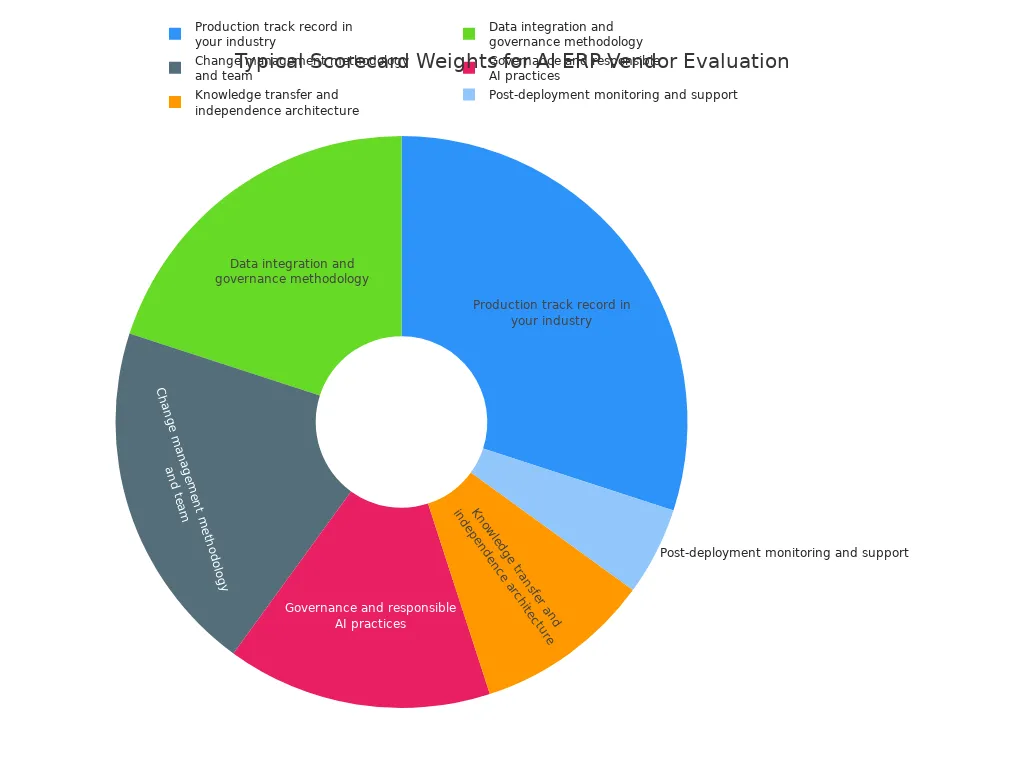
Industrial ai platforms with a high production track record weight perform best. Change management weight ensures operator buy-in.
Pilot Scope and Timeline
Test the system on one line or one plant. Define an 8–12 week timeline. Include real data integration and one AI use case. Measure against success metrics. Reconsider the vendor if the pilot does not improve results.
Step 3 — Prepare Data and People
Clean Master Data First
Over 70% of manufacturers plan large-scale digital updates with data migration. AI-enabled migration is 35% faster and reduces errors by 40%. Clean master data enables real-time insights and advanced automation.
Points for master data quality:
- Without governed master data, AI models generate unreliable insights and poor decisions.
- Inconsistent identifiers prevent accurate correlation of production output with supply chain inputs.
- Higher data quality increases confidence in AI-driven decisions.
- Clean master data supports demand forecasting, inventory optimization, and predictive maintenance.
Manufacturers need the best erp software systems for manufacturing to rely on clean data for production planning and scheduling.
Train Planners and Operators
Train users before go-live. Planners must understand AI recommendations. Operators must trust the system. Use hands-on training with real data. Change management starts during the pilot.
Take a self-assessment quiz or book a free consultation to shortlist the best manufacturing erp solution for your plant. These steps help you find the best manufacturing erp systems for your operation.
Dynamics 365 suits Microsoft-centric shops. SAP S/4HANA fits complex global manufacturers. Oracle ERP Cloud targets finance-heavy operations. Each delivers strong manufacturing erp capabilities. The right choice depends on use-case priority, existing stack, data maturity, and governance needs—not brand size. Rising contenders also deserve attention during evaluation.
Take the next step today. Complete a self-assessment quiz or book a free consultation. These tools help shortlist platforms matching your specific operation.
Industrial ai is heading toward agentic workflows and autonomous planning. Manufacturers should prepare their data and teams now. The best industrial ai platforms drive continuous improvement across every plant. Industrial ai embedded in erp transforms modern manufacturing. This industrial ai shift redefines what manufacturing erp can achieve.
FAQ
How do I choose between the three platforms for my plant?
Map your top three pain points first. Dynamics 365 suits Microsoft-centric shops. SAP S/4HANA fits global manufacturers with complex operations. Oracle ERP Cloud serves finance-heavy enterprises. Match the platform to your use-case priority, not brand size.
What ROI can a manufacturing erp with AI actually deliver?
Reductions in unplanned downtime range from 20% to 35%. Inventory carrying costs drop 15% to 25%. On-time delivery rates improve 10% to 20%. These ranges come from case studies cited in the guide above.
Can I integrate industrial ai with my existing MES and SCADA systems?
Yes. The platforms listed support ISA-95 layer integration. A hybrid architecture connects IoT sensors, edge computing, and cloud analytics with MES, ERP, and QMS. Verify data pipeline compatibility during your vendor pilot.
How long does a typical AI ERP implementation take?
A single-line pilot runs 8 to 12 weeks. Full multi-plant deployment for a mid-size manufacturer takes 18 to 24 months. Timelines depend on data maturity and change management readiness.
What data must be clean before deploying industrial ai?
Clean master data is essential. Inconsistent identifiers prevent accurate production correlation. Over 70% of manufacturers plan large-scale data migration. AI-enabled migration reduces errors by 40% and runs 35% faster than manual methods.
Is native AI better than a bolt-on analytics tool?
Native models read live production data through a real-time semantic layer. Bolt-on tools rely on scheduled batch extracts. This gap matters at high line speeds. Native models also deliver agentic automation across modules.
What governance standards apply to industrial ai platforms?
NIST AI RMF and ISO 42001 are becoming procurement requirements. The EU AI Act may classify ERP quality or predictive maintenance modules as high-risk. Review vendor AI roadmaps and audit trails before signing.
See Also
Why WarpDriven Supply Chain ERP Excels In Smart Enterprise Management
Top Ten E-Commerce Platforms That Integrate With Accounting Systems
How To Future-Proof Your B2B Order Fulfillment Strategy
Using AI To Improve Production Forecasting Accuracy: 2024 Enterprise Best Practices