
Machines on the shop floor produce a constant stream of real-time data. Yet many manufacturers still feed their ERP system through delayed spreadsheets, manual logs, or disconnected tools. This gap leaves decision-makers working with stale numbers and blind spots they cannot afford.
What if AI could bridge these two worlds automatically and continuously? The question matters because the stakes keep rising. Faster decisions, less downtime, and leaner operations all depend on connecting shop-floor data to the erp systems that run the business.
Operations leaders and IT teams both feel this pressure. They need a practical path forward, not another disconnected dashboard. AI offers that path.
Why Connecting Shop-Floor Data to ERP Matters
The Cost of Delayed Data
Traditional mes erp integration often works like a one-way postal service. Machines send signals to a central system, but the return path stays slow or missing. This creates lag and blind spots across the plant.
The financial impact is severe. Siemens reports that unscheduled downtime costs the world's 500 largest manufacturers approximately $1.4 trillion annually, equal to 11% of their revenues. ABB research across 3,200 global plant maintenance leaders shows two-thirds of plants experience unplanned downtime at least monthly, at an average cost of $125,000 per hour. The average annual downtime cost for a large manufacturing plant reaches $129 million, up 65% since 2019.
Manual data entry compounds the problem. A 100-operator, three-shift facility where each operator spends 30 minutes per shift on manual entry consumes 150 labor hours daily, equivalent annually to 26 full-time employees doing non-value-added data movement. McKinsey finds manufacturers lose $17,000–$30,000 per frontline employee per year due to broken systems and inefficient workflows.
Symptoms Manufacturers Recognize
Manual entry errors, stale inventory counts, and missed maintenance windows are common symptoms. Manual data entry carries roughly a 1% error rate, and research indicates the manual data entry error rate can reach as high as 4%. In a process of 10,000 transactions per month, roughly 400 transactions could contain mistakes. Automated systems achieve 99.959%–99.99% accuracy.
These errors cascade. Deloitte reports scrap and rework tied to this blind spot cost manufacturers 5–30% of total manufacturing expenses. McKinsey finds workers waste 32 days per year switching between applications.
AI-driven erp changes this picture. Real-time insights from AI-integrated erp systems reduce downtime and drive continuous improvement. Connecting shop-floor data to the erp system gives teams accurate, real-time data instead of stale reports. Real-time shop floor activity becomes visible across the business. Reliable shop floor data feeds the erp system automatically. This shift turns the shop floor into a source of real-time data that powers better decisions.
How AI Enables Machine-to-ERP Integration
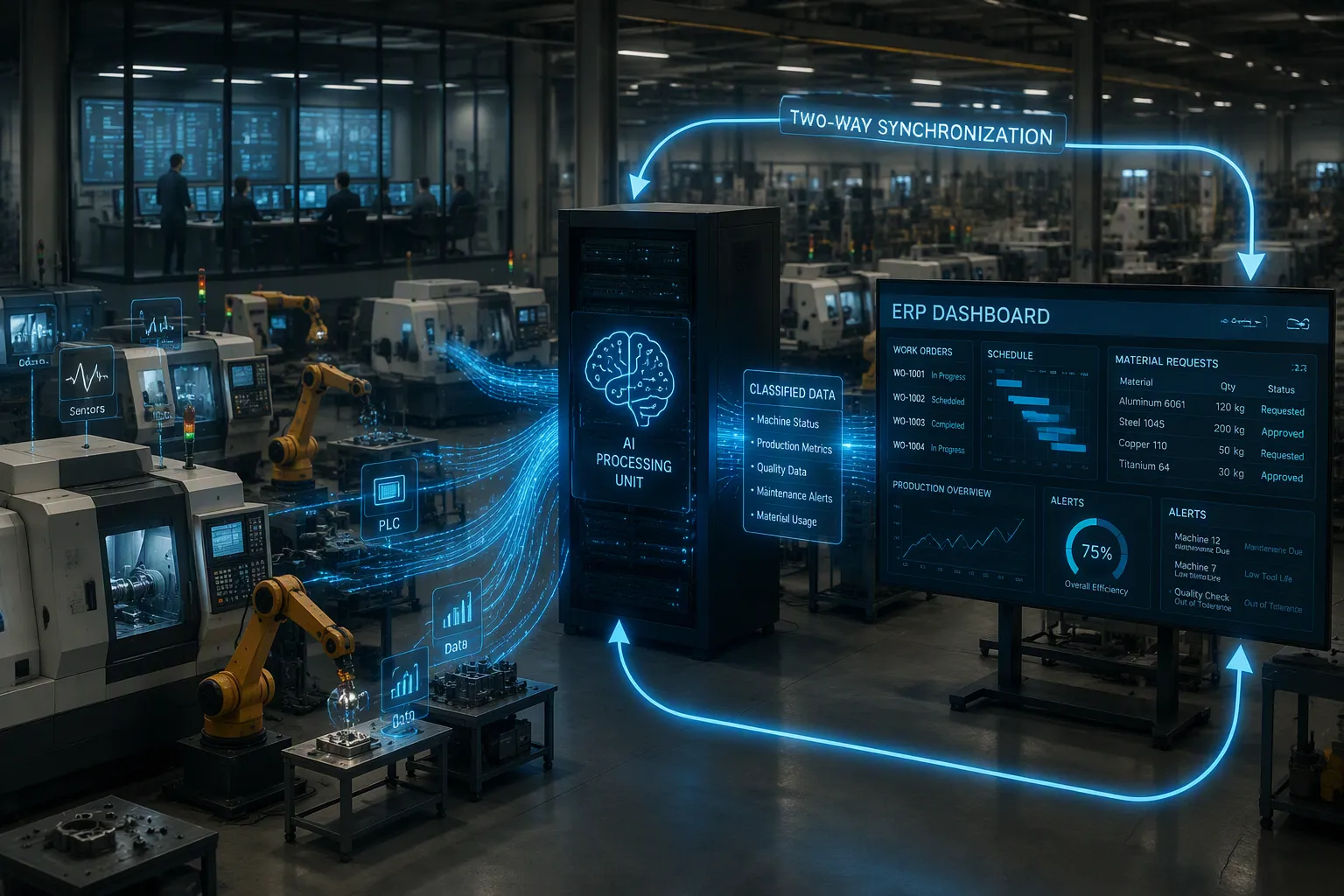
From Raw Signals to ERP-Ready Insights
Bidirectional synchronization replaces the one-way data flow that limits traditional setups. Machines send status, output, and condition signals upward. The erp system sends work orders, schedule changes, and material requests back down. This two-way link closes the loop between planning and production.
Platforms such as MachineMetrics bridge shop-floor machinery and erp through PLCs, SCADA systems, and sensors. These platforms collect raw signals at the source. AI then classifies that shop floor data and triggers automated workflows. A spindle speed drop, a temperature spike, or a cycle time drift becomes a structured event. The system routes that event to the right module without human entry.
This classification step matters for accuracy. AI-based anomaly detection reduces false alerts through several mechanisms. Load-normalized baselines measure deviations from a state-specific reference rather than a fixed threshold. Dynamic baseline learning lets the model adapt to seasonal temperature and production loads. A motor running hotter under heavy load is normal, and the system recognizes that. Pattern match confidence thresholds generate work orders only when an anomaly signature matches a failure pattern with more than 70% confidence. Ambiguous signals merely increase monitoring frequency. Closed-loop feedback feeds actual fault findings back into the model after each repair. False alarm rates fall below 5% by month 4.
The convergence of PLC systems, AI robotics, and erp software creates smart, connected factories. AI and erp work together as one operational layer. This is what machine-to-erp integration looks like in practice.
Benefits That Compound Across the Plant
The gains from ai-erp synchronization build on each other. Faster classification speeds every downstream step. Fewer false alerts mean fewer wasted work orders. Cleaner shop floor data for erp means planners trust the numbers they see.
Consider how ai in erp changes daily operations. Shop floor data collection runs continuously instead of in batches. Ai inside erp tools flag a deviation and open a maintenance request in seconds. The erp system routes that request to the right technician with the right parts list. Sending data from the erp system back to the factory floor confirms the work order and updates the schedule. This loop removes the manual reconciliation that consumes operator time.
The compounding effect shows up across functions. Maintenance teams act on real signals instead of calendar guesses. Inventory counts reflect actual consumption rather than period-end estimates. Production schedulers adjust to real capacity instead of assumed capacity. Each improvement feeds the next.
Ai in manufacturing also raises the quality of human decisions. Operators see context, not raw numbers. Planners see constraints, not surprises. Managers see throughput, not lagging reports. Connecting shop-floor data to the erp system turns fragmented signals into a single operational picture.
Shop floor data erp synchronization at this level requires more than a connector. It requires AI that understands context, learns from outcomes, and improves over time. That capability separates a basic integration from an intelligent one. The result is an ai-driven erp environment where the factory floor and the business system operate as one.
Connecting Factory Floor Data to ERP Systems in Practice
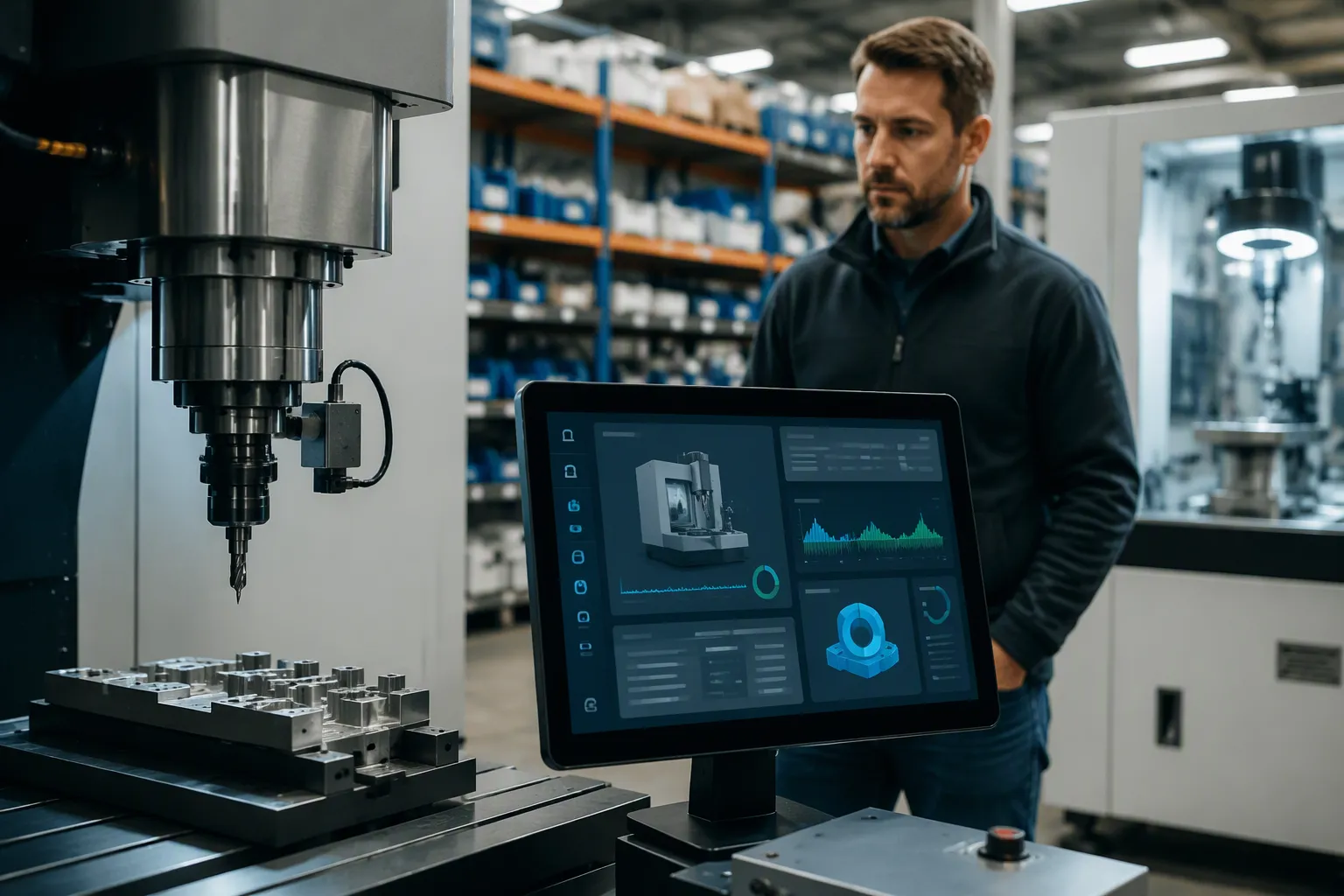
Predictive Maintenance and Inventory Sync
A spindle on a CNC machine begins to draw more current than its baseline. A vibration sensor picks up a shift in frequency. The platform classifies these signals as a bearing wear pattern and assigns a confidence score. When that score passes the threshold, the system opens a work order inside the erp system automatically. The order carries the machine ID, the suspected fault, and the recommended part. A planner never types a single line.
This is machine-to-erp integration at work. The same signal that triggers the work order also updates the spare parts record. The erp system checks whether the bearing sits in stock. If stock runs low, it raises a purchase request before the machine fails. Inventory counts then reflect real consumption instead of period-end estimates.
The payoff reaches beyond maintenance. A 2025 cross-sectional survey of smart production management reported a 37% reduction in stockout rate after sites adopted time-series machine learning and natural language processing for risk signals. The study measured change from baseline to post-adoption within each site and summarized results across sites by sample median. That figure reflects self-reported pre/post improvements, so teams should treat it as directional rather than guaranteed.
Quality Control and Production Scheduling
Quality signals follow the same path. An inline vision system flags a dimensional drift on a production line. That event flows into the erp system as structured data, not a paper tag. The erp system compares the drift against open orders and customer commitments. It then reschedules the affected batch and reroutes capacity to a line that still holds tolerance.
Real-time factory floor data changes the scheduling conversation. Planners stop reacting to yesterday's scrap report. They adjust today's sequence while the shift still has time to recover. Connecting shop-floor data to the erp system closes the gap between what the line produces and what the business promises.
Low-code intelligent erp automation makes this practical for mid-size plants. Teams configure rules and workflows through visual builders instead of custom code. A rule might read: when scrap exceeds a set threshold on a work order, hold the next batch and notify the quality lead. Connecting the factory floor and cloud lets that rule run against live signals from any site. The cloud layer handles data integration and analysis, and the erp system receives clean, structured input.
The same architecture supports ai in erp across functions. Maintenance, quality, and planning all draw from one stream of shop floor data. Each workflow triggers the next without manual handoffs. That continuity defines intelligent erp automation in manufacturing. Connecting factory floor data to erp systems stops being a project and becomes an operating norm. Teams gain real-time data they can trust, and erp synchronization runs continuously in the background.
Before and After Intelligent ERP Automation
A Side-by-Side Operational Comparison
Pre-AI operations depend on manual reconciliation and reactive maintenance. Operators fill out paper logs by hand. Supervisors collect forms at shift change. Clerks retype data into spreadsheets while fixing illegible notes. Managers spend the next morning reconciling discrepancies. Leadership receives reports roughly 24 hours late, by which time the downtime issue has already repeated.
Post-AI operations look different. Sensors log counts and cycle times automatically. Operators record exceptions digitally in seconds. Dashboards update in real time and stay visible to everyone. Managers see downtime spikes immediately and adjust scheduling before problems spread. The next shift starts clean with no data lag or guessing.
| Operational Metric | Before Intelligent ERP Automation | After Intelligent ERP Automation |
|---|---|---|
| Order entry accuracy | 1%–3% error rate; 5,000 orders/month ships 50–150 mistakes | ~99% order accuracy; exceptions caught before fulfillment |
| Mean time to repair | 24–48+ hours | 2–4 hours |
| Parts availability at first dispatch | ~55% | 95%+ |
| Data errors | Baseline | 20%–40% fewer |
| Overall equipment effectiveness | Baseline | 10%–15% increase |
Measuring Impact on Downtime and Efficiency
The numbers tell a clear story. World-class mean time to repair for complex industrial machinery sits under 5 hours. AI-triggered predictive work orders compress that figure toward a sub-2-hour target. That shift saves roughly 3 or more hours per repair. Unplanned downtime events fall by more than 70%. Maintenance costs drop by 30%.
Labor savings on repetitive tasks reach 25% to 50%. Reporting cycles run up to 30% faster. Email handling time per message falls from about 4.5 minutes to about 1.5 minutes. Inventory costs drop 32% after erp improvements. Operational inefficiency falls 23%.
These gains compound. Faster erp synchronization means planners trust the numbers. Cleaner factory floor data means fewer wasted work orders. Teams move from reporting what happened to improving what is happening. Meetings grow shorter because people discuss solutions rather than discrepancies. That is the measurable difference erp automation in manufacturing delivers.
AI turns fragmented shop-floor signals into ERP-ready intelligence. Machines no longer shout into a void. Their data flows into the erp system as structured, actionable events. Maintenance, quality, and planning teams then act on the same trusted picture.
The gains are measurable. Downtime falls, decisions arrive faster, and operational control tightens across every shift. Manufacturers who wait will watch competitors pull ahead. The path forward starts with a demo or a plant assessment. Modern manufacturing rewards plants that connect the floor to the business. That connection defines who stays competitive.
FAQ
What distinguishes AI-driven ERP integration from traditional MES-ERP links?
Traditional MES-ERP integration pushes data one way with delay. AI enables bidirectional synchronization. Machines send signals upward. The erp system sends work orders back down. This loop closes the gap between planning and production.
How does AI reduce false alerts in machine monitoring?
AI uses load-normalized baselines and dynamic learning. It triggers work orders only when confidence exceeds 70%. Ambiguous signals increase monitoring frequency instead. False alarm rates fall below 5% by month four.
What measurable gains can manufacturers expect from intelligent automation?
Unplanned downtime falls by over 70%. Maintenance costs drop by 30%. Labor savings reach 25% to 50%. Inventory costs decrease by 32%. Operational inefficiency falls by 23%. These gains compound across the plant.
Can mid-size plants implement this without custom code?
Yes. Low-code intelligent erp automation uses visual builders. Teams configure rules without writing custom code. The cloud layer handles data integration and analysis. Clean structured input flows to planning and operations.
See Also
Why WarpDriven Supply Chain ERP Excels In Smart Enterprise Management Systems
Using AI To Improve Production Forecasting Accuracy: Top 2024 Enterprise Strategies
Impress Your Customers Using Intelligent Machine Learning Order Systems
How Dynamic Slotting Revolutionizes The Way Warehouse Operations Work