
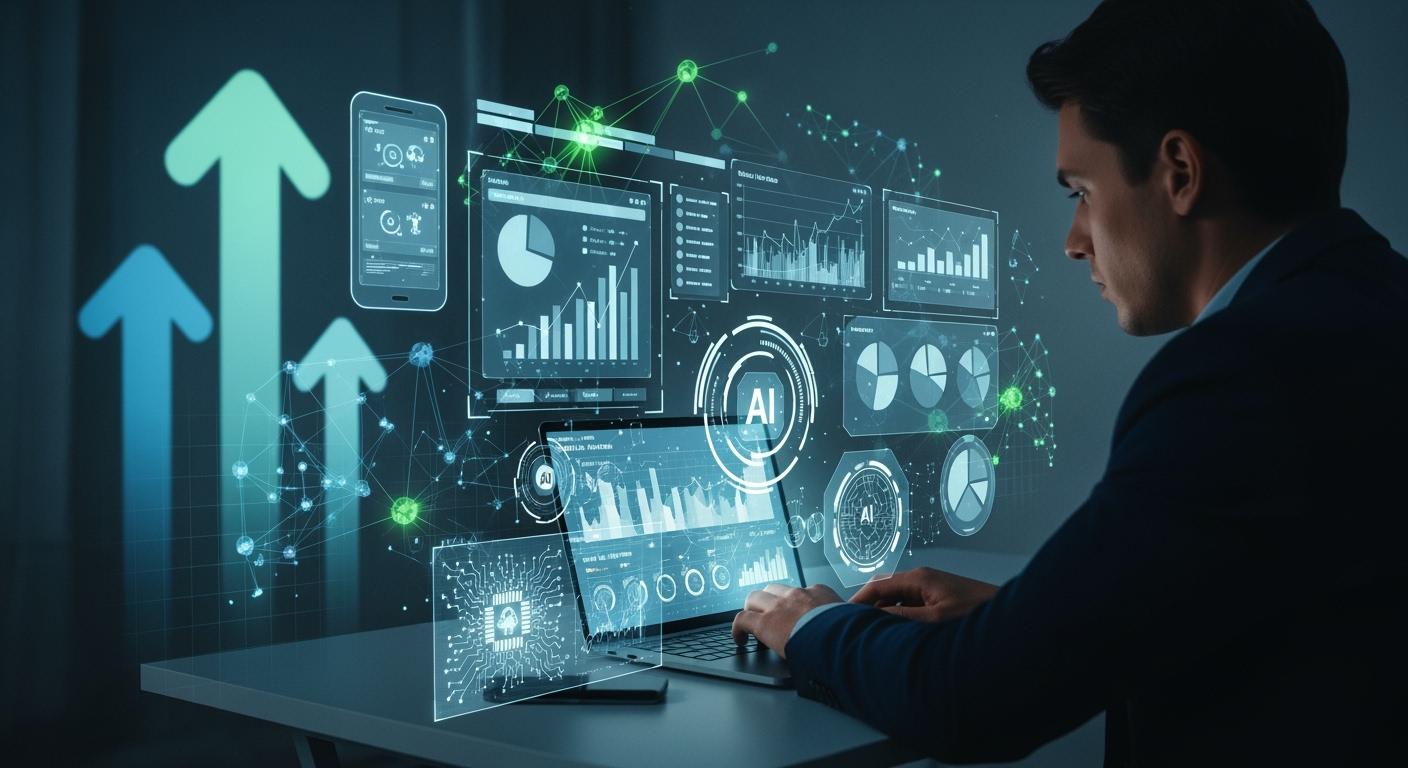
AI trend forecasting gives you the power to make smarter, faster product decisions. Imagine spotting a market shift before your competitors. Companies like Mondelez International and Avon use AI-driven insights to launch new products and boost sales, while Synopsys’ DSO.ai increases design productivity. You gain improved accuracy and waste reduction. Review the numbers:
| Metric | Improvement |
|---|---|
| Forecast Accuracy | Up to 30% improvement |
| Operational Costs | Up to 25% reduction |
| Forecast Errors | Reduction by 20–50% |
AI Trend Forecasting and Product Decisions
Strategic Impact of AI
You want your product decisions to drive growth and reduce risk. AI trend forecasting gives you that edge. Unlike traditional forecasting, which relies only on past data, AI demand forecasting combines historical information with external signals. This approach helps you spot shifts in demand before they become obvious. You can act on trend predictions, not just react to them.
AI-powered demand forecasting tools let you make decisions based on real-time updates. You do not have to wait for quarterly reports or manual analysis. You get instant feedback, so you can adjust your strategy quickly.
Here is how AI predictive analytics compares to traditional forecasting:
| Dimension | Traditional Forecasting | AI Predictive Analytics |
|---|---|---|
| Data Use | Historical only | Historical + external signals |
| Accuracy | Prone to bias/errors | Continuously improves with data |
| Responsiveness | Reactive | Proactive, real-time updates |
| Scalability | Limited by manual effort | Handles large SKU volumes easily |
| Business Impact | Higher risk, inefficiency | Lower risk, growth-ready decisions |
You see the difference. AI demand forecasting helps you scale your product lines and enter new markets with confidence. According to Gartner, companies will increase their use of AI and machine learning in forecasting by 50% in the next two years. This growth comes from the need for more accurate and timely forecasts.
Many leading brands use AI-driven trend forecasting to stay ahead. H&M uses AI to predict fashion trends by analyzing social media, search data, and market signals. In 2023, their AI detected a rise in demand for sustainable fashion. H&M increased production of eco-friendly clothing, which became a top-selling category. Unilever also uses AI to spot shifts in market demand, such as the move toward plant-based diets. This allowed them to expand their product line before competitors.
You can see more examples in the table below:
| Company | AI Application | Impact on Product Strategy |
|---|---|---|
| Eaton Corporation | Generative AI in product development | Reduced design time for an automated lighting fixture by 87%, enabling faster product launches. |
| Mondelez International | AI in snack development | Accelerated recipe development by 4-5 times, leading to over 70 new products and a 5.4% increase in sales. |
| H&M | AI-driven fashion forecasting | Optimized inventory based on trend predictions, reducing waste and increasing availability of in-demand items. |
| Unilever | AI-powered market analysis | Identified trends in plant-based products, allowing for a proactive expansion of their product portfolio. |
| L’Oréal | AI in beauty trendspotting | Detected rising interest in clean beauty, leading to the successful launch of a new product line. |
You can use these strategies to improve your own product launches and reduce time to market.
Data-Driven Insights for Teams
AI demand forecasting gives your team powerful data-driven insights. You can use these insights to make better decisions at every stage of product development. AI-powered demand forecasting tools analyze social media, search trends, and sales data. They help you predict fashion trends, spot emerging fashion trends, and understand what your customers want.
Here are the types of insights you get from AI demand forecasting:
| Insight Type | Description |
|---|---|
| Predictive Analysis | Uses social, search, and market data to forecast trend direction. |
| Social Media Metrics | Analyzes social trends and tracks brand and influencer engagement. |
| Market Intelligence | Identifies top market movers, products, and styles. |
| TikTok Intelligence | Analyzes consumer interest in trends, products, and styles on TikTok. |
| Trend Prediction | Identifies emerging trends before they become mainstream. |
| Product Development | Ensures product innovation is data-backed to maximize potential. |
| Retail Planning | Develops impactful merchandising and assortment decisions. |
| Customer Acquisition | Uses trend-precise strategies to resonate with customers. |
| Multi-Variable Analysis | Analyzes complex relationships among variables for better decision-making. |
| Real-Time Adaptation | Adjusts to changing market conditions dynamically. |
| Integration with Generative AI | Automates report generation and provides natural language explanations for non-technical users. |
You can use AI demand forecasting to turn raw data into actionable strategies. For example, you can cluster customer feedback and segment it by region, age, or product type. This helps you find new opportunities and address weaknesses. You can also use AI to conduct SWOT analyses, so you can prioritize ideas based on strengths, weaknesses, opportunities, and risks.
- AI demand forecasting helps you:
- Identify shifts in demand before your competitors.
- Optimize inventory and reduce waste in retail and fashion industry.
- Align your product strategy with real market needs.
- Improve customer satisfaction by responding to insights quickly.
- Support agile supply chains with real-time data.
For instance, if you notice a spike in negative feedback about a competitor’s product, you can adjust your own product features to fill the gap. This approach keeps your brand relevant and competitive.
Tip: Use AI and e-commerce platforms together to automate demand tracking and trend predictions. This will help you stay ahead in the fast-moving fashion market.
AI demand forecasting transforms your team’s workflow. You move from guessing to knowing, from reacting to leading. You can make smarter, faster decisions that drive growth and reduce risk.
What Is AI Trend Forecasting?
Core Concepts and Methods
You can use AI trend forecasting to spot patterns and predict changes in your market. This process uses advanced tools to scan large amounts of data and highlight what matters most. AI does not just look at numbers. It reads text, checks social media, and finds signals that humans might miss.
Here is a table that shows the main methods used in AI trend forecasting:
| Methodology | Description |
|---|---|
| Information Scanning & Summarization | Synthesizes huge amounts of text from many sources to answer key questions. |
| Thematic Analysis & Concept Identification | Finds recurring themes and new ideas in data. |
| Sentiment Analysis | Measures how people feel about topics in text data. |
| Keyword & Frequency Analysis | Tracks important words and how often they appear. |
| Weak Signal Detection & Anomaly Identification | Spots outliers and new ideas outside the mainstream. |
| Pattern Recognition | Detects complex patterns that are hard to see with simple tools. |
You can use these methods to understand what your customers want and where the market is heading. AI helps you make decisions based on facts, not guesses.
AI vs. Traditional Forecasting
You get faster and more accurate results with AI than with old methods. AI models use huge datasets and update their forecasts in real time. This means you see changes as they happen. Traditional forecasting depends on manual work and old data, which slows you down and can lead to mistakes.
- AI models learn from lots of data and give you dynamic, up-to-date predictions.
- Traditional methods rely on fixed rules and human input, making them less flexible.
- AI forecasting software uses machine learning to improve accuracy, which helps you manage inventory and set prices better.
- Gartner predicts that by 2028, half of all organizations will switch to AI for forecasting because it is faster, cheaper, and less biased.
Tip: When you use AI, you can react to market changes right away. This gives you a big advantage over competitors who still use slow, manual methods.
You can trust AI to help you make smarter product decisions and stay ahead in your industry.
AI Demand Forecasting in Product Development
Early Trend Detection
You want to spot new trends before your competitors. AI demand forecasting gives you this advantage. With ai-based demand forecasting, you can identify shifts in demand early and act fast. This approach helps you launch products at the right time and avoid missed opportunities.
You see the impact of early trend detection in industries like pharmaceuticals. For example:
- The first AI-designed drug, DSP-1181, entered clinical phases in just 12 months. Traditional methods usually take four to five years.
- Insilico Medicine used ai demand forecasting to find new drug targets and generate candidate molecules in only 18 months.
- BenevolentAI identified baricitinib as a possible COVID-19 treatment in three days.
These examples show how ai-driven trend forecasting can speed up product development and reduce risk. You can use ai demand forecasting to predict what customers want and adjust your strategy quickly. This keeps your business ahead in a fast-changing market.
Real-Time and Historical Data Analysis
You need accurate demand forecasts to manage inventory and plan production. Ai demand forecasting combines real-time demand sensing with historical data to improve accuracy. Ai-based demand forecasting systems analyze huge amounts of information, including past sales, weather patterns, and promotions. They also connect data from sources like transaction histories, customer loyalty programs, and social media.
With ai demand forecasting, you can:
- Recognize complex patterns in demand that humans might miss.
- Adapt quickly to changes in the market using real-time demand sensing.
- Unify structured and unstructured data for a complete view of demand.
- Make better decisions based on accurate insights.
Ai demand forecasting accuracy improves over time because these systems learn from new data. You get forecasts that help you reduce waste, optimize inventory, and respond to demand shifts. In retail, this means you can keep shelves stocked with the right products and avoid overproduction. Ai-based demand forecasting supports agile supply chains and helps you stay competitive.
Tip: Use ai demand forecasting to combine real-time demand sensing with historical data. This approach gives you the most reliable insights for your product strategy.
Advantages of AI-Based Demand Forecasting
Forecast Accuracy and Waste Reduction
You want your business to make decisions with confidence. AI-based demand forecasting gives you that power. You can use advanced models to process more than 40 demand signals at once. This leads to a 30% gain in accuracy compared to manual methods, which only use a few signals. When you improve accuracy, you reduce waste and save money.
You can see the difference in this table:
| Forecasting Method | Occupancy Forecast Accuracy | Revenue Forecast Precision | Staffing Demand Accuracy | F&B Demand Accuracy |
|---|---|---|---|---|
| AI Multi-Variable Model | 92% | 88% | 85% | 83% |
| Statistical Time-Series | 78% | 71% | 68% | 64% |
| Manual / Spreadsheet | 62% | 55% | 52% | 48% |
| Accuracy Gain | 30% | 30-40% reduction in food waste |
You can also view the improvement in this chart:
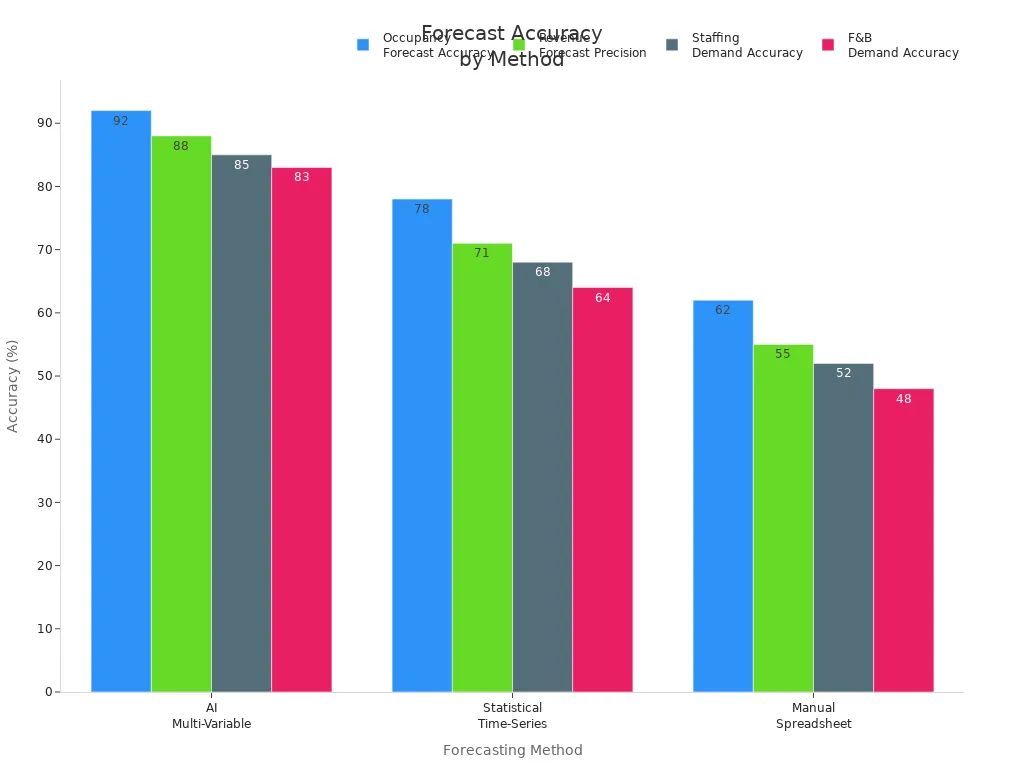
AI-based demand forecasting helps you cut food waste by up to 40%. You can also eliminate 15-22% in unnecessary labor costs with more accurate staffing forecasts. In retail, you can keep shelves stocked with the right products and avoid overproduction.
Here are some real-world examples:
- Marshalls used AI to optimize inventory during the COVID-19 pandemic. The team made 4,000 data-driven forecasting decisions each day and managed orders worth nearly £300,000.
- P&G used an AI-powered platform to reduce forecast errors by 30%. The system analyzed real-time data from many sources.
- Zara and Walmart improved forecast accuracy and reduced stockouts by using AI in inventory management.
You can see that better accuracy leads to less waste, lower costs, and higher customer satisfaction. You do not have to rely on guesswork. You can use data to drive every decision.
Note: AI-based demand forecasting leads to a more efficient production schedule. You can adjust your operations based on predictive data, not just react to shortages.
Agile Supply Chains
You need your supply chain to respond quickly to changes. Predictive analytics powered by AI and machine learning makes this possible. You can use demand forecasting to optimize inventory, improve accuracy, and react to market shifts in real time.
Here is how predictive analytics supports agile supply chains:
- You get real-time insights, so you can monitor and react to sales changes, consumer behavior, and outside factors.
- You improve accuracy by updating predictions as market conditions change.
- You can adjust resources quickly, such as rerouting shipments or changing suppliers.
- You reduce risk by spotting bottlenecks or shortages early and taking action.
- You build a more resilient and competitive supply chain.
You can compare organizations that use AI trend forecasting with those that do not:
| Key Benefit | Description |
|---|---|
| Improves planning | AI analyzes large data sets to identify patterns for more accurate forecasts. |
| Provides real-time insights | AI continuously analyzes data to produce near real-time insights for timely adjustments. |
| Improves scalability | AI handles increased data complexity without needing to scale staff levels. |
| Optimizes inventory | Accurate forecasts help maintain optimal inventory levels to meet demand without excess. |
| Increases revenue | Cumulative benefits lead to higher revenue through optimized operations and customer satisfaction. |
You can see that AI-based demand forecasting gives you a clear advantage. You can respond to disruptions, meet customer needs faster, and keep your business moving forward.
Tip: Use AI-powered demand forecasting to make your supply chain more agile. You can fulfill consumer needs faster and stay ahead of the competition.
Technology Behind AI-Driven Trend Forecasting
Machine Learning and Deep Learning
You rely on advanced technology to power your demand forecasting. Machine learning and deep learning models help you analyze huge amounts of data from many sources. These models learn from patterns in sales, social media, and customer behavior. You can use them to predict what products will become popular and when demand will rise or fall.
Here are the main technologies used in trend forecasting systems:
- Machine learning algorithms process large datasets, including images and sales records.
- Visual recognition tools spot new trends in fashion and design.
- Natural language processing (NLP) helps you understand what people say about products online.
- Predictive analytics forecasts changes in colors, styles, and materials.
Deep learning models, such as RNNs and LSTMs, capture complex patterns in time-series data. These models can learn from many layers of information. You get more accurate predictions because they handle nonlinear relationships. The table below shows how different models compare in accuracy:
| Model Type | Accuracy (%) |
|---|---|
| Proposed DNN | 94.9 |
| Random Forest | 85.7 |
| Support Vector Machine | 60.07 |
| Logistic Regression | 52.45 |
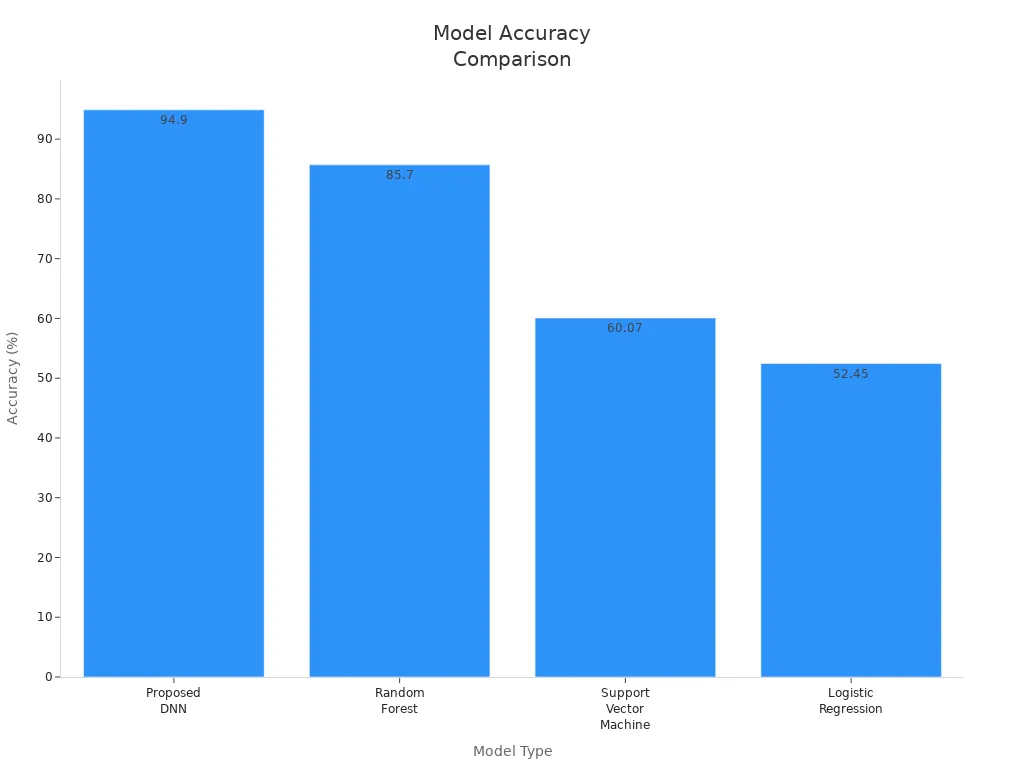
You can also use explainable AI tools like SHAP and LIME. These tools show you which factors drive your predictions. This builds trust in your demand forecasting results.
Pattern Recognition in Big Data
You need to spot trends before they become obvious. Pattern recognition in big data helps you do this. You can find gaps in the market and discover new ways to grow your business. Here is how pattern recognition supports your demand forecasting:
- Identify market opportunities by revealing unmet needs.
- Recognize user behavior patterns to improve products.
- Detect early trends so you can adjust your strategy quickly.
- Analyze operational data to boost efficiency.
- Collect high-quality data from many sources for better results.
- Use advanced tools like data visualization, predictive analytics, and NLP to find patterns.
- Conduct user research to get both numbers and opinions.
- Segment and analyze data to understand trends and causes.
- Make data-driven decisions to act on new product trends.
You use technology to turn raw data into clear insights. This helps you stay ahead in a fast-changing market.
Tip: Combine machine learning, deep learning, and pattern recognition to get the most from your demand forecasting technology.
Practical Applications of AI in Product Development
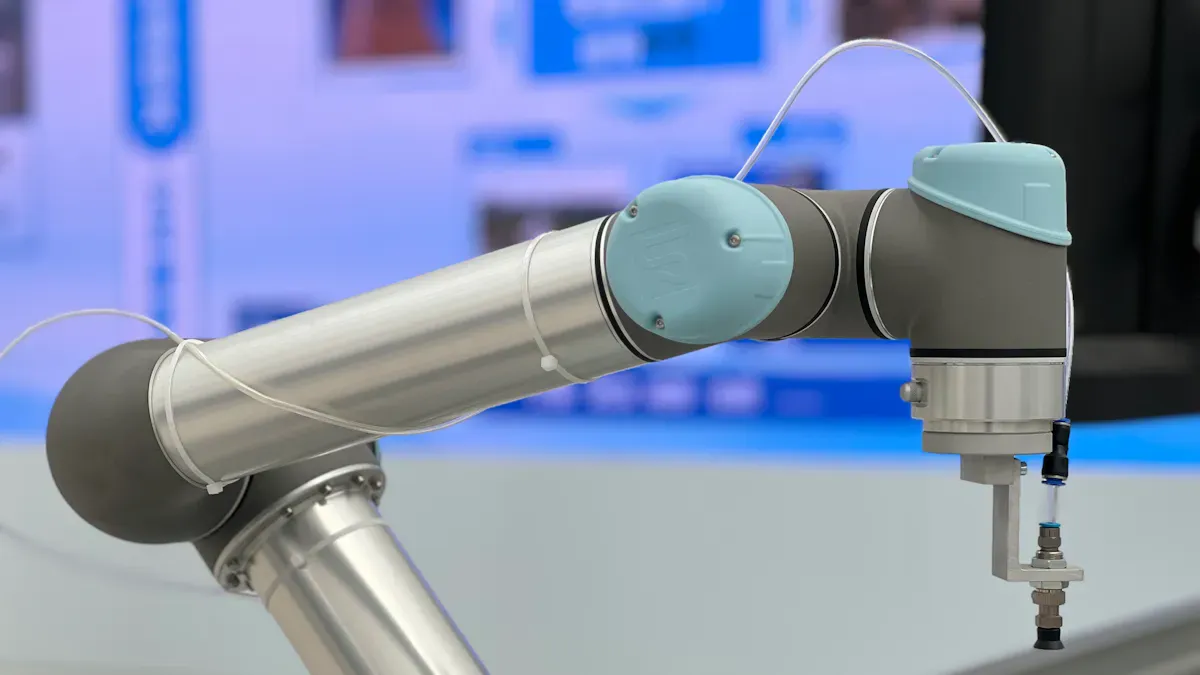
Inventory Optimization
You can achieve inventory optimization through ai forecasts by using advanced systems that process sales and social media data. In the fashion industry, companies rely on ai to predict fashion trends and keep shelves stocked with the right products. For example, More Retail Ltd. improved forecast accuracy from 24% to 76% and reduced waste by 30%. Walmart uses robots and ai-driven platforms to scan aisles and manage inventory, making restocking faster and more accurate. The table below shows how leading companies use ai for inventory optimization:
| Company | AI Application | Results |
|---|---|---|
| More Retail Ltd. | Amazon Forecast | Forecast accuracy improved from 24% to 76%, in-stock rates for fresh produce increased from 80% to 90%, waste reduced by 30%, gross profit up by 25%. |
| Walmart | Bossa Nova shelf-scanning robots | Robots were 50% more productive and three times faster than manual scanning, reducing out-of-stock items and improving shelf compliance. |
| Amazon | Machine learning for demand forecasting | Achieved a 15% reduction in stockouts, improving inventory efficiency and service levels. |
You can see how ai helps you keep up with demand, reduce waste, and improve profit.
Sustainability Planning
You want your business to grow while protecting the environment. Ai-powered demand forecasting helps you reach this goal. You can use ai to enhance sales and reduce waste in retail. This technology lets you respond to customer trends quickly, which supports sustainable practices. Retailers using ai for demand forecasting can meet up to 45% of their carbon reduction targets. You also eliminate waste and avoid overproduction, which is crucial for sustainability. When you adapt to changing trends, you keep your business competitive and eco-friendly.
- Ai-powered demand forecasting reduces waste.
- You align production with real demand.
- You support your sustainability goals and stay ahead in the market.
Market Alignment
You need to launch products that match what customers want. Ai trend forecasting gives you this power. Traditional methods have error rates between 15-30%, but ai-powered methods lower this to 5-15%. This accuracy helps you align new products with market needs. Ai models detect early signals, like changes in search activity or buying patterns. You can launch trending fashion products before your competitors and secure a strong position in the market. Ai also lets you analyze consumer behavior at scale, so you can personalize marketing and product offerings. This is important because 71% of customers want personalized recommendations.
Tip: Use ai to analyze social media and sales data. You will spot new fashion trends before they become mainstream and make better design and production decisions.
Integrating AI Trend Forecasting into Workflows
Overcoming Implementation Challenges
You may face several obstacles when you bring demand analytics into your product development process. Many organizations struggle with data privacy and ethical concerns. You must follow strict rules like GDPR, which can slow down your progress. High initial costs for technology and skilled staff often make it hard for smaller brands to start using demand forecasting. If you run a niche brand, you might not have enough data to train your models, which can lead to weak demand insights.
Some teams resist new technology because they worry that automation will replace creative roles. Over-dependence on automation can also limit creativity and innovation in your product development. You need to balance the power of demand analytics with human expertise.
Common challenges include:
- Navigating data privacy and compliance requirements
- Managing high upfront costs for technology and talent
- Working with limited data for niche or new products
- Addressing resistance from teams used to traditional processes
- Avoiding over-reliance on automation to keep creativity alive
Note: You can overcome these challenges by planning carefully and involving your team early in the process.
Best Practices for Adoption
You can set your team up for success by following proven steps for adopting demand forecasting. Start by assessing your readiness for ai-powered analytics. Make sure your data is organized and validated before you begin. Choose demand forecasting tools that fit your business goals and inventory needs. Pilot test your approach in a safe area to learn what works best.
Encourage your team to learn about demand analytics and work together. Training and collaboration help everyone feel confident using new tools. When you follow these best practices, you build a strong foundation for demand forecasting in your workflow.
Key steps include:
- Assess your readiness for ai adoption
- Organize and validate your data
- Select demand forecasting tools that match your goals
- Pilot test in a controlled environment
- Train your team and promote collaboration
Tip: Start small, learn from your results, and scale up as your team gains confidence.
Getting Started with AI Trend Forecasting
Assessing Readiness
You need to check your organization’s readiness before you launch a demand forecasting project. Start by making sure your data matches the decisions you want to improve. Review who is represented in your data and think about any possible risks. Give your teams responsible access to data across departments. Keep clear records of how you collect and use data.
You can follow these steps to assess your readiness:
- Complete a thorough review of your data for accuracy, consistency, and timeliness.
- Track where your data comes from and how it changes over time.
- Look for bias in your data and fix it before you use it for demand forecasting.
Tip: Good data leads to better demand forecasting results. Make sure your data is clean and well-documented.
Selecting Tools and Partners
You want to choose the right tools and partners for your demand forecasting journey. Look for solutions that offer advanced analytics and machine learning. Make sure the tools can connect with your existing systems and handle real-time data. A user-friendly interface helps your team work faster.
Here are the features you should look for:
| Essential Features | Description |
|---|---|
| Multi-Model Forecasting Engine | Supports different forecasting models for flexibility |
| Automated Model Selection & Tuning | Reduces manual work in model setup |
| Real-Time Data Integration | Keeps forecasts up to date with market changes |
| Scenario Planning & What-If Analysis | Lets you test different demand scenarios |
| Seamless ERP & System Integration | Works with your current business systems |
| User-Friendly Interface | Easy for everyone to use |
| Explainability & Transparency | Shows what drives your forecasts |
| Collaboration & Role-Based Access | Supports teamwork across departments |
| Scalable Architecture | Grows with your business needs |
| Security & Compliance | Meets high security standards |
When you select the right partner, you boost profitability by reducing waste and improving inventory. You also improve customer satisfaction and make your operations more efficient. The right tools help you respond quickly to market changes and make better demand decisions.
If you want to know how to get started with ai forecasting, begin with a readiness check, then choose tools that fit your needs and support your goals.
You see the transformative impact of ai trend forecasting in product development. Companies achieve up to 50% improvement in forecast accuracy, manage inventory better, and respond to market changes in days. You can anticipate demand shifts and align production schedules with confidence. Product managers use ai trend forecasting to create products faster and more cost-effectively. Generative AI will soon become an enterprise-level resource, delivering strategic value across organizations.
The future of product strategy will focus on building enterprise applications that harness ai trend forecasting to address real customer needs and drive market success.
FAQ
What is AI trend forecasting?
AI trend forecasting uses machine learning to analyze data and predict market changes. You can spot new trends early and make better product decisions.
How does AI improve demand forecasting accuracy?
You use AI to process many data sources at once. This increases forecast accuracy by up to 30%. You reduce errors and make smarter inventory choices.
Is AI trend forecasting expensive to implement?
You may face high initial costs for tools and training. Over time, you save money by reducing waste and improving efficiency. Many solutions now offer scalable pricing.
Can small businesses use AI trend forecasting?
You can use AI trend forecasting even if you run a small business. Many platforms offer user-friendly tools and flexible plans. You do not need a large team to get started.
See Also
Machine Learning Techniques Forecast Fashion Trends And Increase Revenue
Artificial Intelligence Powers Demand Predictions For Shopping Success
Using Sales Data To Deliver Precise Fashion Trend Predictions
Fashion Retail In 2025 Enhanced By Predictive Analytics Models
How Predictive Analytics Harmonizes Fashion Supply And Demand