

You see ai changing how businesses work every day. In 2024, 78% of companies use ai in at least one function. The numbers keep rising, showing a 23 percentage point increase from last year. 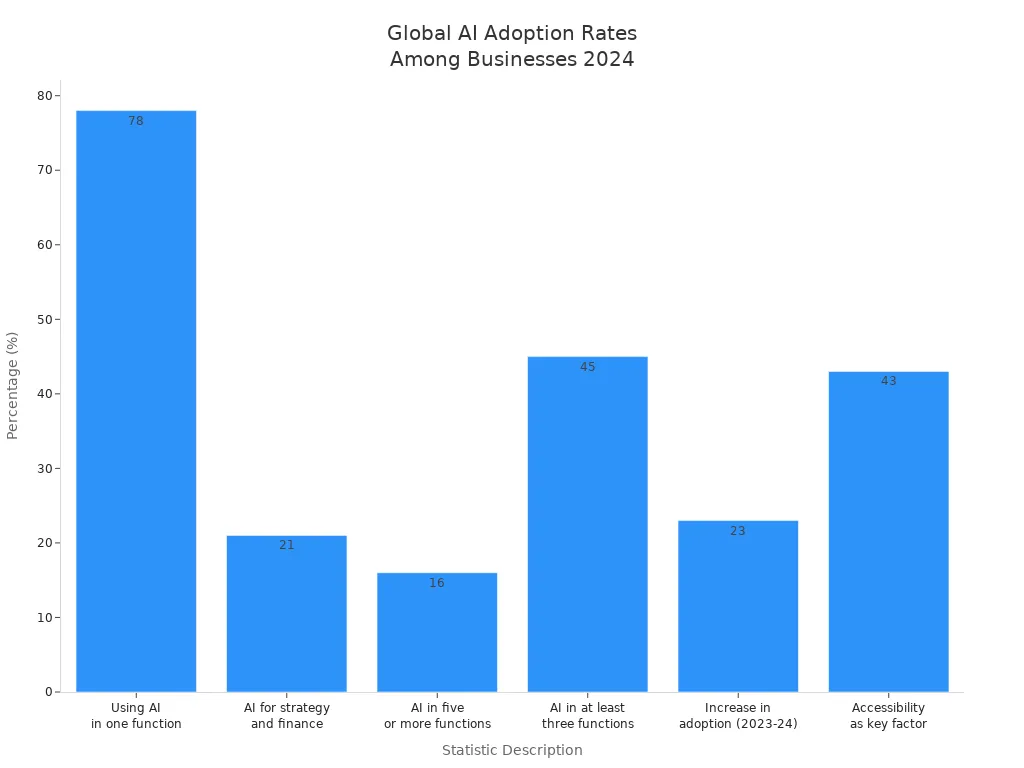 The impact reaches many industries. For example, healthcare saves $150 billion each year, and manufacturing adds up to $2.2 trillion. The AI Transformation Guide helps you understand these changes.
| Sector | Projected Economic Impact |
|---|---|
| Healthcare | Saves $150 billion annually by 2030 in the U.S. |
| Manufacturing | Adds $1.5 trillion to $2.2 trillion annually |
| Finance | Saves over $447 billion by 2030 |
AI Transformation Guide Overview
What Is AI Transformation?
You need a clear understanding of what an ai transformation guide covers before you start any business transformation. This guide helps you see how ai changes your company’s culture, processes, and technology. Leading organizations use ai to boost productivity, cut costs, and spark innovation. You can use this guide to plan your ai initiatives and make smart choices for your team.
Here is how experts describe the main parts of an ai transformation guide:
- Governance sets rules for responsible ai use.
- Strategic use of generative ai helps you solve problems in new ways.
- Build vs. buy decisions let you choose the best tools for your needs.
- Success metrics show if your ai initiatives work.
- Understanding organizational needs keeps your guide focused.
- Balancing control with autonomy empowers your workforce.
- Simplifying technology stacks makes ai easier to use.
- Continuous innovation keeps your business transformation moving forward.
You can see the key components of ai transformation in the table below:
| Key Component | Description |
|---|---|
| Technology integration | Use ai tools like machine learning, natural language processing, and automation to improve productivity and cut costs. |
| Cultural shift | Build a mindset of curiosity, flexibility, and learning. Ai should enhance—not replace—human skills. |
| Process redesign | Embed ai where it adds value. Automate what’s repetitive. Focus people on higher-impact work. |
| Data quality | Strengthen data management to ensure ai can deliver accurate, reliable insights. |
| Change management | Use a structured approach—like the Prosci Methodology—to guide adoption, build trust, and drive success. |
| Governance and ethics | Establish clear rules for responsible ai use, covering privacy, bias, and fairness. |
Why Change Management Matters
You need a comprehensive guide for change management when you start an ai transformation. Many ai projects fail because of poor project management and weak organizational change. You can avoid these problems by following guides that focus on people, not just technology. A people-centric approach helps you build trust and align your team with your business transformation goals.
Research shows that companies using a comprehensive guide for digital transformation succeed more often. You can use ai tools to improve communication, automate tasks, and support your team. Ai also helps you predict risks and personalize support, which boosts engagement and trust. When you follow a guide that puts people first, you set your ai initiatives up for long-term success.
Common Challenges in AI Transformation

Resistance to Change
You may notice that resistance to change is one of the biggest barriers in ai transformation. Many employees feel uncertain when new ai tools arrive. Some worry about job security or do not trust the technology. In fact, 31% of workers admit to actively sabotaging their organization’s ai efforts. A conservative business mindset can slow down enterprise-wide transformation. Change often disrupts comfort and satisfaction, making it hard for teams to adapt. You need to address these concerns early to build trust and encourage participation.
Vision and Strategy Gaps
Without a clear vision, ai transformation can stall. If leaders do not set a strong direction, projects may never move beyond the proof-of-concept stage. You might see wasted investments in tools that do not fit your workflows. Employees can become disengaged if they feel confused or fearful. Delayed transformation can erode your competitive advantage. To avoid these problems, you should define who owns ai decisions and build adaptive workflows. Invest in bridge roles that connect technology and business goals.
Skills and Talent Shortages
You will face a growing demand for ai talent during organizational transformation. The number of job postings requiring ai skills is rising fast. For example, in 2023, there were 1 million postings, and by 2025, this number will reach 7 million. Companies compete for talent, and hiring alone cannot fill the gap. Workers with ai skills now earn a 56% wage premium. You need to focus on reskilling and upskilling your current workforce, not just hiring new talent. Create a skills-based framework and use ai-powered training to help employees grow.
| Year | Job Postings Requiring AI Skills | Growth Rate (%) |
|---|---|---|
| 2023 | 1 million | N/A |
| 2025 | 7 million | 600 |
| Late 2024 | 16,000 per month | N/A |
| 2025 (end) | Expected to triple | N/A |
Technology Alignment Issues
You may struggle to align ai systems with your business goals. Problems like bias, misinformation, and reward hacking can appear. Sometimes, ai projects do not reinforce each other or support enterprise-wide transformation. Leaders must communicate clearly and set shared goals. Focus on outcomes, not just technology platforms, to ensure your ai transformation delivers value.
Governance and Ethics
Governance and ethics play a key role in ai transformation. You must ensure that ai promotes well-being, avoids harm, and supports fairness. Algorithmic bias can lead to discrimination, so you need ethical auditing and risk assessment. Users should have control over how ai affects their lives. Regulatory frameworks, such as the EU AI Act, require compliance and ethical oversight. Without clear guidelines, your business risks financial penalties and reputational damage. Strong governance builds public trust and supports responsible innovation.
The opacity of many machine-learning models, the so-called “black box” problem, complicates these issues further, making it difficult to trace decision pathways or assign liability. Without clear accountability structures, ethical breaches risk going unchecked, eroding public confidence in both technology providers and regulators.
Complete Strategy Guide for AI Change
Strategy Development
You need a clear plan to guide your ai transformation. A complete strategy guide helps you connect your ai strategy with your mission, vision, and purpose. This alignment gives your enterprise a strong foundation for growth and competitive advantage. You can use a proven framework to build your approach. Many organizations use models like the Kotter 8-Step Process, McKinsey’s 7-S Framework, and the ADKAR Model. These frameworks help you manage change and keep your team focused.
| Framework Name | Description |
|---|---|
| Kotter 8-Step Process for Leading Change | A structured approach involving eight steps to lead change effectively. |
| McKinsey & Company’s 7-S Framework | Focuses on seven elements that influence organizational change, emphasizing shared values. |
| Kurt Lewin’s Change Model | A three-step model that includes unfreezing, changing, and refreezing to manage change. |
| ADKAR Model | Outlines five key stages of change: Awareness, Desire, Knowledge, Ability, Reinforcement. |
| The Kübler-Ross Model | Describes the emotional stages individuals go through during change. |
| Satir Change Management Model | Illustrates the stages of change from resistance to integration. |
| William Bridges’ Transition Model | Focuses on the psychological transition individuals experience during change. |
You can also use maturity models to check your current ai capabilities. These models show your strengths and gaps. They help you decide where to invest in technology, data, and talent. Maturity models guide you to align your ai strategy with your business goals. This alignment leads to more value, lower costs, and better customer satisfaction. You can use these tools to make your transformation smooth and effective.
Tip: Start by aligning your ai strategy with your organization’s mission and vision. This step ensures your ai transformation supports your long-term goals.
People Enablement
People drive organizational success. You need to help your team learn new skills and adapt to ai tools. A comprehensive strategy for people enablement includes training, feedback, and support. You can follow these best practices:
- Equip your team with the skills to use ai tools.
- Make it easy for team members to share examples and feedback.
- Track adoption and measure the value of ai initiatives.
You should involve everyone in your enterprise. Executives can learn to use dashboards and approve releases. Domain owners and team leads can report on key performance indicators. Automation builders can use visual tools to create solutions. Team members can lead efforts to automate daily tasks. This approach builds trust and encourages innovation.
Tracking adoption is important. You can use metrics like weekly active users and completed tasks. These numbers show how well your team uses ai. You can also measure value by looking at cycle time and cost-to-serve. These metrics help you see the impact of your ai transformation.
| Method/Metric | Description |
|---|---|
| Measuring Behavioral Change and Business Impact | Tracks learning translation into on-the-job behavior and correlates with business KPIs to show ROI. |
| Content Effectiveness Analysis | Analyzes learner engagement and feedback to identify effective resources and areas for improvement. |
| Real-time Intervention and Support | Provides immediate support through AI tools, enhancing the learning experience and addressing challenges. |
You should focus on value, not just activity. For example, measure customer issues resolved or satisfaction scores. For developers, track feature usage rates or defect reduction. This focus helps you see real progress and supports continuous improvement.
Platform and Technology Alignment
You need to align your platforms and technology with your ai transformation goals. A proven framework for technology alignment includes governance, data readiness, scalable architecture, and change management. You can use the ISO/IEC 42001:2023 standard to manage ai systems and build trust.
| Critical Success Factor | Description |
|---|---|
| Governance Framework | ISO/IEC 42001:2023 provides a framework for AI management systems, emphasizing risk management and stakeholder trust. |
| Data Readiness | 70% of organizations face challenges with data governance, impacting AI model integration. |
| Scalable Architecture | Flexible hybrid cloud approaches are essential for addressing future business growth and technology scalability. |
| Change Management | Executive sponsorship and cross-functional teams are crucial for overcoming resistance and ensuring sustainable transformation. |
You should set up board-level oversight and align ai initiatives with business objectives. Data governance councils and quality standards improve ai model effectiveness. Hybrid cloud solutions support growth and prevent vendor lock-in. Executive sponsorship and cross-functional teams help you overcome resistance and drive transformation.
Modern enterprise platforms let business users join the integration process. Ai can predict integration failures and help you fix problems before they grow. You need new governance frameworks to manage the complexity of ai. This approach ensures accountability and supports enterprise-wide innovation.
Governance and Risk
Strong governance and risk management protect your enterprise during ai transformation. Existing governance systems often focus on human-driven processes. You need extra safety protocols for ai. Third-party risk management helps you address transparency and security with outside partners. The three lines of defense model separates risk accountability and ensures oversight.
| Governance Aspect | Description |
|---|---|
| Existing Governance Systems | Designed for processes with high human involvement, requiring additional safety protocols for AI. |
| Third-Party Risk Management | Firms need to enhance TPRM capabilities to address transparency and security issues with third parties. |
| Three Lines of Defense | Separates accountability for business risks, ensuring oversight and challenge in AI system development. |
| Roles and Responsibilities | Includes ethics review boards and centers of excellence to manage AI projects and share best practices. |
You should watch for risks like biased data, regulatory non-compliance, and security gaps. No clear ownership of ai strategy can lead to fragmented projects. Limited board-level reporting can prevent proper risk checks. Inconsistent data standards can cause unreliable outputs.
You can use predictive ai to spot patterns that lead to failure. Start with small pilot projects to test ai integration. Make sure you have strong data governance to protect privacy and quality. Foster a culture of learning and encourage cross-department collaboration. Use explainable ai to make decisions clear. Review your ai systems often to find and fix bias. Invest in cybersecurity to protect your enterprise.
Note: A comprehensive strategy for governance and risk helps you build trust, avoid costly mistakes, and maintain your competitive advantage.
Practical Guides for AI Adoption
Stakeholder Engagement
You need to involve your workforce early in the ai transformation process. When you personalize training content, you help each person see how ai fits their role. Use interactive methods like workshops to boost participation. Consistent communication keeps everyone informed. Recognize achievements to motivate your workforce and reinforce commitment. Stay flexible and adjust your approach based on feedback. The table below shows effective ways to engage stakeholders:
| Method | Description |
|---|---|
| Personalize training content | Tailor training to interests and needs to boost relevance and commitment. |
| Use interactive methods | Run workshops and hands-on exercises for active participation and collaboration. |
| Consistent communication | Give regular updates and feedback to keep everyone invested in the transformation. |
| Acknowledge achievements | Recognize contributions to motivate and reinforce commitment. |
| Ensure flexibility | Adapt activities based on feedback to maintain enthusiasm and meet changing needs. |
Communication Planning
You need a clear plan to support ai adoption. Start with a manager briefing before launch. Give managers prompts for team meetings. On launch day, send a message with simple tasks for employees to try. Use many channels, such as leadership messages and intranet hubs, to reach your workforce. Address fears about job security and talent gaps. Provide support plans to build trust and encourage participation.
- Manager briefing with launch messaging and FAQs.
- Team meeting prompts for easy discussion.
- Launch day message with simple tasks.
- Multi-channel communication roadmap.
- Address fears and provide support.
Upskilling and Training
Upskilling helps your workforce gain new ai skills. Start with a skills gap analysis. Create personalized learning paths and offer mentorship. This approach builds talent from within and supports continuous improvement. Employees who receive more than five hours of training become regular ai users. Engage communities to share use cases. Document efficiency gains to show measurable impact. Run small pilot programs to test ai applications.
| Training received | Regular AI users |
|---|---|
| More than 5 hours | 79% |
| 1-5 hours | 63% |
| No training | 18% |
- Engage communities for more use cases.
- Document use cases and measurable impact.
- Run pilot programs to test ai.
Measuring Success
You need to measure the success of ai adoption to show measurable impact. Track key performance indicators for your workforce and talent development. Use data to see how often employees use ai and how deeply they engage. The table below lists important KPIs:
| KPI Name | What it Measures | Why it Matters |
|---|---|---|
| AI Prompts Per Employee | Average number of ai interactions per month per team member. | Shows intensity of ai usage and identifies power users. |
| Weekly Copilot Minutes | Total time spent with ai copilot tools each week. | Indicates depth of ai integration into daily work. |
| Adoption Breadth Score | Variety of ai tools and features used, scored 1-10. | Highlights chances for broader productivity gains. |
| Usage Depth Index | Sophistication of ai interactions, from basic to complex tasks. | Differentiates value generation among employees. |
| AI Skills Uplift Rate | Rate of new ai skills developed over time. | Essential for continuous learning and measurable impact. |
You can use these KPIs to guide your ai initiatives and show the value of your transformation.
AI Transformation Case Studies

Success Stories
You can learn a lot from real-world examples of ai transformation. Many organizations have seen big gains by using ai in smart ways. They do not just add new tools. They make ai part of their business strategy. For example, a global retailer used ai to predict demand and manage inventory. This change cut costs and improved customer satisfaction. A hospital group used ai to help doctors spot health risks faster. This led to better patient outcomes and saved lives.
You will notice that successful ai adoption shares common factors. These organizations solve clear problems and measure results. They build strong data systems before starting. They use ai to help people, not replace them. They plan for growth from the start. The table below shows what makes these transformations work:
| Key Factor | Description |
|---|---|
| Integration into Business Strategy | You align ai with your main goals for bigger impact. |
| Solving Specific Problems | You target clear challenges with measurable costs. |
| Solid Data Infrastructure | You start with clean, organized data for better results. |
| Augmenting Human Expertise | You use ai to help people do their jobs better. |
| Measuring Outcomes | You track progress with clear metrics. |
| Planning for Scalability | You design solutions that can grow with your business. |
Lessons Learned
You can avoid common mistakes by looking at failed ai transformation projects. Many companies struggle when they do not manage data well. In banking, scattered data across old systems made ai adoption hard. In healthcare, weak leadership and poor communication led to resistance. Some software firms faced problems because teams did not agree on goals. In legal services, workers feared ai would take their jobs, so adoption stayed low. Retailers sometimes failed because they did not set clear goals or measure return on investment.
You should remember that ai must support your mission and values. One company increased revenue with ai, but lost customer trust. The project ended because it did not match what mattered most. Always focus on people, clear data, and strong leadership. This approach helps you build trust and get the most from your ai transformation.
You can lead your organization through successful change by following clear steps. Focus on people, strategy, and technology. Use ai to solve real problems and measure progress. Remember to build trust and keep learning.
Tip: Start small, track results, and share wins with your team. This approach helps you build momentum and achieve lasting transformation.
FAQ
What is the most important step in preparing for AI transformation?
You should focus on collecting and organizing data. Clean data helps you train models and make better decisions. You need to check data quality, remove errors, and store data safely. Good data supports every part of your AI journey.
How do you keep data safe during AI projects?
You must protect data from leaks and misuse. Use strong passwords and limit who can see data. Encrypt data when you store or send it. Teach your team about data safety. Safe data keeps your business and customers secure.
Why does data quality matter for AI success?
You need high-quality data for accurate results. Bad data can cause mistakes and wrong answers. Check data for missing parts and fix errors. Update data often. Good data helps you trust your AI tools and make smart choices.
How can you use data to measure AI project success?
You can track data before and after you start using AI. Look at data about speed, cost, and customer feedback. Compare data from different times. Use data to see what works and what needs to change. Data shows your progress.
See Also
Revolutionizing Apparel: Strategies for Branding and Manufacturing Success
Essential Strategies for Streamlined Warehouse Inventory Management
Actionable Ecommerce Strategies for Success in 2025