

You need actionable strategies to unlock true growth in Cross-Border eCommerce. AI transforms your business by automating tasks, personalizing customer experiences, and optimizing pricing in real time. Recent studies show that AI gives you a competitive edge by:
- Turning raw data into instant intelligence
- Allowing you to monitor consumer behavior and inventory levels in real time
- Enabling dynamic pricing and flash promotions based on demand
Consider how the following areas drive your success:
| Impact Area | Advantage |
|---|---|
| Customer Experience | AI tailors content and recommendations for each shopper. |
| Operational Efficiency | Automated workflows cut costs and speed up processes. |
| Market Opportunities | Advanced segmentation and churn prediction improve retention strategies. |
| Content Creation | Generative AI produces engaging product descriptions and marketing assets. |
| Dynamic Pricing | Real-time inventory and pricing adjustments maximize revenue. |
With the right approach, you can boost your global competitiveness and see measurable results.
AI’s Impact on Cross-Border eCommerce

Operational Efficiency and Automation
You can transform your cross-border ecommerce operations with ai. Automation speeds up tasks and reduces errors. Companies like PepsiCo use ai-powered platforms to synchronize warehouse operations. This approach increases inventory movement and automates scheduling. You gain better visibility and precision in international logistics. Ai-powered chatbots modernize e-commerce platforms and boost customer service. Image recognition technology improves product classification, making online shopping easier for your customers. Ai helps you manage supply chain complexity and move data efficiently across borders.
Ai gives you a competitive edge by leveraging customer data and optimizing workflows. You save time and cut costs, allowing you to focus on expanding into international markets.
Localization and Language Solutions
Ai-powered localization tools help you reach new customers in global ecommerce. These tools automate translation tasks and reduce costs. You can integrate them with your content management system for seamless workflows. Ai tailors localization efforts to specific audiences using machine learning. It improves accuracy and ensures consistent language usage across platforms. Ai adapts quickly to new languages and markets, helping you expand faster.
| Feature | Description |
|---|---|
| Cost Efficiency | Automates translation tasks, reducing costs associated with human translators. |
| Integration with CMS | Seamlessly integrates with content management systems for automated workflows. |
| Customization and Personalization | Tailors localization efforts to specific audiences using data analysis and machine learning. |
| Improved Accuracy | Continuously learns and refines language understanding for higher accuracy. |
| Consistency Across Platforms | Ensures consistent language usage and terminology across various platforms. |
| Continuous Improvement | Evolves over time, improving translation quality as it processes more data. |
| Speed and Efficiency | Translates large volumes quickly, enabling faster market entry. |
| Adaptability | Easily adapts to new languages and markets for global expansion. |
| Improved Customer Experience | Prepares customized content in native languages, enhancing customer satisfaction. |
You see higher conversion rates when you localize your website. Most shoppers prefer buying products with information in their own language. Investing in localization increases customer loyalty and satisfaction.
Personalization and Customer Engagement
Ai-driven personalization is essential for cross-border ecommerce success. You can use ai to tailor recommendations and create personalized interactions. This builds trust and improves perceptions of value. When customers see relevant products, they feel confident and are more likely to buy. Ai-powered recommendation engines increase repeat purchases and boost average order value. Companies like Amazon generate a large share of revenue from ai recommendations.
| Evidence Type | Statistic |
|---|---|
| Increased Customer Loyalty | 78% of targeted consumers make repeat purchases. |
| Increased Average Order Value (AOV) | Personalized strategies increased AOV by 50%. |
| Revenue from AI Recommendations | Companies like Amazon generate 35% of their revenue from AI personalized recommendations. |
You can enhance customer engagement and drive growth in cross-border e-commerce by using ai to personalize the online shopping experience.
Trends in Global eCommerce Competition
Customer Experience Innovation
You see rapid changes in global ecommerce. AI transforms the customer experience by making every interaction seamless and engaging. Shopify merchants automate support and generate localized content with AI tools. Zalando’s fashion assistant uses conversational AI to help shoppers discover products. Riskified and Forter improve fraud prevention, keeping chargeback rates low and approval rates high. You gain a competitive edge when you unify customer data and use predictive AI to create tailored experiences. Retailers with advanced AI-driven customer experience strategies achieve higher conversion rates and incremental revenue growth. The table below shows measurable outcomes:
| Metric | Outcome |
|---|---|
| Regional conversion rates | 35% lift from NLP implementation |
| Customer engagement | 20% increase from localized AI chatbots |
| Average order value | 12% increase from chatbot engagement |
You can boost customer experience and drive growth in international markets by adopting these innovations.
Data-Driven Market Insights
AI helps you analyze customer data quickly. You turn raw information into actionable intelligence. You optimize supply chains and streamline pricing and inventory management. The landscape of global ecommerce evolves as B2C transactions intensify and cross-border engagement grows. AI becomes a fundamental part of your operations. Yasamine Beheshti, Group Head of E-commerce at Batra Group, said:
"AI and automation are everywhere, and it’s only the beginning. As tools become smarter and more sophisticated, they’ll deliver even more accuracy and value for both customers and clients alike. Personalisation has always been important, but it’s accelerating fast."
You gain deeper market insights and improve customer experience by leveraging AI.
Personalization Across Borders
You personalize experiences for shoppers in every region. Alibaba’s New Retail Strategy integrates online and offline commerce with AI-driven personalization. Forty percent of gross merchandise volume comes from personalized recommendations. Spotify’s Discover Weekly adapts to regional preferences, enhancing music discovery for millions. Jumia’s marketplace personalizes payment methods and adapts to local conditions, increasing gross merchandise value by 28%. You build trust and loyalty by tailoring customer experience to local needs. AI helps you adapt online shopping for different cultures and languages. You see higher engagement and conversion rates when you personalize experiences across borders.
AI Strategies for Cross-Border Growth
Conversion Rate Optimization
You want to turn visitors into buyers. AI helps you optimize conversion rates in cross-border ecommerce by adapting your website and checkout process for each shopper. Many customers abandon their carts because of unexpected fees or confusing currency conversions. Global cart abandonment rates reach 70.19%, especially for international transactions. AI-powered personalization tools let you change content in real time based on user behavior. About 68% of conversion rate optimization professionals use these tools to improve sales performance.
| Evidence Type | Description |
|---|---|
| Cart Abandonment Rate | Global cart abandonment reaches 70.19%, which is higher for international transactions. |
| AI Utilization | 68% of CRO professionals use AI-powered personalization tools for real-time content adaptation. |
You can reduce cart abandonment by showing prices in local currencies and offering transparent shipping costs. AI helps you analyze customer data and predict what shoppers want. You build trust and increase sales by making the buying process simple and clear.
Tip: Use AI to personalize product recommendations and streamline checkout. You will see higher conversion rates and more repeat customers.
Marketing Automation
You need to reach customers across borders quickly and efficiently. AI-driven marketing automation lets you target the right audience and deliver the right message at the right time. You can use AI product recommendation engines to suggest likely purchases based on customer data. Integrate these recommendations across product pages, shopping carts, and email campaigns to boost upselling and cross-selling.
- Implement an AI product recommendation engine.
- Integrate AI recommendations across multiple channels.
- Deploy AI chatbots and virtual assistants for customer engagement.
AI helps you automate workflows and segment disengaged customers. You can tailor emails and content based on individual customer data. Predictive lead scoring assigns values to leads, helping you focus on those most likely to convert. Harley-Davidson used AI to analyze buyer data and refine ad targeting. They saw a 40% increase in qualified leads and a 2,930% return on ad spend in three months. Coca-Cola experienced a 3% sales increase, totaling $12.4 billion in one quarter, by using AI for targeted advertising.
- Utilize predictive lead scoring to identify high-potential leads.
- Segment disengaged customers for re-engagement campaigns.
- Automate marketing tasks for timely communication.
You gain a competitive advantage in cross-border ecommerce by automating marketing. AI lets you respond faster to market changes and customer needs.
Customer Lifecycle Management
You want to keep customers coming back. AI enhances customer lifecycle management in international e-commerce by providing actionable insights and automating support. You can fine-tune inventory and pricing strategies to match market demand. AI-powered chatbots and virtual assistants offer 24/7 assistance, improving customer satisfaction. These systems provide personalized product recommendations and multilingual support.
- AI processes large volumes of data quickly.
- Retailers monitor consumer behavior and adjust strategies in real time.
- Dynamic pricing and flash promotions respond to demand instantly.
AI lets you respond to market changes and stay competitive. You build loyalty by offering personalized support and recommendations. You improve business growth by keeping customers engaged throughout their journey.
Note: Use AI to automate customer support and personalize interactions. You will see higher retention and satisfaction rates.
Dynamic Pricing and Demand Forecasting
You need to set the right price for every market. AI-driven dynamic pricing and demand forecasting help you maximize revenue in cross-border ecommerce. AI systems analyze promotional calendars, competitor pricing, and real-time sales velocity. Research shows that AI-based forecasting reduces errors by 20-50% compared to traditional methods. You can decrease lost sales due to stockouts by up to 65%.
Some FlavorCloud brands saw a 13x increase in international conversion rates after using AI-driven localized pricing features.
| AI Tool | Functionality |
|---|---|
| AI-Powered Demand Forecasting Platforms | Predict demand per region using historical sales, market trends, and seasonality. |
| Pricing and Margin Optimization Tools | Adjust product pricing dynamically based on competitor analysis, demand, and shipping costs. |
- Lower operational costs by reducing stockouts and overstocking.
- Make data-driven decisions for pricing, demand forecasting, and supply chain management.
You gain control over pricing and inventory. AI lets you adapt quickly to currency fluctuations and market trends. You improve profitability and customer acquisition by offering the right products at the right price.
Callout: Integrate AI for dynamic pricing and demand forecasting. You will see measurable growth and stronger cross-border e-commerce performance.
AI in Cross-Border Logistics

Real-Time Tracking and Route Optimization
You want your logistics to run smoothly across borders. AI gives you real-time tracking and smart route optimization. You can see where every package is at any moment. AI predicts customs delays and finds the fastest routes. This helps you balance cost, speed, and compliance. Companies like DHL, Amazon, and FedEx use AI to improve delivery times and reduce costs. The table below shows how AI transforms logistics:
| Company | AI Application | Key Features | Measurable Impact |
|---|---|---|---|
| DHL | Smart Route Selection | Evaluates routing, predicts customs times, balances cost and speed | 12% faster transit, 18% lower logistics costs, 25% better customs clearance |
| Amazon | Dynamic Route Generation | Real-time optimization, clustering, predictive models | 10% better delivery efficiency, 30% lower last-mile costs, more same-day shipping |
| FedEx | AI-Enabled Control Tower | Predicts delays, automated rerouting, multi-modal optimization | 20% more on-time deliveries, 15% less fuel use, $200M+ annual savings |
You gain a clear advantage by using AI for tracking and route planning. You deliver faster and keep customers happy.
Automated Warehousing and Tariff Engineering
AI changes how you manage warehouses and handle compliance. You use predictive analytics to forecast demand and manage inventory. AI-powered robots and vehicles move goods quickly and cut labor costs. Staff learn faster with AI simulations and virtual reality. You track shipments in real time, making compliance easier.
- Predictive analytics for demand and inventory
- Warehouse automation with robots and vehicles
- AI-powered staff training
- Real-time shipment tracking
New tariffs affect your costs. You must follow compliance rules for equipment and sourcing. Many companies now buy from regional suppliers to avoid extra duties. You stay ahead by using AI to manage these changes.
Cost Reduction and Supply Chain Resilience
AI helps you cut costs and build a strong supply chain. You use predictive visibility to forecast duties, taxes, and shipping timelines. This improves compliance and reduces surprises. Adaptive AI systems learn from outcomes and spot issues early. You make better decisions with real-time data and predictive modeling.
| Contribution of AI | Description |
|---|---|
| Predictive Visibility | Forecast duties, taxes, and shipping timelines for better compliance and lower costs. |
| Adaptive Systems | Learn from results, optimize routing, and spot problems before they grow. |
| Improved Decision-Making | Use real-time data to plan sourcing and forecast capacity, reducing risks. |
Companies using AI in logistics report fewer delivery exceptions and lower operational costs. You gain resilience and agility, making your cross-border logistics ready for any challenge. Choose AI-driven fulfillment solutions to stay compliant and efficient.
Implementing AI in eCommerce Operations
Selecting AI Tools and Platforms
You want to choose the right ai solutions for your international ecommerce business. The best tools help you manage multiple marketplaces and handle complex rules. You need solutions that work with Amazon, eBay, Shopify, and other ecommerce platforms. Look for ai solutions that support cross-border compliance and automate customs forms. The right solutions predict inventory needs for each international market and automate shipping. You also want solutions that make returns easy and dashboards simple to use. Your business grows when you pick solutions that scale with more products and warehouses. Here are the top criteria for selecting ai solutions:
- Multi-marketplace integration for all major ecommerce channels.
- Cross-border compliance for VAT, customs, and import/export rules.
- Inventory forecasting for each international region.
- Shipping automation with label generation and tracking.
- Returns management for international orders.
- User-friendly interface with clear reports.
- Scalability for large catalogs and peak seasons.
Integration with Existing Systems
You need ai solutions that fit with your current ecommerce systems. Choose solutions that connect with your order management, payment, and warehouse tools. This makes your international operations smooth and error-free. You can automate tasks and reduce manual work. Your team saves time and focuses on growing your international customer base. Train your staff to use new solutions and keep your data clean. Good data helps ai solutions work better and gives you accurate results. Keep monitoring your solutions and update them as your international business changes.
Tip: Involve leaders from every department when you add new ai solutions. This creates strong support and helps your international ecommerce succeed.
Measuring ROI and Success
You want to see real results from your ai solutions. Track how your international ecommerce improves with clear metrics. Measure conversion rates, average order value, and fraud reduction. Check how much you save on customer service and inventory. Use these numbers to see your total benefit and return on investment.
| Metric | Year 1 Impact |
|---|---|
| Conversion Rate Improvement | $1,200,000 |
| Average Order Value Improvement | $1,500,000 |
| Reduced Fraud Losses | $300,000 |
| Total Revenue Benefits | $3,000,000 |
| Customer Service Automation Savings | $150,000 |
| Inventory Improvement | $200,000 |
| Marketing Efficiency Gains | $180,000 |
| Total Cost Benefits | $530,000 |
| Total Annual Benefit | $3,530,000 |
| Year 1 Investment | $300,000 |
| Year 1 ROI | 1,077% |
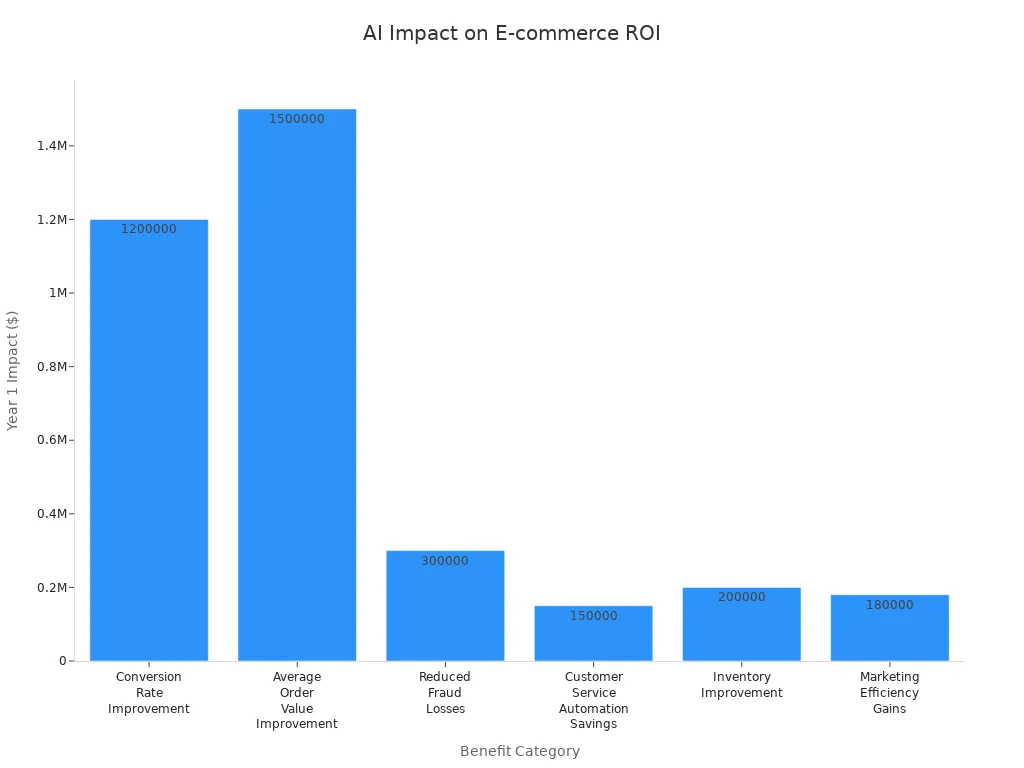
You can also track business impact, operational efficiency, and customer experience. Use metrics like revenue growth, market share, and customer satisfaction. Monitor time savings, automation rates, and cost reductions. Your international ecommerce grows when you measure and improve your ai solutions.
You secure long-term growth in cross-border e-commerce when you adopt AI-driven strategies. Industry experts report up to 20% revenue growth, 25% higher conversion rates, and 30% better productivity:
| Benefit | Impact |
|---|---|
| Revenue Growth | Up to 20% |
| Enhanced Consumer Experiences | Increase conversion rates by up to 25% |
| Improved Operational Efficiency | Boost productivity by up to 30% |
| Improved Profitability | Lower operating costs by up to 10% |
Continuous innovation in AI keeps you ahead. You improve customer satisfaction, automate operations, and adapt pricing in real time:
| Evidence Type | Description |
|---|---|
| Customer Experience | AI enhances personalization, boosting satisfaction. |
| Operational Efficiency | Automation and optimization drive efficiency. |
| Predictive Analytics | Better inventory and segmentation for targeted marketing. |
| Dynamic Pricing | Real-time pricing adapts to market changes. |
| Content Creation | Generative AI creates tailored marketing content. |
Take action now with these steps for measurable impact:
- Define your target KPIs.
- Prioritize 1-3 high-impact use cases.
- Prepare and clean your data.
- Choose a secure AI architecture.
- Build compliance guardrails.
- Keep humans in the loop for key decisions.
- Pilot, measure, and refine your approach.
- Train your teams for success.
- Scale winning strategies to new markets.
You drive measurable results and global impact when you act on these strategies.
FAQ
What is the fastest way to start using AI in cross-border eCommerce?
You should begin with AI-powered tools for product recommendations and automated translations. These solutions deliver quick wins. You see higher conversions and faster market entry. Choose platforms that integrate easily with your current systems.
How does AI help reduce cross-border shipping costs?
AI analyzes routes and predicts delays. You get smarter shipping choices and avoid costly mistakes. Many businesses report lower logistics expenses and faster deliveries. You keep customers happy and boost your bottom line.
Can AI improve customer trust in new markets?
Absolutely! AI personalizes content and support in local languages. You show shoppers you understand their needs. This builds trust and encourages repeat purchases. Customers feel valued and stay loyal to your brand.
Is AI difficult to integrate with my existing eCommerce platform?
Most modern AI solutions offer plug-and-play integration. You connect them with a few clicks. Training your team takes little time. You see results quickly without disrupting your daily operations.
What KPIs should I track to measure AI success?
Focus on conversion rates, average order value, and customer satisfaction. Track cost savings from automation. Monitor how fast you enter new markets. These KPIs show your AI investment delivers real growth.
See Also
Effective Ecommerce Strategies for 2025: A Practical Guide
The Importance of Blind Shipping in E-Commerce Growth
Enhancing Warehouse Efficiency Through Smart Ecommerce Solutions
TAGG Logistics: Elevating E-Commerce Performance for 2025
Financial Advantages of Zone Skipping in E-Commerce Operations