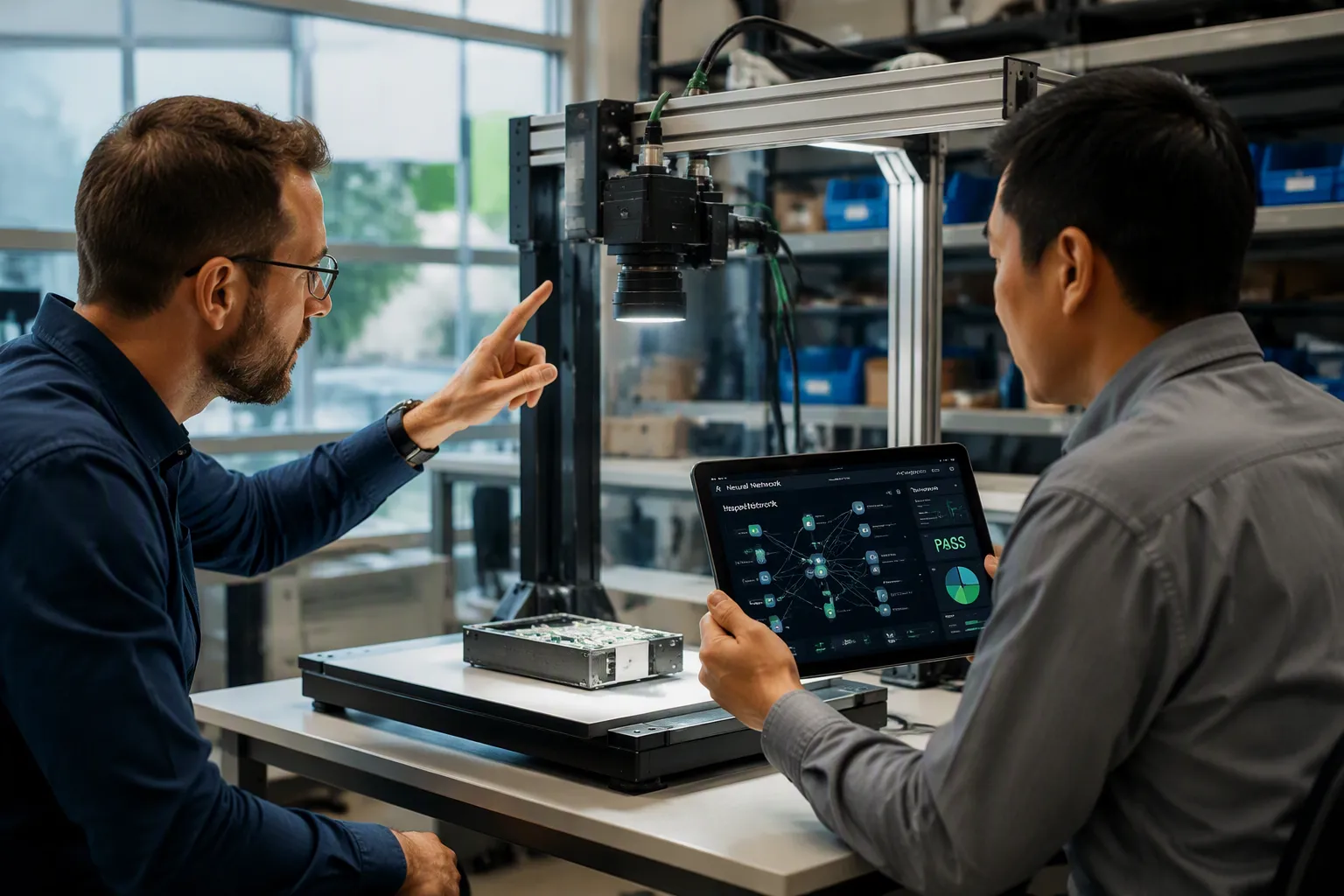
You face a common dilemma: machine vision vs. AI inspection. Both terms appear often, yet they solve different problems. The right answer depends on your specific application, not on industry buzz. This comparison weighs cost, complexity, flexibility, and transparency to guide your choice. Machine vision uses rule-based programming for predictable checks. AI learns from examples to catch subtle flaws. Your product quality goals and defect types determine the best fit. We examine how each technology handles inspection, where computer vision excels, and which approach delivers the quality you need. Understanding these trade-offs helps you choose with confidence.
Machine Vision vs AI Inspection: What They Are
What Is Machine Vision?
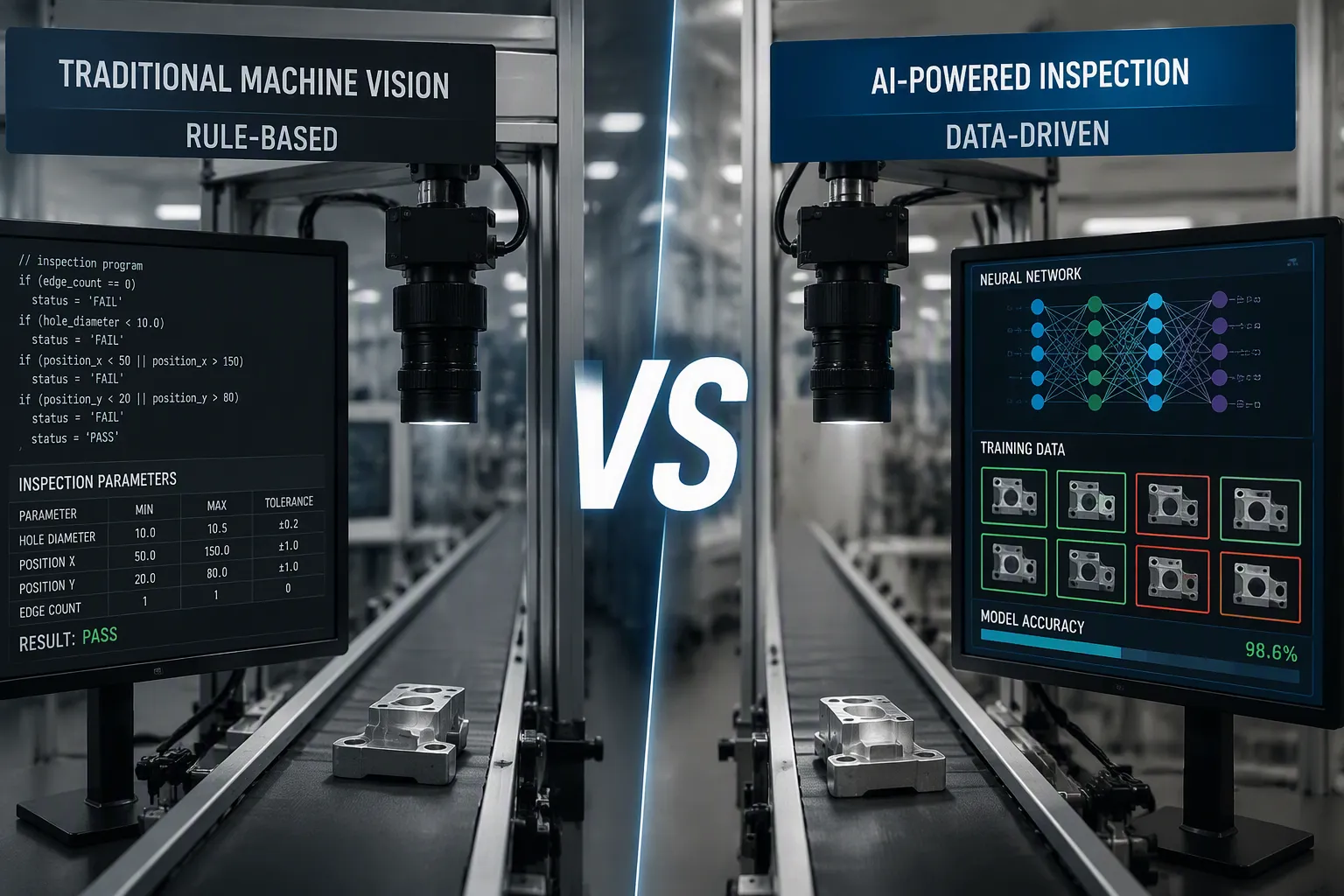
Machine vision uses rule-based programming to inspect products. You define specific criteria, such as exact dimensions, color thresholds, or edge positions. The system then applies these fixed rules to every item passing through your line. This approach works well for predictable checks where you know precisely what to look for. For example, you might verify that a bottle cap sits flush or that a label appears in the correct position.
Traditional machine vision systems excel at speed and consistency. They process thousands of parts per hour without fatigue. However, they struggle when conditions shift. Lighting changes, part position variation, or tool wear can confuse the fixed rules. According to industry analysis, rule-based systems achieve typical accuracy of 80–85% under real production conditions. For surface defects like scratches or texture irregularities, that number drops to 60–80%. The predefined rule sets cannot fully capture the natural variability in defect size, shape, and severity.
AI-Powered Computer Vision Explained
AI-powered computer vision takes a different approach. Instead of programming rules, you train the system using labeled examples. You show it hundreds of images of good parts and defective parts. The deep-learning model learns the patterns that distinguish acceptable quality from flaws. This method adapts to new products with minimal manual intervention.
The deployment speed difference is dramatic. A product changeover that traditionally required weeks of reprogramming with machine vision can now complete in a day or less using AI transfer learning. Traditional training from scratch takes 3 to 6 weeks of active production time. AI transfer learning adaptation requires only 1 to 2 days, mostly waiting for image capture. This reduction of roughly 85–95% means you can switch product lines quickly without lengthy downtime.
For automated visual inspection, AI technologies reach 95–99% accuracy on complex surface defects. This performance gap matters when you inspect castings, metal finishes, or textured materials. The visual inspection process becomes more reliable because the model learns subtle patterns that fixed rules miss. Computer vision powered by deep learning handles variation gracefully, making it suitable for environments where products change frequently or defects appear unpredictably.
The core distinction between machine vision vs. AI inspection comes down to how each system learns. Machine vision follows your explicit instructions. AI discovers patterns from examples. Your choice depends on whether your inspection task demands rigid consistency or adaptive intelligence.
Core Differences: Rule‑Based vs AI
Programming vs. Training
You program a traditional machine vision system with explicit rules. You define measurements, thresholds, and pass-fail criteria. The system follows your instructions exactly. Every inspection runs the same logic. This approach gives you complete control. You know precisely why the system rejects a part. You can trace each decision to a specific rule you wrote.
Training an AI system works differently. You show the model examples instead of writing rules. You feed it hundreds of images of acceptable parts and defective ones. The deep-learning model identifies patterns on its own. It learns what separates good from bad without explicit instructions. This process takes less hands-on engineering time. You spend your effort curating quality training data rather than coding logic.
The deployment timeline reveals the practical difference. A product changeover that requires weeks of reprogramming with traditional machine vision can finish in a day or less using AI transfer learning. Traditional training from scratch consumes 3 to 6 weeks of active production time. AI transfer learning adaptation needs only 1 to 2 days, mostly waiting for image capture. This reduction of roughly 85–95% lets you switch product lines quickly without lengthy downtime.
Your team skill set matters too. Rule-based programming demands engineers who understand optics, lighting, and algorithm design. AI training requires people who can curate datasets and interpret model performance. Many manufacturers build hybrid teams or partner with vendors who supply both skill sets.
Handling Variation and Anomalies
Production environments rarely stay static. Lighting shifts throughout the day. Parts arrive with slight positional variation. Tools wear down and change surface appearance. Traditional machine vision struggles with these conditions. Fixed rules cannot adapt when the input changes. A threshold that works at noon may fail at 4 PM when sunlight enters the facility.
AI-powered computer vision handles variation gracefully. The model learns from many examples across different conditions. It recognizes that a part remains acceptable despite minor lighting changes or positional shifts. This flexibility reduces false rejects and keeps your line running smoothly.
The accuracy gap between human inspection and computer vision deserves attention. Human inspectors miss up to 40% of defects under real production conditions. Computer vision systems achieve detection accuracy of 97–99%. This performance difference directly impacts your quality metrics and customer satisfaction.
| Metric | Human Inspectors | Computer Vision |
|---|---|---|
| Defect Miss Rate | 20-30% | Not specified |
| Detection Accuracy | 70-85% | 95-99% |
Subtle defect detection represents another dividing line. Surface scratches, texture irregularities, and color variations challenge rule-based systems. These flaws vary in size, shape, and severity. No fixed rule captures every possible presentation. AI models excel here because they learn from examples of real defects. They recognize patterns that resemble past failures, even when the exact appearance differs.
High-speed, predictable checks remain the strength of machine vision. Measuring a dimension, verifying a label position, or confirming component presence suits rule-based logic perfectly. These tasks rarely change and demand consistent execution. You want deterministic results you can audit and reproduce.
Complex visual inspection pushes you toward AI. Castings, metal finishes, and textured materials produce natural variation. Defects hide within that variation. AI-powered computer vision distinguishes acceptable variation from genuine flaws. This capability makes it the preferred choice for demanding surface quality applications.
Your decision hinges on the nature of your defects. Predictable flaws with clear specifications favor machine vision. Unpredictable or subtle defects demand AI. Many operations discover they need both approaches for different inspection points.
Cost, Complexity, and Transparency
Setup and Scalability
Your initial investment differs between these technologies. Traditional machine vision requires specialized engineers who understand optics. You pay for their expertise during every product changeover. AI-powered computer vision demands less programming skill but requires quality training data. You spend time capturing and labeling images instead of writing code.
The setup timeline reveals a stark contrast:
| Setup for new product | Traditional Machine Vision | AI Visual Inspection |
|---|---|---|
| Time required | Engineer must rewrite/retune rules (days–weeks) | Retrain model on new images (minutes–hours) |
This speed advantage lets you pivot production lines quickly.
The financial returns justify the investment. OxMaint reports that a well-scoped AI quality inspection project typically delivers a first-year ROI between 200% and 400%. The median first-year ROI sits at 300%. Most manufacturers recover their costs within 6 to 18 months.
Scaling across multiple lines also differs. Machine vision systems replicate easily when your product stays consistent. Each new line requires identical hardware and programming. Computer vision scales with data. You train once, then deploy the model across many cameras.
Explainability and Debugging
Transparency matters when you justify rejections to customers or auditors. Traditional machine vision offers complete traceability. You can trace every decision to a specific rule you wrote. You know exactly why the system rejected a part. This audit trail satisfies strict regulatory requirements.
AI-powered computer vision operates differently. The deep-learning model identifies patterns without explicit instructions. You cannot easily explain why the model rejected a specific part. This opacity creates challenges in regulated industries.
Debugging also differs between approaches. A machine vision system failure prompts you to examine the rules and adjust thresholds. The fix is straightforward. Computer vision failure requires gathering more training images. You retrain the model and hope the new examples correct the error.
Your tolerance for ambiguity guides this choice. Machine vision provides clarity but limited flexibility. Computer vision offers adaptability but less transparency. Many manufacturers accept this trade-off because the accuracy gains outweigh the explainability concerns.
Best Use Cases for Machine Vision and AI
When Machine Vision Works Best
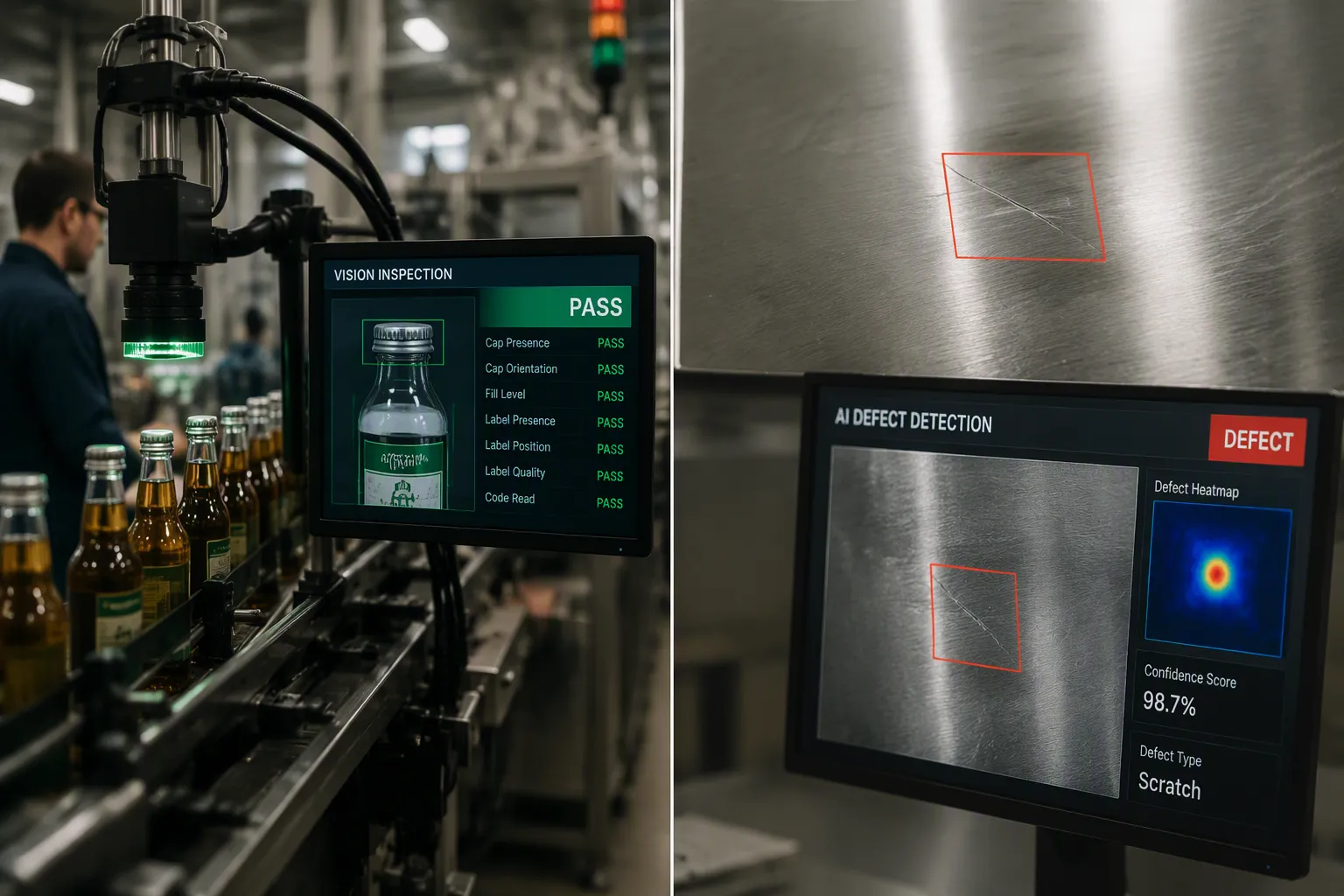
Machine vision fits high-speed packaging lines perfectly. You run hundreds of parts per minute. Each inspection must be identical to the last. A rule-based system never gets tired. It applies the same criteria to every single part.
Consider a beverage bottling operation. You check cap torque, label alignment, and fill level. These measurements stay constant across thousands of units. Defects have clear boundaries you can define in advance. Traditional machine vision achieves 97-99.5% detection rates under these conditions. Your line runs at full speed without bottlenecks.
Human operators cannot keep up. The best individual inspectors peak at 80% accuracy. Their performance drops within 20-30 minutes on task. Detection rates fluctuate between 60-85% depending on shift timing and fatigue. Machine vision eliminates this variability. Every part receives the same level of scrutiny at 4 PM as it does at 9 AM.
The machine vision vs. AI inspection decision becomes straightforward here. You can define every acceptable condition. You know exactly what counts as a defect. Machine vision delivers speed, transparency, and full traceability. You trace each rejection back to a specific rule you wrote. That clarity satisfies auditors and quality managers.
Stick with machine vision when your product and defects stay predictable. The setup cost pays for itself through consistent quality and reduced manual inspection labor. Your team writes rules once and deploys them across multiple lines with identical hardware.
When AI Inspection Excels
Your production environment includes defects that resist simple definition. Surface scratches vary in depth and angle. Texture irregularities shift with material batches. Traditional machine vision cannot capture every possible presentation. AI-powered computer vision learns from example images instead.
Complex defect detection shows the clearest gap. Consider internal flaws in metal castings. Subsurface micro-cracks measure less than 0.05mm. Human inspectors catch only 12% of these defects. Computer vision detects 91.2% of them using multi-spectral imaging combined with deep learning. Standard RGB cameras miss these subsurface issues entirely.
Porosity in cast components presents another challenge. Tiny voids form inside the material during cooling. Human inspectors find 58% of these defects. Computer vision reaches 98.9% accuracy. Surface cracks larger than 0.05mm become visible with 99.4% detection. Humans find only 64%. The improvement directly affects your product quality metrics.
Textile manufacturing also proves the AI advantage. Fabric defects appear in endless variations. A human operator across a full shift detects 60-70% of flaws. Fatigue reduces that rate over time. Computer vision systems maintain 95%+ detection consistently across every yard of fabric. No variation between inspectors. No performance drop after lunch.
The table below summarizes how automated visual inspection compares to human inspection for complex defects:
| Defect Type | AI Vision Accuracy | Human Inspector Accuracy |
|---|---|---|
| Subsurface micro-cracks | 91.2% | 12% |
| Porosity (cast components) | 98.9% | 58% |
| Surface cracks (>0.05mm) | 99.4% | 64% |
Your product quality improves because computer vision catches patterns you did not anticipate. The model learns from examples instead of rules. The defect detection capability makes AI the preferred choice for demanding applications where variation is natural and defects hide within acceptable variation.
Choose AI inspection when your defects resist definition and your products change frequently. The training investment pays for itself through higher accuracy and faster changeovers.
Hybrid Systems: Combining Both
Benefits of a Hybrid Approach
Combining machine vision with AI-powered computer vision creates a system stronger than either approach alone. The rule-based speed of traditional machine vision handles deterministic checks at line speed. The deep learning flexibility of AI catches subtle defects that fixed rules miss. The computer vision model learns patterns that distinguish good parts from bad ones. This hybrid configuration maximizes the value of your machine vision investment while adding defect detection that rule-based systems miss. The computer vision portion adapts to new product variants quickly. This approach gives you modern computer vision capabilities alongside proven speed from rule-based methods.
One large electronics manufacturer demonstrates this advantage. After a costly production failure, the company deployed a hybrid 3D and AI system. An intelligent robot planner adjusts camera positions, lighting conditions, and image counts based on the product. The system uses semantic terms instead of complex code. This lets non-experts modify plans for new product variations quickly.
The performance improvement is substantial. Combining machine learning with optical methods increased detection accuracy by 65% compared to traditional methods alone. This gain comes from letting each technology do what it does best. Traditional machine vision handles dimensional checks at high speed. AI-powered computer vision handles surface defects and anomaly detection. The hybrid approach preserves transparency for critical measurements. The hybrid inspection system combines both approaches seamlessly.
Implementation Guidance
Start with a comprehensive assessment of your production line. Identify bottlenecks between existing machine vision systems and new AI equipment. Document your current defect rates and detection capabilities.
Design tailored solutions for your specific products. Select cameras and software that match your requirements. Develop algorithms that handle product variability.
Create interfaces between your existing machine vision hardware and the new AI components. Use standard industrial protocols like EtherNet/IP. Feed images from your line scan cameras into the AI system. The computer vision model analyzes images for subtle defects.
A global packaging leader followed this approach. They installed an edge vision controller on their existing network. They established an SFTP connection to feed images to the new AI model. The AI was trained using historical images across multiple product categories. The facility eliminated virtually all manual classification while maintaining production speed. They achieved ROI within six months.
Train your staff to operate the hybrid system. Define acceptance criteria for detection rate and false reject rate. Monitor performance continuously and collect edge cases for retraining. This keeps your quality improvement ongoing while both machine vision and computer vision work in harmony.
Choose machine vision for deterministic, high-speed tasks. Choose AI inspection for complex, variable defects. Hybrids deliver maximum flexibility.
Your decision framework:
- Clear defect specifications → machine vision
- Subtle or changing flaws → AI
- Audit transparency required → traditional machine vision
- Rapid product changeovers → AI
- Limited initial budget → machine vision
Evaluate your application honestly. No single answer fits every scenario. Your product quality goals and defect types determine the right path. Consider accuracy needs, variation levels, and transparency requirements. Then select the technology that matches your reality. The machine vision vs. AI inspection question resolves when you examine your specific production environment. Computer vision excels where rules fail. Quality outcomes depend on matching technology to your actual inspection challenges.
FAQ
Can I upgrade my existing machine vision system to include AI?
Yes. You can add a computer vision module to your current setup. This hybrid approach gives you faster defect detection without replacing your hardware. Many vendors offer this upgrade path.
Does AI inspection need a large dataset to start?
No. You need only 50 to 100 images per product type. Transfer learning reduces this requirement dramatically. You capture images during production and train the model quickly.
When should I choose traditional machine vision?
Choose traditional machine vision when your defects have clear specifications. You need audit transparency. Your products rarely change. This approach delivers speed and full traceability.
How does computer vision improve my product quality?
Computer vision catches defects humans miss. It maintains 95 to 99 percent accuracy consistently. Your quality metrics improve because every part receives the same thorough inspection every time.
See Also
Enhancing Production Forecasting Accuracy With AI For Enterprises 2024
Applying AI Predictive Maintenance In Textiles By 2025
Impress Your Customers Using Smart Machine Learning Orders
Using AI For Dynamic Safety Stock In Fashion Retail 2025
Leveraging AI For Demand-Driven Production Scheduling In 2025