

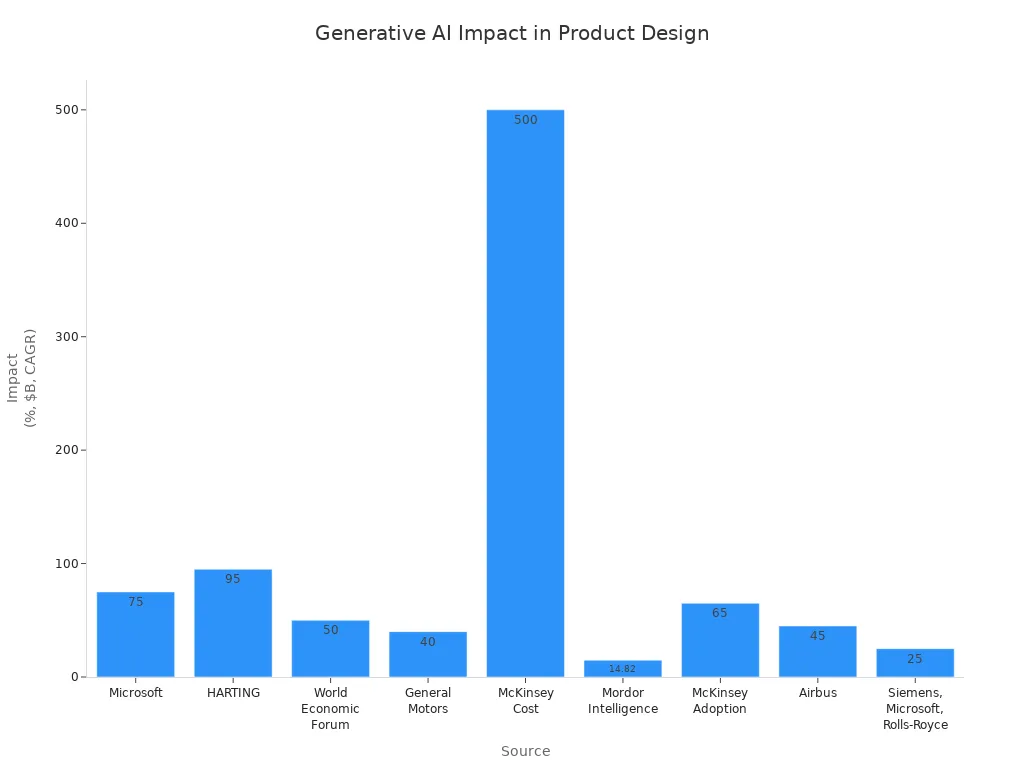
You now see generative AI changing how you approach AI Product Design in 2026. With this technology, you work faster and smarter. Many companies report impressive results:
- Microsoft shows a 75% reduction in programming time for factory tools.
- HARTING cuts custom connector setup time by 95%.
- Leading manufacturers experience 50% faster new product launches.
AI helps you automate routine tasks, so you can focus on creative ideas. The table below shows the most significant improvements you gain:
| Improvement Type | Description |
|---|---|
| Seamless integration with design systems | AI keeps your designs consistent and easy to customize. |
| Real-time collaborative design | You get instant feedback and can improve ideas with your team. |
| Personalized user experiences | Designs fit individual needs, making users happier. |
| Dynamic and adaptive interfaces | Interfaces adjust in real-time for a smoother experience. |
| Advanced multi-modal models | You can create complex designs using different types of input. |
You still play a key role. Your expertise and creativity guide the process, while AI boosts your results.
Generative AI Impact

Accelerating Design Cycles
You can now move from idea to prototype in days instead of months. Generative AI compresses the product design cycle by letting you explore many options at once. For example, HARTING used an AI-powered assistant and cut design time by 95%. Subaru reduced the time for die face shape design from 48 hours to just 2 minutes. These changes mean you can test more ideas and improve your products faster. When you use AI Product Design tools, you automate design iterations and simulations. This helps you avoid costly mistakes and make better decisions based on data.
Tip: Rapid prototyping with AI lets you see what works and what does not, so you can focus on the best ideas.
Content Generation Across Stages
Generative AI supports you at every step of the AI Product Design process. In the ideation phase, you can use AI to suggest new concepts by analyzing past successes and user needs. During prototyping, AI generates CAD designs ready for 3D printing or working app prototypes in just hours. In testing, AI simulates real-world conditions, such as material stress or drug interactions, without building physical models.
| Phase | Example |
|---|---|
| Ideation | Automotive companies use AI to propose new vehicle designs based on safety data. |
| Rapid Prototyping | AI generates CAD files for 3D printing and working app prototypes. |
| Testing and Simulation | Aerospace firms simulate material stress tests without building prototypes. |
You get more original ideas and can quickly see which ones work best.
Professional Expertise and AI Collaboration
Your expertise remains essential in AI Product Design. Generative AI acts as your partner, not your replacement. You guide the process, set goals, and make final decisions. AI helps you by handling routine tasks and offering creative suggestions. Studies show that teams using AI tools produce more original ideas and save time. For example, AI support in call centers boosted worker productivity, especially for new team members. In consulting, AI improved performance in product innovation and ideation. When you combine your skills with AI, you achieve better results and launch products that meet real user needs.
Generative AI in AI Product Design

Six Stages of Generative Design
You can break down the generative design process into six clear stages. Each stage helps you create better products and makes your work easier. AI Product Design uses these stages to guide you from idea to finished product.
| Stage | Description | AI Benefit |
|---|---|---|
| Generate | You create design options using algorithms and your chosen parameters. | AI lets you use conversational prompts to explore many creative and diverse possibilities. |
| Analyze | You evaluate each design based on your goals. | AI interprets complex criteria in natural language, making analysis more accurate and easier. |
| Rank | You rank designs by performance. | AI prioritizes designs using multiple criteria you describe, saving you time. |
| Evolve | You refine the best options through improvements. | AI implements changes based on your feedback, speeding up the process. |
| Explore | You explore and validate the generated designs. | AI enables you to query and interact with designs using plain language for deeper insights. |
| Integrate | You integrate the chosen design into your project. | AI helps describe context and constraints in natural language for seamless integration. |
Note: Studies show that following these six stages leads to better outcomes. Many teams report improved usability and positive user feedback. For example, hospitals successfully implemented new health modules using this process. You can expect effective technology output and strong user satisfaction.
Rapid Prototyping in AI Product Design
You can now build prototypes much faster than before. Generative AI lets you create and test ideas in minutes instead of months. You quickly generate multiple versions of your product based on user input. This speed helps you experiment and make decisions faster.
- You compress the development cycle from weeks to minutes.
- You achieve results that used to take months in just a few minutes.
- You reduce operational costs by using resources better and wasting less material.
- You focus on innovation instead of manual tasks.
Tip: Rapid prototyping with generative AI helps you enter the market faster and stay ahead of competitors.
Tools and Starter Kits
You have access to many tools and starter kits that make AI Product Design easier. These tools help you with writing, design, video, audio, research, and coding. You can use them to streamline your process and boost creativity.
- ChatGPT: Helps you draft and plan your projects.
- Claude: Reads and reasons over long documents.
- Google Gemini: Supports writing and media tasks, including video generation.
- Perplexity: Provides fast research with citations.
- GitHub Copilot: Assists with code completion.
- Canva: Offers easy templates and is popular with non-designers.
- Figma: Industry standard for UI/UX design with intelligent suggestions.
- Adobe Firefly: Generates images and designs quickly.
- Jotform AI Agents, Jasper, Copy.ai, DALL·E 3, Canva Magic Studio, Runway, Synthesia, Filmora, ElevenLabs, Suno, Udio, Bubble, Cursor: These tools cover everything from design to video and audio creation.
| Aspect | Description |
|---|---|
| Concept Visualization | You visualize product ideas early by generating realistic or stylized images from descriptions. |
| Rapid Prototyping | You quickly create concept art, sketches, and 3D model renderings to speed up ideation. |
| Design Exploration | You experiment with design variations without manual redesign efforts. |
Tip: Tools like Stable Diffusion help you visualize concepts and explore design options quickly. You can create sketches and models in minutes, making your workflow smoother.
# Example: Using generative AI for rapid prototyping
# You describe your product idea in plain language.
# The AI generates multiple design options instantly.
# You select, refine, and integrate the best design.
You can use these tools to make your AI Product Design process faster, more creative, and more efficient.
Future Advancements
Seamless Workflow Integration
You see generative AI making your design workflow smoother and more productive. AI tools like Monday.com and Asana help you organize tasks and manage resources. You can automate repetitive steps, which saves time and reduces mistakes. AI platforms centralize communication and feedback, so your team stays connected. You focus more on creative work and less on manual tasks. Companies like Siemens and Autodesk offer cloud-based solutions that let you access advanced design tools without needing special IT setups.
- Generative AI optimizes design workflows.
- Task prioritization and resource management improve.
- Automation reduces errors and boosts creativity.
Tip: Start by mapping out tasks that AI can automate. Train your team to use new tools for better results.
Real-Time Collaboration
You work with your team in real time. AI-driven platforms give you instant updates and feedback. Communication becomes easier, and everyone stays on the same page. You see high-quality designs delivered faster. Review cycles shorten, so you can make changes quickly. Brands like Netflix and Disney use AI for concept art, while Coca-Cola creates unique ad visuals with AI.
- Immediate recommendations help you make decisions.
- Centralized feedback keeps projects moving.
- Integrated teamwork leads to better outcomes.
Adaptive Interfaces
You experience interfaces that change based on your actions. Generative AI predicts your needs and adjusts the design for you. The interface stays consistent across devices, making your experience smoother. AI simulates user interactions and optimizes content in real time. Fashion retailers use AI to analyze trends and design collections quickly. Adaptive feedback lets interface elements change as you use them, improving usability.
- Interfaces adapt to your behavior.
- AI predicts preferences for intuitive design.
- Real-time optimization keeps content relevant.
Note: Studies show adaptive features increase engagement and help you complete tasks faster.
Next-Gen Code Generation
You use AI to generate high-quality code and documentation. AI agents understand requirements and create code for you. Agile processes become faster, with sprint durations dropping from weeks to days. You move straight to prototyping, which speeds up innovation. The focus shifts to reliable and correct code, reducing defects and costs.
| Advancement | Description |
|---|---|
| High-Quality Code Generation | AI creates robust code, not just snippets. |
| Agile Process Improvement | Sprints shorten, boosting productivity. |
| Automation of Documentation | Documentation updates in real time. |
| AI Agents in Agile | Agents generate code based on requirements. |
| Cost and Time Reduction | Development costs and time drop, enabling new models. |
Tip: Use AI-powered code tools to improve quality and speed in your projects.
Leadership Strategies
Fostering Innovation
You can lead your team to greater creativity by making generative AI part of your daily work. Encourage everyone to try new AI tools, even if the results are not perfect at first. When you use AI to generate ideas, you help your team think outside the box. For example, design agencies use AI to create new product features based on what customers want. AI also helps you review user feedback quickly and spot ways to improve your products. This process saves time and money, letting your team focus on what matters most—making better products. You can see how AI helps you test ideas, refine them, and make sure your final product meets user needs.
| Strategy | Description |
|---|---|
| Cultural Shift | Help your team understand how AI changes their roles and the company’s goals. |
| Leading by Example | Use AI tools yourself to inspire others to experiment. |
| Cross-Disciplinary Collaboration | Bring together people from design, engineering, and marketing. |
| Core Competency | Treat AI skills as essential for everyone, not just experts. |
| Policy Implementation | Set clear rules to protect ideas and manage risks. |
| Critical Thinking | Encourage your team to question AI results and think for themselves. |
Upskilling Teams
You can help your team learn new AI skills by making training easy and open to everyone. AI makes learning faster and more personal. For example, some companies have cut the time to create training materials by over 70% using AI. Start by finding team members who are excited about AI and let them lead by example. Build small groups where people can share what they learn. Try out new AI tools in small projects and use the results to show leaders the value of AI. Make sure AI learning becomes a regular part of your team’s work.
“It’s going to take a deliberate effort to make sure [AI education is] inclusive—that communities can participate and engage—because once you can engage, the beautiful thing is that you can engage from anywhere.”
Ethical AI Use
You play a key role in making sure your team uses AI responsibly. Set clear rules to protect privacy and keep data safe. Teach your team to check AI systems for fairness and bias. Make sure everyone knows the importance of honesty and transparency when using AI. Encourage your team to keep learning about AI ethics and best practices. Work with people from different fields to make sure your AI products are safe and fair.
| Guiding Principles | Description |
|---|---|
| Academic Integrity | Follow ethical standards in all research and development. |
| Data Privacy and Security | Protect personal data and keep information confidential. |
| Ethical Considerations | Check AI systems often for fairness and safety. |
Tip: Share your commitment to responsible AI use with your whole organization. This builds trust and sets a strong example for others.
Generative AI changes how you design AI products. You work faster, create better ideas, and solve problems with less effort. You see new tools and smarter workflows every year. To stay ahead, you should:
- Try new AI tools with your team.
- Keep learning about AI trends.
- Share best practices with others.
Remember: Your skills and curiosity drive success in the future of AI product design.
FAQ
What is generative AI in product design?
Generative AI helps you create new ideas, designs, or code using smart computer programs. You give it instructions, and it gives you many options to choose from. This makes your work faster and more creative.
How does generative AI save time?
You use generative AI to automate tasks like making sketches, writing code, or testing ideas. This means you finish projects faster and spend less time on boring work.
Can you trust AI-generated designs?
You should always check AI-generated designs. Your skills help you spot mistakes or problems. AI gives you options, but you make the final choice to ensure quality.
What tools can you start with?
You can try tools like ChatGPT for writing, Figma for design, and GitHub Copilot for coding. These tools help you get started with AI in your projects.
See Also
Exploring AI's Role In Shaping Fast Fashion Trends
Innovative AI Approaches To Sustainable Fashion Practices
Utilizing AI To Improve Production Forecasting For 2024