

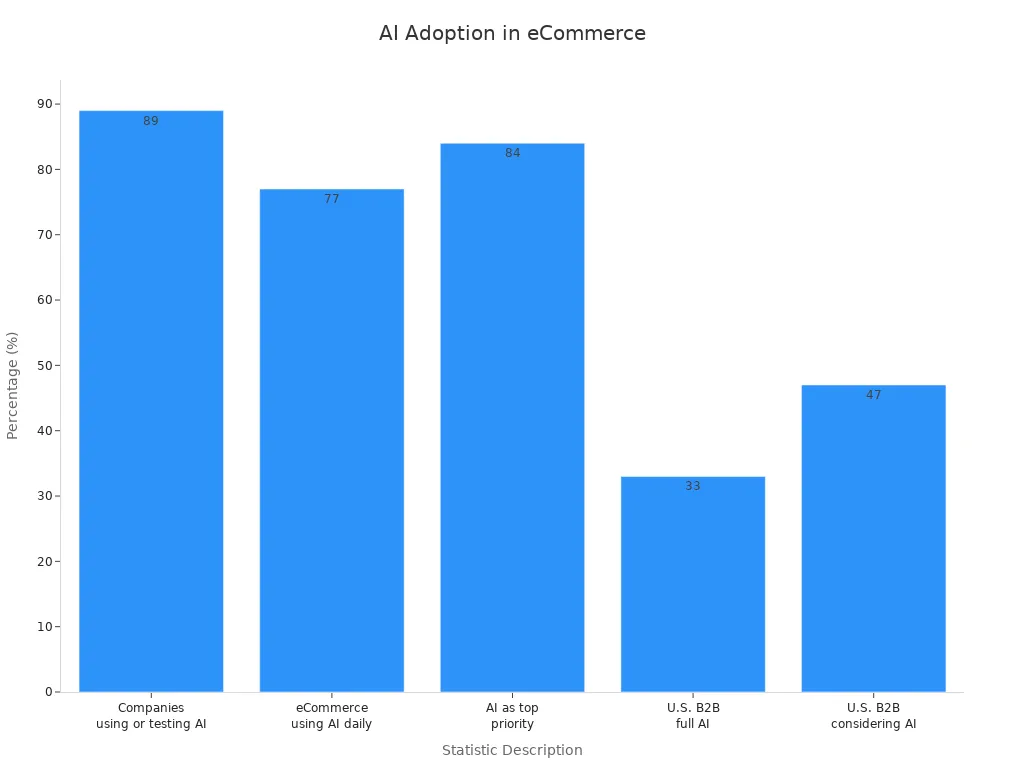
You can use ai tools to automate many ecommerce operations that usually take lots of time and effort. Most companies now use ai automation for ecommerce, as shown below:
| Statistic Description | Percentage |
|---|---|
| Companies actively using AI or testing via pilots | 89% |
| eCommerce respondents using AI daily | 77% |
| eCommerce companies considering AI a top strategic priority | 84% |
| U.S. B2B eCommerce companies with full AI implementation | 33% |
| U.S. B2B eCommerce companies considering AI implementation | 47% |
You first find out what tasks need automation. These often include:
- order processing and fulfillment
- inventory synchronization
- customer service
- marketing campaigns
Ai helps by cutting ticket handling time, boosting productivity, and using smart algorithms to automate work. This means you spend less time on manual tasks, make more sales, and improve customer experience.
AI Automation for eCommerce Overview

What Is AI Automation?
You use ai automation for ecommerce to manage and improve your online store with smart technology. Ai tools handle tasks like analyzing customer data, running marketing campaigns, recommending products, and managing inventory. These systems work without much human help. They make your store run smoothly and help you serve your customers better.
Ai automation for ecommerce covers several main categories. The table below shows how you can use ai in different parts of your business:
| Category | Description |
|---|---|
| Customer Support | Ai chatbots and agents give real-time help and personalized answers to customer questions. |
| Personalized Recommendations | Ai systems study what shoppers do and suggest products they might like. |
| Cart Abandonment Solutions | Ai agents offer deals or reminders to shoppers who might leave without buying. |
| Supply Chain Optimization | Ai improves logistics, inventory, and order tracking for better efficiency. |
You can see that ai automation for ecommerce touches every part of your store, from helping customers to managing stock.
Key Benefits for Online Stores
Ai automation for ecommerce brings many benefits to your online store. You can make your operations faster and more accurate. Here are some key advantages:
- Ai streamlines your daily tasks, reduces costs, and helps you react quickly to changes in the market.
- Automation brings consistency and speed, which are important for running your store well.
- Ai takes care of boring tasks, so you save on labor and improve how your store works.
A recent industry report highlights these benefits:
| Benefit | Description |
|---|---|
| Supply chain optimization | Ai finds the best delivery routes by looking at real-time and past data, making your logistics more efficient. |
| Customer satisfaction | Ai personalizes offers and improves customer service with quick chatbot responses. |
| Error reduction | Ai collects data automatically, so you make fewer mistakes in sales and stock forecasts. |
| Cost reduction | Ai helps you predict sales, cut inventory and labor costs, and get better deals with suppliers using data insights. |
Tip: Ai automation for ecommerce also improves customer experience. Chatbots answer questions any time, and personalized suggestions help shoppers find what they want. Research shows that better information from ai means customers return fewer products and feel happier with their purchases.
Best AI Tools for eCommerce

Personalization and Recommendations
You can use ai tools to create a unique shopping experience for every customer. These tools study what shoppers do and suggest products they might like. Some of the most popular ai-driven tools for personalization in ecommerce include:
- Tolstoy: Lets you make shoppable videos and create product images quickly.
- Jasper: Helps you write content that matches your brand’s voice.
- Clerk.io: Offers smart search and personalized product recommendations.
- Octane AI: Lets you build quizzes to collect data and suggest products.
- Vue.ai: Uses image recognition to give each customer a tailored experience.
These ai-powered automation solutions help you boost sales by showing the right products to the right people.
Customer Support Automation
Customer support automation makes it easy to handle questions and problems fast. Ai tools can answer most customer questions without human help. Here are some key features you will find:
| Feature | Description |
|---|---|
| Intelligent Virtual Agents | Handle up to 90% of questions on chat, email, or phone. |
| Agent Assist | Give real-time tips to support staff during live chats. |
| Automated Ticket Classification | Sorts support requests to the right team quickly. |
| Sentiment Scoring | Checks how customers feel to improve service. |
| Omnichannel Unification | Combines all support channels in one place. |
| Analytics Dashboards | Shows reports to help you make better decisions. |
These ai tools improve customer interactions and make your support team more efficient.
Analytics and Optimization
Ai tools for ecommerce analytics help you understand your business and find ways to grow. They can increase payment approval rates, which means more sales. Some tools recover lost money from chargebacks by sending evidence automatically. You can also see where customers drop off during checkout and find ways to fix it. Ai helps you spot trends and make smarter choices for your store.
Note: False declines cost online stores billions each year. Ai-driven tools can help you recover lost sales and improve your revenue.
Fraud Protection and Security
Ai tools protect your store and your customers from fraud. They look at lots of data to find strange patterns in transactions. These tools can spot payment fraud and account takeovers with high accuracy. Ai keeps learning and updating to stop new types of fraud. You can also customize these tools to fit your business needs. This keeps your store safe and your customers happy.
Implementing AI Tools in Your Store
Assessing Your Needs
Before you start with ai in your ecommerce business, you need to know what you want to improve. Look at your daily tasks and find the ones that take the most time or cause the most problems. These are often the best places to use automation.
Here are some important points to consider when you assess your needs:
- Identify high-impact tasks for automation.
- Make sure your systems can work together smoothly.
- Plan for growth and good performance.
- Keep your data accurate and high quality.
- Pick solutions that protect your data and follow rules.
- Think about how much money you will save or earn.
- Get your team involved early.
- Test everything before you go live.
Tip: Involve your team in this process. They know where the biggest problems are and can help you find the best places to use ai.
Selecting the Right Solution
Choosing the right ai for your ecommerce store can feel hard, but you can make it easier by focusing on what matters most to your business. Start by looking for solutions that fit your needs and budget.
Consider these factors when you pick your ai solution:
- Personalization features that help you serve each customer better.
- Easy data integration with your current systems.
- Cost and pricing models that fit your budget.
- Solutions that match your business needs.
- The ability to understand what customers want when they search.
- Strong recommendations powered by ai.
- Tools that support chat and conversation with shoppers.
- Simple setup and easy use.
- Good data management and strong security.
Note: Look for ai that can grow with your business. Flexible pricing plans and scalable systems help you handle more customers as your store grows.
Integration Steps
Once you choose your ai, you need to add it to your ecommerce platform. Start small and make sure everything works before you use it everywhere. This helps you avoid big problems and lets you see the benefits early.
Follow these steps to integrate ai into your store:
- Find your biggest pain point and start there.
- Begin with a small project to show how ai can help.
- Connect and test your ai with your current systems.
- Look at the results and see what works.
- Use ai in more parts of your business as you see success.
You may face some technical challenges during integration. Here are two common ones:
| Challenge | Description |
|---|---|
| Integration with Existing Systems | Many ecommerce stores use old systems. Adding ai can be hard and may need big changes. |
| Algorithm Bias | Ai can sometimes make unfair choices if it learns from bad data. You need to check and fix this. |
Tip: Always test your ai before using it for important tasks. This helps you catch problems early and keeps your store running smoothly.
Team Training and Adoption
Your team needs to feel ready and confident before using ai in real work. Training helps everyone understand how ai works and how it can help them do their jobs better.
Best practices for team training and adoption include:
- Teach your team about ai and its benefits to reduce fear and confusion.
- Give hands-on training so staff can use ai every day.
- Encourage your team to try new things and ask questions.
- Start with training that covers both simple and advanced uses.
- Create a space where learning and trying new ideas is safe.
| Best Practice | Description |
|---|---|
| Educate teams | Show how ai helps and why it matters. |
| Train employees | Give lessons and practice time with ai tools. |
| Foster innovation | Let your team test new ideas and learn from mistakes. |
You can measure how ready your team is by looking at:
| Metric Type | Description |
|---|---|
| Training Completion Rates | Track how many people finish ai training. |
| Employee Engagement Metrics | Use surveys to see how your team feels about ai. |
| Continuous Monitoring | Check every few months to find gaps and improve training. |
| Cultural Readiness Indicators | High survey and training rates show your team is ready for ai. |
Note: Small businesses can start with simple ai and grow over time. Always measure how well your team uses ai and keep improving your training.
Measuring Success and Overcoming Challenges
Tracking Performance and ROI
You need to measure how well your ai works in your ecommerce store. Tracking the right metrics helps you see if your automation brings real value. You can use numbers to check if your store gets better results. Here are some important metrics you should watch:
| Metric | Description |
|---|---|
| Conversion Rates | Measure the percentage of visitors who make a purchase. |
| Customer Satisfaction Scores | Evaluate how satisfied customers are with their shopping experience. |
| Operational Efficiency | Assess how effectively resources are utilized in the eCommerce process. |
| Sales Revenue | Track the total income generated from sales. |
| Operational Costs | Monitor the expenses associated with running eCommerce operations. |
| Process Efficiency | Measure the speed and effectiveness of business processes. |
You can use these numbers to see if your ai makes your store faster, cheaper, and more helpful for shoppers. For example, higher conversion rates and better customer satisfaction scores show that your automation works well. Lower costs and faster processes mean your store runs smoothly.
Tip: Check these metrics often. This helps you spot problems early and make smart changes.
Common Pitfalls and Solutions
You may face some challenges when you use ai in ecommerce. Many stores make the same mistakes. Knowing these pitfalls helps you avoid them and get better results.
| Pitfall | Mistake | Pivot |
|---|---|---|
| The "Smarter Chatbot" Fallacy | Treating AI agents as simple chatbots that only answer questions | Adopt an "agentic" mindset for task execution |
| Decoupling AI from Bottom-Line Outcomes | Focusing on metrics like "tickets deflected" instead of revenue | Measure AI as a sales channel with revenue-centric metrics |
| Training on "Dirty" or Fragmented Data | Feeding outdated or messy data to AI | Invest in a "Commerce-Ready" Knowledge Base |
| Ignoring the Nuance of Conversational Search | Optimizing AI for rigid queries | Implement conversational search that understands intent |
| Creating a Fragmented Customer Journey | Using siloed AI tools for different stages | Deploy a unified AI agent for a seamless experience |
| The "All-or-Nothing" Automation Trap | Removing human oversight too early | Use a Hybrid Agent Model for complex queries |
| Diluting the Brand Voice | Using generic AI personalities | Fine-tune AI to reflect brand’s unique tone |
| Treating AI as a "Set and Forget" Project | Not reviewing AI performance regularly | Commit to continuous optimization of AI agents. |
You can solve these problems with a few smart steps:
- Pick ai with ready-to-use templates and workflows. This makes setup easy and lets your team focus on creative work.
- Use unified data and automated messages to give shoppers a smooth experience across all channels.
- Run loyalty programs and win-back campaigns to keep customers coming back.
Note: Review your ai often and keep improving it. This helps your store stay ahead and keeps your customers happy.
You can automate your ecommerce business by following a few clear steps.
- Find manual tasks that slow you down.
- Map your customer journey to spot where ai can help.
- Start with high-impact, easy wins.
- Test and monitor each ai project.
- Keep improving as your business grows.
| Next Step | What You Can Do |
|---|---|
| Research | Explore new ai solutions for your business needs. |
| Map Opportunities | Plan where ai will make the biggest difference. |
| Measure Results | Track how ai improves your store’s performance. |
Start with clear goals and measure your progress. Try different ai options to see what works best for you.
FAQ
How do AI tools help small eCommerce stores?
You can use AI tools to automate tasks like customer support and product recommendations. This saves you time and money. Small stores often see faster growth and better customer satisfaction with AI.
Are AI tools expensive for beginners?
Many AI tools offer free trials or affordable starter plans. You can start small and upgrade as your business grows. This makes AI accessible for new store owners.
Can AI replace human workers in my store?
AI handles repetitive tasks, but you still need people for creative work and complex decisions. You get the best results when you combine AI with your team’s skills.
What data do I need to use AI in my store?
You need accurate product details, customer information, and sales history. Good data helps AI work better. Always keep your data updated for the best results.
See Also
Impress Customers Using Intelligent Machine Learning Order Systems
Cutting-Edge Ecommerce Strategies for 2025: A Practical Guide
Enhancing Productivity Through Intelligent Ecommerce Warehouse Solutions
Top 10 E-commerce Platforms for Seamless Accounting Integration