

An ai business operating system gives you a single platform that connects data, people, and processes. You use ai to automate tasks, analyze information, and adapt to changes in real time. This approach helps you grow, cut costs, and stay ahead of competitors.
The strongest AI business strategies are usually tied to measurable business outcomes rather than to technology adoption for its own sake. This indicates that the real value of AI lies in its ability to improve operational efficiency and drive strategic growth.
- AI helps you make better decisions by finding patterns in large datasets.
- You can optimize resources and streamline operations faster than with traditional software.
- Dynamic allocation ensures your team works on the right tasks at the right time.
What Is an AI Business Operating System?
Core Purpose and Definition
You use an ai business operating system to connect all parts of your company. This system brings together data from many sources and helps you make better decisions. Leading technology analysts describe an ai operating system as software that links inputs like occupancy, utilization, and asset lifecycles. It creates a unified intelligence platform. Departments such as HR, IT, and finance work on a shared layer of insights. You gain centralized data insights that help you see the big picture.
The main objectives and purposes of an ai business operating system include:
| Objective/Purpose | Description |
|---|---|
| Millisecond Response Times | Enables instant reasoning and action. |
| Massive-Scale Coordination | Facilitates coordination with millions of agents simultaneously. |
| Secure Execution Environments | Provides secure environments for executing AI tasks. |
| Robust Observability | Offers end-to-end observability to track and refine actions. |
| Agentic AI at Scale | Allows building and deploying millions of intelligent agents for complex tasks. |
| Real-Time Intelligence | Processes streaming data for immediate, data-informed decisions. |
| Global AI Coordination | Unifies workload deployments across various environments for consistent performance. |
| Next-Gen Enterprise Inference | Integrates real-time information with historical knowledge for contextual answers. |
| Simplified AI Stack | Replaces fragmented solutions with a unified platform, reducing overhead. |
| Accelerated Time-to-Value | Enables rapid deployment of AI initiatives with low-code tools. |
| Enterprise-Scale Security | Ensures safe and compliant AI deployment with robust governance. |
| Future-Ready Foundation | Adapts to emerging technologies without disruptive re-platforming. |
You see that the built world ai operating system gives your business a strong foundation for growth and adaptation.
Key Differences from Traditional Systems
You notice big differences between an ai business operating system and traditional business software. The ai operating system orchestrates workflows across your operations. Traditional software handles only single tasks and lacks integration. You get seamless, automated data flow across systems with an ai operating system. Manual data transfer slows down traditional tools.
Here is a table that shows these differences:
| Feature | AI Operating Systems | Traditional Software |
|---|---|---|
| Workflow Management | Orchestrates entire workflows across operations | Handles discrete tasks without integration |
| Data Integration | Seamless, automated data flow across systems | Requires manual data transfer between tools |
| Operational Efficiency | Adapts and optimizes processes based on learning | Limited by fragmented tools and manual interventions |
| Client Lifecycle Management | Manages the entire client lifecycle in one platform | Each stage requires separate tools and manual updates |
| Intelligence | Learns from engagements to improve future processes | Lacks cross-system intelligence and insights |
You benefit from the built world ai operating system because it automates administrative tasks. You scale your business without needing more overhead. Firms using ai operating systems handle 30-50% more client engagements with the same support structure. You gain comprehensive intelligence for better decision-making. Traditional software requires more support as you grow, which increases costs.
- AI operating systems automate administrative tasks, allowing you to scale without proportional increases in overhead.
- Traditional software needs more administrative support as you grow, leading to higher costs.
- You can handle more client engagements with the same team, which boosts profitability.
- AI systems give you better intelligence for decisions, while traditional software offers limited insights.
Centralized Workflows and Automation
You use an ai business operating system to centralize workflows and automate operations. The system uses a unified orchestration layer. This layer connects different systems and keeps workflows consistent and governed. Legacy systems rely on isolated automation tools, which often break and cannot adapt to new needs.
AI workflow automation connects data flows and enforces governance policies. You get observable automated workflows. Decisions made by the system are easier to audit. You see fewer manual interventions, quicker cycle times, and better adherence to service level agreements. The built world ai operating system lets you optimize resources intelligently. You do not just add more resources to manage growth.
As your operations scale, complexity increases. The ai business operating system builds structure and moves insights throughout your organization. Decision quality improves, customer satisfaction rises, and confidence grows at all levels. AI reduces friction, allowing your judgment to scale.
AI impacts scalability by improving efficiency and reducing costs. It automates repetitive tasks, so you scale operations quickly. AI-powered analytics tools give you real-time data analysis. You identify bottlenecks and inefficiencies, which helps you make better decisions and scale effectively.
You also see that up to 35% of work in centralized functions could be automated by 2030. This boosts efficiency and collaboration. Nearly 75% of organizations have modernized their ERP with ai, improving predictive capabilities and teamwork. Faster decision-making leads to productivity and efficiency gains.
Tip: When you use an ai business operating system, you centralize workflows, automate tasks, and reduce friction as your business grows. You gain better control, faster insights, and improved collaboration across departments.
Main Components of an AI Operating System
Data Integration and Orchestration
You need strong data integration and orchestration to make your ai business operating system work. This means you bring together data from many sources and connect it in one place. When you do this, you can see a full picture of your business. You do not have to search through different systems. You can improve your processes because you have all the information you need. For example, customer service teams solve problems faster when they see a customer’s full history in one view. You also get better results because ai can use this data to make smart choices as events happen.
Tip: Unified data integration helps you find patterns and make decisions that were not possible before.
Intelligent Agents and Automation
Intelligent agents are a key part of your ai operating system. These agents handle tasks that repeat often, like sending reports or checking for errors. You do not need to do these jobs by hand. Intelligent agents can also help with bigger projects by choosing the best way to finish them. When you use these agents, you save time and money. Your team can focus on important work, like planning and guiding others. You also see fewer mistakes and faster results.
| Outcome Description | Percentage Improvement/Reduction |
|---|---|
| Faster decision-making through automated data analysis | 40–60% |
| Cost reduction in repetitive operations | Up to 45% |
| Increase in customer satisfaction | 35% |
| Improvement in workflow efficiency | 25–50% |
| Reduction in human errors | 30% |
| Faster time-to-market for new products | 3–5x |
| Improvement in cross-department collaboration | 20% |
| Better resource utilization | Up to 70% |
Real-Time Analytics and Visibility
You use real-time data and analytics to see what is happening in your business right now. This helps you make quick and smart decisions. AI tools can look at complex data and give you clear answers fast. You can spot problems early and fix them before they grow. You also get predictions about what might happen next, so you can plan ahead. When you connect your data across teams, everyone works with the same facts. This leads to better teamwork and faster actions.
Real-World Example
Banks use ai operating systems to connect data from many sources. Intelligent agents check for fraud and help with risk checks. Real-time analytics tools give leaders instant updates. This means banks can stop problems quickly and serve customers better. Many other industries, like healthcare and HR, use these same tools to improve their work.
Note: The main parts of an ai business operating system—data integration, intelligent agents, and real-time analytics—work together to help you grow, save money, and make better choices.
How AI Business Operating Systems Drive Growth

Efficiency and Cost Savings
You want your enterprise to work faster and spend less. An ai business operating system helps you do both. You can automate many tasks that used to take hours. For example, you can use ai to handle support requests, check compliance, and even close your financial books. This means you spend less time on routine work and more time on important projects.
Here is a table that shows how companies improve efficiency with ai:
| Efficiency Gain | Description |
|---|---|
| Reduced Response Times | You answer customers faster and solve problems quickly. |
| Minimized Escalations | Fewer issues need human help, so you save money. |
| Cost Reduction in Admin Functions | You can cut costs by up to 30 percent in administrative work. |
| Increased Productivity | Your teams get more done, sometimes over 40 percent more, with ai tools. |
| Higher Engagement Rates | Marketing teams see better results with personalized content. |
| Faster Financial Closures | Finance teams finish their work faster with fewer mistakes. |
| Higher Query Volumes | Support centers handle more questions without hiring more staff. |
| Drastic Time Reduction | Some tasks that took thousands of hours now take only seconds with ai. |
| Predictive Maintenance | You can fix machines before they break, so you avoid costly downtime. |
You also save money because ai automates many administrative tasks. You do not need to spend as much time on routine activities. Your workflows become smoother, and your teams can focus on high-value work. When you use ai, you get insights that help you improve client satisfaction and cut costs at the same time.
- ai can automate financial analysis and compliance checks.
- ai-driven predictive maintenance helps you avoid equipment failures and production stops.
Tip: When you use ai to automate routine work, you free up your team to focus on what matters most. This leads to better results and lower costs for your enterprise.
Predictive Insights for Decision-Making
You need to make smart choices to help your enterprise grow. ai business operating systems give you predictive insights that help you see what will happen next. You do not have to guess. You get clear signals about problems and opportunities before they happen.
Here is a table that shows how ai helps you make better decisions:
| Predictive Capability | Description |
|---|---|
| Operational Bottlenecks | ai finds issues before they slow you down. |
| Customer Churn Signals | ai spots when customers might leave, so you can act. |
| Inventory Needs | ai tells you when you need more stock. |
| Cash Flow Issues | ai warns you about money problems early. |
| Quality Problems | ai finds mistakes before they reach your customers. |
You get insights that help you understand your business context and priorities. ai routes work to the right people based on their skills and availability. You do not have to worry about exceptions breaking your process. The system handles them and learns from outcomes. You can connect many tools and teams, so your enterprise works as one unit.
ai in business analytics changes how you make decisions. You move from looking at old data to acting on what will happen next. With machine learning and natural language processing, you get insights faster. You can improve your forecasts and personalize experiences for your clients.
Here is how ai helps you with decision-making:
- You find patterns and trends in large amounts of information.
- You make decisions before problems grow.
- You lower risks by acting early.
- You can grab new opportunities quickly.
You also get intelligent recommendations that guide you to the best actions. These insights help you stay ahead of the competition.
Note: Predictive insights from ai give you the power to act early and make better choices for your enterprise.
Scalability and Enhanced Experiences
You want your enterprise to grow without adding more costs. ai business operating systems make this possible. You can handle more work and serve more clients without hiring more people. ai automates tasks and helps you scale up quickly.
Here is a table that shows how ai helps you scale and improve experiences:
| Aspect | Description |
|---|---|
| Cost reduction | ai cuts manual work and lowers costs, so you can grow faster. |
| Enhanced decision-making | ai gives you insights to optimize your processes and save money. |
| Customer experience | ai improves how you talk to clients, making them happier and more loyal. |
| Predictive analytics | ai forecasts demand and helps you manage inventory, so you never run out of stock. |
| Productivity and innovation | ai lets your team focus on creative work, not boring tasks. |
| Scalability and flexibility | ai systems grow with your business, so you can handle more work without big changes. |
| Risk mitigation | ai finds risks early, saving you money on fraud and compliance problems. |
You also improve client communication and responsiveness. ai helps you answer questions faster and handle more client engagements without raising your costs. This boosts your profitability.
When you connect your systems with ai, your enterprise becomes faster and more agile. You make better decisions and give both customers and employees a better experience.
- ai operating systems improve client communication and satisfaction.
- You can serve more clients with the same team, which increases your profits.
Callout: Businesses that use ai to connect their systems see faster growth and happier customers. You can scale up without losing quality or control.
You get insights that help you adapt to changes and keep your enterprise strong. ai gives you the tools to grow, innovate, and lead in your industry.
Implementing an AI Business Operating System
Assessing Readiness and Setting Goals
You start by checking if your organization is ready for ai. You look at your data infrastructure, technical skills, and team mindset. You want to know if your systems can handle ai workloads and if your people understand how ai works. You also need to set clear goals before you begin. These goals help you measure success and keep your project on track.
| Step | Description |
|---|---|
| Data Infrastructure Assessment | Evaluate the quality, accessibility, and governance of data across business units. |
| Technical Capability Evaluation | Assess your current systems for ai support and integration. |
| Organizational Readiness | Survey your team for ai literacy and skill gaps. |
| Use Case Prioritization | Choose high-value projects for quick wins and long-term growth. |
You focus on goals like enhancing productivity, increasing visibility, and improving decision-making. You also want seamless integration with your current technology and to solve important business problems.
- Ensure seamless integration with existing technologies.
- Address high-value business problems to maximize ai's impact.
Data and Integration Requirements
You need strong data integration to make your ai business operating system work. You connect to databases and APIs for complete insights. You must access high-quality data and prepare it by cleaning and enriching it. You also manage data flow to provide accurate information to ai models. Sometimes, you need middleware or APIs to connect old systems with new ai tools.
| Requirement | Description |
|---|---|
| Data Integration | Connect to various sources for comprehensive insights. |
| Accessing Data | Find and use high-quality data for effective ai deployment. |
| Data Preparation | Clean and enrich data for model training and analysis. |
| Integration Challenges | Use middleware or APIs to ensure compatibility with legacy systems. |
| Data Flow Management | Manage data flow for accurate and timely information to ai models. |
You must follow strong governance practices to protect your data and ensure compliance. You set rules for who can access information and how you use it. Good governance keeps your ai systems safe and reliable.
Overcoming Challenges and Best Practices
You face challenges when you add ai to old systems. Legacy systems use different formats and lack standard communication. Many organizations run on outdated infrastructure, which makes ai integration hard. Data silos and limited interoperability slow down progress. Performance constraints can limit what ai can do.
- 86% of CIOs believe their networks are not ready for ai demands.
- Integration challenges often require changes to your technology stack.
- Outdated infrastructure complicates ai integration.
You overcome these challenges by checking your infrastructure capacity and performance. You run upskilling programs to teach your team about ai. You communicate openly and involve employees in decisions. You also use strong governance to manage change and keep your systems secure.
Tip: Invest in training and transparent communication to build trust and support for ai adoption. Strong governance helps you manage risks and ensures your ai business operating system works smoothly.
You see a direct link between AI business operating systems and measurable growth. Companies report faster decision-making, cost savings, and better customer experiences.
- Walmart saved $75 million in one year and cut CO₂ emissions by 72 million pounds.
- Goodwill uses AI to sort donations, boosting efficiency.
- Teams create high-quality content faster and personalize services for customers.
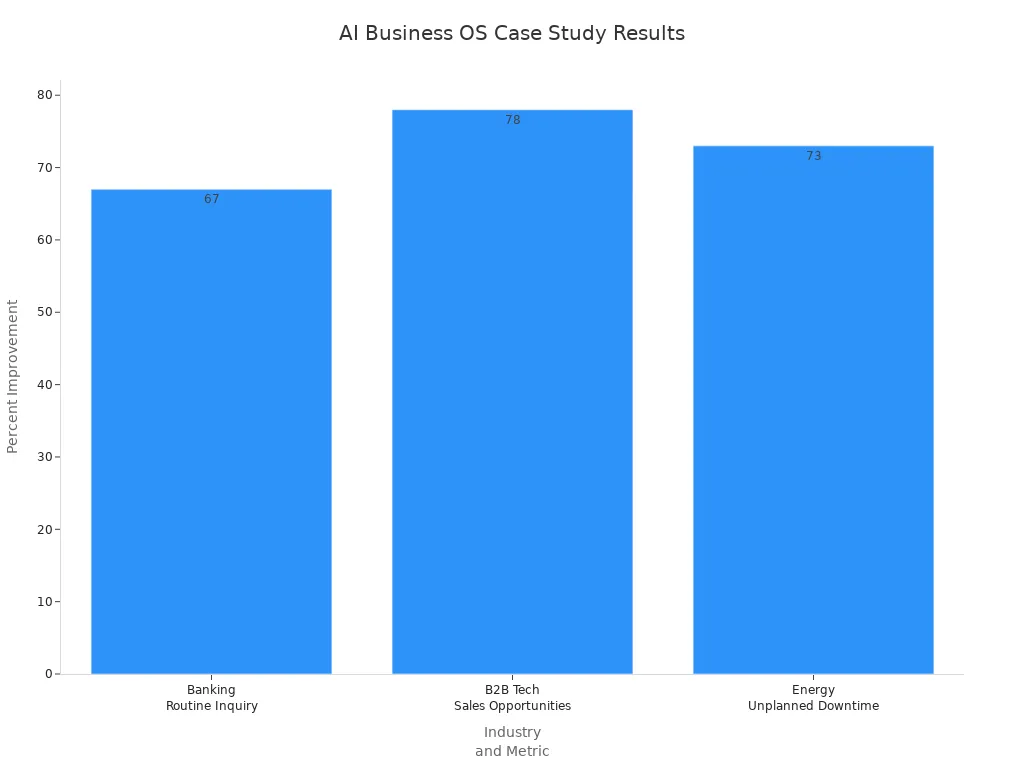
You should assess your readiness by checking your data, processes, and team mindset. Early adopters gain speed, innovation, and a strong market position. AI will shape how you work, decide, and grow in the future.
FAQ
What is the main benefit of using an AI business operating system?
You get faster decisions and better results. AI connects your data, automates tasks, and helps you grow your business. You save time and money.
How does AI improve teamwork in my company?
AI gives everyone the same information. Your teams work together better because they see real-time updates. You solve problems faster.
Is it hard to start using an AI business operating system?
You can start small. Focus on one area, like customer support or finance. Many systems offer easy tools and guides. You do not need to change everything at once.
Will AI replace my employees?
AI helps your team do more important work. It takes care of boring or repetitive tasks. Your employees can focus on creative and valuable projects.
What industries use AI business operating systems?
Many industries use AI, such as banking, healthcare, retail, and manufacturing. You can find AI tools in almost every field today.
See Also
Enhancing Business Growth Through Supply Chain Outsourcing
Key Features of WarpDriven ERP for Smart Enterprise Management
The Role of Outsourcing in Boosting Business Agility
The Negative Impact of Excessive SKU Proliferation
Strategies to Ensure Your B2B Order Fulfillment Is Future-Ready