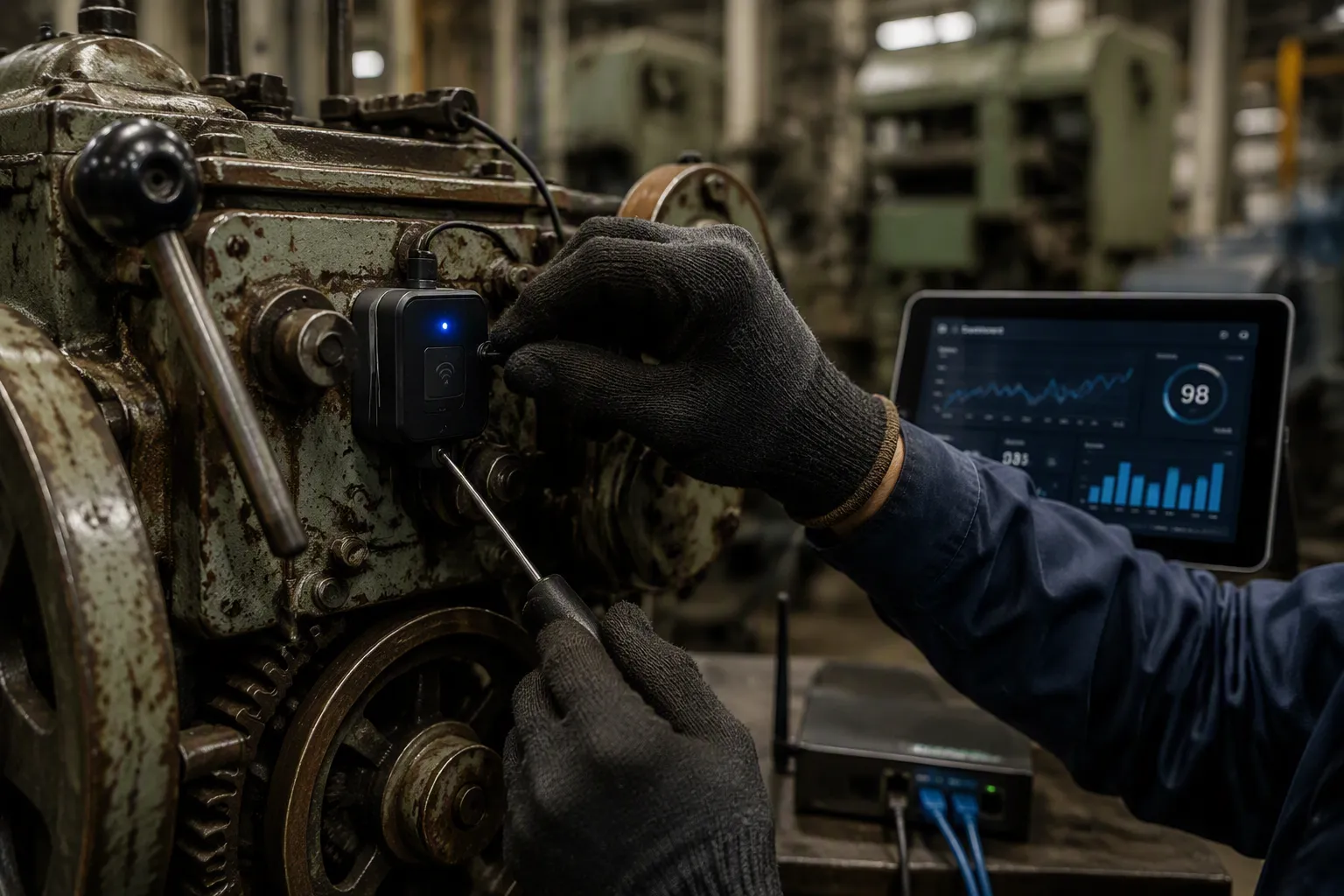
Replacing a fully functional machine costs far more than giving it new senses. By 2026, sensor costs have plummeted; a key MEMS chip fell from $200 in 2020 to under $8. Edge computing is mature, and gateways are widely available. This makes retrofitting smartly for Industry 4.0 a low-risk option. Retrofitting legacy machines adds sensors to your existing equipment without replacement. For retrofitting existing machines cost-effectively, assess your legacy equipment, select IoT integration, implement a secure pilot, and track ROI. This article shows you how.
Retrofitting Legacy Machines: Initial Assessment and Opportunity Identification
Defining Essential Data Needs and Machine Pain Points
Before you install sensors on any machine, you must first determine the data you actually need. Start by identifying the operational pain points that cost you time and money. Unplanned downtime, quality rejects, and energy waste all point to specific missing data.
Vibration, temperature, and pressure are the three most common data points for monitoring your legacy machines. These iot-enabled sensors detect hazardous conditions such as overheating motors or abnormal pressure levels. Bearing faults alone account for approximately 60% of electric motor failures, making vibration analysis your highest-value monitoring target. Advanced vibration detection identifies 90–95% of bearing problems 6–12 weeks before failure.
Map each pain point to a sensor type. If a machine runs hot, you need temperature probes. If it vibrates excessively, you need accelerometers. This mapping turns vague concerns into measurable data requirements. You then have a clear path for iot integration.
Evaluating Machine Condition and Retrofitting Feasibility
Not every machine qualifies as a good candidate. Some legacy machines have no documentation or use proprietary protocols. You must assess your legacy equipment's physical and electronic condition first.
Check whether your legacy equipment has control cabinet space, accessible mounting points, and a stable power supply. Look for existing controllers that follow standards like IEC 62541 for OPC UA or ISO 13374 for condition monitoring. If a machine is under 15 years old and its replacement cost exceeds six times the retrofit cost, choose a retrofit. This is a smart investment for your plant.
Plan a structured audit. Week one involves identifying three bottleneck machines and checking cabinet space. Week two focuses on ordering retrofit sensors and defining data tags. Weeks four through six involve mounting sensors rigidly and checking for ground loops. Week seven validates sensor data against a handheld gauge.
Take a knowns-unknowns approach. Leverage existing data from historians (knowns) and identify gaps (unknowns). For those gaps, select fit-for-purpose sensors that match your environment. These smart sensors help you optimize production and deliver actionable insights. This iiot approach directly maps pain points to sensor requirements.
IoT Integration for Legacy Machines: Choosing Sensors and Connectivity
External Sensors Versus Extracting Data from Existing Controllers
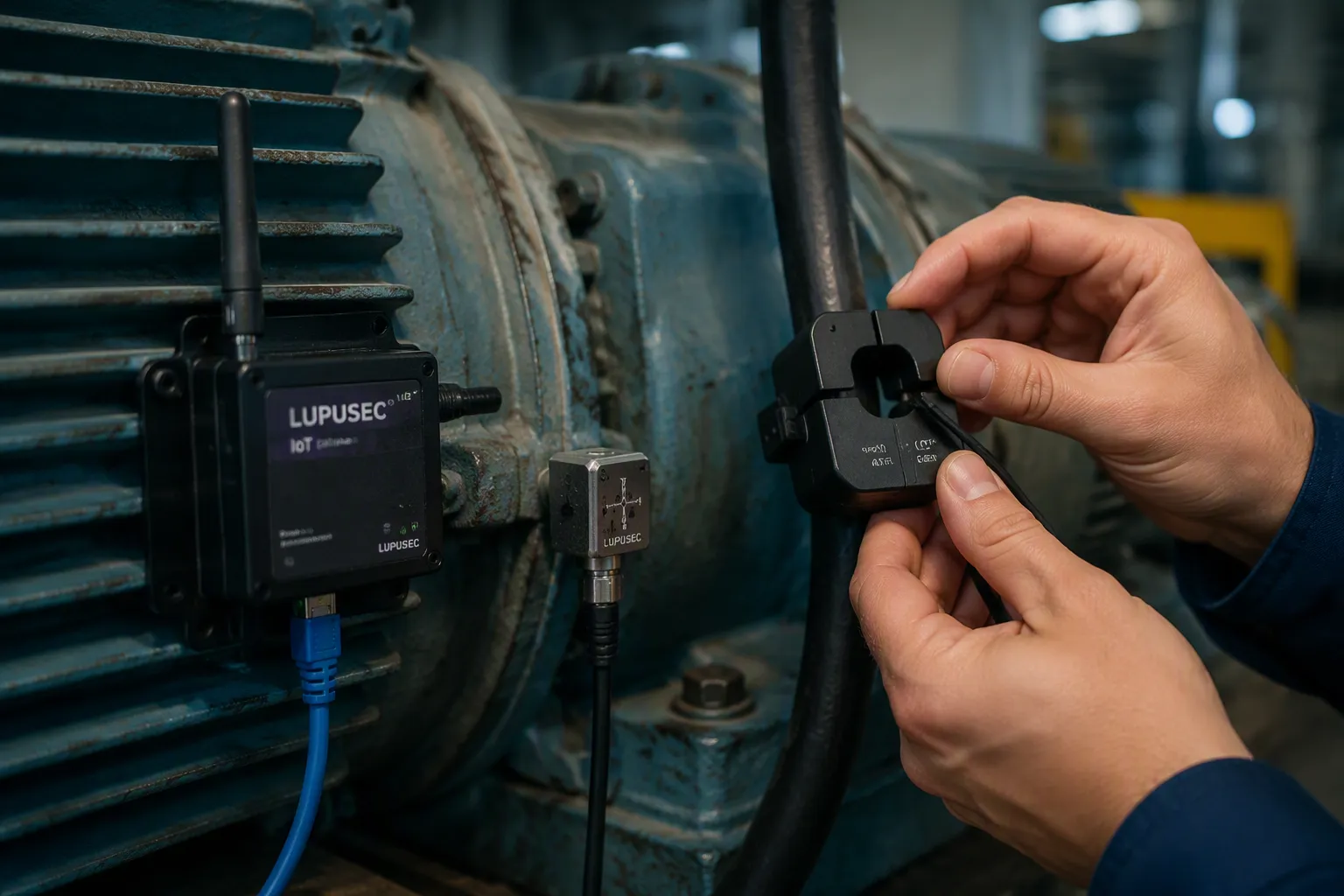
You face a fundamental choice when adding iot technology to older equipment. You can attach external sensors directly to the machine, or you can extract data from existing controllers. Each path offers distinct advantages.
External sensors work on any machine regardless of age. A split-core current transformer costs about $50 per major motor and installs in 30 minutes with zero downtime. Vibration accelerometers run $150–$500 per sensor point. Temperature RTDs cost $30–$100 per point. These iot-enabled sensors add new senses to your legacy equipment without touching existing controls.
Extracting data from existing controllers costs less when your machine already speaks a standard protocol. A Tier 5 machine from 2018 or later with native OPC-UA or MTConnect needs only $500–$2,000 for integration. A Tier 4 machine from 2008–2018 with Ethernet ports requires a protocol-specific gateway and license, costing $2,000–$5,000. Older Tier 2 machines with closed controllers force you toward external sensors, with costs reaching $5,000–$15,000.
Your decision hinges on machine age and controller type. Newer legacy machines reward controller integration. Older legacy machines demand external retrofit sensors.
Gateways, Protocol Converters, and Edge Computing for Legacy Interfaces
Gateways bridge the gap between your legacy equipment and modern systems. A 2026 industry article highlights that advanced Modbus gateways support multi-protocol conversion, explicitly including Modbus to MQTT. These devices bridge legacy RS-485 or RS-232 Modbus RTU devices to Ethernet and cloud-friendly protocols. This enables iiot integration and real-time data dashboards without replacing legacy hardware.
The machineCDN edge gateway handles EtherNet/IP and Modbus simultaneously and delivers data to MQTT in the cloud. It features automatic device detection, configurable tag maps, and a store-and-forward buffer. This protocol-aware normalization ensures readings from different protocols arrive in the cloud with identical formatting. You achieve integration with modern systems using no protocol converters, no middleware, and no custom integration code.
Edge computing localizes compute power to reduce latency for real-time applications. Processing data near the source reduces bandwidth congestion and avoids delays from transmitting large volumes to the cloud. This approach enables retrofitting legacy machines without disrupting existing infrastructure. You add smart sensors incrementally while edge devices handle local processing.
Wireless protocol selection matters for your connectivity layer. LoRaWAN modules offer ultra-low-power operation with ranges up to 15 km in rural areas and costs of $8–$15 per unit. Multi-protocol gateways bridging 5G, ZigBee, and LoRa cost $290–$520 per unit. These gateways prove critical for integrating legacy ZigBee lighting with new LoRa environmental sensors. Wi-Fi 6E suits high-bandwidth applications with latency under 20 milliseconds, but remains inferior to LoRaWAN for wide-area monitoring due to power consumption and infrastructure cost.
A tiered hybrid architecture serves most retrofit projects. Use Industrial Ethernet for control and safety loops. Deploy Wi-Fi 6E or wired Ethernet for high-bandwidth monitoring. Choose LoRaWAN or NB-IoT for wide-area condition monitoring. This smart approach connects your production assets without forcing a single protocol on every device.
The simple architecture follows a clear path: external sensors feed data to a gateway, and the gateway sends processed insights to the cloud. This iot integration pattern works across machine tiers and protocol boundaries.
Retrofit Implementation for Legacy Equipment: Secure and Scalable Steps
You start with a single machine. A phased approach minimizes production disruption. Retrofitting legacy machines begins with a proof-of-concept on one critical asset. This section covers how to build that pilot and secure your brownfield deployment.
Building a Pilot: From Sensor Installation to Data Visibility
Begin with an operational assessment. Evaluate your production goals and critical equipment. Select one bottleneck legacy machine for your pilot. This machine should represent common control types in your facility.
Plan sensor placement carefully. Mount sensors close to the bearing housing and load zone. Never mount them on flexible guards. Standardize measurement axes across similar machines. Follow ISO 20816-3:2022. Take two radial measurements per bearing and one axial reading. This captures accurate vibration data for predictive maintenance.
Collect baseline readings across normal speed and load conditions. Activate alarm thresholds only after this step. On variable-speed equipment, capture speed context. This avoids misleading frequency-based interpretation.
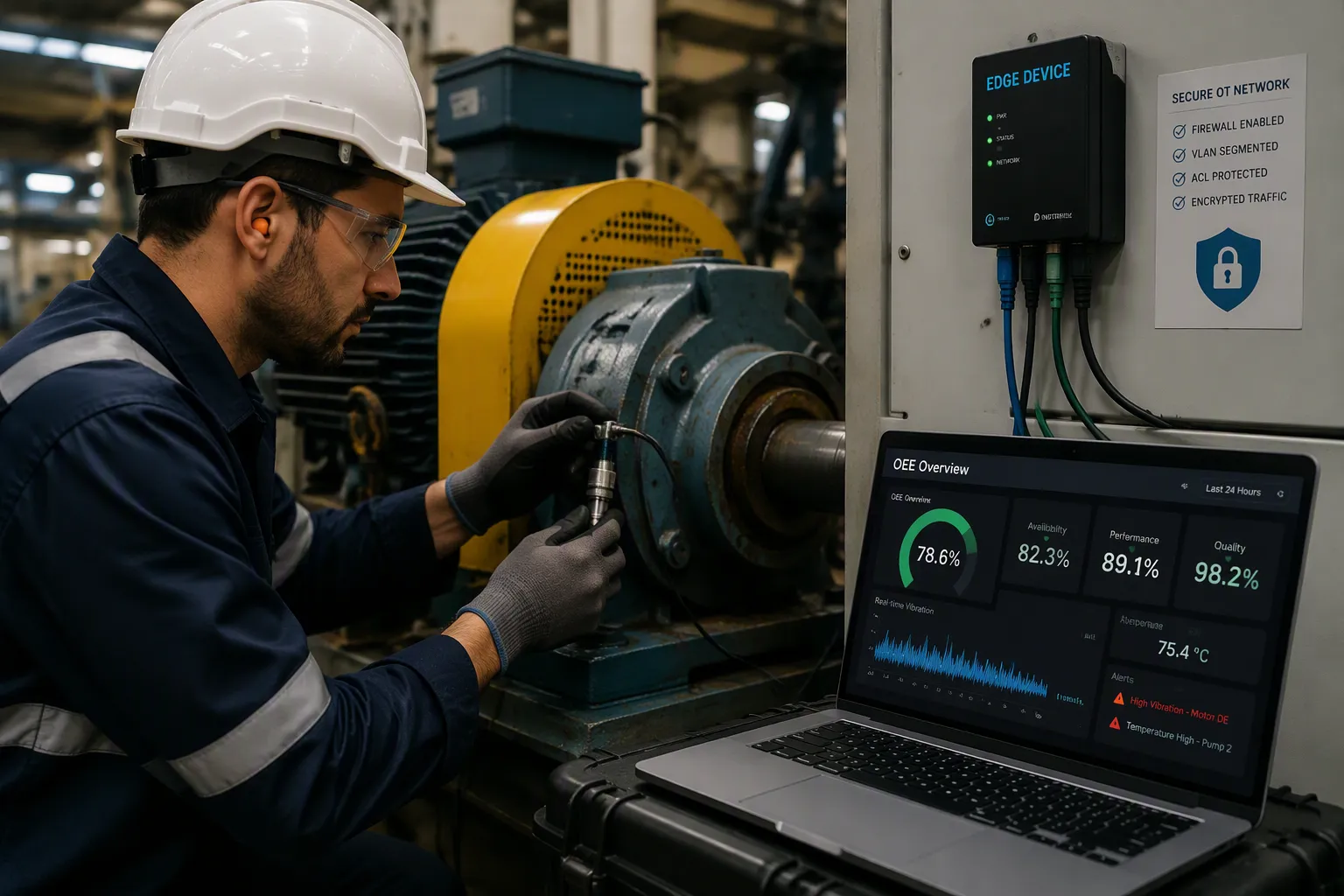
Now install an edge device. It should support protocol adapters and secure transport. Segregate your OT network from corporate IT. Use VLANs and firewall rules. Synchronize clocks with NTP. This creates secure integration between old and new systems.
Build your dashboard for real-time data visibility. Design live OEE per machine at one-minute refresh. Include rolling 60-minute availability plots. Set alert thresholds. Trigger operator alerts for stops exceeding two minutes. Trigger supervisor alerts when performance drops more than 20 percent over ten cycles.
Validate your pilot. Compare dashboard OEE against manual logs for five shifts. Aim for ±15 percent accuracy. Run 30 to 50 test cycles. Measure operator response times. Your goal is under two minutes median. This method delivers data-driven insights you can trust.
Cybersecurity and Data Governance for Brownfield Deployments
Integrating IoT with legacy equipment introduces security risks. You must isolate your sensor network from existing controls.
Use network segmentation strategies. Physical separation creates the strongest isolation. Virtual segmentation using VLANs offers a practical alternative. Implement micro-segmentation to limit compromise impact. Place legacy equipment behind industrial firewalls. These devices block unauthorized commands. Use Network Access Control to verify device identity.
Follow a zone architecture. Assign sensors to Level 0-1 segments. Give HMIs and SCADA controlled access at Level 2. Keep corporate networks separate at Level 3-4. This iiot approach protects operations.
Data governance matters equally. Define data quality standards. Use automated monitoring to detect anomalies. Assign data ownership across teams. Implement role-based access controls. Ensure compliance with GDPR and ISO. Maintain audit trails. Classify data by sensitivity. Keep raw events for 30 to 90 days. Store aggregates for one to three years.
Your framework enables smart scaling. You can connect additional legacy machines with confidence. You can optimize production without compromising safety. This iiot strategy delivers insights and smart improvements. Integration with modern systems becomes achievable.
Choosing the right IoT gateway simplifies IoT integration. IoT sensors provide the missing data. IoT connectivity ties everything together. Integrating IoT with brownfield deployments requires planning. Each successful retrofit project follows this proven path. Retrofitting adds value without full replacement. Retrofitting your plant one machine at a time builds momentum.
Benefits of Retrofitting Existing Machines: ROI and Future Trends
Measurable Gains: Predictive Maintenance and Operational Efficiency
You gain real financial returns when you retrofit legacy equipment with IoT sensors. Industry data shows manufacturers implementing predictive maintenance achieve 20-50% reductions in unplanned downtime. Modern wireless IoT sensors retrofit onto existing equipment regardless of age, brand, or manufacturer.
According to a Deloitte report, predictive maintenance reduces maintenance expenses by 25% compared to traditional methods. It cuts reactive repair costs by up to 40%. Rather than replacing parts on fixed schedules, your teams replace components based on actual wear-and-tear data. You service pumps only when sensor data shows efficiency drops. This avoids unnecessary labor and part replacement costs.
Energy savings add another layer of value. Retrofitting existing machines with AI-driven predictive analytics and intelligent sequencing controls can cut energy consumption by 15% to 30%. The savings come from optimizing how and when compression mechanics operate, not from altering hardware. Comprehensive system integration with IoT connectivity delivers proven energy savings of 30-50%.
These gains directly address the pain points you identified during your initial assessment. Your operational efficiency improves because you stop guessing about machine health. Your production efficiency rises because you schedule maintenance during planned windows. The iiot approach turns raw sensor readings into data-driven insights that drive smart decisions.
Future-Proofing Your Retrofit with Edge AI and Digital Twins
Edge AI transforms your retrofit from a monitoring project into a real-time control system. Edge inference latency stays under 10 milliseconds, which is 10-50 times faster than cloud-only processing. This speed matters for high-speed production. At 50,000 RPM, a 200-millisecond cloud delay equals 166 rotations of undetected damage.
| Path | Stages | Total Latency |
|---|---|---|
| Edge AI | Sensor → Local Gateway → AI Inference → Action | 1-10 ms |
| Cloud AI | Sensor → Gateway → Internet → Data Center → Return → Action | 50-500 ms |
Digital twins extend this capability further. You attach wireless sensors to conveyors, pumps, and overhead systems that may be 20+ years old. Edge computing and cloud-based analytics then enable predictive maintenance. One reported outcome is a 70% reduction in unplanned downtime. This demonstrates tangible benefits from your retrofit approach.
Your smart integration path follows a clear sequence. You sense data in under 1 millisecond. You analyze it in under 10 milliseconds. You decide on action in under 50 milliseconds. You act within 60 seconds through automated work orders. This architecture optimizes equipment performance without replacing existing sensors, PLCs, or SCADA systems.
Retrofitting legacy machines unlocks Industry 4.0 benefits without a full capital overhaul. This low-risk strategy follows three proven phases. First, assess your data needs and legacy equipment condition. Second, select complementary sensors and IoT connectivity for seamless integration. Third, implement a secure, pilot-driven rollout for your legacy machines. Retrofitting existing machines keeps costs low. Industry surveys confirm the payoff.
| Project Scope | ROI Timeline |
|---|---|
| Brownfield smart factory pilot (10–20 assets) | 45–90 days |
| Full smart-factory retrofit with AI-powered maintenance and quality | 12–18 months |
Start with one critical machine today. Run a 90-day pilot. Let the data prove the case for scaling. Consulting with integration partners or leveraging your existing cloud platforms can accelerate your IIoT journey toward smarter production.
FAQ
What Does a Single Machine Retrofit Cost?
Your costs vary by machine age and controller type. External sensors cost $150–$500 per point. Controller integration costs $500–$2,000 for newer machines. Older machines with closed controllers cost $5,000–$15,000 for full retrofitting of legacy equipment.
Do You Need to Stop Production for Installation?
No. You install split-core current transformers in 30 minutes with zero downtime. You mount vibration sensors during planned maintenance windows. A phased pilot approach minimizes disruption to your production schedule.
Can You Retrofit Machines That Are 30 Years Old?
Yes. External sensors work on any machine regardless of age. You attach sensors directly to the machine surface without touching existing controls. This makes even very old machines suitable for iot retrofitting.
How Long Does a Pilot Project Take Before You See Results?
A pilot on one machine typically takes 7 weeks. You spend week one identifying the machine. Weeks two through six cover sensor installation and testing. Week seven validates the data. Full projects show ROI within 45–90 days.
See Also
Forecasting Textile Machine Failures With AI In 2025
How AI Sensors Transform Fashion Supply Chains In 2025
Achieving Perfect Just-In-Time Delivery Using AI In 2025
Using Predictive Analytics To Optimize Retail Inventory In 2025
AI Solutions For Reducing Fashion Returns Efficiently In 2025