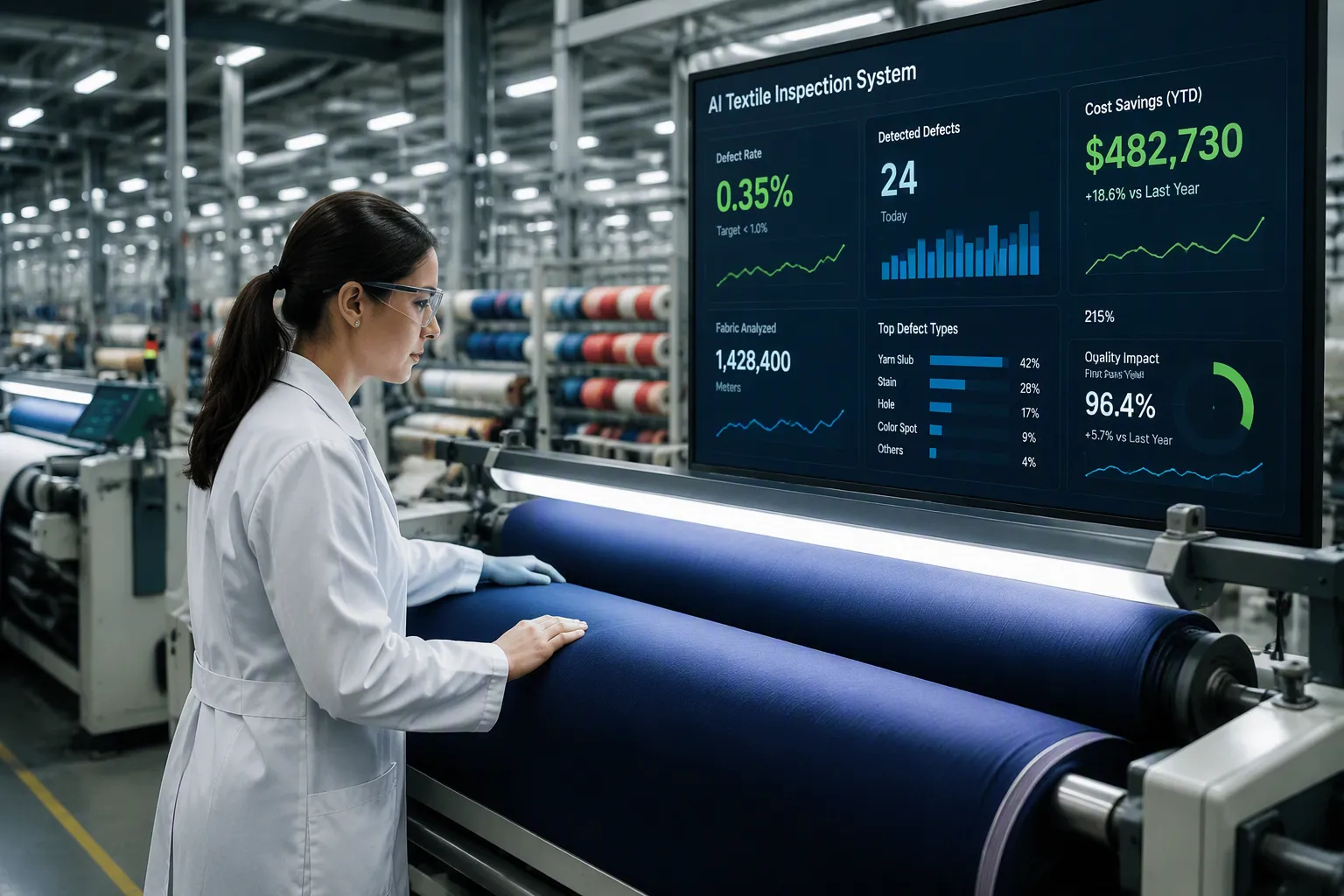
Your factory loses money every time a defect slips through. Manual inspection catches only about 70% of defects. AI systems start at 98% accuracy and can reach over 99% in quality control applications. This dramatic gap directly impacts your bottom line.
AI-powered quality control transforms your manufacturing operation. You achieve ai quality control roi in as little as 90 days. Manufacturers report 200–400% returns on their investment. This technology reduces waste while improving overall quality management.
The return on investment extends beyond defect reduction. You gain efficiency, customer trust, and competitive advantage. Understanding these financial drivers helps you make smart decisions for your textile manufacturing business.
The Hidden Costs of Traditional QC
Manual inspection feels straightforward. You station workers along the line, and they watch for flaws. Yet this approach drains your budget in ways you might not track. Human eyes tire, attention wanders, and consistency drops by the hour. Studies show manual inspection catches only about 70% of defects. That gap means flawed fabric moves forward, and you pay for it twice.
Labor and Rework Expenses
Your inspection team represents a major payroll line. You hire dozens of workers to examine every roll, every seam, every print. Each inspector needs training, supervision, and breaks. Even then, two inspectors rarely agree on the same flaw. One calls it a defect; another lets it pass. This inconsistency creates chaos downstream.
When a defect reaches the cutting room or the customer, you face rework costs. Someone must locate the problem, pull the material, and fix or discard it. Rework consumes labor hours, machine time, and floor space. You pay your best operators to repair mistakes that automated detection could have caught in seconds. These expenses multiply across every production run.
AI changes this equation. An automated system inspects every inch of fabric at full line speed. It never tires, never loses focus, and applies the same standard to every batch. You redirect your skilled workers from repetitive checking to higher-value tasks. Your payroll supports production, not patrolling for flaws.
Waste and Lost Revenue
Defects create waste at every stage. A flawed roll might become seconds, selling at a steep discount. Worse, it might become scrap, carrying zero recovery value. You also waste the raw materials, energy, and labor invested before the defect appeared. Traditional quality control discovers problems late, after you have already spent money making them.
Lost revenue extends beyond the defective goods themselves. A customer who receives substandard fabric may return it, demand a refund, or cancel future orders. Your reputation suffers with every missed defect. Competitors with reliable quality assurance win those accounts. You lose not just this order but the lifetime value of that relationship.
Modern defect detection prevents this cascade. AI identifies problems at the source, often before you complete a full roll. You stop production, correct the issue, and save the material. Your waste drops, your yield rises, and your customers receive consistent quality. The financial impact of this shift appears directly on your profit statement.
AI-Powered Quality Management: Boosting Profitability
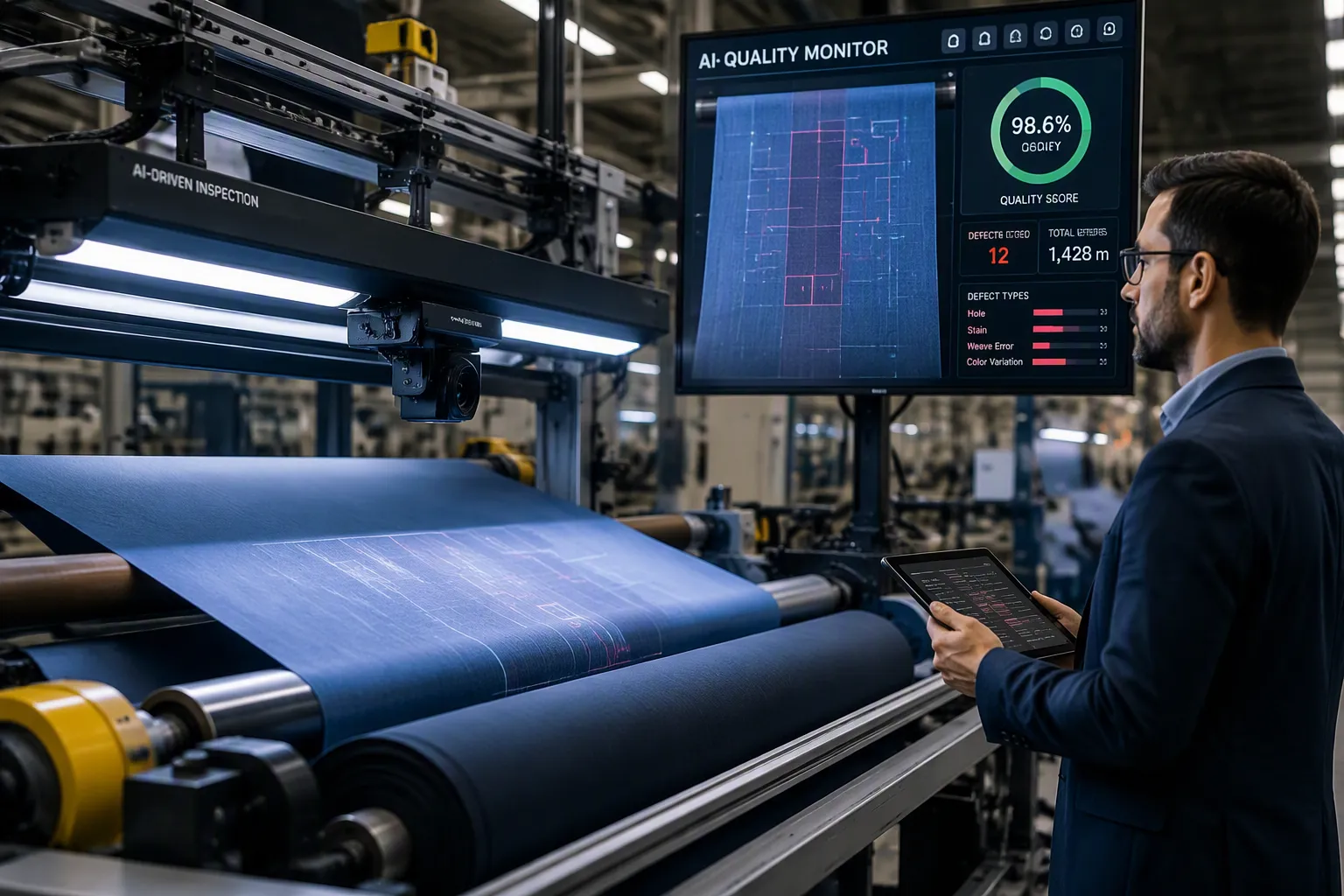
Your factory's profit margin depends on catching defects before they cost you money. AI-powered quality control transforms this process into a financial advantage. Systems begin with 98% accuracy immediately. Within weeks, they can reach over 99% accuracy. This rapid improvement drives an ai quality control roi in just 90 days. Manufacturers consistently report 200–400% returns on their investment. These numbers translate directly into your bottom line.
Defect Reduction and Savings
Defect reduction creates your largest savings opportunity. AI quality systems catch flaws that human eyes miss. The financial impact appears across multiple cost categories simultaneously.
Leading technical textile producers reported a 40% drop in defect rates within months of deploying AI inspection systems. This reduction means fewer rejected rolls, fewer customer complaints, and fewer chargebacks. Your quality assurance team shifts from firefighting problems to preventing them.
Material waste drops dramatically with AI-powered quality management. Consider these measured results from textile mills:
- Overall material waste reduction reaches 20–35% across mills and garment factories
- Real-time AI defect detection at loom outputs cuts defect-related fabric rejection by 65%
- AI catches defects within 2–5 metres of production, compared to 30–60 metres for manual inspection
Catching defects early saves the material itself. You stop production quickly, correct the issue, and preserve valuable fabric. This early detection represents the core of modern manufacturing quality management.
The annual cost savings from reduced defects tell a compelling story. One textile factory documented these results after deploying AI inspection:
| Cost Category | Annual Savings |
|---|---|
| Inspection labor | $112,000 |
| Customer returns and chargebacks | $192,000 |
| Rework and repair cost | $105,000 |
| Seconds and markdown losses | $63,000 |
| Total annual savings | $472,000 |
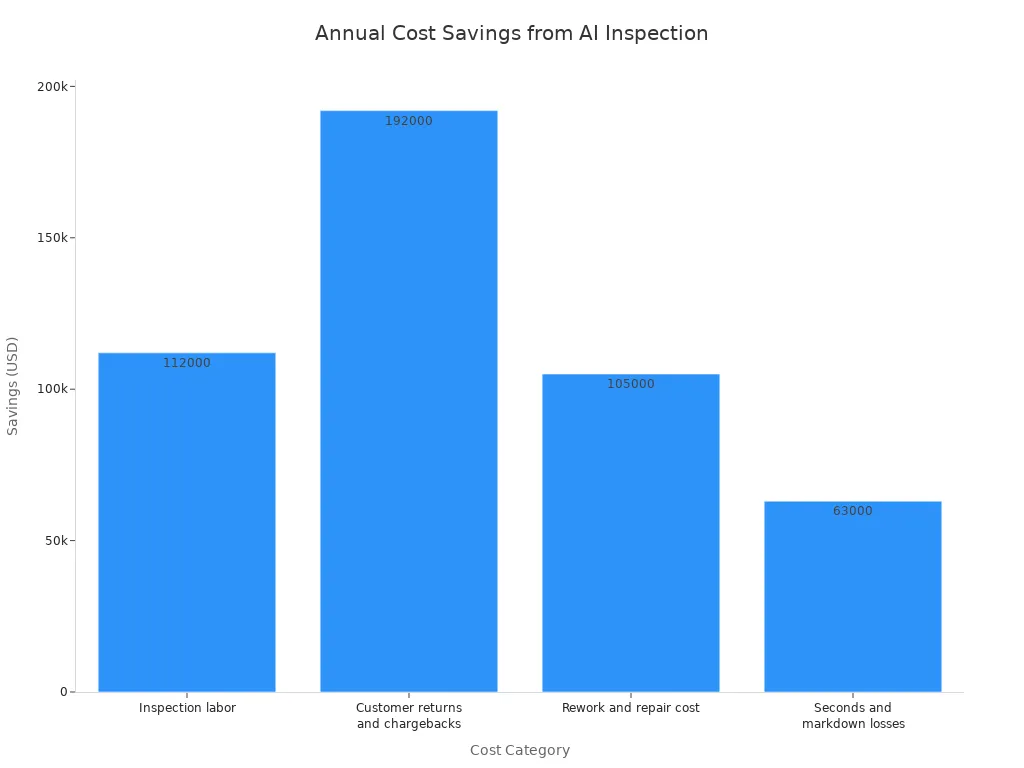
These savings come from real-time data analysis that identifies problems instantly. Your quality data becomes actionable intelligence rather than historical records. Every defect caught early represents recovered revenue.
Labor Efficiency Gains
Your inspection team represents significant payroll expense. AI-powered quality control changes this equation completely. A single AI system handles the workload of 3 to 5 manual inspectors. This capability reduces labor hours for quality inspection by approximately 66–80%.
In practical applications, the AI fabric inspection machine helps companies reduce the labor cost of fabric inspection by more than 50%. You redirect your skilled workers toward higher-value tasks. Your payroll supports production output rather than repetitive checking.
This efficiency gain extends beyond inspection itself. Your quality management solutions free supervisors from manual oversight. Your best operators focus on process improvement rather than defect hunting. Your factory produces more goods with the same workforce.
The roi calculation becomes clear when you combine labor savings with defect reduction. Your efficiency increase compounds with waste reduction. Your quality assurance costs drop while your production capacity rises.
AI-powered quality control delivers measurable financial returns. The technology pays for itself quickly. Your management team sees results within one quarter. Your manufacturing operation becomes more competitive with every production run.
The data supports your decision. AI-powered quality management delivers proven results across textile manufacturing. Your factory can achieve the same outcomes with proper implementation. The financial case for adoption grows stronger with each passing quarter.
Real-World AI Quality Control ROI Case Studies
Numbers on a spreadsheet tell one story. Real factories tell another. You need concrete examples to understand what ai quality control roi looks like in daily operations. The following cases show how textile manufacturers transformed their quality outcomes within a single quarter.
Case Study: 90-Day ROI Achievement
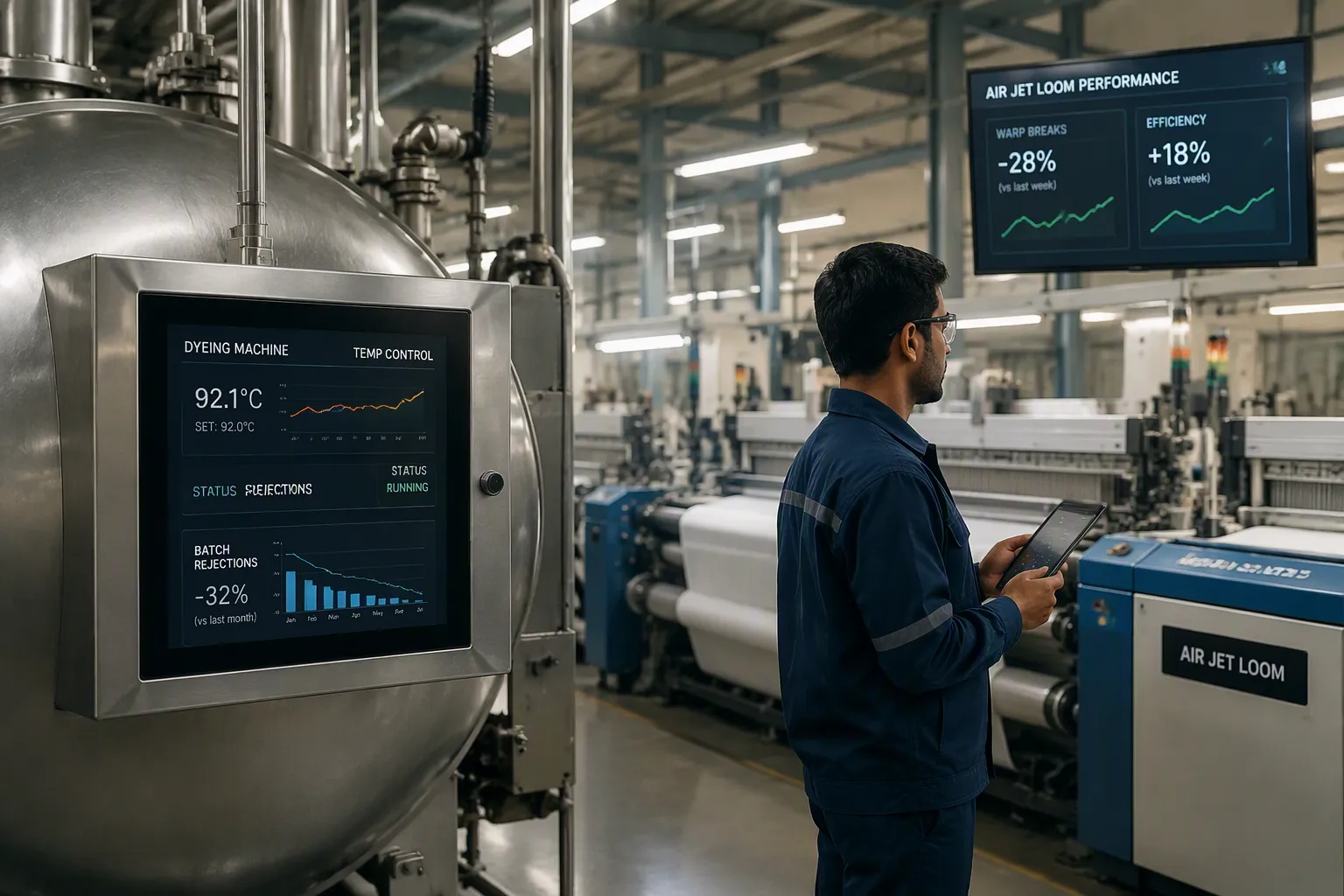
A mid-sized textile factory faced persistent quality problems across two production areas. Their dyeing process produced inconsistent batch results. Their air jet looms suffered frequent warp breaks. Both issues cost them money through rework, downtime, and customer complaints. They deployed an AI-powered quality control system to address both problems simultaneously.
The dyeing machine temperature control module delivered immediate results. Batch rejections dropped from 12-15 per year to just 3 per year. That reduction of 75-80% meant fewer discarded materials and less wasted chemical input. Troubleshooting time fell from 4 hours to 45 minutes, an 81% improvement. Junior technicians now resolve 85% of issues independently without waiting for senior engineers. Your team gains similar autonomy when AI identifies root causes instantly.
The air jet loom module produced equally impressive outcomes. Warp breaks decreased by 68% after the system identified the underlying cause. Production efficiency increased by 12% as a direct result. Average break clearing time dropped from 8 minutes to 3 minutes, a 62.5% improvement. Your operators spend less time fixing problems and more time producing fabric.
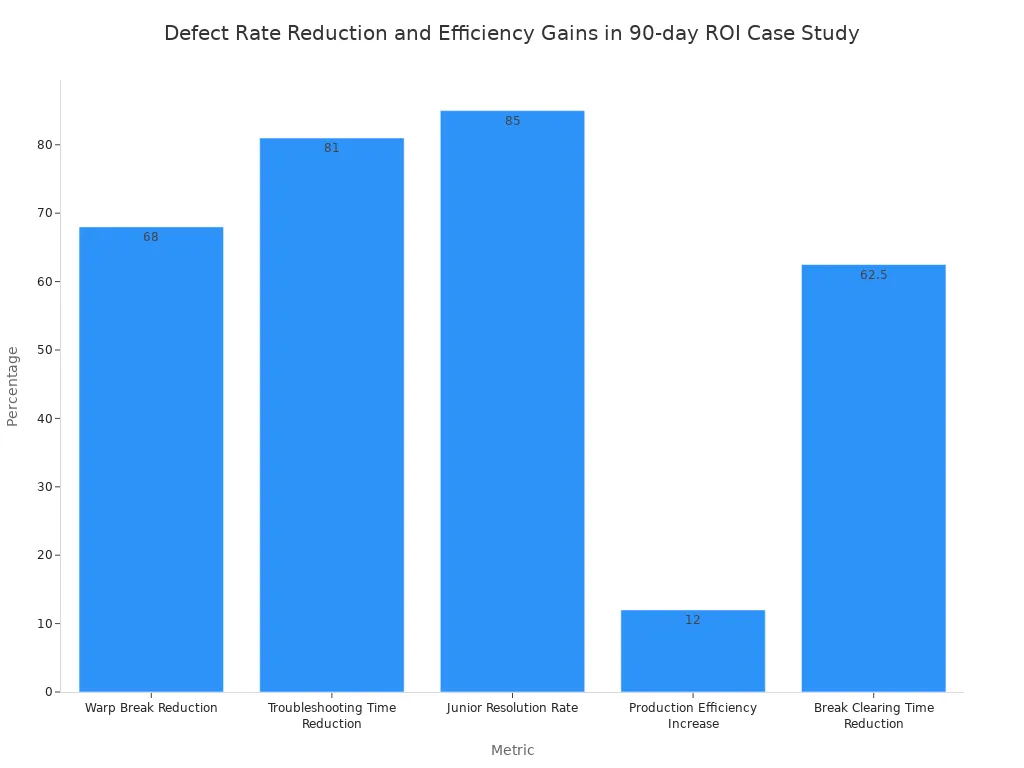
The table below summarizes these measurable gains:
| Sub-case | Defect rate reduction | Efficiency gain |
|---|---|---|
| Dyeing Machine Temperature Control | Batch rejections dropped from 12-15 per year to 3 per year (75-80% reduction) | Troubleshooting time reduced from 4 hours to 45 minutes (81% faster); junior technicians resolve 85% of issues independently |
| Air Jet Loom Warp Break Reduction | Warp breaks reduced by 68% after root cause identification | Production efficiency increased by 12%; average break clearing time reduced from 8 to 3 minutes (62.5% faster) |
These improvements produced an roi within 90 days. The savings from reduced waste and increased efficiency covered the system cost quickly. Your factory can expect a similar timeline when you address your specific production bottlenecks.
Long-Term Impact on Profit Margins
The 90-day results matter, but long-term gains create lasting competitive advantage. Gartner predicts that by 2025, over 50% of manufacturers will integrate AI for quality control. This integration will result in a 30% improvement in quality outcomes. Factories that adopt early position themselves ahead of competitors who wait.
Your defect reduction compounds over time. Each percentage point represents recovered material, reduced rework, and fewer customer returns. Your quality assurance team shifts from reactive problem-solving to proactive prevention. This transformation changes your entire manufacturing culture.
Customer satisfaction increases when you deliver consistent quality. Satisfied customers place larger orders and remain loyal through market fluctuations. They recommend your factory to other buyers. Your reputation for reliability becomes a marketing asset that competitors cannot easily copy.
The data you collect through AI-powered quality management becomes strategic intelligence. You identify patterns across production runs. You predict equipment failures before they cause defects. You optimize processes based on factual evidence rather than guesswork. This data-driven approach to management improves every aspect of your operation.
Your profit margins expand as waste shrinks and efficiency grows. The initial investment fades into history while the savings continue indefinitely. Each production run benefits from the same AI-powered quality control system. Your manufacturing operation becomes more profitable with every passing quarter.
The evidence from real factories confirms what the financial models predict. AI delivers measurable returns quickly and sustains those gains over time. Your factory can achieve the same results when you commit to this technology.
Navigating AI-Driven Quality Management for Maximum ROI
Initial Investment and Payback Period
The upfront cost of an ai inspection system raises questions for manufacturing leaders. You need to understand the full financial picture before committing resources. The investment includes hardware, software, integration, and staff training. These costs vary based on your manufacturing operation size and production complexity. Your management should evaluate these factors carefully.
The payback period tells you when you recover your investment. Textile manufacturers who adopt ai-driven inspection systems see a payback period of 9 to 18 months. The average falls at 13.5 months. Your specific timeline depends on your current defect rates, production volume, and waste levels. A factory with high defect rates recovers its investment faster because the savings are larger. Good management of this transition accelerates your returns.
Your roi calculation should include all savings categories. Reduced labor costs, lower material waste, fewer returns, and higher production efficiency all contribute. The 200–400% roi that manufacturers report comes from this combination of savings. Your management team can model these numbers using your own production data for accurate planning.
The rapid accuracy ramp-up supports fast payback. Your ai system starts at 98% accuracy immediately. Within weeks, it can reach over 99% accuracy. This quick improvement means you start saving money almost immediately after installation. Your ai-powered quality management system begins paying for itself from day one. This ai technology transforms your financial outlook within a single quarter. Effective ai-powered quality management requires commitment from all levels of management.
Overcoming Common Integration Challenges
Integration presents the biggest hurdle for most factories. Your manufacturing process contains multiple systems that must work together. Connecting these systems requires careful planning and execution. Many manufacturing operations underestimate this step during their transformation effort.
67% of textile factories report that data silos between departments are their primary bottleneck when integrating systems for ai-based quality control.
Breaking down these silos requires a unified approach. You need to connect your existing systems into a single platform for manufacturing quality management. The key steps include:
- Connecting your ERP system (SAP, Oracle, or Tally) with production data from the factory floor
- Unifying buyer orders, material data, and machine records into one intelligence layer
- Creating a single source of truth for your management system
This end-to-end quality integration transforms how your factory operates. Your quality assurance team gains access to complete information. Your operators see real-time data from every stage of production. Your management makes decisions based on facts rather than guesses. Integrated quality platforms deliver this capability reliably. Your entire manufacturing operation benefits from better management of quality data.
Staff training represents another common challenge. Your team needs to understand how to work with the new system. The learning curve is short. Most operators become comfortable within days. The ai system provides clear visual feedback that anyone can understand. Your digital transformation succeeds when you invest in proper training and change management. Your ai-powered quality control system becomes more effective with trained operators.
The best approach starts with a pilot program. Select one production line or one product type. Implement the ai-powered quality control system there. Measure the results. Use those results to build your case for full deployment. This phased approach reduces risk and builds confidence across your organization. Your quality management solutions grow with your experience. These quality management solutions deliver consistent results.
Your factory can achieve an ai quality control roi in just 90 days. Manufacturers report 200–400% returns. You gain efficiency improvements and waste reduction. Customer satisfaction rises when you deliver consistent quality.
This ai-powered quality management system delivers proven results. The payback period averages 13.5 months. Your manufacturing operation becomes more competitive with each production run. Strong management of this transition accelerates your returns. Quality management becomes your competitive advantage.
Start your transformation today. Audit your current quality control costs. Consider a pilot program on one production line. Consult an ai vendor to model your own returns. This ai-driven quality management approach gives you a lasting edge. Your ai-powered quality control investment pays dividends for years. Effective management of your quality program starts now.
FAQ
How quickly does AI quality control reach full accuracy?
Your AI system starts at 98% accuracy on day one. Within weeks, it can reach over 99% accuracy. This rapid ramp-up means you begin saving money almost immediately. Most factories achieve full ai quality control roi within 90 days of installation.
What factors affect the payback period for AI inspection?
Your payback period depends on current defect rates, production volume, and waste levels. Factories with high defect rates recover costs faster. The average payback period spans 9 to 18 months. Most manufacturers report 200–400% returns on their ai investment.
How much training do workers need for AI quality systems?
Most operators become comfortable within days. The AI system provides clear visual feedback that anyone can understand. Your quality team shifts from repetitive checking to higher-value tasks. This transition improves overall quality management across your factory floor.
Can AI quality control connect with existing factory systems?
Yes. AI platforms integrate with your ERP system, production data, and machine records. Breaking down data silos between departments creates a single source of truth. This unified approach strengthens your manufacturing quality management and delivers consistent results across every production run.
What savings categories should I include in my ROI calculation?
Include labor cost reductions, material waste savings, fewer customer returns, and higher production efficiency. One textile factory documented $472,000 in annual savings from AI inspection. Your quality data becomes actionable intelligence that drives continuous improvement in your manufacturing operation.
See Also
AI Driven Textile Equipment Maintenance Forecasting For 2025
How AI Sensors Transform Fashion Supply Chains In 2025
Innovative AI Fashion Solutions For A Greener Earth