

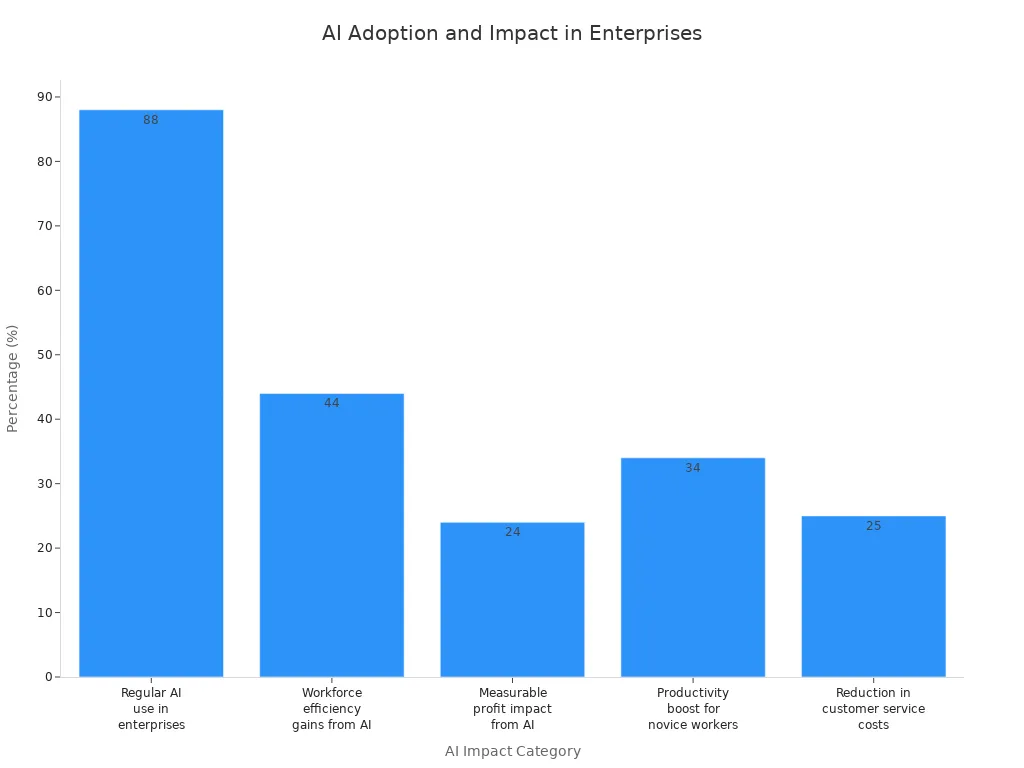
An ai business operating system gives you a smart way to manage your company. You use ai to automate tasks, speed up decisions, and connect different parts of your business. With ai, you see faster cycle times and lower costs because machines and people work together to solve problems. The table below shows how many enterprises now use ai and what results they report:
| Evidence Description | Percentage/Impact |
|---|---|
| Regular AI use in enterprises | 88% |
| Workforce efficiency gains from AI | 44% |
| Measurable profit impact from AI | 24% |
| Productivity boost for novice workers using AI | 34% |
| Reduction in customer service costs through AI | 25% |
You can see that ai brings real gains, such as saving up to an hour each day and making workflows smoother. Businesses that use ai business operating systems report better accuracy, faster responses, and improved customer experiences.
AI Business Operating System Overview

What Is an AI Business Operating System
You can think of an ai business operating system as the brain of your company’s digital operations. This system uses advanced ai technologies, such as machine learning and natural language processing, to help you automate tasks and make smarter decisions. Unlike traditional software, an ai operating system adapts to your needs and learns from your data. You do not need a huge budget or a team of data scientists to use it. Modern ai business operating systems work for companies of all sizes and help you interact with your data in simple ways.
Key components of an ai business operating system include:
- Machine learning and deep learning models
- Data management systems
- Natural language processing tools
- Neural networks
- Autonomous decision-making algorithms
- User-friendly interfaces
- Security frameworks
- Integration features
These features allow you to connect different parts of your business and improve how you work every day.
Core Functions and Capabilities
An ai operating system gives you powerful tools to automate and optimize your business. You can use predictive analytics to see trends and get recommendations for your next steps. The system can adjust your processes on its own, like changing schedules or predicting when machines need repairs. You also get personalized experiences for your customers, which helps you build stronger relationships.
| Function/Capability | Description |
|---|---|
| Predictive and Prescriptive Analytics | Offers insights and suggestions based on market trends and customer behavior. |
| Autonomous Process Optimization | Adjusts operations in real time for better efficiency. |
| Personalized Customer Experiences | Tailors interactions and recommendations for each customer. |
| Cross-Functional AI Integration | Connects data and decisions across all business areas. |
| AI-Governed Compliance and Risk Management | Tracks rules and manages risks automatically. |
An ai business operating system learns from real-time data. It uses feedback to improve its actions, so you always get the best results. This means your company can respond quickly to changes in the market.
Integration with Enterprise Workflows
You can connect an ai operating system to many workflows in your business. For example, you can automate finance tasks like invoice processing, improve supply chain forecasting, and speed up customer service responses. IT teams use ai to classify and solve problems faster.
Tip: Start by linking your ai business operating system to the workflows that slow you down the most. You will see quick wins in efficiency and accuracy.
When you use an ai business operating system, you break down data silos and help your teams work together. The system supports real-time updates and keeps your business running smoothly. Over time, the ai learns from your operations and adapts to new challenges, making your company more agile and competitive.
Benefits & Use Cases of AI Operating System

Efficiency and Automation
You can use an ai business operating system to make your company run faster and smarter. Automation lets you handle repetitive tasks without human effort. This means you save time and money. For example, ai can process invoices, review legal documents, and answer customer questions. You do not need to spend hours on these jobs anymore.
Here is how automation brings real value:
| Source | Evidence | Impact |
|---|---|---|
| IBM’s 2025 enterprise study | 55% of executives cite greater operational efficiency | Significant time and cost savings |
| McKinsey’s 2025 State of AI | 10-20% cost reductions in key business areas | Lower operational costs |
| PwC’s 2025 Responsible AI | 55% of leaders saw better customer experience | Increased revenue through loyalty |
You can see these results in real companies. JPMorgan Chase built an ai system called COiN. This system reviews legal documents and loan agreements. Before, this work took 360,000 hours each year. Now, automation does it in seconds. This saves money and lets people focus on more important work.
- AI tools in consulting firms save employees up to 7.5 hours per week by automating emails and document summaries.
- AI-powered document processing extracts data from thousands of invoices in minutes.
- AI chatbots in HR handle routine questions, so staff can work on complex tasks.
When you use a built world ai operating system, you connect your workplace data and remove bottlenecks. You get scalable automation that grows with your business. This means you can handle more work without hiring more people.
Predictive Operations
An ai operating system gives you the power of intelligence. You can see problems before they happen. The system uses real-time data and machine learning to predict what your business needs next. You can optimize resources, prevent delays, and keep everything running smoothly.
AI business operating systems use predictive analytics to:
- Forecast inventory needs and avoid shortages.
- Allocate resources where they are needed most.
- Create marketing campaigns that reach the right customers.
- Analyze large datasets for better decision-making.
- Anticipate demand and prevent supply chain disruptions.
- Forecast market trends and customer behavior for proactive planning.
You measure the success of predictive operations with metrics like forecast accuracy, cost reductions, operational uptime, and return on investment. For example, Shell uses a built world ai operating system to monitor over 10,000 assets. The system processes 20 billion sensor readings each week. This helps Shell predict when machines need repairs and avoid costly breakdowns.
With real-time orchestration, you can adjust your operations as soon as new data arrives. This keeps your business agile and ready for change.
Enhanced Employee Experience
You improve the employee experience when you use ai for automation and workflow orchestration. Employees spend less time on manual work and more time on creative tasks. AI-driven tools help your team learn new skills and work together better.
- Studies show ai adoption leads to a 14% average productivity increase for customer service reps. Less experienced employees see gains up to 34%.
- AI-enabled HR platforms reduce administrative workloads by 27% and shorten onboarding cycles by 23%.
- Personalized ai-driven learning platforms boost training completion rates by 22% and increase satisfaction with development by 19%.
A built world ai operating system supports employee upskilling and engagement. Employees join strategic conversations about work and ai. This gives everyone a sense of belonging and purpose. You create a culture where people want to learn and grow.
| Evidence Description | Explanation |
|---|---|
| Involvement in strategic conversations | Employees from all groups join discussions about work and ai. |
| Democratized work | Employees have more input, leading to higher productivity and engagement. |
| Mindset of perpetual reinvention | Employees keep learning new skills to stay competitive. |
Note: When you use a data intelligence platform, you give your team access to intelligent recommendations and adaptive learning. This helps everyone stay ahead in a changing business world.
Real-World Examples
Many industries use ai to transform their business. Here are some real-world examples:
| Industry | Company | Transformation Description | Key Outcomes |
|---|---|---|---|
| Retail | Walmart | Enhanced supply chain with ai for truck routing and load optimization. | Saved $75 million in a year; reduced CO₂ emissions by 72 million pounds. |
| Automotive | BMW | Integrated ai for real-time quality control in assembly lines. | 60% reduction in vehicle defects; faster quality checks. |
| Financial | JPMorgan Chase | Developed ai to automate document review for legal work. | 360,000 staff hours saved annually; increased speed and accuracy in processing. |
| Automotive | CarMax | Used generative ai to summarize customer reviews for better engagement. | Summarized 100,000 reviews into 5,000 highlights; improved SEO and content creation focus. |
| Energy | Shell | Implemented ai for predictive maintenance across global assets. | Monitored over 10,000 assets; processed 20 billion sensor readings weekly for predictive insights. |
You can also see how ai helps in healthcare. Cleveland Clinic uses ai to handle administrative tasks. This saves staff time and lets them focus on patient care.
When you use agent-driven automation and ai workflows, you connect your data and make your business more efficient. You remove data silos and enable workflow orchestration. This helps your company adapt quickly and stay ahead of the competition.
Tip: Start with one area, like finance or HR, and expand your ai use as you see results. A built world ai operating system grows with your business and brings intelligence to every part of your operations.
Adoption Considerations for AI
Integration Challenges
You may face several challenges when you connect ai business operating systems to your current systems. Legacy infrastructure often creates barriers for new technology. The table below shows common issues and strategies to solve them:
| Challenge | Description | Strategy |
|---|---|---|
| Incompatibility Between AI and Legacy Systems | Old systems do not match modern ai frameworks. | Use modularization and microservices. |
| Fragmented Data and Silos | Data silos slow down ai and limit insights. | Centralize data and standardize metadata. |
| Scalability and Performance Barriers | Legacy systems cannot handle ai workloads. | Move to cloud-native ai platforms. |
| Model Deployment Complexity | Old systems lack tools for ai model management. | Adopt MLOps and hybrid deployment models. |
| Security, Compliance, and Governance Risk | Legacy systems may not meet new compliance standards. | Embed governance from the start. |
You can also use API-based connections, middleware solutions, and phased implementation to bridge gaps. Investing in flexible infrastructure and cloud-based solutions helps you scale ai as your needs grow. Automated data pipelines and modular design make it easier to expand your ai workflows.
Tip: Regularly monitor your ai systems for performance issues. Early detection helps you optimize workflows and maintain smooth orchestration.
Data Readiness
You need high-quality data for successful ai deployment. Your data should be structured, complete, and relevant. Good data governance and regular quality checks keep your ai outputs reliable. Make sure your data is accessible across all workflows, but control who can use it. Compliance with rules like GDPR or HIPAA is essential.
High-quality data supports accurate learning and reduces bias. Poor data leads to unreliable results and slows down your ai workflows. Reliable data helps your ai system improve over time, which is key for long-term success.
Governance and Security
Strong governance and security protect your ai business operating system. You should set clear roles and responsibilities for every stage of the ai lifecycle. Embed governance early in your workflows, from data collection to model deployment. Create a cross-functional council to align governance with your business needs.
You can use frameworks like the NIST AI Risk Management Framework, OECD Principles on AI, and the EU AI Act. These help you manage risks and stay compliant. Common security risks include data leaks, unclear accountability, and model bias. You can reduce these risks by using role-based access controls, regular audits, and fairness checks.
Note: Over 70% of companies feel unprepared for new ai regulations. Start building your governance and security plans now to stay ahead.
Organizational Impact
Adopting ai changes how your company works. You may see fewer management layers and new roles appear. Ai speeds up information flow and empowers employees at all levels. Companies like Amazon and McKinsey have merged departments and automated routine work with ai agents.
You can expect lower maintenance expenses and faster workflows. Some companies report up to 42% reductions in development costs. To manage change, share knowledge, align ai with your values, and keep communication open. Involve employees in feedback and focus on human skills alongside ai orchestration.
Callout: Start with clear business goals for your ai journey. Map your workflows, train your teams, and launch pilot projects to measure success before scaling.
You can unlock new value for your business with an ai business operating system. Early adopters show that you should start small, focus on key needs, and build cross-functional teams. In the future, ai will unify your operations, enable autonomous agents, and make your investments flexible. You must discover and protect every ai agent as they become more common than people. Responsible ai will boost your efficiency and help you manage risks. Now is the time to assess your readiness and plan your ai journey.
FAQ
What is an AI business operating system?
You use an AI business operating system to connect every part of your workplace. It helps you automate tasks, manage data, and make smart decisions. This system learns from your workplace data and improves how you work every day.
How does AI improve workplace productivity?
AI handles routine jobs in your workplace, like sorting emails or scheduling meetings. You save time and focus on important tasks. Your workplace becomes more efficient, and you see fewer mistakes. AI also helps you find better ways to organize your workplace.
Can AI help with workplace safety?
Yes, AI can monitor your workplace for risks. It checks equipment, tracks safety rules, and alerts you to problems. You keep your workplace safe and protect your team. AI also helps you follow safety laws and avoid accidents.
Will AI replace jobs in the workplace?
AI changes how you work in the workplace. It takes over repetitive tasks, but you still need people for creative and complex work. You can learn new skills and use AI as a tool. Your workplace becomes a place for growth and teamwork.
How do you start using AI in your workplace?
You begin by finding slow or manual tasks in your workplace. Choose one area and add AI tools to help. Train your team and check results. As you see success, you expand AI to more parts of your workplace.
See Also
Key Features That Distinguish WarpDriven ERP For Enterprises
Essential Advantages of SaaS WMS for Today's Warehousing
The Role of Outsourcing in Enhancing Supply Chain Agility
The Impact of SOPs on Warehouse Efficiency in 2025
Strategies to Ensure Your B2B Order Fulfillment Remains Relevant