
AI ERP agents are goal-directed software systems that manage your SKUs and procurement workflows with minimal oversight. These ai agents read live data from your erp system, then act—verifying purchase orders, monitoring inventory, and triggering supplier requests. Unlike static tools, they adapt to changing demand and supplier behavior. The stakes are real: McKinsey reports 35% inventory improvement and 15% better supplier compliance, while Gartner notes a 25% drop in supplier failure rates. You gain faster cycle times, fewer stockouts, and less manual work. This shift reshapes how teams handle procurement every day. As agentic capabilities mature, your system will move from record-keeping to active decision-making.
What Are AI ERP Agents?
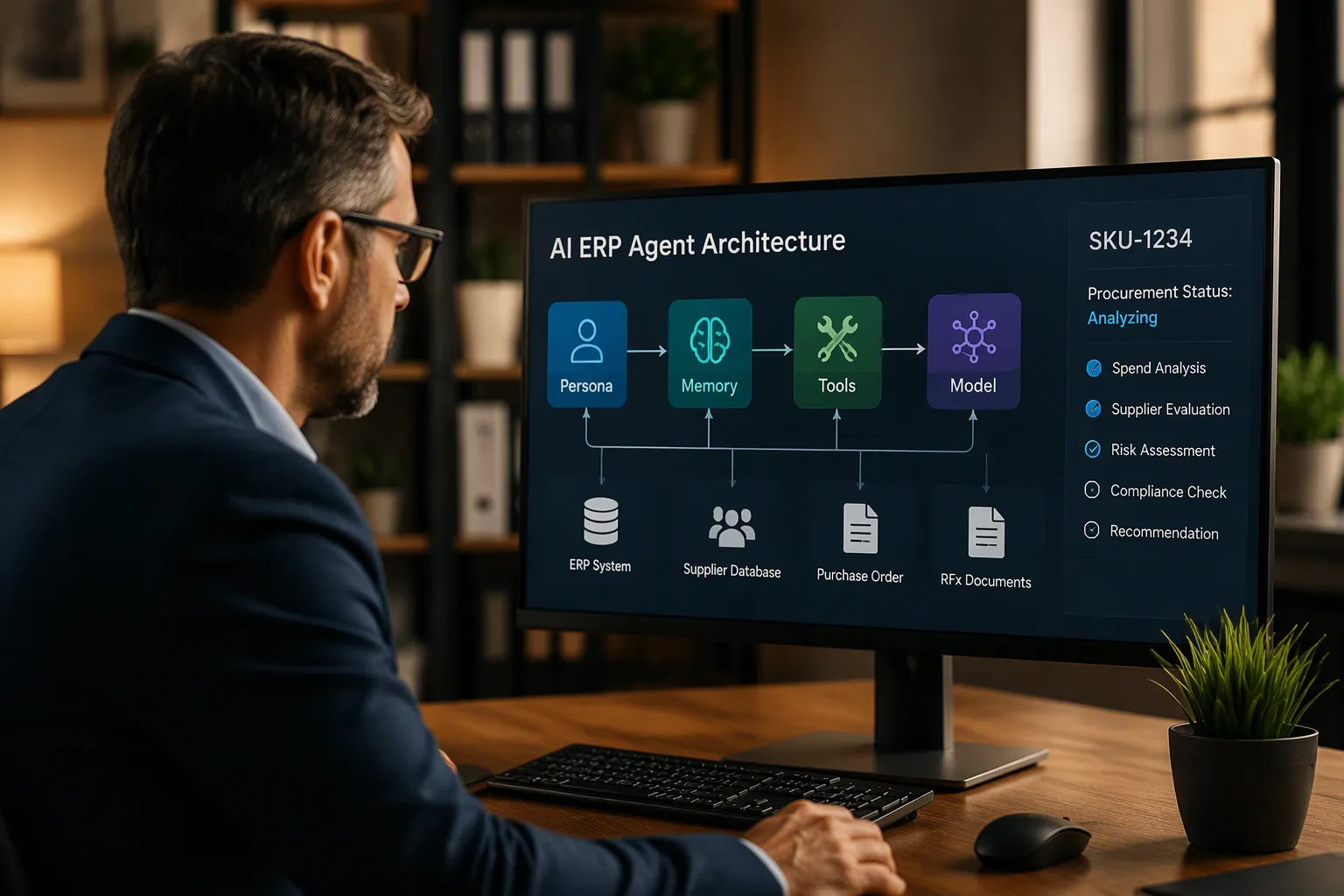
AI ERP agents are goal-directed software systems. They use agentic AI and machine learning to manage purchasing, supplier relationships, and spend analysis with minimal human oversight. These systems observe spend and market signals, decide the best sourcing action, and execute it directly in your ERP, e-sourcing, or payables systems. They combine perception, memory, reasoning, planning, and tool-calling. This makes them different from rule-based tools that need constant human guidance.
Core Architecture
Every agent rests on four building blocks. The persona defines its role, tone, and operational limits. Memory stores short-term conversations, long-term data, episodic interactions, and shared verified facts. Tools extend reach through APIs, databases, and browsers. The model acts as the brain, powering language understanding and reasoning.
| Component | Function |
|---|---|
| Persona | Sets role, tone, and operational limits |
| Memory | Stores context across sourcing events |
| Tools | Connects to ERP, finance, and supplier systems |
| Model | Drives reasoning and action |
Autonomy grows in stages. You start with recommend-only agents that flag issues while humans approve every decision. As trust builds, you widen scope. Routine decisions move to the agent, and only non-standard cases escalate to reviewers. Fully autonomous execution covers standard categories: the agent issues RFxs, evaluates responses, selects suppliers, and handles order creation. It routes exceptions to humans when thresholds are crossed.
Integration with ERP systems follows the same paths your existing applications use. REST APIs are the most common style. OAuth and API keys authorize the agent with specific permission scopes. Webhooks enable real-time, event-driven notifications instead of constant polling. Your ERP system stays in place. The agent reads stock, invoice status, and purchase orders first. Write actions come later, after monitored, human-approved use. This approach to ERP integration keeps your data safe and your governance guardrails intact.
Agents vs. LLMs and Automation
A standalone LLM generates text. It responds only when prompted. It cannot act independently or touch external systems. Simple automation follows fixed rules and cannot adapt when conditions change.
| Dimension | LLMs | AI ERP Agents |
|---|---|---|
| Operating mode | Reactive | Proactive |
| --- | --- | --- |
| Output | Text and summaries | Workflows and actions |
| Autonomy | None | Interacts with systems |
| Scope | Single tasks | Multi-step processes |
AI agents operate continuously toward goals. They perceive their environment, process information, and take action. They learn from past outcomes and recalibrate without human intervention. Multi-agent coordination lets specialized agents for sourcing, risk, and legal work in parallel. They resolve conflicts against global business objectives.
This shift moves procurement from AI-as-assistant to AI-as-operator. Agentic AI in procurement now handles purchase order verification, invoice checks, and supplier follow-ups. These agent-driven workflows reduce manual steps. Your team sets direction and reviews output instead of executing every step. The result is real procurement intelligence, not just faster typing.
Agentic AI in Procurement: Adoption and Benefits
Adoption Trends
Current adoption of agentic AI in procurement sits at just 9%. This lags behind software development at 35% and marketing at 26%. Yet interest is accelerating. Nearly 50% of procurement teams ran pilots in 2024. A full 64% of leaders believe agentic AI will reshape procurement workflows by 2030. You see 42% of teams planning to invest in new technologies in 2025. Another 33% upgrade existing tools. These agentic ai use cases in procurement cover supplier onboarding, purchase order verification, and spend analysis. The gap between adoption and intent signals a turning point. Early movers evaluate orchestration platforms that wrap around your current ERP system.
You rank these platforms using specific criteria. Agent autonomy levels matter most. You decide whether your ai agents recommend, execute with approval, or act autonomously. ERP integration depth follows next. You evaluate how deeply agents connect with your transaction systems and master data. Incumbent vendors hold an inherent advantage in integration with erp systems. AI-native vendors face added complexity. Other criteria include sourcing capabilities, cloud maturity, implementation risk, and total cost of ownership. You apply these factors across 25 procurement platforms in side-by-side comparisons.
Measurable Benefits
The numbers justify the investment. Agentic AI in procurement cuts cycle times by 60%. Accounts payable workload drops from 100% to 40% retained. Query resolution falls from 60 minutes to under 4 seconds. Data access incidents go from 2-3 per quarter to zero. These metrics translate into real procurement intelligence. Your team shifts from manual tasks to strategic analysis.
Decision-making improves sharply with agentic AI in procurement. Real-time insights eliminate reporting bottlenecks. You no longer wait weeks for manually compiled reports. AI keeps data clean and correctly categorized. Spend analysis delivers results instantly. AI/ML models reduce manual effort by 60-80% while continuously improving classification accuracy. You gain prescriptive analytics that recommend specific actions like dispute filing or contract renegotiation. This procurement intelligence helps you identify savings faster and negotiate better terms.
Supplier management also benefits substantially. You optimize your supplier network more effectively. Contract compliance monitoring becomes continuous. Maverick spend drops as agents enforce purchasing policies. This procurement intelligence gives you tighter control.
Agentic AI in procurement also improves spend analysis accuracy. AI applies consistent logic to every record and flags unusual transactions. Models learn continuously from expert corrections. This level of procurement intelligence lets you act on insights rather than gather data.
Agentic AI Use Cases in Procurement

Agentic AI use cases in procurement target the workflows that consume the most time and drive the largest costs. These ai-powered workflows cover the entire source-to-pay chain and automate procurement workflows. You can reduce your procurement workloads by automating supplier onboarding, inventory monitoring, purchase order verification, RFQ triggering, bid comparison, contract compliance monitoring, and spend analysis. Each of these workflows gains from the autonomous decision-making of ai agents. Agentic AI in procurement delivers measurable time savings and cost reductions across these areas.
High-Impact Workflows
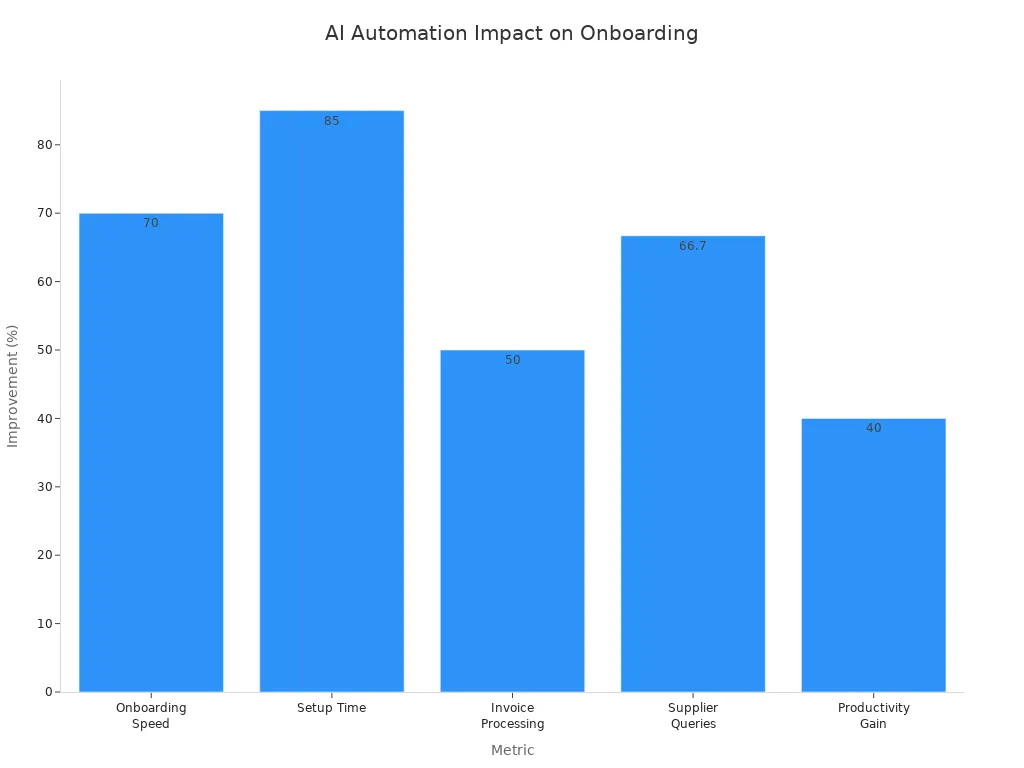
You can automate supplier onboarding with ai agents to eliminate document-heavy manual steps. AI extracts fields from legal, tax, and insurance documents, validates them, and routes exceptions. This reduces onboarding time by 70% and supplier queries by 3X. The chart below shows these improvements.
- Inventory monitoring: AI continuously analyzes demand, stock levels, and supply constraints across your ERP system. It generates replenishment recommendations and adjusts safety stock dynamically. This reduced stockout rates by 30% and holding costs by 15%. Order creation becomes automated, removing manual entry.
- Purchase order verification: The system checks PO details against contracts in your ERP and supplier terms. It flags errors and routes approvals autonomously, cutting intake-to-PO cycle times by 40–60%. This automates a key step in the source-to-pay workflow and streamlines order creation.
- RFQ triggering and bid comparison: An autonomous sourcing agent generates RFQs, matches suppliers across your supplier network, and evaluates responses. Autonomous rfq generation eliminates periodic manual reviews. This compressed sourcing time from weeks to days and reduced manual vendor coordination. AI-powered supplier engagement streamlines the matching process and leads to faster order creation.
- Contract compliance monitoring: The agent extracts key terms, tracks renewal dates, and flags non-standard clauses. This speeds up category strategy development by 70% and delivers direct procurement intelligence.
- Spend analysis: AI normalizes spend data, detects maverick spending, and forecasts demand. Industry surveys reported enhanced analytics from these systems. This is a core source of procurement intelligence.
Real-World Use Cases
These real-world examples show how procurement workflows benefit from automation. A mid-size manufacturer deployed AI to monitor SKU levels across its ERP system. The system auto-triggered RFQs when stock dropped below thresholds. This eliminated manual inventory checks and reduced stockout incidents. Order creation flowed automatically from approval to supplier, enabled by autonomous rfq generation.
A retailer used AI to compare bids from multiple suppliers across its supplier networks. The system evaluated price, lead time, and compliance against contract terms. It enforced contract compliance automatically, reducing maverick spend and improving procurement intelligence.
A distributor used AI to automate supplier onboarding. The system collected and validated documentation, routed approvals, and monitored ongoing risk. This reduced maverick spend by enforcing policy at intake, providing procurement intelligence. Order creation for new suppliers became faster and more accurate.
These agentic ai use cases in procurement highlight the practical benefits of autonomous agents. Agentic AI in procurement shifts your team from manual execution to strategic oversight. The result is faster cycles, fewer errors, and deeper procurement intelligence.
Limitations, Risks, and Adoption Steps
Key Limitations and Risks
Data quality remains your biggest obstacle. AI-powered ERPs need integrated data from ERP, logistics, and quality systems. Incomplete or siloed data produces inaccurate scores and alerts. A semantic layer encodes what source data cannot: "marketing services" in your category tree maps to spend across three different P2P fields, and a specific supplier belongs to a parent group across four affiliates. Without this context, your ai agents give numbers you must defend rather than numbers you can trust.
Supplier record fragmentation compounds the problem. The same vendor appears as SUPPLIER 1, SUPPLEIR 1, and SUPPLIER 1 Inc. across your erp system. A category manager recognizes these as one supplier; a system might not. Poor data leads to inaccurate predictions in risk detection.
Governance and compliance concerns demand equal attention. Nearly three in four companies plan to deploy agentic AI within two years, yet only one in five have a mature governance model for autonomous agents. An agent minimizing supply chain costs may terminate contracts and onboard replacements without checking financial stability or delivery capability. You need documented human oversight structures, escalation triggers, and override logging before deployment. The EU AI Act requires risk classification, testing documentation, and human oversight provisions, with penalties up to 7% of global annual turnover. Strong governance guardrails protect your supplier network and your organization.
Adoption Steps
Start by auditing data readiness. Map data and system ownership before granting write access. Fix master data inconsistency, stale pricing, and cross-system naming conflicts. Deploy read-only procurement agents first and let humans evaluate recommendations for months.
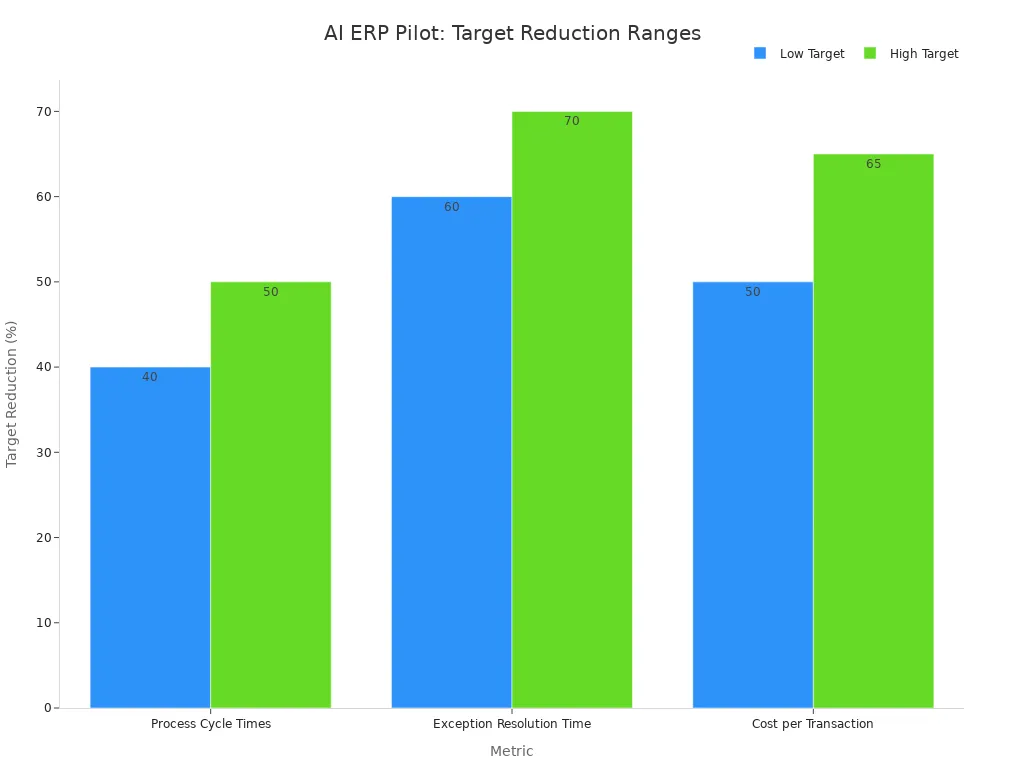
Next, identify one high-impact workflow such as supplier onboarding or PO verification. Choose an orchestration platform and define autonomy levels. Rank agents on what they recommend versus commit, erp integration depth, and verified pricing. Run a pilot and measure cycle time and cost savings against these benchmarks.
| Metric Category | Metric | Target |
|---|---|---|
| Cycle Time | Process Cycle Times | 40–50% reduction |
| Cycle Time | Exception Resolution Time | 60–70% reduction |
| Cost Savings | Cost per Transaction | 50–65% reduction |
| Cost Savings | Total Productivity ROI | 5.5–7.6X in year one |
Build an audit trail before deployment to trace every action and permission used. Define exception handling and escalation paths. Establish baseline performance benchmarks for order creation and cycle time. Once your pilot proves value, scale to additional workflows. Strong governance guardrails and deep integration with erp systems make this transition smooth.
AI erp agents turn your SKU and procurement work from manual chores into guided, autonomous action. The most important gain to remember is the 60% cycle time reduction. You also gain the power to automate supplier onboarding with ai agents, cutting document-heavy steps and supplier queries. Start by auditing your data readiness. Then pick one high-impact workflow, such as PO verification, and run a pilot. Measure cycle time and cost savings before you scale. Agentic ai will keep reshaping procurement and inventory management. Your erp becomes a system that acts, not just records.
FAQ
What makes AI agents different from regular automation?
Regular automation follows fixed rules. AI agents adapt to changing conditions. They learn from past outcomes. They act proactively. They connect to your systems and execute workflows.
How do agents connect to your ERP system?
Your existing ERP connects through REST APIs. Webhooks enable real-time alerts. The agent reads data first. Write actions start only after human approval.
What risks should you watch for?
Data quality poses your biggest risk. Inconsistent supplier records cause inaccurate results. You need governance guardrails. Define escalation paths before deployment. Procurement decisions still need human oversight.
What workflow should you automate first?
Start with one high-impact workflow. Supplier onboarding or PO verification works well. Run a pilot first. Measure cycle time and cost savings. Scale only after proven value.
See Also
Why WarpDriven Supply Chain ERP Excels In Smart Enterprise Management
How Outsourcing Supply Chain Providers Enhances Business Agility Today
How Warehouse Operations Gain Advantages From SOPs In 2025
Unlocking Business Growth Through Supply Chain Management Outsourcing
Maximizing Efficiency Using Smart Ecommerce Warehouse Strategies