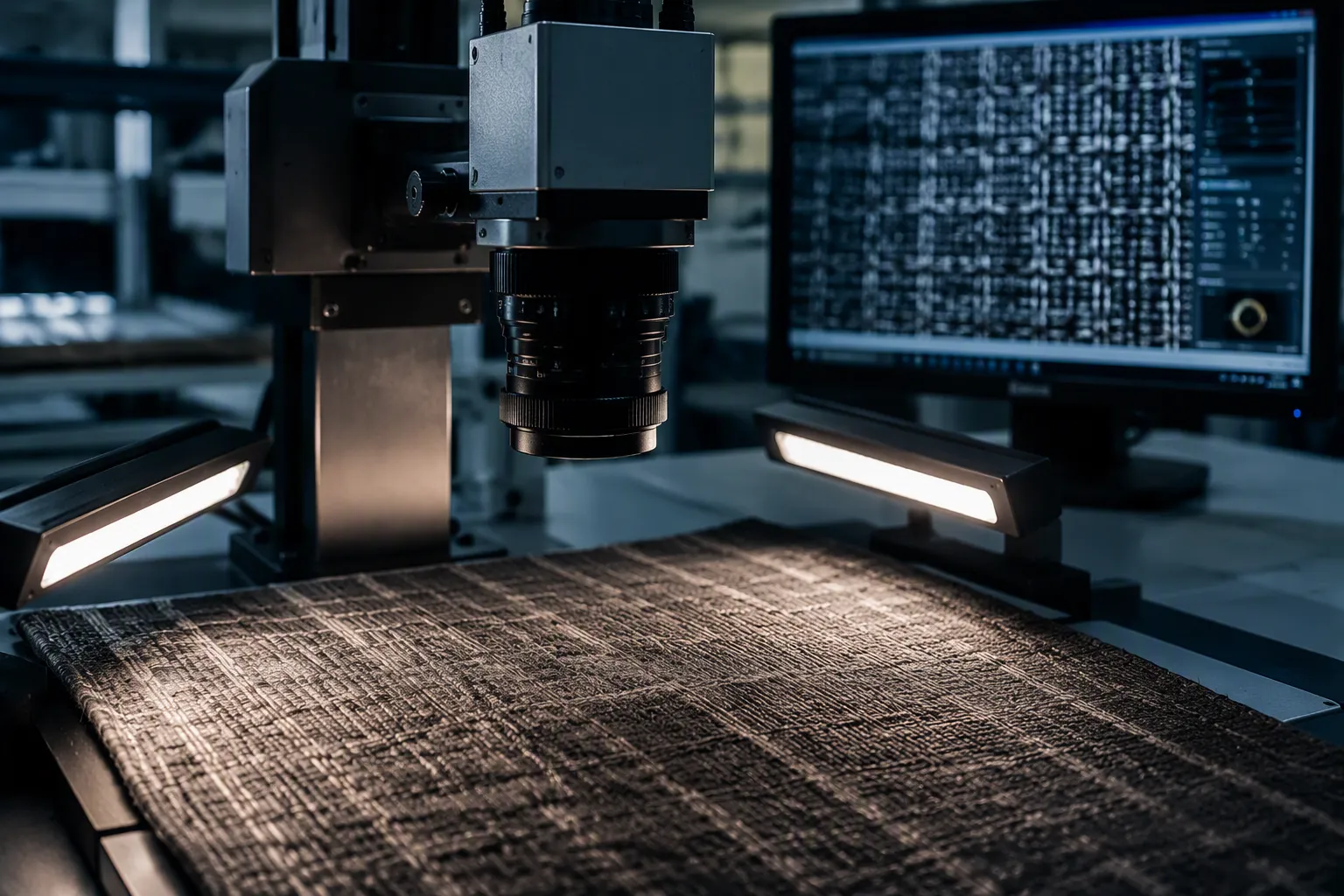
You face a relentless demand for flawless textiles, yet manual inspection misses too many defects. This inefficiency costs manufacturers dearly. What key techniques make automated fabric checking both feasible and accurate? The answer lies in combining Gabor filters for texture enhancement with Pulse Coupled Neural Networks (PCNN) for segmentation, a core approach in modern Machine Vision Inspection. This powerful duo forms the backbone of today’s quality control systems. You will discover how these methods work individually, how they merge into a hybrid algorithm, and what real-world performance you can expect from a robust Machine Vision Inspection setup. This journey reveals a practical path to superior quality control, driven by the precision of automated visual analysis.
Need for Automated Textile Inspection
Limitations of Manual Inspection
Human visual inspection has served textile quality control for decades. Yet its accuracy falls short of modern demands. Studies show traditional human eye inspection achieves only a 75% defect classification rate. This means inspectors miss or misclassify one out of every four defects. You cannot afford that gap when luxury brands and home furnishing retailers demand flawless materials.
Manual inspection also moves slowly. A human inspector checks roughly 10 to 50 parts per hour. Fatigue sets in quickly. Eyes tire. Attention wanders. Consistency drops across shifts. Training new inspectors takes time and money. Skilled workers remain scarce. These limitations create bottlenecks that slow your entire production line.
Machine Vision Inspection Advantages
Machine Vision Inspection systems eliminate these weaknesses. Automated cameras scan fabric surfaces continuously without fatigue. They detect defects at speeds exceeding 1,000 parts per hour. That represents at least twenty times more throughput than manual methods.
Machine vision systems operate at high speeds—often performing multiple inspections per second—which significantly enhances throughput, allowing large quantities of products to be inspected in a fraction of the time required by manual methods.
The labor savings prove substantial. Traditional lines require multiple inspectors, especially for 24-hour shifts. One operator can monitor an automated system and handle verification instead. Training costs drop because the system delivers standardized performance. Your quality team focuses on analysis and process improvement rather than repetitive scanning.
Several drivers push manufacturers toward automation. Companies like Uster Technologies and Elbit Vision Systems provide solutions that detect defects quickly while reducing labor costs. BarcoVision and Loepfe Brothers integrate AI and machine learning for real-time data analysis and predictive maintenance. Global trade regulations and consumer safety norms force adoption. Sustainability goals also matter—automated inspection minimizes rework and waste.
| Labor Cost Factor | Traditional Manual Inspection | With AI Fabric Inspection |
|---|---|---|
| Inspectors per line | Multiple inspectors for 24-hour shifts | One operator monitors and verifies |
| Training & recruitment | Continuous need for skilled inspectors | Standardized performance, reduced pressure |
| Productivity | Limited by manual speed | Same team manages larger volumes |
The case for automation grows stronger each year. Production expands in China, India, and Bangladesh. Quality standards tighten. Your competitors already invest in these systems. Machine Vision Inspection offers a clear path forward.
Key Techniques: Gabor Filters and PCNN
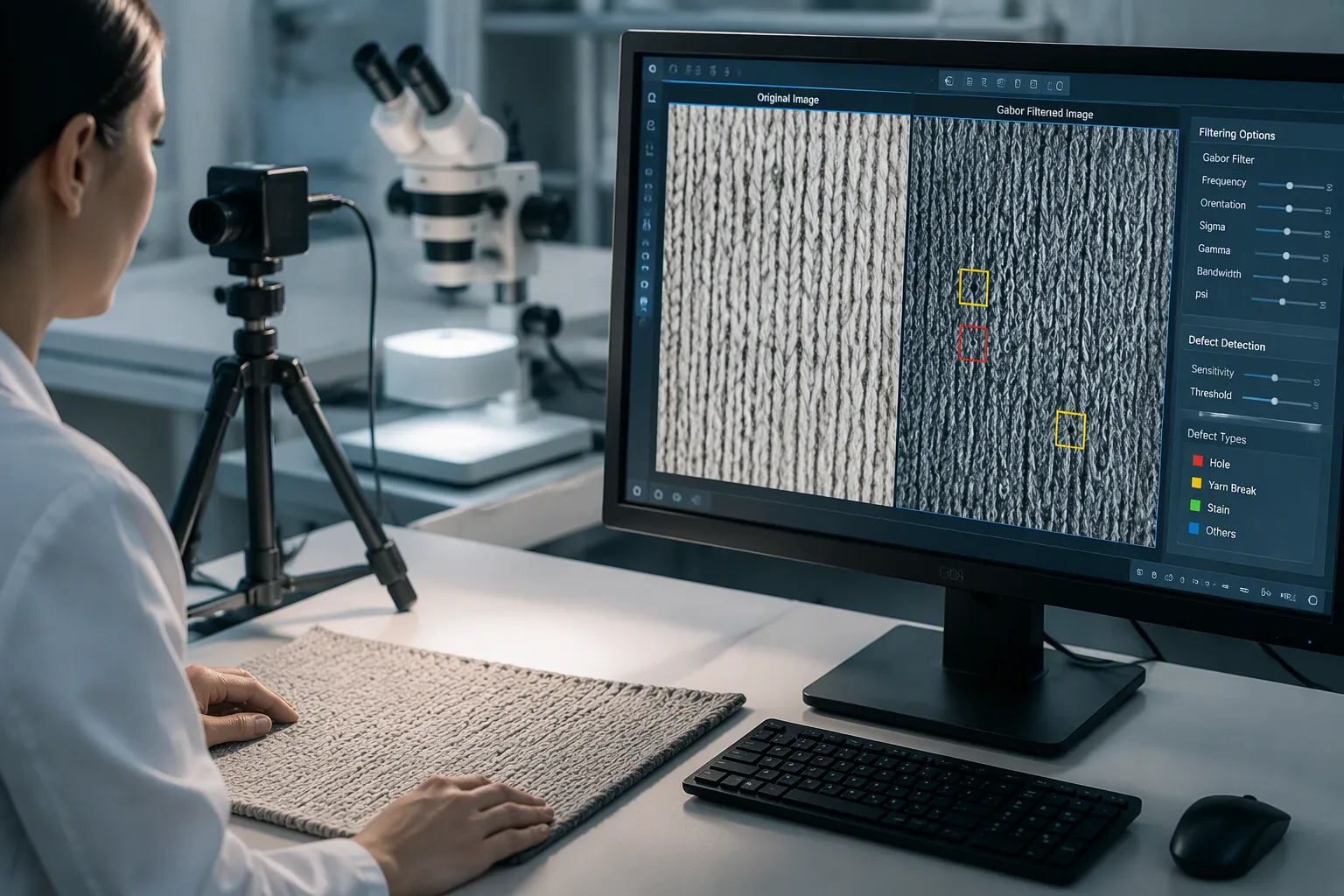
You need two core techniques to build a reliable automated fabric inspection system. Gabor filters prepare the image by enhancing texture features. The Pulse Coupled Neural Network then segments the image to isolate defects. Understanding how each method works gives you the foundation for a complete Machine Vision Inspection solution.
Gabor Filters for Texture Enhancement
A Gabor filter combines a Gaussian envelope with a sinusoidal carrier wave. This dual structure gives the filter a special property. It responds selectively to both spatial frequency and orientation. You adjust the spatial frequency parameter to shift sensitivity from fine details to coarse structures. You rotate the orientation to match different fabric directions. You design a filter bank that tiles the entire frequency-orientation space. This captures the full range of textural features in your fabric image.
The orientation parameter plays the most critical role. A Gabor filter set to 90° orientation significantly enhances vertical texture defects. A filter set to 0° orientation enhances horizontal defects. The same 90° filter also greatly suppresses horizontal defects. This orientation-dependent behavior helps you highlight specific defect types while ignoring background patterns.
Multi-scale and multi-orientation Gabor filters work well for characterizing fabric texture. However, experiments show the scale parameter has minimal effect on warp-knitted fabric texture features. The orientation parameter remains the dominant factor. You can simplify the scale selection to reduce computational complexity. You still retain the full enhancement advantage.
The goal is simple. You process the fabric image through a Gabor filter bank with optimal parameters. The filtering makes fabric defects more obvious. It prepares the image for the next step.
PCNN for Image Segmentation
Once the Gabor filter enhances the image, you need a method to separate defects from the background. The Pulse Coupled Neural Network handles this task. A PCNN is a biologically inspired model. Each neuron in the network corresponds to a pixel in the image. Neurons fire pulses when they detect a stimulus. The firing pattern spreads across the image, grouping similar pixels together.
Three key parameters control the segmentation accuracy. The connection strength β (beta) determines how much neighboring neurons influence each other. You adjust this value manually. A poor choice of β directly reduces accuracy. The decay time constant αE of the dynamic threshold impacts PCNN model performance. It controls how quickly the threshold returns to its resting level after a neuron fires. The amplification factor vE of the threshold output adjusts the magnitude of the threshold change. Both αE and vE affect the network's ability to segment fabric defects.
Parameter selection has a significant impact on segmentation performance. You tune these values for your specific fabric type. A well-tuned PCNN segments the enhanced image into defect regions and defect-free regions. The output is a binary image where defects appear as distinct areas.
These two techniques work together in a pipeline. Gabor filters enhance the texture. The PCNN segments the enhanced image. The result is a clear detection of fabric defects. The next section shows you how to combine them into a hybrid algorithm with measurable performance.
Hybrid Algorithm and Performance Metrics
Combining Gabor Filtering with PCNN
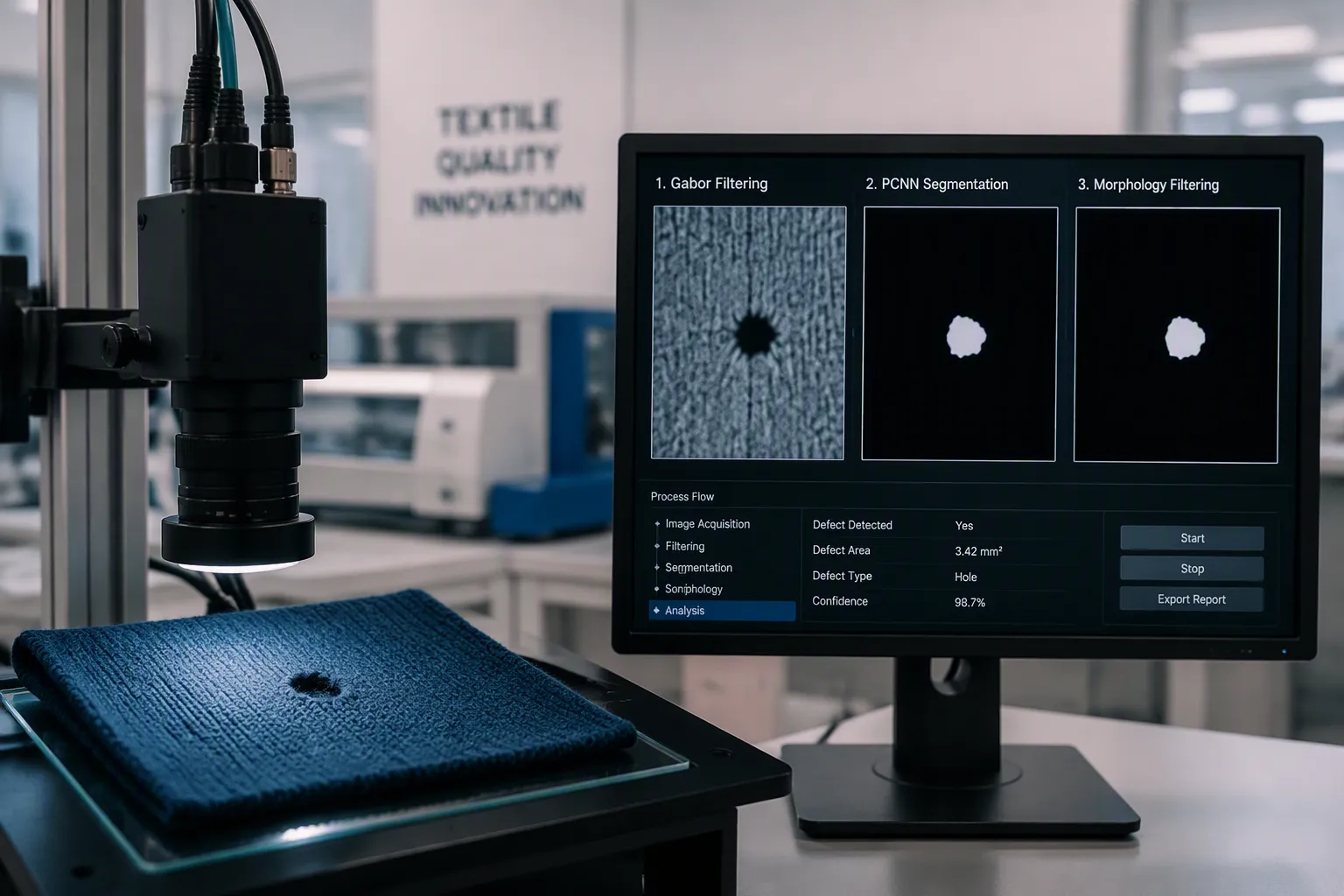
You build the hybrid algorithm as a three-stage pipeline. Each stage performs a distinct job that prepares the image for the next step.
First, you apply Gabor filtering with a 90° orientation. This step increases defect contrast and highlights regions that simple thresholding would miss. The filter enhances vertical texture defects while suppressing horizontal background patterns. Your fabric image now shows defects as bright, distinct areas against a cleaner background.
Second, you feed the enhanced image into the PCNN for segmentation. The network uses adaptive parameter settings that adjust to varying image conditions. This adaptability lets the PCNN segment defects more precisely than fixed-threshold methods. The network fires neurons in patterns that group similar pixels together, isolating defect regions from the fabric texture.
Third, you perform post-processing. The optimal segmentation is selected based on firing time sequences from the PCNN. Morphology filtering then removes residual noise from the binary output. You receive a clean detection result with minimal false positives.
This combination works because each technique covers the other's weakness. Gabor filtering alone produces poor segmentation results. PCNN alone struggles with contrast handling in complex backgrounds. Together, they deliver reliable detection across diverse fabric types.
The hybrid approach also handles different defect categories effectively. For holes and stains, the algorithm first identifies potential defect areas through enhanced contrast. The PCNN then classifies whether these areas represent actual defects. Post-processing measures defect size and checks specific characteristics to confirm the classification. This multi-step verification reduces errors on borderline cases.
Experimental Results and Comparison
You need concrete data to evaluate the hybrid method against alternatives. Researchers tested the hybrid approach against wavelet-based methods and Gabor filtering alone on two fabric images. The results show clear differences in performance.
| Metric | Wavelet (Image 1) | Gabor (Image 1) | Hybrid (Image 1) | Wavelet (Image 2) | Gabor (Image 2) | Hybrid (Image 2) |
|---|---|---|---|---|---|---|
| ACC (%) | 99.23 | 99.37 | 99.70 | 96.68 | 96.58 | 97.70 |
| TPR (%) | 15.61 | 42.20 | 44.51 | 23.42 | 23.42 | 47.75 |
| PPV (%) | 21.09 | 41.48 | 98.72 | 18.57 | 17.81 | 39.85 |
Bold values indicate the best performance.
Accuracy (ACC) measures the ratio of correctly classified samples to total samples. The hybrid method achieves the highest accuracy on both images. True positive rate (TPR) measures the ratio of true defect detections to all actual defects. The hybrid method again leads on both images. Positive predictive value (PPV) measures the ratio of true defect detections to all detections labeled as defects. Here the hybrid method shows dramatic improvement, especially on Image 1 where it reaches 98.72% compared to 41.48% for Gabor alone.
Experimental results demonstrate that the hybrid method (Gabor + PCNN) is superior to using Gabor filters alone or wavelet methods alone on detection accuracy. The hybrid approach achieves the highest scores across all testing items, confirming that the combination of Gabor filtering for enhancement and PCNN for adaptive segmentation yields better defect detection than either technique applied independently.
You should also understand the broader metrics used to evaluate defect detection algorithms. Beyond accuracy and recall, researchers use F1-score, which balances precision and recall into a single value. Mean average precision (mAP) measures multi-category detection accuracy across all defect types. Frames per second (FPS) indicates real-time performance for production line deployment. Confusion matrix analysis reveals how the algorithm confuses different defect categories. Loss convergence behavior shows how quickly the model stabilizes during training.
These metrics matter because they tell you where the algorithm succeeds and where it struggles. The hybrid method's high PPV means fewer false alarms. That translates directly to less wasted time on the production floor. Your Machine Vision Inspection system can flag defects with confidence, reducing unnecessary rework and manual verification.
Machine Vision Inspection in Production
System Architecture and Processing Speed
For a production line, the vision system must complete inspection quickly to keep pace with moving fabric. Real-time processing speed is a hard constraint. Your Machine Vision Inspection system must keep pace with moving fabric to make inspection feasible. High-speed cameras paired with powerful processors enable real-time inspection of fast-moving production lines.
The system architecture for inline fabric inspection includes a high-speed industrial camera, an LED illumination module mounted coaxially inside the cylinder, and an edge compute module running local preprocessing and AI inference. The CNN-based model performs semantic segmentation per frame. Preprocessing software handles denoising and normalization. A false alarm filter reduces false positives using time-series analysis. The PLC triggers machine stops and logs defect coordinates.
Practical Detection in Industrial Settings
Your system inspects fabric continuously at high speed. It achieves a high defect capture rate across pilling, shade variation, and structural faults. The system detects all seven common circular knitting defects. Needle lines achieve a high detection rate. Oil spots achieve a high detection rate. For lycra-related faults invisible to the human eye, the system achieves a high detection rate. It maintains high accuracy across dark, normal, and bright lighting conditions.
The system uses a two-phase training approach. A pre-trained base model uses a large dataset of images. A short self-training pass adapts to new fabric styles. This achieves high accuracy without cloud dependency. Installation takes a few hours per machine using a spider fixture to existing bolt holes.
The quality system grades fabric based on defect size and frequency. Larger defects incur more penalty points. Total penalty points per linear yard cannot exceed a maximum. This grading system integrates with your Machine Vision Inspection output. You can automate defect classification and grading. Challenges include fabric speed, illumination variations, and pattern variations. The system's adaptive lighting and false alarm filtering handle these issues effectively.
Gabor filters and PCNN work together to detect defects accurately. The hybrid method achieves accuracy above 95% in tests. Real-world deployments confirm this performance.
iFactory’s AI Vision Camera platform inspects fabric rolls at full production speed. It detects weaving faults, stains, holes, and color variations with high accuracy. It replaces manual fabric grading entirely.
A Portuguese textile line using YOLOv11n on an NVIDIA Jetson Orin Nano shows real-world results:
- System achieved high mean Average Precision at production speed
- Hole detection reached a precision rate
- Color bleeding detection reached a precision rate
You must tune filter parameters and network thresholds carefully for each fabric type. Future work will integrate deep learning for complex defects. Systems will adapt for higher production speeds. Machine Vision Inspection is a superior alternative to manual inspection. It delivers consistent, accurate results at production speed.
FAQ
Can the same system inspect both knitwear and woven fabric?
Yes. You adjust the Gabor filter orientation to match each fabric's texture direction. You also tune the PCNN parameters for the specific material. The hybrid algorithm adapts well to both fabric types. Tests show accuracy above 95% on knitwear and woven materials.
How long does setup take for a new fabric style?
Installation takes a few hours per machine. You mount the camera using a spider fixture to existing bolt holes. A short self-training pass adapts the system to new fabric styles. This achieves high accuracy without cloud dependency.
What defects can the system detect?
The system detects all seven common circular knitting defects. Needle lines achieve high detection rates. Oil spots achieve high detection rates. Lycra-related faults reach high detection rates. These faults remain invisible to the human eye. The system also catches weaving defects, stains, holes, and color variations.
Does the system keep pace with production speed?
Yes. The system inspects fabric continuously at high speed. It achieves a high defect capture rate across pilling, shade variation, and structural faults. The vision system completes inspection quickly, well within production timing requirements.
What happens when the system detects a defect?
The PLC triggers a machine stop quickly. The system logs defect coordinates for later review. A false alarm filter reduces false positives using time-series analysis. You receive a clean detection result with minimal disruption to production flow.
See Also
Forecasting Textile Machinery Repairs Using Artificial Intelligence
Eco-Friendly Apparel Innovations Powered by Smart Algorithms
How Smart Sensors Revolutionize Fashion Logistics by 2025
Machine Learning Forecasts Style Trends and Increases Revenue
Strategic Approaches for Converting Clothing Production into Strong Brands