
You should consider Acumatica, NetSuite, Microsoft Dynamics 365, SAP S/4HANA, SAP Business One, Infor SyteLine, and Epicor Kinetic as the top AI ERP Platforms for manufacturing. AI in enterprise resource planning boosts productivity with real-time insights and automation. The table below shows how AI ERP Platforms outperform traditional systems:
| Feature/Benefit | AI ERP Platforms | Traditional ERP Systems |
|---|---|---|
| Decision-Making | Real-time, data-driven decisions | Reactive, based on historical data |
| Predictive Analytics | Anticipates challenges | Limited predictive capabilities |
| Automation | Reduces manual tasks | Manual intervention needed |
Top AI ERP Platforms for Manufacturing
Quick List of Best Manufacturing ERP
You can find many options for the best manufacturing erp, but some platforms stand out. Market research shows that these ai erp platforms are the most widely used by manufacturers:
- Microsoft Dynamics 365
- Infor CloudSuite Industrial (SyteLine)
- Epicor Kinetic
- SAP S/4HANA
- Oracle NetSuite
These ai erp platforms help you manage production, inventory, and supply chain tasks. You can use them to automate processes and gain real-time insights.
Why These AI ERP Platforms Matter
You need ai erp platforms that solve real manufacturing problems. These platforms use ai to improve efficiency and reduce downtime. For example, ai-driven predictive maintenance helps you avoid equipment failures. Real-time production monitoring lets you respond quickly to issues. Supply chain optimization uses ai and IoT to manage resources better. Role-based ai dashboards give you the information you need for your job.
You should look at the criteria that experts use to choose the best manufacturing erp. The table below shows what matters most:
| Criteria | Description |
|---|---|
| Business Case | Establishes executive buy-in and outlines the reasons for seeking new ERP software. |
| Understanding Business Goals | Helps evaluate ERP systems based on their ability to support specific business objectives. |
| Needs Assessment | Identifies pain points and requirements before selecting an ERP system. |
| Change Management | Prepares the organization for the transition and addresses employee concerns regarding the new system. |
Each ai erp platform offers unique ai features. Microsoft Dynamics 365 Business Central uses Microsoft Copilot to automate tasks and answer questions. You can use predictive analytics to forecast demand and manage inventory. Power BI gives you real-time dashboards for key metrics. Other ai erp platforms offer financial forecasts, inventory tracking, intelligent planning, fraud detection, and predictive analytics for machinery maintenance.
Tip: You should choose ai erp platforms that match your business goals and support your team. The best manufacturing erp will help you grow and stay competitive.
How AI Transforms Manufacturing ERP Systems
Automation and Efficiency Gains
You can boost your factory’s performance with ai-manufacturing erp. These systems use ai to automate routine tasks and speed up your workflow. You do not need to spend hours on manual data entry or paperwork. Instead, you can focus on important decisions. When you use production planning erp, you see real results. For example, companies have reduced supply chain costs by 20% and unscheduled labor expenses by 25%. Regulatory compliance improves by 35%. The return on investment can reach 275% in three years.
| Metric | Improvement Percentage |
|---|---|
| Reduced supply chain expenditures | 20% |
| Dropped unscheduled labor costs | 25% |
| Enhanced regulatory compliance | 35% |
| ROI Projection (3-year) | 275% |
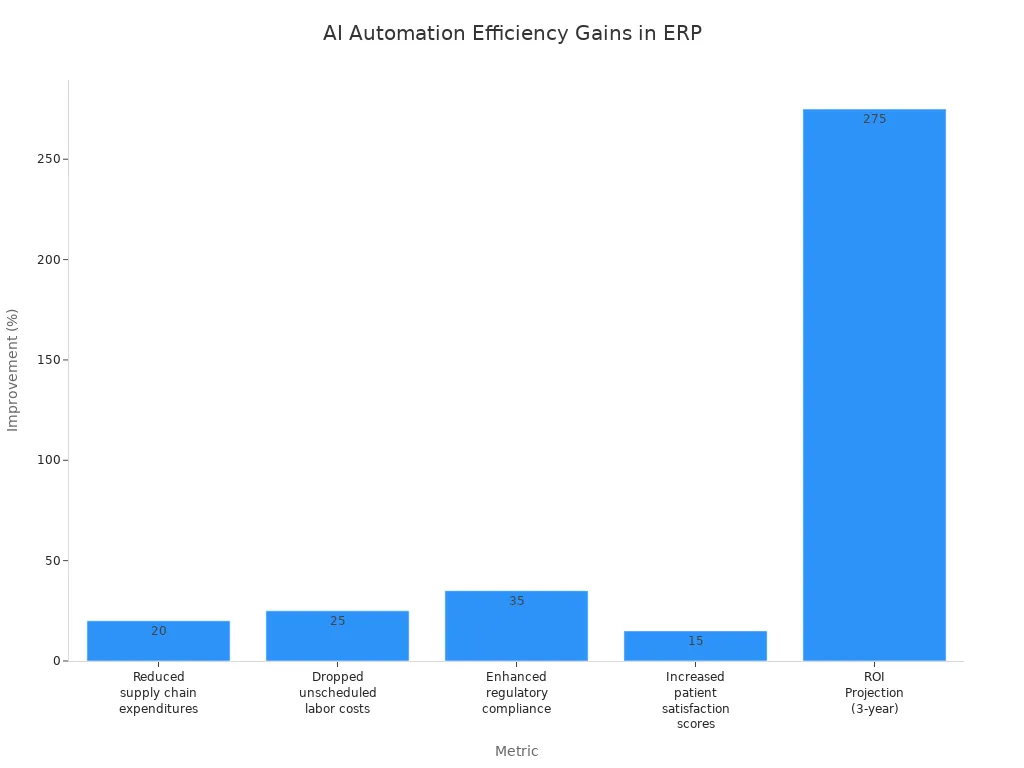
You can see how ai-manufacturing erp makes your operations smoother and more cost-effective.
Predictive Analytics in AI-Manufacturing ERP
You can use ai-manufacturing erp to predict what your business needs next. With ai, you get better demand forecasting and smarter production planning. These systems improve forecast accuracy by 50%. You can make decisions based on real market data. Production planning erp helps you manage inventory and schedules. You can cut operating costs by up to 23%. Some platforms even track sustainability, so you can optimize for speed, cost, and the environment.
| Evidence Description | Impact |
|---|---|
| AI-driven demand forecasting improves accuracy by 50% | Enables data-driven decisions based on comprehensive market analysis, enhancing inventory management and production planning. |
| ERP systems reduce operating costs by up to 23% | Provides real-time visibility into inventory and production schedules, optimizing resource allocation. |
| Integration of sustainability tracking | Optimizes schedules for speed, cost, and environmental impact, improving operational efficiency. |
Tip: You should keep your data clean and train your team to use ai-manufacturing erp features. This helps you get the best results from predictive analytics.
Real-Time Data and Smart Integration
You can connect every part of your business with ai-manufacturing erp. These platforms give you real-time data for production planning erp. You see what happens on the shop floor, in the warehouse, and in the supply chain. Ai helps you forecast demand by looking at sales trends and market signals. It learns from usage patterns to keep inventory at the right level. Advanced systems track supplier lead times, so you avoid shortages.
- Real-time supply chain visibility removes delays.
- Instant document processing solves problems quickly.
- Ai speeds up decision-making and lowers mistakes.
- You get better efficiency in every department.
You can trust ai-manufacturing erp to keep your business running smoothly and help you stay ahead in production planning.
AI ERP Platforms Comparison
Key AI Features Overview
You need to understand how different manufacturing erp systems use ai to improve your business. Each platform offers unique advanced ai features that help you make better decisions and streamline operations. Acumatica gives you ai-powered analytics for operational efficiency. NetSuite uses cloud deployment and ai analytics for real-time decision-making. Microsoft Dynamics 365 integrates with Microsoft tools and offers scalable enterprise resource planning solutions with cost savings. SAP S/4HANA provides advanced ai analytics and predictive demand forecasting. SAP Business One connects with ai tools to enhance business processes. Infor SyteLine uses ai for advanced production scheduling. Epicor Kinetic optimizes schedules and reduces downtime in manufacturing.
| ERP System | Key AI Features |
|---|---|
| Acumatica | AI-powered analytics for operational efficiency. |
| NetSuite | Cloud deployment and AI analytics for real-time decision-making. |
| Microsoft Dynamics 365 | Seamless integration with Microsoft tools, scalable solutions, and cost savings. |
| SAP S/4HANA | Advanced AI analytics with predictive demand forecasting. |
| SAP Business One | Integration capabilities with AI tools for enhanced business processes. |
| Infor SyteLine | AI capabilities for advanced production scheduling. |
| Epicor Kinetic | Schedule optimization leading to reduced downtime in manufacturing. |
Note: You should look for enterprise resource planning solutions that match your business needs and offer advanced ai features for optimization.
Best-Fit Scenarios for Each Platform
You can choose manufacturing erp systems based on your company size and industry needs. Acumatica works well for mid-size manufacturers moving to cloud erp. NetSuite fits mid-size companies that want real-time ai analytics. Microsoft Dynamics 365 suits businesses using Microsoft ecosystems and needing ai-driven erp for production planning. SAP S/4HANA supports large global manufacturers with ai-driven production optimization. SAP Business One helps companies seeking enhanced business processes with ai integration. Infor SyteLine is ideal for complex manufacturing operations needing predictive maintenance and scheduling optimization. Epicor Kinetic benefits automotive, machinery, and discrete manufacturing with predictive quality management and real-time monitoring.
| AI ERP Platform | Best For |
|---|---|
| Acumatica | Mid-size manufacturers moving to cloud ERP |
| NetSuite | Mid-size manufacturers adopting cloud ERP |
| Microsoft Dynamics 365 | Businesses using Microsoft ecosystems |
| SAP S/4HANA | Large global manufacturers |
| SAP Business One | Companies seeking enhanced business processes |
| Infor SyteLine | Complex manufacturing operations |
| Epicor Kinetic | Automotive, machinery, and discrete manufacturing |
Tip: You should select ai-driven erp platforms that support your growth and offer optimization for your production and supply chain.
Reviews of Best Manufacturing ERP Platforms
Acumatica ERP
You can use Acumatica as a flexible manufacturing erp software. This platform stands out for its strong ai features that help you automate and simplify daily tasks. You will find that Acumatica uses ai-powered erp systems to reduce manual work and improve accuracy. Here are some of the most valuable ai tools you get with Acumatica:
- AP document recognition creates accounts payable documents from vendor bills using ai and machine learning. This reduces errors and saves time.
- Natural language search lets you find data and reports by typing questions in plain English.
- Helpdesk self-support gives you interactive help and self-service options, so you solve problems faster.
- Warehouse shipping and receiving uses ai to automate picking, packing, and shipping. This improves speed and accuracy in your warehouse.
- Guided reporting and analytics generate dashboards and reports with ai-driven insights. You make better decisions with these tools.
You can rely on Acumatica to support your production planning and inventory forecasting. Many manufacturers choose this manufacturing erp software for its user-friendly design and strong automation.
NetSuite ERP
NetSuite is a popular choice for manufacturing erp software. You can use it to manage production, inventory, and supply chain tasks. NetSuite helps you centralize data from all your plants, making benchmarking easier. The system offers customizable dashboards and supports best practices for continuous improvement.
| Evidence Type | Description |
|---|---|
| Data Acquisition | NetSuite streamlines data collection and reporting for all your locations. |
| Customizable Dashboards | You can set up dashboards to track key metrics and compare performance. |
| Best Practices | The platform encourages you to use proven methods for better results. |
| Continuous Improvement | NetSuite helps you find gaps and improve your operations over time. |
You benefit from ai-powered erp systems in NetSuite. These tools include predictive analytics for revenue and inventory forecasting, automation for invoice processing, and intelligent workflows for billing. You also get smart forecasting tools that adjust reorder points, ai-assisted hiring, and ai-driven analytics for sales and supply chain optimization. NetSuite automates financial reconciliations and customer service, and it offers new ai tools for text generation and planning. You can use predictive insights to optimize inventory and spot inefficiencies.
Microsoft Dynamics 365 & Business Central
You can use Microsoft Dynamics 365 and Business Central as powerful manufacturing erp software. These platforms give you a unified system for finance, inventory, and production. You get deep integration with Microsoft tools like Power BI, which helps you analyze data and make informed decisions.
Strengths:
- You manage finance, inventory, and operations in one place.
- You use ai-powered erp systems for demand forecasting and inventory management.
- You can deploy in the cloud, on-premise, or both.
- You automate workflows and scale your operations quickly.
Weaknesses:
- You may need premium licenses for advanced manufacturing features.
- The total cost can be high due to licensing and setup.
- Integrating with old systems can be complex.
- There is a learning curve if you switch from simpler software.
“Business Central lets us automate workflows, integrate multiple apps, and scale operations quickly.” — Kenny Jeans, AGT Products Inc.
You will find ai features that predict demand, optimize production scheduling, and improve supply chain efficiency. You can monitor equipment health in real time and predict failures before they happen. These platforms automate inspection processes and help you meet industry standards. You use Power Automate and Power BI for actionable insights, which reduces manual work and improves consistency.
SAP S/4HANA & SAP Business One
SAP S/4HANA and SAP Business One are leading choices for manufacturing erp software. Many large manufacturers use these platforms, including Siemens, BMW, Tata Motors, Sinopec, and Lenovo. SAP S/4HANA holds about 23% of the global erp market, with strong adoption in the United States, Germany, China, India, and Asia-Pacific.
| Feature | Description |
|---|---|
| Embedded AI Capabilities | You use machine learning in your workflows for better decisions. |
| Predictive Analytics | You forecast demand and manage inventory and production more accurately. |
| Intelligent Automation | You automate procurement and reduce manual tasks. |
| Real-time Production Optimization | You adjust production processes instantly with real-time data. |
| Quality Prediction | You predict product quality and reduce defects and waste. |
| Maintenance Scheduling | You optimize maintenance to cut downtime and improve reliability. |
| Supply Chain Optimization | You manage your supply chain better with ai, ensuring timely delivery and resource allocation. |
You can use these ai-powered erp systems to improve production, inventory forecasting, and supply chain management. SAP platforms help you automate tasks, reduce errors, and make smarter decisions.
Infor SyteLine ERP
Infor SyteLine is a strong manufacturing erp software for complex production environments. You get advanced ai features that help you forecast demand, optimize production, and prevent equipment failures.
| AI Feature | Description |
|---|---|
| Predictive Modeling | You forecast demand, predict machine failures, and spot quality issues using historical data. |
| Prescriptive Optimization | You get recommendations for the best actions based on your resources and constraints. |
| What-If / Scenario Simulation | You test different strategies and see how they affect your key metrics. |
| Embedded Automation & Decision Rules | You automate routine decisions and use ai outputs in your business logic. |
| Model Training & Lifecycle Management | You tune and retrain ai models easily with low-code tools. |
| Seamless Workflow Integration | You see ai insights in your daily tasks, which helps with adoption. |
| Demand Forecasting & Inventory Optimization | You reduce stockouts and overstock by modeling demand accurately. |
| Predictive Maintenance & Asset Health | You spot equipment issues early to avoid breakdowns. |
| Quality & Defect Prevention | You detect quality problems before they affect production. |
| Production Scheduling / Sequencing | You optimize throughput with ai predictions. |
| Sales & Order Promising | You improve delivery dates by linking inventory and production forecasts. |
| Cost & Margin Optimization | You allocate resources to maximize profit. |
Infor SyteLine also gives you an easy interface, role-based home pages, and extensive customization. You can use DataViews to import data and create detailed reports. This manufacturing erp software helps you make better decisions and improve efficiency.
Epicor Kinetic
Epicor Kinetic is a modern manufacturing erp software that uses ai-powered erp systems to boost your production. You get predictive quality management, real-time shop-floor monitoring, and ai supply-chain forecasting. These features help you spot quality issues early, monitor production instantly, and plan inventory forecasting with more accuracy.
- Epicor Data Analytics gives you insights using machine learning.
- Epicor Virtual Agent (EVA) acts as a chatbot that automates tasks and offers recommendations.
- Epicor Kinetic Design provides an ai-driven framework for user-friendly applications.
You can use Epicor Kinetic to optimize production, reduce downtime, and respond quickly to market changes. This manufacturing erp software supports automotive, machinery, and discrete manufacturing. You will find that Epicor Kinetic helps you stay competitive with advanced ai tools and real-time data.
Choosing the Right AI ERP Platform
Critical Selection Factors
When you select an AI ERP platform, you need to focus on what matters most for your manufacturing business. Consider these important factors:
- Choose software that scales with your company as you grow, add new facilities, or merge with others.
- Look for a system that manages your entire operation, including financials, shop floor management, quality control, and scheduling.
- Make sure the platform supports multi-site operations and gives you real-time access to information.
- Pick a flexible, cloud-based solution that adapts to changes in your services or operations.
- Ensure strong data security with a secure cloud framework and compliance validation.
- Select a platform that lets you build custom applications and automate workflows for your unique needs.
You should also decide if you want a best-of-breed or end-to-end system, on-premise or cloud-based, open source or commercial, proprietary or platform, and horizontal or industry-specific solutions.
Scalability and Integration
You need an AI ERP platform that grows with your business. Integration transforms your manufacturing from reactive to proactive. With real-time data and predictive analytics, you can make better supply-chain decisions. These platforms connect your operational and IT layers, giving you full visibility across your value chain. Manufacturers who use AI-powered ERP can predict issues before they become problems, scale operations easily, and connect with advanced technologies.
| Benefit | Impact for Manufacturers |
|---|---|
| Real-time data accessibility | Faster supply-chain response |
| Predictive analytics | Improved production planning |
| Seamless integration | Easier adoption of new technologies |
Industry Fit and Support
You must choose an AI ERP platform that fits your industry. Manufacturing faces pressure to improve efficiency and decision-making. Traditional ERP systems cannot handle complex analytics or fast-changing supply-chain needs. AI-powered ERP helps you turn operational data into insights and adapt to unstable supply-chain environments. You need a system that supports your unique production planning and supply-chain challenges. AI integration is essential for manufacturers who want to stay competitive and meet rising customer expectations.
Tip: Always check if the vendor offers industry-specific support and understands your manufacturing processes.
You gain long-term benefits when you choose the right AI ERP platform. You centralize your data, reduce errors, and improve decision-making. Start by assessing your business needs, building a strong data strategy, and selecting technology that fits your goals. Request demos and talk with vendors to see what works best. For success, keep your data clean, encourage teamwork, and focus on solutions that explain their results. Remember, ongoing support and training help your team get the most from your investment.
FAQ
What is an AI ERP platform?
You use an AI ERP platform to manage your business with smart tools. AI helps you automate tasks, analyze data, and make better decisions. These systems improve efficiency and reduce errors.
How does AI improve manufacturing ERP?
AI helps you predict demand, schedule production, and spot problems early. You save time with automation. You get real-time insights that help you respond quickly.
Tip: Use AI features to track inventory and prevent equipment failures.
Which AI ERP platform fits small manufacturers?
You can choose Acumatica or NetSuite. Both offer cloud-based solutions and easy setup. These platforms scale as your business grows.
| Platform | Best For |
|---|---|
| Acumatica | Small to mid-size |
| NetSuite | Small to mid-size |
Can you customize AI ERP platforms?
You can customize dashboards, workflows, and reports. Most platforms let you add features or connect with other apps. Customization helps you match the system to your needs.
Is training needed for AI ERP systems?
You need training to use AI ERP systems well. Training helps your team understand new features and get the most value. Many vendors offer online courses and support.
See Also
Why WarpDriven ERP Is Essential for Smart Supply Chain Management
Using AI to Improve Production Forecasting in 2024 Enterprises
Capacity Planning Powered by AI for Modern Brands