
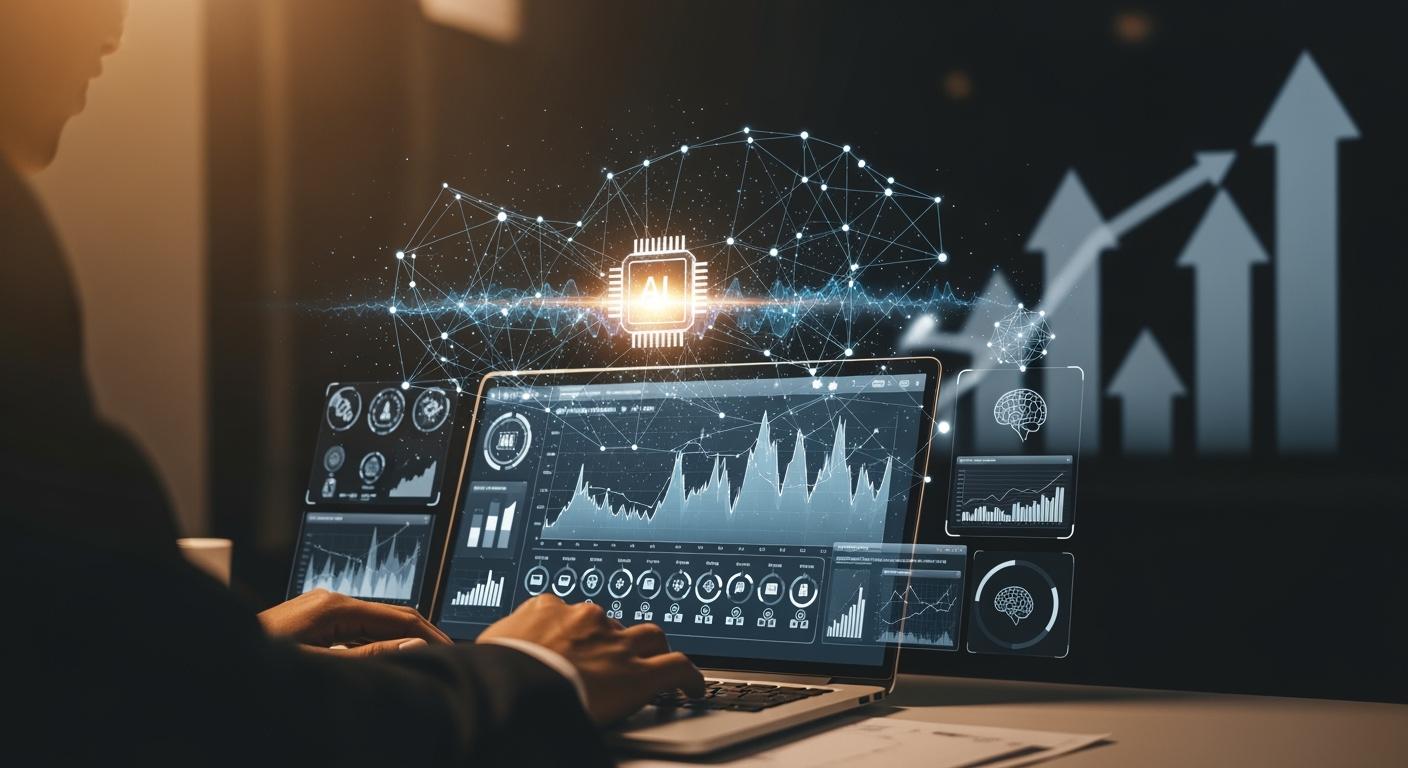
Ai trend forecasting helps you make smarter product decisions with speed and confidence. You gain instant access to insights that let you respond quickly to market shifts. Ai trend forecasting gives product managers and business leaders tools to predict customer needs and spot emerging patterns. Ai can process huge datasets and reveal patterns that traditional methods miss. You benefit from enhanced accuracy and predictive power. Ai trend forecasting helps you create tailored strategies that drive measurable business outcomes. A recent study shows that 65% of senior executives see ai and predictive analytics as key growth drivers in 2025. You get a competitive edge by using ai trend forecasting. Get ready to discover practical benefits and real-world examples that show how ai trend forecasting transforms your decisions.
Ai trend forecasting enables you to see what others might overlook, making your product choices stronger and more effective.
- Ai trend forecasting boosts your ability to:
- Respond quickly to changing trends
- Improve decision-making with accurate predictions
- Unlock new growth opportunities
AI Trend Forecasting for Product Development
Why AI Trend Forecasting Matters
You want to make smart choices in product development. AI trend forecasting gives you the power to spot trends early and act fast. You can use ai to analyze huge amounts of data and find patterns that help you plan your next move. This approach changes how you handle digital product development. You no longer rely on guesswork. Instead, you use real-time insights to guide your decisions.
AI, with its machine learning and deep learning techniques, has taken demand forecasting to a whole new level. They solve all of the problems with traditional forecasting while sprinkling more advantages on top.
You can see how ai trend forecasting helps you in many ways:
- AI trend forecasting utilizes machine learning and behavioral data to identify emerging styles and trends, which enhances the accuracy of product development.
- By providing real-time insights, brands can respond to trends before they become mainstream, thus speeding up the product development cycle.
- The integration of ai into workflows allows for rapid execution of trend insights into product creation and planning, significantly reducing time to market.
- AI trend forecasting replaces traditional guesswork with quantifiable signals, leading to more informed decision-making.
- The ability to act quickly on insights helps mitigate risks associated with late product launches and overproduction.
- AI amplifies designers' intuition and merchandisers' foresight, allowing for quicker and more accurate responses to market demands.
- Decision-makers gain clarity to act before trends peak, which is crucial for maintaining a competitive edge in fast-paced markets.
You can use ai to improve digital product development. You get accurate forecasts that help you launch products at the right time. You can adjust your strategies based on real-time data. This makes your product development process faster and more reliable. You can also use ai trends to predict what customers want next. This gives you an advantage in the market.
A consumer goods company relying on traditional regression may not spot early signals of a trend change. An AI model can detect these signals, such as increased search activity or shifts in buying frequency, and adjust forecasts accordingly.
You can see how ai trend forecasting empowers decision-makers across all levels of an organization. Teams can make smart choices regarding new launches, pricing strategies, and resource allocation with access to accurate forecasts and data analytics.
AI vs. Traditional Methods
You may wonder how ai compares to traditional methods in product development. The differences are clear. AI can handle vast amounts of data and adapt as trends change. Traditional methods rely on historical data and human intuition. This limits their ability to spot new trends quickly.
| Aspect | AI-Powered Forecasting | Traditional Methods |
|---|---|---|
| Scalability | Can handle vast amounts of data | Limited by data size and complexity |
| Accuracy | Provides more accurate predictions | Relies on historical data and human intuition |
| Speed | Offers real-time insights | Requires significant time and effort |
You can see that ai gives you more accurate and faster results in digital product development. You can use ai to reduce errors and improve your forecasts. Here is a comparison of error rates:
| Forecasting Method | MAPE Rate |
|---|---|
| Traditional Methods | 15-30% |
| AI-Powered Methods | 5-15% |
You can use ai to cut error rates in product development. This means you waste less time and resources. You can respond to trends faster and launch products that match customer needs. You can also use ai trends to guide your digital product development process.
AI-powered forecasting can:
- Ingest vast data sets, including historical transactions and external signals.
- Continuously learn and adapt as patterns shift over time.
- Generate recommendations in near real time to keep forecasts aligned with actual demand.
You can see that ai makes product development smarter and more efficient. You can use ai to improve every step of your digital product development process. You get better results and stay ahead of trends.
Core Mechanisms of AI in Trend Forecasting
Real-Time Data Analysis
You can use ai to collect and analyze data as soon as it appears. This process helps you spot new patterns and trends quickly. Ai forecasting technologies pull information from many sources. You see data from social media, competitor performance, customer demographics, market trends, and external factors like weather. The table below shows common real-time data sources:
| Type of Data Source | Description |
|---|---|
| Social media trends | Insights into consumer discussions and engagements on platforms like TikTok, Instagram, and Twitter. |
| Competitor performance data | Information on pricing changes, promotional campaigns, and customer reviews to gauge market dynamics. |
| Customer demographics | Data on purchasing habits and preferences to inform market size and positioning. |
| Market trend analysis | Broader economic indicators and seasonal patterns that affect consumer behavior. |
| External data sources | Influences like weather conditions and economic trends that can impact demand. |
Ai helps you estimate product demand and forecast sales. You identify market shifts early and adjust your strategy. Ai analyzes customer engagement to predict churn and improve retention. Real-time data analysis gives you the latest information, so you make decisions based on current trends. Ai algorithms process large amounts of data and find patterns that human analysts might miss. You respond faster to changes and improve accuracy.
Predictive Modeling and Automation
Ai uses predictive modeling to improve accuracy in trend forecasting. You see models like ARIMA, ETS, STL, and regression used for different tasks. The table below explains these techniques:
| Technique | Description | Use Case |
|---|---|---|
| ARIMA | Handles time series data with autoregressive and moving average components. | Website traffic forecasting over the next 3 months. |
| ETS | Decomposes time series into error, trend, and seasonality components. | Sales forecasting for a retail store. |
| STL | Decomposes time series into seasonal, trend, and residual components using LOESS. | Sales forecasting in a region with seasonal variations. |
| Regression Model | Estimates relationships between dependent and independent variables. | Marketing ROI analysis to identify effective strategies. |
Ai automates tasks like user research, data analysis, and decision-making. You save time and reduce manual workload. Ai tools summarize feedback, highlight patterns, and simulate roadmap scenarios. You prioritize initiatives that maximize value and align with business goals. Automation lets you focus on strategy and creativity, while ai handles repetitive tasks. You see higher accuracy and faster results.
Multi-Layered Methodologies
Ai combines machine learning with expert analysis to boost accuracy. You benefit from continuous learning and adaptation. Ai forecasting technologies learn from new data and adjust to market changes. You see up to 30% improvement in forecast accuracy and up to 25% reduction in costs. Google uses deep learning to analyze weather patterns and optimize energy demand predictions.
You get the best results when ai and human experts work together. Ai finds patterns quickly, while experts add context and creativity. This combination leads to more accurate trend predictions. Experts validate ai findings to ensure insights are relevant. You make smarter decisions and respond to market shifts with confidence.
Ai forecasting technologies help you automate data collection, model training, and trend identification. You gain higher accuracy by integrating expert analysis with ai.
AI Demand Forecasting Benefits
Inventory Optimization
You can use ai demand forecasting to improve inventory optimization. This approach helps you keep the right amount of stock at all times. You avoid both overstock and stockouts. Ai demand planning uses real-time demand sensing to track sales, customer behavior, and market trends. You get accurate forecasting that matches your inventory with actual demand. Companies have achieved a 22% reduction in inventory costs through ai demand forecasting. You save money and use your resources better.
Ai demand forecasting also helps you adjust quickly to changes in demand. Real-time demand sensing lets you spot shifts in customer needs. You can change your inventory levels before problems happen. The table below shows how ai-driven inventory optimization impacts your business:
| Impact Area | Description |
|---|---|
| Stockout Reduction | AI uses real-time demand sensing to monitor data signals, enabling faster adjustments to demand shifts, thus reducing stockouts. |
| Overstock Prevention | Dynamic adjustment of reorder points based on real-time signals prevents excessive stock buildup while ensuring service reliability. |
| Improved Service Levels | Predictive demand forecasting helps maintain optimal stock levels, leading to fewer backorders and higher customer satisfaction. |
You can see that ai demand forecasting gives you better control over your inventory. You keep customers happy and avoid wasted stock.
Reducing Risk and Waste
Ai demand forecasting reduces risk and waste in your supply chain. You use ai-based demand forecasting to make better decisions about production and distribution. Forecasting with ai and machine learning models can reduce forecast errors by 20–50% compared to traditional methods. You get more accurate demand planning and fewer surprises.
Companies using ai demand planning see fewer stockouts and less overstock. This leads to lower holding costs and less waste. Ai-powered forecasting tools help you respond 30–40% faster to disruptions. You can adjust your plans quickly when something changes in the market. Firms that use ai-based demand forecasting achieve a 10–15% reduction in operational costs and see more revenue growth.
| Evidence Type | Description |
|---|---|
| Improved Accuracy | AI and machine learning models can reduce forecast errors by 20–50% compared to traditional methods. |
| Optimized Inventory Management | Companies using ML-based forecasting see fewer stockouts and overstock situations, leading to lower holding costs. |
| Enhanced Agility | AI-driven tools enable a 30–40% faster response to disruptions compared to traditional models. |
| Cost Reduction | Firms implementing AI-based models achieve a 10–15% reduction in operational costs and increased revenue growth. |
You can measure the reduction in waste after using ai demand forecasting. Ai models analyze historical sales data and market trends. You get accurate demand predictions. This helps you align production with real demand. You prevent overproduction and reduce waste. Unilever used ai in their ice-cream supply chain. They saw a 30% improvement in stock availability and less wasted perishable inventory.
- Companies use ai models to analyze historical sales data and market trends, which leads to accurate demand predictions.
- This alignment of production with actual demand helps prevent overproduction, thereby reducing waste.
- Unilever's implementation of ai in their ice-cream supply chain resulted in a 30% improvement in stock availability and a significant reduction in wasted perishable inventory.
Revenue Growth
Ai demand forecasting supports revenue growth by improving sales forecasting accuracy. You use ai demand planning to predict what customers want and when they want it. Ai integrates external signals like weather, social media trends, and economic indicators. This gives you a better understanding of what drives demand. Real-time demand sensing lets you adjust your forecasts quickly. You can respond to sudden changes, like a viral trend, and update your plans right away.
| Evidence Type | Description |
|---|---|
| Integration of external signals | AI incorporates various external factors like weather, social media trends, and economic indicators, enhancing the understanding of demand drivers. |
| Real-time adjustments | AI models can quickly adapt to changes, such as a sudden increase in demand due to a viral trend, allowing for immediate forecasting updates. |
| Continuous learning | AI systems analyze historical data and patterns, improving accuracy in predictions over time. |
You also benefit from continuous learning. Ai systems study past data and patterns. Your forecasts get better over time. Ai demand forecasting reduces understocking and overstocking by providing precise forecasts at the SKU level. You can offer more personalization in your products and services. This leads to higher customer satisfaction and more sales.
- Ai demand forecasting reduces understocking and overstocking by providing precise forecasts at the SKU level.
- You use ai demand planning to create more personalization in your product offerings.
- Accurate forecasting helps you meet customer needs and grow your revenue.
- Ai demand forecasting supports your business goals and helps you stay ahead of the competition.
Ai demand forecasting gives you the tools to optimize inventory, reduce risk and waste, and drive revenue growth. You make smarter decisions and build a stronger business.
Fashion Trend Forecasting with AI

Predicting Styles and Colors
You can use fashion trend forecasting with ai to see what styles and colors will become popular. In the fashion industry, ai systems look at huge amounts of data. These systems check search queries, social media posts, and even online shopping habits. You get early signals about what people want to wear. Ai can spot changes in color preferences before most people notice them. You see which shades and patterns will lead the next season. Fashion brands use ai to adjust their collections. This helps you avoid making clothes that will not sell. You can reduce unsold inventory and save money.
- Ai systems analyze large datasets, including search queries and social media mentions, to predict fashion trends.
- These algorithms can identify shifts in color preferences and styles before they become mainstream.
- Fashion brands utilize ai to optimize their collections based on predicted trends, reducing unsold inventory.
You can trust ai to help you stay ahead in the fashion industry. Ai makes predicting fashion trends faster and more accurate. You do not have to guess what will be popular next.
Enhancing Collection Planning
Fashion trend forecasting with ai gives you tools to plan collections better. In the fashion industry, you need to know what people want before you design new items. Ai helps you listen to what people say online. Ai tools scan hashtags, images, and viral moments. You see which patterns and styles are gaining attention. Computer vision algorithms look at photos to find popular designs. Hashtag analysis shows you which fashion movements are growing.
- Ai tools perform social listening by scanning platforms for the latest hashtags, image trends, and viral moments.
- Computer vision algorithms scan images to spot popular patterns, indicating potential trend shifts.
- Hashtag analysis tracks trending hashtags to identify which fashion movements are gaining momentum.
You can also use ai to understand how people feel about new styles. Natural language processing checks feedback and reviews. You get early warnings about new trends. Regular feedback analysis lets you change your designs quickly. Ai even helps you decide how many pieces to make. You avoid making too much or too little. Some platforms use ai to check if materials are sustainable. You lower waste and make smarter choices.
- Understanding consumer sentiment helps brands tailor their marketing strategies.
- Regular feedback analysis allows for quick adjustments to designs and marketing messages.
- NLP can provide early warning signals about emerging trends.
- Ai tools estimate the precise quantity of each item needed, avoiding excess inventory.
- Some platforms evaluate the sustainability credentials of raw materials.
- Ai minimizes the risk of creating designs that do not sell, reducing waste.
You see how fashion trend forecasting with ai changes the way you work in the fashion industry. You make better decisions, reduce waste, and create collections that people want.
Industry Applications of AI Trend Forecasting
Retail and Merchandising
You see ai changing the way you work in retail. Ai helps you predict what customers want and when they want it. You use ai to analyze sales data and market trends. This lets you plan your inventory and avoid overstock. Ai helps you choose the right styles and sizes for your store. You reduce waste and save money. Ai also helps you plan your product mix. You find patterns in data and create collections that sell better. Retailers use ai to improve customer satisfaction. You get accurate demand forecasts and lower costs. Global apparel brands use ai tools for regional inventory allocation. You minimize markdowns and increase full-price sales.
- Ai systems analyze historical sales data and current market trends to predict customer demand accurately.
- Ai helps optimize inventory levels by predicting which styles and sizes will sell best, reducing excess stock.
- Ai identifies patterns in data to create effective product mixes, enhancing sales opportunities.
- Ai algorithms analyze large datasets to improve decision-making in supply chain operations.
- Retailers use ai to enhance customer satisfaction by providing accurate demand forecasts, which also help in reducing waste and costs.
- Global apparel brands utilize ai tools for regional inventory allocation, minimizing markdowns and increasing full-price sell-through rates.
Ai gives you the power to make smarter choices in retail. You respond faster to market changes and keep your customers happy.
Manufacturing and Supply Chains
You see ai making supply chains more efficient. Ai improves inventory management and reduces costs. You use ai to align production with market needs. Ai streamlines logistics and speeds up delivery times. You waste less and deliver products faster. Ai tools process real-time data and improve demand forecasting. You achieve better product distribution and build operational resilience. Companies use ai for supply chain planning and inventory management. Ai solves complex optimization challenges and boosts efficiency.
| Aspect | Impact |
|---|---|
| Inventory Management | Optimized through ai, leading to reduced costs and improved stock levels. |
| Demand Forecasting | Enhanced accuracy, allowing for better alignment with market needs. |
| Logistics | Streamlined processes, resulting in faster delivery times and reduced waste. |
A 2022 McKinsey survey shows the highest cost savings from ai are in supply chain management. You see 95% of manufacturers using ai for supply chain applications. Ai helps you solve tough problems with many variables. You gain value in production and inventory management.
- Most manufacturers use ai for supply chain applications.
- Ai addresses complex optimization challenges, enhancing overall efficiency.
Ai trend forecasting helps you build stronger supply chains and improve manufacturing outcomes. You stay ahead of disruptions and deliver products on time.
Overcoming Challenges in AI Trend Forecasting
Adapting to Market Changes
You face many challenges when you use ai for trend forecasting. Markets change quickly. You must keep your ai models up to date. Poor data quality can lead to mistakes. Incomplete or biased data makes it hard for ai to spot real trends. Legacy systems add complexity. You may struggle to connect ai with old technology. Continuous model maintenance is important. You need to check your ai models often to make sure they stay relevant.
- Poor data quality and management can cause incomplete or biased results.
- Legacy architecture makes it hard to integrate ai with existing systems.
- You must maintain ai models regularly to keep them accurate.
You can overcome these challenges by updating your data sources and reviewing your ai models often.
Integrating AI into Workflows
You need to fit ai into your daily work. Many companies use old systems. These systems do not always work well with ai. You may need to modernize your technology. Start by mapping your workflow. Find places where ai can help. You can use ai to automate tasks like data collection and analysis. This saves time and reduces errors. You should train your team to use ai tools. Clear communication helps everyone understand how ai fits into their work.
- Map your workflow to find areas where ai can add value.
- Automate repetitive tasks with ai to boost efficiency.
- Train your team so they feel comfortable using ai tools.
When you integrate ai into your workflow, you make smarter decisions and respond faster to market changes.
Data Quality and Security
High-quality data is essential for successful ai forecasting. You must use robust data governance practices. Modernizing your data systems helps eliminate silos. This improves forecast accuracy. Ai can automate data cleansing and validation. Continuous monitoring catches issues quickly. Ai-powered governance measures protect your data. You can use ai to control access and log activity. Anonymizing sensitive data keeps information safe. Ai tools restrict access if they detect suspicious activity.
- Use robust data governance to keep your data safe.
- Modernize your systems to remove silos and improve accuracy.
- Ai automates data cleansing, validation, and monitoring.
- Ai-powered security measures prevent breaches and protect sensitive information.
- Continuous monitoring and contextual validation improve reliability.
You build trust in your ai systems by focusing on data quality and security.
Getting Started with AI Trend Forecasting
Assessing Readiness
You need to check if your organization is ready to use ai trend forecasting. Start by looking at key areas that show your level of readiness. Use the table below to guide your assessment:
| Criteria | Description |
|---|---|
| Executive Backing | Support from top leaders helps drive ai adoption. |
| Alignment | CIO, CTO, and CDO must share the same vision for ai projects. |
| Resource Allocation | Leaders should set aside budgets for ai initiatives. |
| Cultural Adaptability | Your team should feel comfortable with new ideas and changes. |
| Data Maturity | Make sure your data is high quality and ready for ai use. |
| Governance | Clear rules for data use help ai work safely and effectively. |
An ai-ready culture welcomes experimentation. Your team should feel safe to try new things and trust data-driven insights. You also need to check your data. Make sure it is complete, labeled, and free from bias. Keep your data fresh and remove duplicates to help ai models learn better.
Choosing Tools and Partners
You want to pick the right ai tools and partners for trend forecasting. Look for solutions that offer strong forecast accuracy. Ask about metrics like Mean Absolute Percentage Error (MAPE), especially for products with changing demand. Check if the system can handle large amounts of data and retrain models quickly. Make sure you can understand how the ai makes its predictions. Good tools let you see the reasons behind each forecast. Data integration is important. Choose tools that can bring together both your internal and external data with ease.
- Forecast accuracy and clear metrics
- Scalability and speed for large datasets
- Model interpretability for trust and understanding
- Easy data integration from many sources
The right ai partner helps you unlock the full value of trend forecasting.
Building a Data-Driven Culture
You need a strong data-driven culture to support ai trend forecasting. Leadership must show commitment and support. Teach your team about data through training programs. Make data easy to access, but keep strong rules for security and accuracy. Focus on key metrics that match your business goals. Set up regular feedback loops so you can learn from your results and improve over time.
- Leadership commitment to data and ai
- Data literacy programs for all employees
- Balance between data access and governance
- Focus on actionable metrics
- Continuous feedback and learning
When you build a data-driven culture, you help ai trend forecasting succeed and drive better product decisions.
Future Trends in AI for Product Development
Modular Architecture
You see modular architecture changing the way you use ai for product development. Modular design lets you adapt quickly to new technologies and shifting market demands. You can add new ai features or remove old ones without disrupting your whole system. This flexibility helps you respond to every trend as it appears. Modular architecture supports rapid experimentation. You test ai features and see which trend delivers the best results. Companies like Netflix and Uber use modular ai to scale their features globally. You gain the ability to launch new products faster and keep up with every trend in the market.
- Modular design enables you to experiment with ai features and test new trend ideas without risking system stability.
- You scale ai capabilities efficiently and respond to global trend shifts.
Modular architecture also helps you save money. You reduce downtime and cut costs by up to 30%. You focus your resources on the trend that matters most. You build a system that grows with your business and adapts to every trend. You gain more control over ai and use it to generate valuable insights for product development.
Modular architecture gives you the power to follow every trend and make smarter decisions with ai.
Digital Twins
Digital twins play a big role in the future of ai-driven product development. You create a digital copy of your product or process. This twin updates in real time and helps you track every trend. You use ai and machine learning to analyze data from your digital twin. You get insights that help you forecast the next trend and optimize your process. Digital twins improve your decision-making and boost operational efficiency. You see how every trend affects your product and make changes quickly.
| Role of Digital Twins | Description |
|---|---|
| Real-time Data Synchronization | Digital twins enable continuous updates with real-time data, enhancing accuracy in product development. |
| Predictive Modeling | They utilize ai and ml to analyze data, providing insights that help forecast trends and optimize processes. |
| Enhanced Decision-Making | By integrating various technologies, digital twins improve operational efficiency and support informed decision-making. |
You use digital twins to test new trend ideas before launching them. You see how a trend will impact your product and adjust your strategy. You gain insights that help you stay ahead of every trend. Digital twins let you experiment and learn from each trend in a safe environment. You build better products and respond to market changes faster.
Digital twins help you use ai to track every trend, gain insights, and make smarter product decisions.
You see how ai transforms product strategy. You use ai to make smarter decisions and spot trends early. You improve your product strategy with real-time insights. You start by assessing your readiness and choosing ai-driven solutions. You build a data-driven culture that supports innovation. You adapt your product strategy as ai evolves. You gain a competitive edge with ai. You unlock new opportunities and shape the future of product strategy.
Embrace ai to lead your product strategy forward and stay ahead in a changing market.
- Assess your readiness for ai
- Choose the right ai-driven solutions
- Build a data-driven culture
- Adapt your product strategy with ai
FAQ
What is AI trend forecasting?
AI trend forecasting uses advanced algorithms to analyze data and predict changes in the market. You can spot patterns early and make smarter decisions. This helps you stay ahead of competitors and respond quickly to new market demands.
How does AI improve product decisions?
AI gives you real-time insights about the market. You see what customers want and when trends shift. This lets you adjust your product strategy and launch items that match market needs. You reduce risks and increase your chances of success.
Can AI trend forecasting help small businesses?
Yes, AI trend forecasting works for businesses of any size. You use AI tools to track market changes and find opportunities. Small businesses can react faster to market shifts and compete with larger companies by understanding what the market wants.
What types of data does AI analyze for market trends?
AI checks social media, sales numbers, customer reviews, and market reports. You get a clear picture of what is happening in the market. AI combines different sources to give you accurate forecasts and help you plan for market changes.
How do you start using AI for market trend forecasting?
You begin by collecting quality data about your market. Choose AI tools that fit your needs. Train your team to use these tools. You review market insights often and adjust your strategy to match what the market shows.
See Also
Using Machine Learning To Forecast Fashion Trends Effectively
Achieve Precise Fashion Predictions Through Sales Insights
Harness AI To Anticipate Demand For Future Purchases
Using Predictive Analytics To Align Fashion Supply And Demand