

AI transforms cross-border eCommerce by enabling you to reach a wider customer base and streamline your operations. The global cross-border eCommerce market is rapidly expanding, with projections indicating a rise from USD 551.23 billion in 2025 to over USD 2 trillion by 2034. To stay competitive, manage intricate operations, and cater to diverse customer preferences, leveraging AI is essential. AI equips you with tools for enhanced efficiency and personalized experiences. By taking action now, you can secure a significant advantage in the cross-border eCommerce landscape.
- Market value in 2025: USD 551.23 billion
- Projected value in 2034: USD 2,006.98 billion
- CAGR from 2025 to 2034: 15.44%
AI’s Impact on Cross-Border eCommerce

Operational Efficiency Gains
You can boost your cross-border e-commerce operations with ai. Ai helps you predict market trends and assess the viability of new markets. You gain insights into shipping performance, which lets you track shipments and spot delays before they affect your customer. Ai uses cognitive automation to improve decision-making in cross-border logistics. You can forecast demand more accurately for each customer segment or product range. Real-time data from ai helps you identify logistics bottlenecks and resolve them quickly. Ai streamlines your cross-border e-commerce workflow, so you save time and reduce errors.
- Ai algorithms provide valuable predictions for market viability and shipping performance.
- Cognitive automation enhances your decision-making in cross-border operations.
- Ai improves demand forecasting accuracy by customer segment or product range.
- Real-time data usage helps you identify and resolve logistics bottlenecks proactively.
You can operate more efficiently and scale your cross-border e-commerce business with ai.
Enhanced User Experience
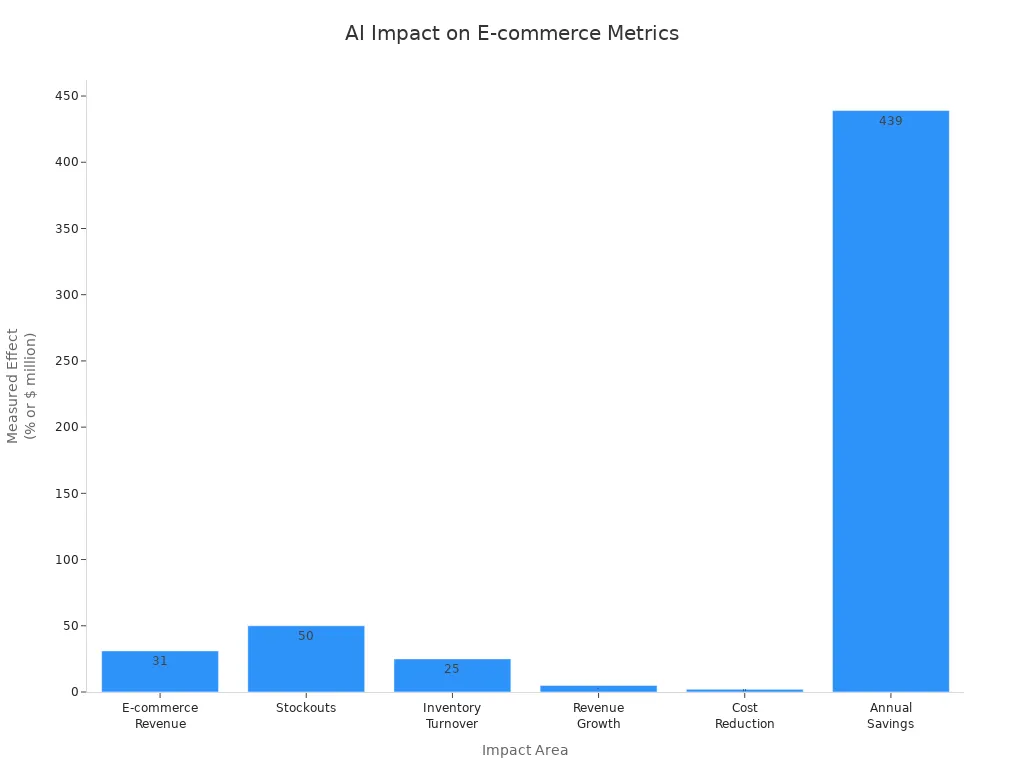
Ai transforms the customer experience in cross-border e-commerce. You can personalize product recommendations and optimize pricing for each customer. Ai reduces stockouts, so your customer finds what they need. Ai increases inventory turnover and helps you manage supply more effectively. You see measurable improvements in revenue and cost reduction.
| Impact Area | Measurable Effect |
|---|---|
| E-commerce Revenue | Up to 31% increase |
| Stockouts | Reduced by up to 50% |
| Inventory Turnover | Enhanced by 20-30% |
| Revenue Growth | 2-5% increase |
| Cost Reduction | 1-2% decrease |
| Annual Savings from AI Support | Over $439 million |
Ai gives you the tools to deliver a seamless cross-border e-commerce experience. You can meet customer expectations and grow your business globally.
What Is AI in Cross-Border eCommerce
Key Applications and Scope
You can use ai to transform your cross-border e-commerce business. Ai helps you manage many tasks that once took a lot of time. In cross-border e-commerce, you need to handle different languages, currencies, and shipping rules. Ai makes these tasks easier and faster. You can use intelligent product selection systems to find the best items for each market. Multilingual marketing and customer service platforms help you talk to every customer in their own language. Ai-based logistics scheduling lets you plan shipments and avoid delays. Intelligent product review tools help you understand what customers think about your products. Ai-driven data analysis and decision support systems give you the information you need to make smart choices.
- Intelligent product selection systems
- Multilingual marketing and customer service platforms
- Ai-based logistics scheduling
- Intelligent product review tools
- Ai-driven data analysis and decision support systems
Ai uses machine learning, natural language processing, and predictive analytics. These tools help you automate demand forecasting, customer behavior analysis, and multilingual support. You can improve efficiency, boost customer experience, and scale your cross-border e-commerce business. Ai also automates translation, logistics, and fraud detection, so you can focus on growth.
AI-Driven Business Processes
You can see big differences between ai-driven business processes and traditional ones in cross-border e-commerce. Ai uses data analytics to find the best keywords for product sales. This helps you improve localization and reach more customers. Traditional processes often rely on manual keyword selection, which takes more time and can miss important trends. Ai-driven translation services update quickly when your inventory changes. This reduces lost sales and keeps your cross-border e-commerce store up to date. Automation lets you respond to customer needs faster and with fewer errors. You can build a smarter, more responsive cross-border e-commerce operation with ai.
Cross-Border eCommerce Challenges
Logistics and Fulfillment Complexity
You face many challenges when you manage cross-border e-commerce. Customs clearance often takes a long time and can slow down your deliveries. Each country has different rules for shipping logistics, which makes planning difficult. You must deal with longer transit times and sometimes shipments get delayed or lost. High shipping costs can hurt your profits, and these costs change depending on where you send packages. Tariffs can add more delays and make your logistics routes less reliable. These problems can stop you from investing in better cross-border e-commerce systems.
- Customs clearance delays
- Different shipping regulations in each country
- Longer transit times and risk of lost shipments
- High and unpredictable shipping costs
- Tariffs causing delivery delays and route changes
Tip: You can improve your cross-border e-commerce by learning about each country's shipping logistics and planning for possible delays.
Language and Localization Barriers
You need to speak your customer's language to succeed in cross-border e-commerce. Most online shoppers want to buy products in their own language. Many will not trust or buy from a website in another language. If you do not translate your site well, you can lose sales. People want to understand what they buy, so clear and correct translations matter. Good localization helps you increase your sales and keeps your customers happy. It also lowers the number of returns.
- 76% of shoppers prefer to buy in their native language
- 40% will not buy from sites in other languages
- Clear translations build trust and boost sales
- Effective localization increases conversion rates and satisfaction
Compliance and Risk Issues
You must follow many rules in cross-border e-commerce. Each country has its own customs laws and import or export regulations. You need to pay attention to tax laws and data protection rules. Consumer protection laws also change from place to place. Some countries require product labels in the local language. Others have special safety standards, like CE marking in the EU. You must handle customer data carefully, especially if you sell to people in the EU. These rules can make cross-border e-commerce complex, but following them protects your business.
- Customs and trade compliance
- Consumer protection and data privacy laws
- Tax and financial complexity
- Local product labeling and safety standards
Note: Staying updated on cross-border e-commerce laws helps you avoid fines and keeps your business running smoothly.
AI Solutions for Cross-Border eCommerce

Automated Translation and Localization
You can use ai tools to break language barriers in cross-border e-commerce. Automated translation platforms help you reach customers in their native language. Google Translate API and DeepL offer accurate, context-aware translations. These ai tools integrate with your content management system and automate translation workflows. You save time and reduce manual effort. Ai tools handle product tagging and localize entire content based on raw descriptions. They map categories and extract features efficiently. You deliver clear product information to every customer.
Tip: Ai-driven localization improves conversion rates. Real-time personalization lets you show prices in local currencies. Machine learning optimizes checkout flows by analyzing payment behaviors. You can increase conversion rates by 25 to 30 percent in new markets.
| Evidence Type | Description |
|---|---|
| Real-time Personalization | Ai agents handle live currency conversion and render localized pricing for each region. |
| Checkout Optimization | Machine learning analyzes local payment habits and improves checkout flows. |
| Translation Efficiency | Ai speeds up translation and keeps content consistent across languages. |
Smart Logistics and Tariff Engineering
Ai tools help you manage logistics and tariffs in cross-border e-commerce. You use ai-driven automation to optimize product classification and customs documentation. Ai calculates tariffs dynamically and reduces compliance costs. Smart border clearance bots automate customs processing and verify credentials. They assess cargo risks and enhance security. Ai tools enable seamless trade by applying trade agreement provisions and calculating duty rates. Automated compliance verification checks shipments against regulations.
| Example | Description |
|---|---|
| AI-driven automation | Optimizes product classification, customs documentation, and tariff calculations. |
| Smart Border Clearance Bots | Automate customs processing and assess cargo risks for commercial vehicles. |
| Cross-Border Trade Facilitation | Applies trade agreement provisions and calculates preferential duty rates. |
| Automated Compliance Verification | Checks shipments against regulations and ensures compliance with trade laws. |
Ai tools provide enhanced visibility across global networks. You know the status of shipments, costs, and potential issues in advance. Predictive modeling lets you forecast duties, taxes, and shipping timelines weeks ahead. Real-time data integration from carriers creates a unified view. You can simulate sourcing strategies, forecast capacity, and adjust shipment routes. Compliance teams identify and mitigate risks before shipments depart. Ai tools empower you to make smart decisions and operate efficiently in cross-border e-commerce.
Dynamic Pricing and Personalization
Ai tools transform pricing and personalization in cross-border e-commerce. You use real-time pricing engines to replace static pricing. Ai adjusts prices based on market demand and regional purchasing power. McKinsey reports sales increases of up to 5 percent with dynamic pricing. Margins can expand by as much as 10 percent when prices change according to real-time elasticity. Consulting firms observe median sales lifts between 2 and 5 percent after implementing dynamic pricing algorithms.
Ai tools analyze customer data from many sources. You segment customers into micro-targeted groups. Personalized content and recommendations appear in real time. This increases customer engagement and drives repeat purchases. 80 percent of consumers are more likely to buy from brands that offer personalized experiences. 91 percent prefer shopping with brands that recognize them and provide relevant recommendations. Ai tools help you build brand loyalty and grow your cross-border e-commerce business.
- Ai algorithms segment customers for micro-targeted personalization.
- Real-time recommendations enhance customer engagement.
- Dynamic pricing engines increase revenue and expand margins.
- Personalized experiences foster brand loyalty and repeat purchases.
Fraud Detection and Compliance
You face many types of fraud in cross-border e-commerce. Account takeover fraud, refund and return fraud, and marketplace fraud are common. Ai tools analyze transaction patterns, device fingerprints, and user behavior. You detect fraud quickly and protect your business. Global e-commerce fraud losses exceeded $48 billion in 2023. Etsy used specialized ai models to reduce international transaction fraud by 41 percent and increase cross-border sales by 23 percent.
Ai tools automate customs documentation and check statutory changes across jurisdictions. You reduce the risk of non-compliance. Ai compliance ensures your systems follow laws and ethical standards. This protects your business from legal penalties and keeps market access. Automated compliance solutions manage global regulations efficiently. You transform compliance into a core competency for your cross-border e-commerce business.
Note: Ai tools help you detect fraud, automate compliance, and operate safely in cross-border e-commerce.
AI Tools and Technologies
Chatbots and Multilingual Support
You can use ai tools to improve your customer support in cross-border e-commerce. Chatbots powered by ai handle conversations in many languages. One international platform uses a chatbot that communicates in 15 languages. This chatbot automates routing and keeps service level agreement compliance at 99.2%. You see faster response times and higher customer satisfaction in overseas markets. Ai chatbots manage 70-80% of support interactions, so your team can focus on complex issues. These ai tools help you recover up to 35% of abandoned carts and boost conversions by 25%. Ai-powered virtual agents deliver consistent, high-quality support without needing extensive training. This reduces the workload for your human support team and improves the customer experience.
Tip: Ai tools like Zendesk AI and Intercom provide 24/7 multilingual support, making your business accessible to customers worldwide.
Predictive Analytics and Big Data
Ai tools use predictive analytics to help you make smart decisions in cross-border e-commerce. You can analyze historical data and forecast future trends. This helps you manage inventory and plan marketing strategies. Ai tools improve demand forecasting accuracy for each customer segment or product range. You see market viability predictions and gain insights for better decision-making. The global cross-border e-commerce market is projected to reach $551 billion by 2025, driven by ai and predictive analytics.
| Evidence Type | Description |
|---|---|
| Market Forecast | The global cross-border e-commerce market will reach $551 billion by 2025. |
| Revenue Impact | Ai-driven smart recommendations can triple revenue and increase conversions. |
Ai tools amplify your decision-making with cognitive predictions. You can optimize inventory, reduce errors, and scale your business without increasing costs.
Best Practices for AI Adoption
Integration with eCommerce Platforms
You can set your business up for success in global markets by following proven strategies for integrating ai with your ecommerce platform. Start by defining your objectives. Decide if you want to improve ai search visibility, boost customer experience, or optimize inventory. Focus on data quality. Clean and accurate data helps ai deliver better results and increases visibility. Use APIs and built-in integrations to connect ai tools with your existing systems. This makes the process smoother and reduces errors. Build a team with ai specialists who understand both technology and ecommerce. Monitor your ai solutions and adjust them as needed. Protect customer data with strong security strategies to avoid legal issues.
Tip: Many businesses see fast growth when they use ai to improve ai search visibility and automate product listings. This helps you reach more customers in new regions.
Common pitfalls to avoid:
- Using generic ai tools without customization for your business
- Relying only on human review for ai outputs
- Not training your team on ai strategies and tools
- Ignoring data privacy and compliance strategies
Team Training and Change Management
You need to prepare your team for ai adoption with the right strategies. Choose training programs that focus on practical skills and change management. One effective program is the AI Adoption and Workforce Readiness Certificate. It takes 13.5 hours and uses virtual instructor-led training. This program teaches your team how to design and manage ai-focused learning strategies. Your team will learn how to handle change and get better business results.
| Program Name | Duration | Format | Focus | Outcome |
|---|---|---|---|---|
| AI Adoption and Workforce Readiness Certificate | 13.5 hours | Virtual instructor-led training | AI adoption strategies | Team can design and manage ai learning programs |
Note: Teams that understand ai strategies can avoid mistakes and drive growth in global markets.
Performance Monitoring
You should track the success of your ai strategies with clear performance indicators. Start with a low-risk, high-impact use case. Make sure each ai application connects to a measurable goal. Pilot several strategies to see what works best. Use these key performance indicators:
| KPI | Description |
|---|---|
| User Behavior Metrics | Track how users interact with your platform to improve their experience. |
| Customer Behavior Metrics | Study buying patterns to adjust your marketing strategies. |
| Data Quality | Check that your data stays accurate for effective ai analysis. |
| Operational Efficiency | Measure how ai strategies improve your business processes. |
| Customer Experience | See how ai-driven personalization increases satisfaction and engagement. |
You can use these strategies to optimize ai search visibility, reduce friction, and align ai with your business goals. Avoid shallow strategies and always check for data privacy risks. With the right strategies, you can unlock new growth and stay ahead in global markets.
You can win in cross-border e-commerce by using AI to improve every part of your business. AI helps you target customers, speed up deliveries, and boost sales. The table below shows how AI supports your growth:
| AI Application | Impact |
|---|---|
| Customer Segmentation | Better targeting and personalization |
| Logistics Acceleration | Faster and more efficient deliveries |
| Recommendation Systems | Higher customer satisfaction and sales |
| Supply Chain Forecasting | Smarter inventory planning |
| Warehouse Automation | Lower costs and smoother operations |
You should start exploring AI tools now. This will help you stay ahead and grow your business worldwide.
FAQ
What is the main benefit of using AI in cross-border eCommerce?
You can use AI to automate tasks and make smarter decisions. AI helps you reach more customers, lower costs, and improve your service. This gives you a strong advantage in global markets.
How does AI help with language barriers?
AI tools translate your website and product information into many languages. You can connect with customers in their native language. This builds trust and increases your sales.
Can AI improve shipping and delivery times?
Yes. AI tracks shipments and predicts delays. You can use this information to choose better routes and carriers. This helps you deliver orders faster and keep customers happy.
How do I use cross-border trade data with AI?
You can feed cross-border trade data into AI systems. AI finds patterns and trends in the data. This helps you plan inventory, set prices, and enter new markets with confidence.
Is AI safe for handling customer data?
AI tools use strong security features to protect customer data. You should always follow data privacy laws and update your systems. This keeps your business and your customers safe.
See Also
Exploring Blind Shipping: Essential Tactic for E-Commerce Growth
Enhancing Productivity Through Intelligent Ecommerce Warehouse Solutions
Is Overflow Warehousing Capable of Supporting E-Commerce Expansion?
Advantages of Blind Shipping for Contemporary E-Commerce Retailers
Cutting-Edge Ecommerce Strategies for 2025: A Practical Guide